
If you drink water from a private well, the water is yours to watch. No city plant checks it. No utility sends you a report each year. Sooner or later, most well owners ask the same question: what does well water testing near me cost 2026 actually look like in dollars?
The honest answer is that the price moves a good deal. A basic bacteria test from a local lab may cost less than a dinner out. A full panel that checks minerals, metals, pesticides, and chemicals can cost several hundred dollars. This guide walks through each option in plain terms, so you can match the right test to your needs and your budget.
Why Well Water Testing Matters
A well pulls water from the ground under your land. Along the way the water can pick up natural minerals such as iron and calcium. It can also pick up things that do not belong there: bacteria from a failing septic system, nitrates from farm fertilizer, arsenic from the rock itself, or chemicals from an old spill nearby.
You cannot see most of these things. Clear water can still carry bacteria. Water that tastes fine can still hold too much arsenic or lead. Health agencies have advised well owners for decades to test each year for bacteria and nitrates. A test is the only way to know what you are drinking.
What a Well Water Test Covers: Well Water Testing near Me Cost 2026
Not every test checks the same things. Before you compare prices, it helps to know the common test groups. Most labs sell tests as packages.
Total coliform and E. coli. This is the basic health test. It tells you whether bacteria from animal waste or a failing septic system have reached your water. Every well owner should run this test each year.
Nitrate and nitrite. Nitrates come from fertilizer, manure, and septic systems. High levels are a special danger to babies, because they can cause a blood disorder called blue baby syndrome.
pH, hardness, iron, and manganese. These are the taste and stain minerals. They are not usually a health threat at common levels, but they spoil taste, stain sinks and laundry, and shorten the life of water treatment equipment.
Lead, arsenic, and other heavy metals. Arsenic occurs naturally in the rock of many regions. Lead can come from old pipes or pump parts. These tests matter most in areas with known problems or in older homes.
Chemicals and pesticides. These tests look for solvents, gasoline components, and farm chemicals. They cost more and take longer, but they matter near farms, gas stations, or old industrial sites.
A basic package covers bacteria and nitrate. A standard package adds minerals and a few metals. A full panel covers nearly everything. Each step up adds to the price.
The Three Ways to Test Your Well Water
Certified Laboratory Testing
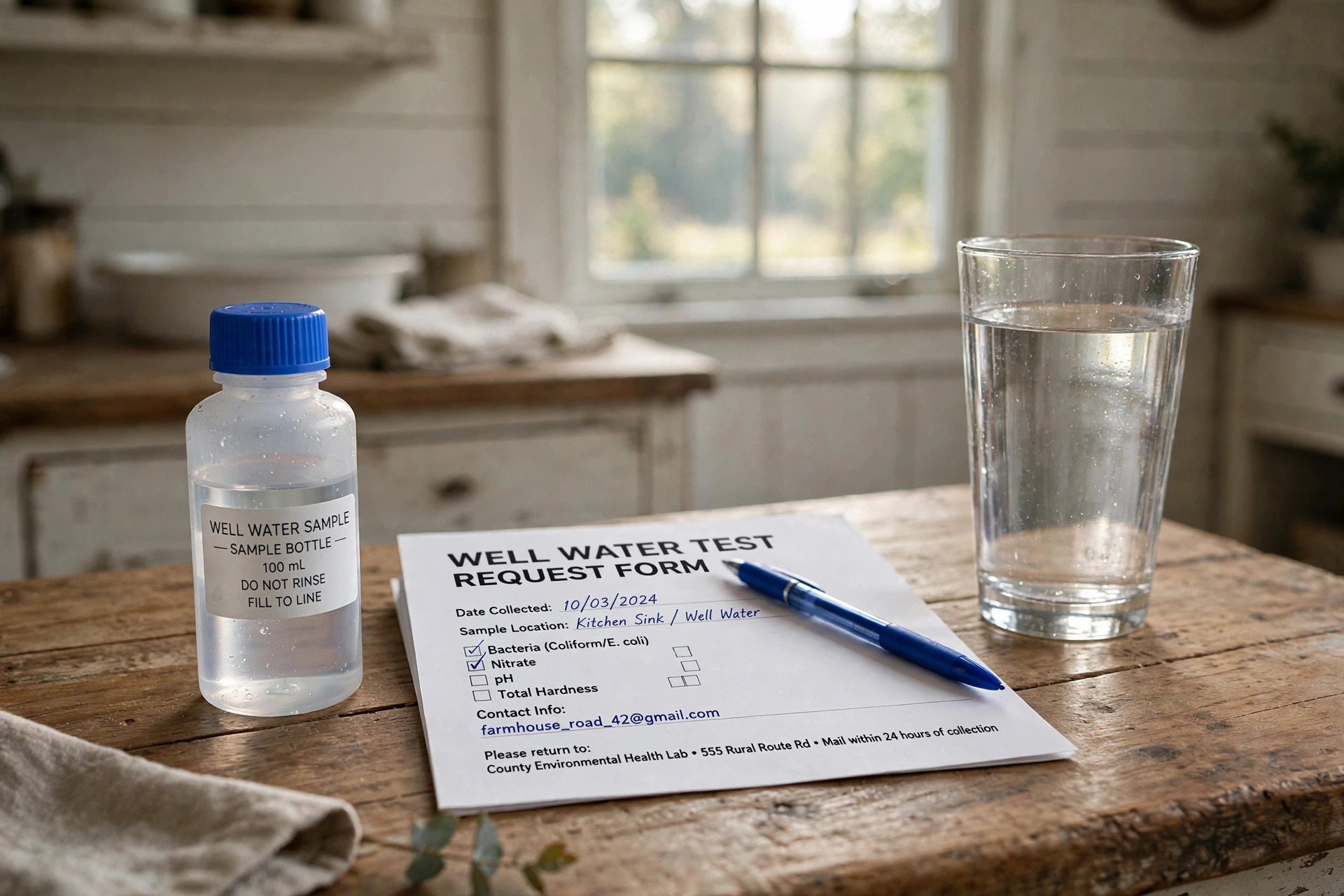
A certified lab gives you the most trusted result. You collect the sample in a sterile bottle, keep it cold, and deliver it to the lab within the stated time limit. The lab runs the tests and sends back a written report with exact numbers and safe limits.
To find a lab, type “well water testing near me” into a search engine, or check your county health department website. The Environmental Protection Agency also keeps guidance on finding certified testing services.
Lab prices in 2026 look roughly like this:
– Bacteria test alone: 25 to 60 dollars. – Basic package (bacteria plus nitrate): 40 to 90 dollars. – Standard mineral package: 80 to 150 dollars. – Metals panel (lead, arsenic, copper, and others): 100 to 250 dollars. – Full drinking water panel: 200 to 500 dollars.
Prices run lower in rural counties with public health labs and higher near big cities. Some counties hold yearly testing days where a basic package costs 20 to 30 dollars. Ask your county health office about such events before you pay full price.
Home Test Kits
A home test kit lets you check your water at the kitchen table. The best water test kit for well water usa options fall into two groups.
Strip tests are the cheapest. You dip a paper strip into a glass of water and compare the colors to a chart. A kit costs 15 to 30 dollars. Strips are fast and simple, but they are not precise: a strip will not catch bacteria, and it cannot measure lead at the low levels that matter for health.
Mail-in kits are a step up. You fill the bottles, mail them to a lab, and get results by email in a week or two. These kits cost 60 to 200 dollars depending on the panel. The science matches a local lab, since a certified lab does the work.
Home kits suit well owners who want a quick screen between annual lab tests. They do not replace a certified lab result when you need one for a home sale or a mortgage. Banks and buyers in most states still want a lab report from a certified facility.
County Health Department Testing
Many county health departments test well water directly or through a partner lab. Some run free testing days for bacteria after floods or storms. University extension services in farm states often run low-cost nitrate screening.
It is worth a phone call. Ask your county health office three questions: Do you test private well water? What does each test cost? Do you hold discount testing days? When a low-cost option exists, this office is where you hear about it.
How to Choose the Right Test
Start with your reason for testing. The reason points to the test.
Routine yearly check. Order the basic bacteria and nitrate test from a certified lab. This is the minimum that health agencies advise.
Buying or selling a home. Lenders and buyers usually want a lab report, often the bacteria test plus nitrate and lead. Ask what they require before you pay for more.
Bad taste, smell, or stains. Iron gives water a metallic taste and rusty stains. Sulfur smells like rotten eggs. Hard water leaves white scale. A mineral panel tells you which mineral is at fault, and a trusted retailer can show you the treatment units that match common test results. Fixture makers such as Kohler note that mineral-heavy water wears out faucets and valves faster.
Living near farms, gas stations, or factories. Order a metals panel and a pesticide or solvent screen. These cost more, but they are the only way to rule out the chemicals most likely near such sites.
After a flood or septic work. Test for bacteria first. Do not drink the water until a lab gives the all clear.
If you are unsure where to start, many labs sell a “homeowner” package that bundles bacteria, nitrate, lead, and the main minerals at one price. It is often cheaper than ordering each test alone.
What Drives the Cost Up or Down
Location. A county with a public health lab may charge half of what a private lab charges two counties over. Call two or three places before you decide.
Number of tests. Each test added to the panel adds a fee. Order the tests that fit your risk, and skip the rest.
Turnaround time. Standard service takes three to ten business days. Rush service can double the fee.
Sample collection. Some labs send a technician to collect the sample for 50 to 150 dollars extra. Collecting the sample yourself is free, and the lab gives you the bottle and the written steps.
A simple rule of thumb for 2026: budget 50 to 100 dollars for a solid yearly check, 150 to 300 for a deeper workup when something seems wrong, and 300 to 500 only when you need the full chemical picture.
How to Collect a Good Sample
A test is only as good as the sample. Run the cold tap for several minutes before you fill the bottle. This clears water that has been sitting in the pipes. Do not use the hot tap.
Fill the sterile bottle the lab gave you. Do not touch the inside of the cap or the bottle mouth. Fill to the marked line, close it tight, and label it with your name, the date, and the time.
Keep the sample cold in a cooler with ice packs. For bacteria, the limit is often 24 to 30 hours. A late sample can give a false result, and you will pay twice. If you bought a mail-in test kit, read the kit instructions twice before you start.
What to Do With the Results
The lab report lists each test with your number next to a safe limit. Anything above the limit needs action. Anything close to the limit is worth watching with a retest in six to twelve months.
If bacteria show up, do not panic. A single positive result often comes from the sample bottle or the faucet rather than the well itself. Labs advise a retest first. If the second test is also positive, the standard fix is to shock-chlorinate the well with a measured dose of household bleach. Your county health office can give you the exact dose, and home repair guides from This Old House walk through common well upkeep tasks in plain steps. Test again after treatment to confirm the water is clean.
If nitrates are high, the fix is treatment, not flushing. A reverse osmosis unit or a whole-house nitrate filter can bring levels down. If lead shows up, check the age of your pipes, faucets, and pump parts. Fixture makers such as Moen publish plain guides on spotting older plumbing that may leach lead.
Keep every report in a folder. A stack of yearly reports shows trends, and buyers like to see a clean history when you sell the home.
Money-Saving Tips for 2026
Ask the county first. A five-minute call to the health department may turn up a discount testing day or a low-fee lab you did not know about.
Test yearly, not monthly. Annual bacteria and nitrate testing is the advised rhythm.
Bundle tests. Lab packages cost less per test than single tests ordered one by one.
Collect the sample yourself. The technician visit adds 50 to 150 dollars for a job most adults can do in ten minutes.
Fix problems before retesting. If a test finds iron or hardness, talk to a water treatment specialist about a filter or softener before you pay for another round of the same test. Readers comparing long-term costs may also want to read the best well water filtration system reviews usa to see which units handle the minerals their test found.
Safety Notes
Never drink water that a lab has flagged for bacteria until the problem is fixed and a retest is clean. Boil water for one full minute if you must use it before treatment.
Keep bleach and other well treatment chemicals away from children and pets. Wear gloves and eye protection when you handle them.
Do not pour paint, oil, or chemicals on the ground near your well. What goes into the soil can reach your water. The federal guidance on source water protection explains how a setback distance around the well keeps contamination out.
If your well head is cracked, buried, or missing its cap, fix it before you test. A damaged well head lets surface water in, and no test result can be trusted until the well is sealed. A local home improvement store stocks well caps and seals for common well sizes.
Frequently Asked Questions
How much does well water testing near me cost in 2026? A basic bacteria and nitrate test from a certified lab usually costs 40 to 90 dollars. A standard package with minerals runs 80 to 150 dollars. A full panel with metals and chemicals can reach 200 to 500 dollars. County discount days can cut the basic test to 20 to 40 dollars.
How often should I test my well water? Health agencies advise testing for bacteria and nitrates every year, and running a deeper test for minerals, metals, and other problems every three to five years. Test sooner if the taste, smell, or color changes, after floods or septic work, or when a new baby arrives in the home.
Can I test my well water myself at home? Yes, for a rough screen. Home strip kits cost 15 to 30 dollars and give quick readings on pH, hardness, and some minerals. But strip kits cannot detect bacteria or measure lead at health-relevant levels. For results you can trust or use in a home sale, use a certified lab or a mail-in kit processed by one.
What is the cheapest reliable way to test well water? A county health department lab or a discount testing day is usually the cheapest reliable path, often 20 to 40 dollars for bacteria and nitrate. If no public option exists near you, a certified private lab at 40 to 90 dollars is the next best value. For a deeper look at minerals and metals, readers often compare the home water quality test cost near me options before choosing between a lab visit and a mail-in kit.
A Short Final Word
Knowing what well water testing near me cost 2026 figures look like takes the guesswork out of a job every well owner must do. The price is modest for the yearly basics and climbs only when you order the deeper chemical panels. Pick the test that fits your reason, collect the sample with care, and keep the reports in a folder. Clean water is worth the small yearly cost.
References
Aquasana. (n.d.). Water filtration systems. https://www.aquasana.com Delta Faucet. (n.d.). Kitchen and bathroom faucets. https://www.deltafaucet.com Family Handyman. (n.d.). DIY home repair and maintenance. https://www.familyhandyman.com Kohler. (n.d.). Bathroom and kitchen fixtures. https://www.kohler.com Lowe’s. (n.d.). Home improvement products. https://www.lowes.com Moen. (n.d.). Faucets and plumbing fixtures. https://www.moen.com The Home Depot. (n.d.). Home improvement products. https://www.homedepot.com This Old House. (n.d.). Home renovation guidance. https://www.thisoldhouse.com U.S. Environmental Protection Agency. (n.d.). Protecting human health and the environment. https://www.epa.gov
Was this guide helpful?

About James Carter
The My Garden US editorial team writes practical, in-depth home and garden guides for American homeowners — tested advice, no fluff.
You May Also Like
Best Under Sink Water Filter 2026 USA: A Plain Guide to Cleaner Tap Water
June 26, 2026 0 views
Toilet Auger vs Plunger Comparison: Which Tool Clears Clogs Best in USA Homes
June 3, 2026 0 views
Matte Black Kitchen Faucet: Pros and Cons for American Homes
January 28, 2026 0 views