
If your tap water looks cloudy, if grit shows up in the tub, or if your appliances wear out too soon, a sediment filter may be the answer. The whole house sediment filter installation cost is one of the first things homeowners ask about. This guide explains the price range, what drives it up or down, and how to choose the right system for your home.
A whole house sediment filter sits on the main water line where water enters the house. It catches sand, silt, rust, and dirt before they reach your taps, your water heater, and your appliances. Homes on well water need these filters most of all. City homes with old pipes can benefit too.
Why a Sediment Filter Matters
Sediment is any small solid particle carried in water. Sand and silt come from wells. Rust flakes off from aging iron or galvanized pipes. Even city water can carry fine grit after a main break or heavy road work.
These particles cause real damage. They clog faucet aerators and showerheads. They wear out the valves in toilets, dishwashers, and washing machines. They settle in the bottom of water heaters and cut the tank’s life. They scratch dishes and stain tubs.
A sediment filter also protects other treatment gear. Carbon filters, softeners, and UV lights all work better when sediment is removed first. Dirt can coat softener resin. It can block UV light. It can clog carbon blocks. This is why many installers put a sediment filter first in any whole house water filtration system. The whole house water filtration cost installed drops when the main system does not have to fight dirt.
For well owners, sediment is almost always present. A good best sediment filter for well water choice will extend the life of the pump and the pressure tank. The upfront price is small next to a new well pump, which can cost several thousand dollars.
The United States Environmental Protection Agency publishes water quality standards that public systems must meet, and its drinking water pages explain what homeowners should watch for in their own supply (epa.gov).
What to Look For When You Choose: Whole House Sediment Filter Installation Cost
Micron rating is the key number. It tells you the size of the particles the filter catches. A 50-micron filter catches coarse sand. A 20-micron filter catches finer silt. A 5-micron filter catches very fine particles and some rust haze.
Lower is not always better. A very fine filter clogs faster and can choke water pressure. Most homes do well with a 20-micron or 50-micron filter. Well owners with heavy sand may start coarse and then add a finer second stage later.
Flow rate matters too. A whole house filter must pass enough water for showers, laundry, and dishwashers at the same time. Look at the filter housing’s rated flow in gallons per minute. A small home may need 10 to 15 gallons per minute. A large home may need 20 or more. If the filter is too small, you will feel the drop in pressure every time two taps run at once.
Housing size affects how often you change cartridges. The common “big blue” 20-inch housings hold large cartridges that last months. Slim 10-inch housings are cheaper but need more frequent changes. For a whole house, the larger housing is usually the better buy over time.
Cartridge type is another choice. Pleated cartridges can be rinsed and reused a few times. Spun poly cartridges are throwaway but cheap. String-wound cartridges suit coarse jobs. Pick one that matches your water test results.
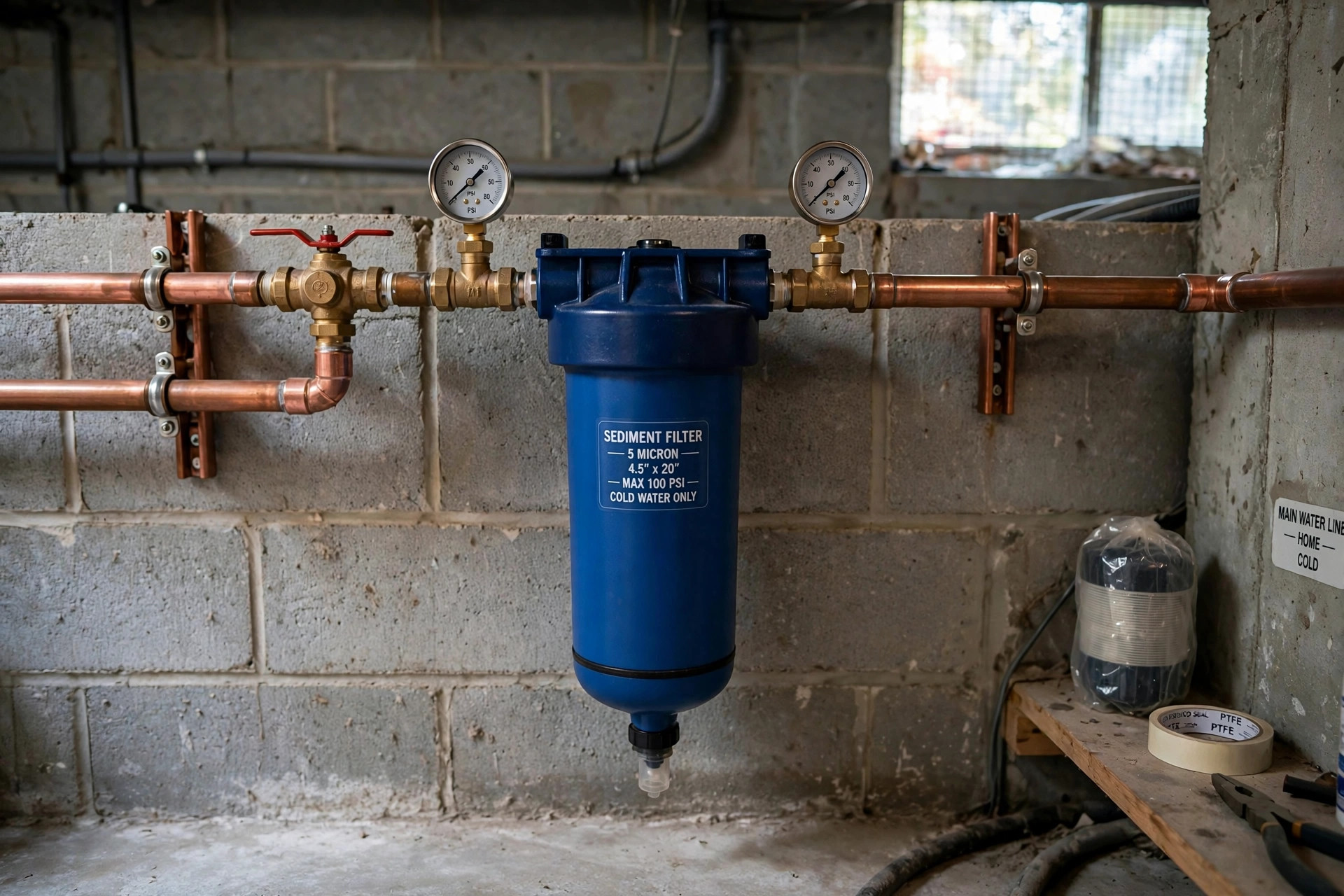
Material quality counts in the housing itself. Look for reinforced sumps rated for your home’s water pressure. A bypass valve lets you keep water flowing while you change the cartridge. A pressure relief button makes the change job cleaner. Mounting brackets keep the unit stable.
Retailers such as Home Depot and Lowe’s carry a wide range of housings and cartridges, and their product pages list pressure ratings and dimensions that help you compare models side by side.
Types and Options
Single-stage sediment filter. One housing, one cartridge. This is the simplest setup and the lowest cost. It suits city water with light rust or homes that want basic pre-filtration before a softener.
Two-stage sediment filter. Two housings in series. The first catches coarse particles, the second catches fine ones. This is a common pick for well water. The first cartridge does the hard work, so the second lasts longer.
Spin-down filter. A reusable screen that you flush clean with a valve. No cartridges to buy. It catches coarse sand and sediment. Many well owners pair a spin-down unit with a cartridge filter behind it for fine particles.
Backwashing sediment filter. An automatic unit that cleans itself on a timer. No cartridge changes. These cost more up front but can suit homes with very heavy sediment. They need a drain connection for the backwash water.
Combination systems. A sediment stage built into a larger treatment setup, such as a softener or a multi-stage filter. If you already plan to install a softener, ask the installer to add a sediment pre-filter. Guides from This Old House and Family Handyman walk through how these combined installs fit into a typical basement or garage.
Which type fits your home? City water with mild rust usually needs only a single stage. Well water with sand and silt often needs a spin-down or two-stage setup. Heavy sediment loads may justify a backwashing unit. A water test tells you which camp you fall in, so test first and buy second.
Whole House Sediment Filter Installation Cost Breakdown
Here is the heart of the matter. The whole house sediment filter installation cost depends on the unit, the labor, and your home’s plumbing.
The filter unit. A basic single-housing kit with a 20-inch “big blue” housing costs about $60 to $150. A two-stage setup costs about $120 to $300. A spin-down pre-filter adds $50 to $150. A quality backwashing unit costs $400 to $900 or more. Cartridges are sold separately or in the kit; a single large cartridge costs $10 to $40.
Plumber labor. Professional installation usually runs $200 to $500 for a straightforward job. The plumber cuts into the main line, adds shutoff valves, mounts the housings, and tests for leaks. Most installs take two to four hours. Rates vary by region and by how busy local plumbers are.
Pipe work and parts. Extra costs appear when the main line is hard to reach. Copper, PEX, or PVC pipe, fittings, valves, and a drain line can add $50 to $200 in materials. If the main line is behind a finished wall or in a tight crawl space, labor climbs.
Total installed price. Put it together and most homeowners pay $300 to $800 for a professionally installed single-stage or two-stage sediment filter. Simple DIY installs can cost as little as $100 to $200 in parts. High-end backwashing systems with complex plumbing can pass $1,000.
Well water homes often land at the higher end because installers add a spin-down pre-filter and sometimes two cartridge stages. Reading a few best well water filtration system reviews can show what other well owners paid for similar setups.
How to keep the cost down. Install near the pressure tank or where the main line enters the house. Keep the run short and open. Ask for standard 20-inch housings so cartridges stay cheap and easy to find. Get two or three quotes from licensed plumbers. Do the job once and do it right; a leak from a poor install costs far more than a proper fitting.
Do not forget the ongoing cost. Cartridges need replacing, usually every three to six months. Budget $30 to $100 a year for cartridges in a typical home, more if your water carries heavy sediment. This running cost is small, but it belongs in your planning.
Fixture makers like Moen, Delta Faucet, and Kohler all note that sediment shortens the life of valves and aerators, which is another reason a whole house filter pays for itself over time.
Care and Upkeep
A sediment filter is easy to care for, but it does need a schedule. Mark cartridge changes on a calendar. Most homes change cartridges every three to six months. Well homes with heavy sand may change them monthly.
Watch your water pressure. A sudden drop at every tap often means a clogged cartridge. Many owners install pressure gauges on each side of the filter. When the gap between the two readings grows, it is time for a change.
Change the cartridge the clean way. Shut off the water before the filter. Open a tap to relieve pressure. Press the relief button on the housing. Unscrew the sump with the housing wrench. Drop in the new cartridge, check the O-ring, and tighten by hand plus a small turn. Turn the water back on slowly and check for leaks.
Inspect the O-ring each time. A cracked or flat O-ring causes slow leaks. A thin coat of silicone grease keeps it supple. Keep a spare O-ring on hand; they cost a few dollars.
Clean the housing sump with mild soap and water while the cartridge is out. Do not use harsh cleaners that can crack the plastic. If the sump looks cloudy or stressed, replace it. A burst sump floods a basement fast.
For spin-down filters, open the flush valve weekly or as the maker directs. For backwashing units, check the drain line and confirm the cycle runs on schedule.
Safety Notes
Water and pressure demand respect. A whole house filter holds the full pressure of your home’s water supply. Always shut off the water and relieve pressure before you open a housing.
Know where your main shutoff valve is before you start. If a fitting fails during the work, you must be able to stop the water in seconds.
Use parts rated for your pressure. Most homes run 40 to 80 pounds per square inch. Check your pressure with a gauge. If it reads above 80, install a pressure reducing valve. High pressure strains filter housings and every fixture in the house.
If you solder copper near the filter, keep heat away from the plastic housing. Remove the cartridge and the sump, or solder the joints before you mount the unit. Melted plastic fails under pressure.
When in doubt, hire a licensed plumber. The install cost is modest. The cost of a flooded basement is not. Local codes may also require a permit or a licensed installer for work on the main line, so check your town’s rules.
Frequently Asked Questions
How much does it cost to install a whole house sediment filter? Most homeowners pay $300 to $800 for professional installation of a single-stage or two-stage unit. DIY installs run $100 to $200 in parts. Backwashing systems with complex plumbing can pass $1,000.
Do I need a plumber, or can I install it myself? A handy homeowner can install a basic unit with push-fit fittings and clear access. Hire a plumber if the main line is hard to reach, if you must cut copper, or if local code requires a licensed installer.
Where should the filter be installed? On the main water line, right after the main shutoff valve and before the water heater and any treatment gear. For well systems, install after the pressure tank.
How often do I change the cartridge? Every three to six months in most homes. Check monthly at first. Heavy sediment loads shorten the interval. A pressure drop across the filter is the clearest sign.
Will a sediment filter lower my water pressure? A clean, correctly sized filter causes almost no pressure drop. An undersized or clogged filter will. Size the housing for your home’s peak flow and change cartridges on time.
Does a sediment filter make water safe to drink? It removes particles, not germs or dissolved chemicals. It improves taste and clarity and protects other filters, but it is not a purifier. Pair it with the right treatment for your water test results.
A Final Word
The whole house sediment filter installation cost is one of the smallest investments in home plumbing, and it protects some of the largest. A few hundred dollars now can add years to your water heater, your appliances, and your fixtures. Test your water, size the unit for your home’s flow, and keep a cartridge schedule. Clean water starts at the main line.
References
Aquasana. (n.d.). Water filtration systems. https://www.aquasana.com Delta Faucet. (n.d.). Kitchen and bathroom faucets. https://www.deltafaucet.com Family Handyman. (n.d.). DIY home repair and maintenance. https://www.familyhandyman.com Kohler. (n.d.). Bathroom and kitchen fixtures. https://www.kohler.com Lowe’s. (n.d.). Home improvement products. https://www.lowes.com Moen. (n.d.). Faucets and plumbing fixtures. https://www.moen.com The Home Depot. (n.d.). Home improvement products. https://www.homedepot.com This Old House. (n.d.). Home renovation guidance. https://www.thisoldhouse.com U.S. Environmental Protection Agency. (n.d.). Protecting human health and the environment. https://www.epa.gov
Was this guide helpful?

About Emily Rodriguez
The My Garden US editorial team writes practical, in-depth home and garden guides for American homeowners — tested advice, no fluff.
You May Also Like
Water Softener Salt Delivery Service Near Me: How to Keep Your Home’s Water Soft
March 5, 2026 0 views
Best Water Leak Detector for Water Heater USA: A Complete Buying Guide
January 2, 2026 0 views
Kitchen Sink Basket Strainer Reviews USA: A Plain Buyer Guide
February 22, 2026 0 views