
Introduction
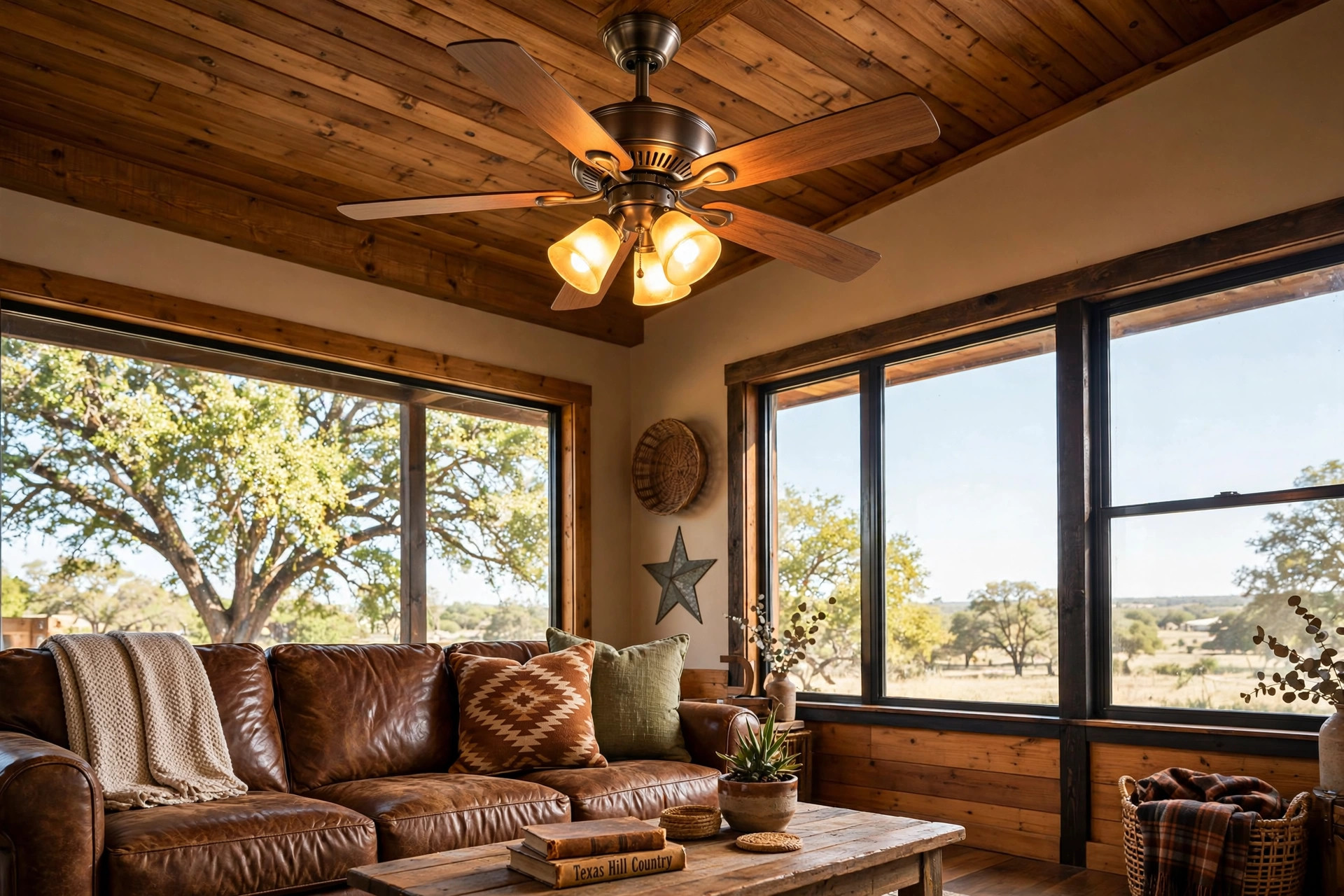
Texas summers are long, hot, and costly to cool. When the thermometer climbs past one hundred degrees, the air conditioner runs for hours and power bills rise. That is why ceiling fans lights Texas homes USA is a search so many homeowners make each year. A ceiling fan with a light kit cools a room and lights it at the same time, cutting the load on the air conditioner.
A ceiling fan does not lower the air temperature. It moves air across the skin, which makes a room feel four to six degrees cooler. A person in a room with a moving fan can set the thermostat a few degrees higher and still feel fine. Over a whole Texas summer, that small change saves real money.
This guide covers what to know before you buy: why fan lights matter in Texas, how to pick the right size and motor, the main types on the market, what they cost, how to keep them clean, and how to stay safe. It also answers common questions.
Why Ceiling Fan Lights Matter in Texas: Ceiling Fans Lights Texas Homes Usa
Heat, humidity, and long cooling seasons
Most of Texas has a cooling season that runs from April into October. An air conditioner alone can keep a home cool, but it uses a great deal of power. A ceiling fan helps it do its job. The fan moves air, and moving air picks up heat from the skin faster than still air. The room feels better.
Government energy research shows that a ceiling fan lets a homeowner raise the thermostat setting by about four degrees with no loss of comfort. That change can cut cooling costs over a season. A fan that costs cents a day to run can save many dollars on the air conditioner. The light kit on the fan adds one more saving, since it takes the place of a table lamp or a separate ceiling fixture.
Light and air from one fixture
Texas evenings need light after dark, and many Texas homes have low or standard ceilings. A fan with a light kit puts light where the family gathers without a second fixture hanging down. Bedrooms gain floor space when a table lamp moves out. Look for LED kits or kits that accept standard LED bulbs. They last for years and use very little power.
How to Choose the Right Fan Light
Size the fan to the room
Fan size is measured by blade span. A small room up to about seventy-five square feet needs a fan of twenty-nine to thirty-six inches. A medium room up to one hundred and seventy-five square feet needs a fan of forty-two to forty-four inches. A large room over two hundred and twenty-five square feet needs a fan of fifty to fifty-four inches. A great room may need a fan of sixty inches or more, or two fans side by side.
Too small a fan will spin fast and still move little air. Too large a fan in a tiny room can feel like a wind tunnel. Measure the room first. Match the blade span to the size. The room size is the single most important choice.
Check the motor type
Two motor types are common. The standard AC motor has been used for decades. It works well and costs less. The DC motor is newer. It uses less power, runs quieter, and offers more speed settings. A DC motor fan can use seventy percent less electricity than an AC fan at the same speed. In Texas, where a fan may run ten hours a day for months, that saving adds up.
DC fans cost more up front, but the gap has shrunk. If the budget allows, a DC motor is the better long-term buy. Check reviews of wifi smart bulbs reviews buying guide usa if you plan to pair the fan with smart lighting, since some DC fans include remote or app control.
Pick the light kit carefully
Light kits come built in or as add-ons. Check four things. First, brightness. Look for the lumen number. Sixteen hundred lumens lights a room well. Second, color temperature. Warm white feels cozy. Cool white feels bright and clean. Third, dimming. Not every kit dims, so check the box. Fourth, bulb type. Integrated LED panels last long but must be replaced as a whole unit. Kits that take standard screw-in LED bulbs are easier to service.
Controls and remotes
Most new fans come with a handheld remote or a wall control. The remote sets speed and turns the light on and off. Some fans add a reverse switch for winter. In winter, a fan should run slow in reverse to push warm air down from the ceiling. That saves heat in North Texas winters. A few fans link to a phone app or a voice assistant. For a basic bedroom, a simple remote is enough.
Types and Options
Indoor fans
Indoor fans are the most common. They suit bedrooms, living rooms, kitchens, and home offices. Pick a finish that matches the room. White blends into a white ceiling. Dark finishes stand out as a design feature. Wood-tone blades suit ranch and farmhouse styles that are popular across Texas.
Damp-rated fans for porches
Many Texas homes have covered porches and patios. A standard indoor fan will not last there. Moisture can damage the motor and warp the blades. Damp-rated fans are built for covered outdoor spots. They resist humidity and light rain. A damp-rated fan light also pairs well with string lights on a covered patio, as many homeowners comparing patio string lights california homes usa discover when they light the same spaces.
Wet-rated fans for open areas
A wet-rated fan can take direct rain. It suits an open pergola or an uncovered deck. These fans cost more than damp-rated ones, and their motors and wiring are sealed. Do not put an indoor or damp-only fan where rain can hit it. It will fail, and the warranty will not cover it.
Low-profile and hugger fans
Texas homes built in the nineteen seventies and eighties often have eight-foot ceilings. A standard fan with a downrod hangs too low in such rooms, since blades should stay at least seven feet above the floor. Low-profile fans, also called hugger fans, mount close to the ceiling. They move a bit less air than a fan on a long downrod, but they are far safer. Measure the ceiling height before you buy.
Fans with strong light output
Some rooms need real task light. A kitchen, a laundry room, or a home office needs more than a soft glow. A few fans carry light kits with three or four bulbs or a strong LED panel, putting out three thousand lumens or more. Check the lumen rating on the box. If you are replacing a bright flush-mount fixture, add extra lighting such as led recessed lights california homes usa to fill in dark corners.
Cost and Price
A basic indoor fan with a simple light kit costs between fifty and one hundred and fifty dollars at large home stores. Mid-range models with better motors, remotes, and nicer finishes run from one hundred and fifty to three hundred and fifty dollars. High-end designer fans and large DC-motor models can cost four hundred dollars or more. Damp-rated and wet-rated fans cost a bit more than indoor ones of the same size.
Installation is a separate cost. If a ceiling box for a fan already exists, a handy homeowner can swap a fan in an hour or two. If no box exists, or if new wiring is needed, hire an electrician. In Texas, a fan installation by a licensed electrician often costs between one hundred and fifty and three hundred dollars per fan. Older homes may need the ceiling box replaced with a fan-rated box. That small part costs little but matters for safety.
Running costs are low. A typical AC-motor fan on medium speed uses about sixty watts. Run for ten hours, that is six-tenths of a kilowatt-hour. At Texas electric rates, that costs around ten cents a day. A DC-motor fan may use only twenty watts, or about three cents a day. The LED light kit adds about ten to fifteen watts. Over a summer, the fan can save far more on the air conditioner than it costs to run.
Shoppers can browse options at Home Depot and Lowe’s, which both carry a wide range of fan lights with Texas-friendly damp ratings. Specialty lighting stores such as Lamps Plus and Lumens carry higher-end designs with stronger light kits.
Care and Upkeep
A ceiling fan needs little care. Dust is the main enemy. In Texas, dust and pollen settle on blades fast. Wipe the blades every month or two with a damp cloth or a pillowcase pulled over each blade. A pillowcase traps the dust instead of pushing it into the air.
Check the screws twice a year. Vibration can loosen the screws that hold the blades and the light kit. A quick check with a screwdriver takes five minutes. A flickering light often means a loose bulb, not a bad fixture.
Clean the light cover when you clean the blades. Glass and plastic shades collect dust and dead insects. Wash the shade in warm soapy water, dry it well, and put it back. For LED panels, wipe with a dry or slightly damp cloth. Do not spray cleaner into the motor housing.
If the fan wobbles, fix it. Most fans come with a small balancing kit. Turn the fan off, then try the clip and weights on different blades until the wobble stops. A wobbling fan wears out its mount. If the wobble is severe, stop using the fan and check the ceiling box. Advice on fan balance and maintenance can be found in the home repair guides at This Old House and The Spruce.
Change the direction with the seasons. In summer, blades should turn counter-clockwise when you look up at them, pushing air down. In winter, switch to clockwise at low speed, pulling cool air up and pushing warm air down along the walls.
Safety
Ceiling fans are safe when they are installed right and used with care. The number one rule is the ceiling box. A fan must hang from a box rated for fan support. A normal light fixture box is not strong enough. If you are not sure what box is in your ceiling, have an electrician check it.
Keep blades at least seven feet above the floor. In rooms where children jump on beds, more height is better. Teach children not to throw things at a running fan. A thrown toy can break a blade or a glass light shade.
Use the right bulbs. If the light kit lists a maximum wattage, stay under it. With LED bulbs this is easy, since they use few watts. When in doubt, use LED bulbs at or below the listed wattage.
Turn off the power at the breaker before any wiring work. A wall switch is not enough. Test the wires with a non-contact tester before you touch them. If the wiring looks old, brittle, or confusing, call an electrician. Texas has many homes with aluminum wiring from the nineteen sixties and seventies, which needs special connectors.
For outdoor fans, check the rating before you buy. An indoor fan on a porch can short out in humid air. Only use damp-rated fans in covered outdoor spots and wet-rated fans where rain can reach them. The safety experts at the U.S. Consumer Product Safety Commission publish guidance on safe installation of home electrical fixtures, and their advice is worth reading before a do-it-yourself install.
Frequently Asked Questions
Can a ceiling fan with a light really lower my electric bill in Texas?
Yes, it can. The fan itself uses little power. Its real saving comes from letting you set the thermostat higher. The moving air makes you feel cooler, so the air conditioner runs less. The savings are largest in homes where the air conditioner used to run all day.
What size fan light do I need for a twelve by fourteen foot bedroom?
A twelve by fourteen foot room is one hundred and sixty-eight square feet. A forty-four or forty-eight inch fan suits it well. Pick a light kit with at least sixteen hundred lumens so the room is bright enough to read by.
Are LED light kits better than kits that take regular bulbs?
Both work fine. Integrated LED panels last for many years and use very little power. Kits that take standard LED screw-in bulbs are easier to fix, since you just change the bulb. Integrated panels must be replaced as a whole part if they fail.
Can I install a fan light myself, or do I need an electrician?
If a fan-rated box and wiring already exist, many homeowners do the swap themselves. The job takes basic tools and about an hour. If there is no box, if the wiring is old, or if you need a new circuit, hire a licensed electrician.
Do ceiling fans help in winter too?
Yes. Run the fan slow in reverse, which is clockwise when you look up. This pushes warm air that collects near the ceiling back down. It helps most in rooms with high ceilings, which many newer Texas homes have.
How long does a ceiling fan light last?
A good fan motor can last fifteen to twenty years or more. LED bulbs often last ten years or more in normal use. The parts that wear out first are usually the remote receiver and the pull chains, if the fan has them.
A Final Word
A ceiling fan with a light is a simple tool. It does two jobs, costs little to run, and suits the Texas climate well. Pick the right size for the room. Choose a motor and light kit that fit your budget. Install it on a fan-rated box, keep the blades clean, and switch direction with the seasons.
Shoppers who want to compare energy use can check the efficiency ratings at ENERGY STAR and the buying guides at Consumer Reports. For lighting design ideas, Philips offers guides on choosing color temperature and brightness for each room.
References
Consumer Reports. (n.d.). Product reviews and ratings. https://www.consumerreports.org ENERGY STAR. (n.d.). Energy efficient products. https://www.energystar.gov Lamps Plus. (n.d.). Lighting and home decor. https://www.lampsplus.com Lowe’s. (n.d.). Home improvement products. https://www.lowes.com Lumens. (n.d.). Lighting and ceiling fans. https://www.lumens.com Philips. (n.d.). Lighting products. https://www.philips.com The Home Depot. (n.d.). Home improvement products. https://www.homedepot.com The Spruce. (n.d.). Home and garden advice. https://www.thespruce.com This Old House. (n.d.). Home renovation guidance. https://www.thisoldhouse.com U.S. Consumer Product Safety Commission. (n.d.). Product safety information. https://www.cpsc.gov
Was this guide helpful?

About David Wilson
The My Garden US editorial team writes practical, in-depth home and garden guides for American homeowners — tested advice, no fluff.
You May Also Like

LED Recessed Lights: Reviews and Buying Guide for American Homes
June 6, 2026 0 views
Garage Shop Lights for Sale USA: A Plain Buyer’s Guide
August 31, 2026 0 views
Bedroom Table Lamps for California Homes USA: A Simple Guide
September 18, 2026 0 views