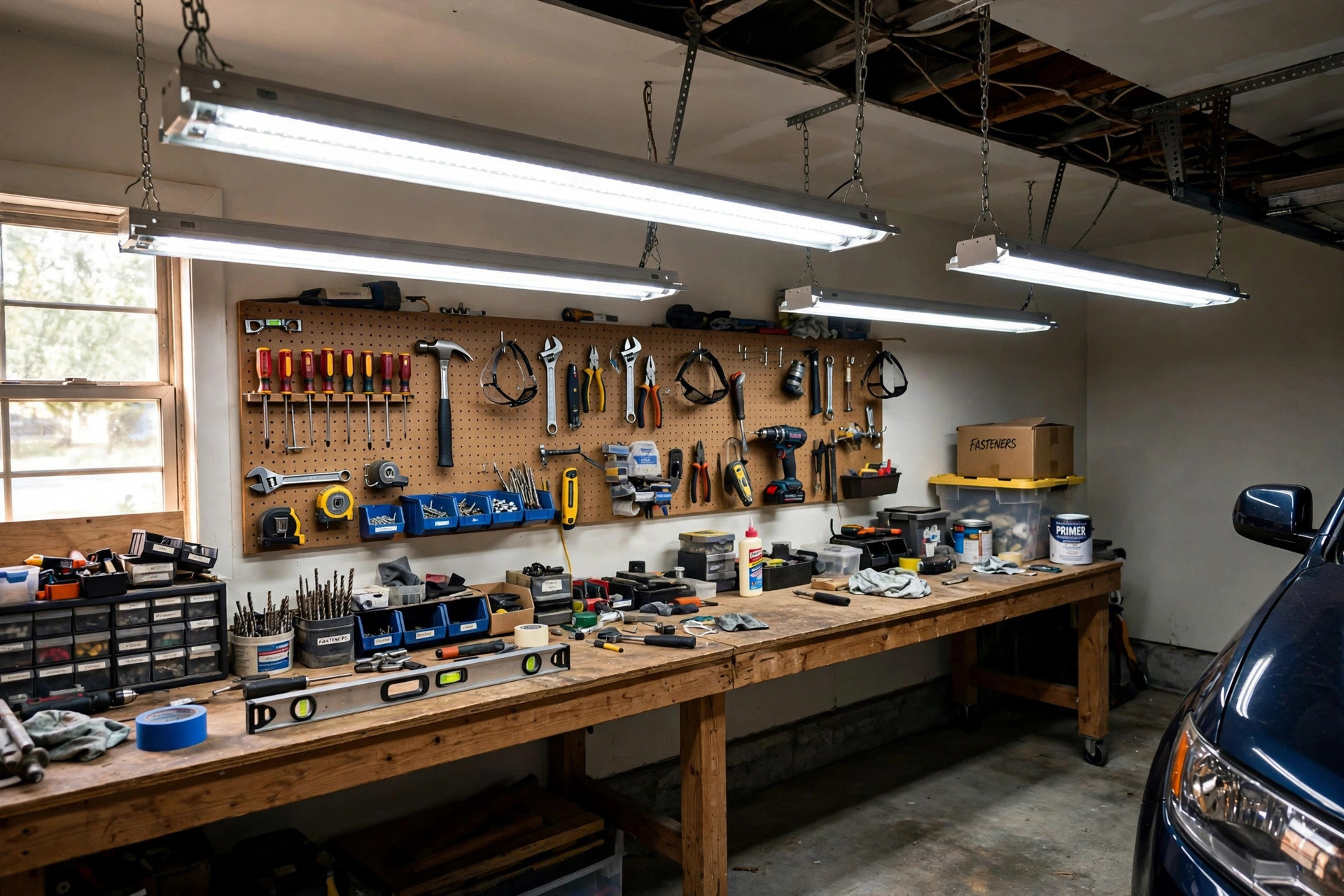

A dark garage makes every job harder. A workbench hides tools. A floor hides screws. A car engine hides bolts. Many homeowners ask about garage shop lights where to buy usa. The answer is simple. These lights sell in most home improvement stores and many online shops across the country. The hard part is knowing which seller to trust and which fixture to pick. This guide answers both questions. It lists the best places to buy. It explains the types of shop lights. It covers cost, care, and safety. It ends with common questions. By the end, the reader will know where to go and what to buy.
Why Good Shop Lights Matter
A garage is a workshop. People fix cars there. They build shelves. They sharpen tools. They paint small parts. Bad light slows all of this down. It also causes mistakes. A driver can spill oil. A woodworker can cut a board too short. Eye strain builds up over time. Headaches follow.
Good shop lights fix these problems. They spread even light across a bench and floor. They cut shadows. They make small text and small parts easy to see. Modern LED fixtures use little power. They run cool. They last many years. They cost less to run than old tubes.
Lighting also matters for home value. A bright garage looks larger and cleaner. Buyers notice. A realtor often says that good light sells a room. The garage is no different. A few strong fixtures can lift the whole space.
Where to Buy Garage Shop Lights in the USA: Garage Shop Lights Where to Buy Usa
American buyers have many choices. The main ones fall into four groups. Big stores. Online sellers. Lighting specialists. Local electrical shops.
Big Home Improvement Stores
The Home Depot is the largest seller of home goods in the country. It stocks shop lights in almost every store. Aisles hold 4-foot LED shop lights, linkable fixtures, and high bay lights. Staff can answer basic questions. The website lists prices and stock by zip code. Many buyers check the site of The Home Depot first, then pick up the fixture at the store the same day.
Lowe’s is the second big choice. It carries many of the same brands. Utilitech is its store brand. The site shows local stock and delivery options. Buyers who want to see the light before buying should visit Lowe’s. Both chains run sales around spring and fall. Prices drop by 20 percent or more during these events.
Online Marketplaces
Online sellers offer the widest choice. Wayfair sells home lighting with free shipping on many orders. Its pages show clear specs and buyer reviews. Shoppers can compare ten fixtures side by side. The lighting pages at Wayfair cover shop lights, high bays, and linkable LED bars.
Large general marketplaces also sell shop lights. Prices are often low. Reviews can be mixed. Buyers should check the seller rating and the return policy. Look for UL or ETL marks in the listing photos. A cheap light with no safety mark is a bad deal.
Lighting Specialty Sellers
Specialty stores focus on light only. Their staff know the products well. Lumens.com is one such seller. It carries commercial-grade fixtures and explains terms like lumens and color temperature in plain language. The learning pages at Lumens help buyers match a fixture to a garage size.
Warehouse Clubs and Local Electrical Supply Shops
Warehouse clubs sell two-packs and four-packs of shop lights at low unit prices. Stock varies by store. Local electrical supply houses serve trade buyers. They also sell to the public. Prices can be higher. But the staff give strong advice. They can explain damp ratings and circuit loads. This help matters for large or damp garages.
Types of Garage Shop Lights
Not all shop lights work the same way. Each type suits a different need.
LED Shop Lights
LED shop lights are the most common choice today. They come as 2-foot and 4-foot bars. Many hang from chains. Some mount flush to the ceiling. They give bright, even light. They use half the power of old fluorescent tubes. A 4-foot LED shop light often makes 4,000 to 5,000 lumens. That is enough for most home garages.
LEDs also last long. A rated life of 50,000 hours is common. That means more than 15 years of normal use. They turn on at full brightness in cold weather. Old tubes flicker in winter. LEDs do not.
Fluorescent Shop Lights
Fluorescent fixtures are older technology. They use T8 or T12 tubes. They cost less to buy. They cost more to run. The tubes contain a small amount of mercury. That means special disposal rules in many states. Most buyers now pick LED over fluorescent. But fluorescent fixtures still sell in some stores. They suit buyers who already own spare tubes.
High Bay Lights
High bay lights suit tall garages. Barns and large shops need them too. They hang from high ceilings, usually 10 feet or more. They throw light down in a wide cone. UFO-style round high bays are popular. They make 15,000 to 30,000 lumens each. Two or three can light a three-car garage with a high ceiling.
Linkable and Smart Shop Lights
Linkable lights connect in a row. One cord feeds power to the first fixture. Short link cords pass power to the next. This setup cuts wiring work. Smart shop lights add motion sensors or timers. Some link to phone apps. They cost more. They suit busy shops where lights should turn on hands-free.
Buyers who want help picking a fixture can read our garage shop lights buying guide. It walks through each choice step by step. Those working on other rooms may like our LED recessed lights installation guide or our dining room chandeliers buying guide.
How to Choose the Right Shop Light
A few numbers matter more than brand names. Learn them once. Then shopping gets easy.
Brightness and Lumens
Lumens measure light output. A one-car garage needs about 5,000 to 10,000 lumens total. A two-car garage needs 10,000 to 20,000 lumens. Divide the total by the fixture output. That gives the fixture count. Two 5,000-lumen bars suit a one-car garage. Four suit a two-car garage. Workbenches need extra light. Add one fixture over the bench.
Color Temperature
Color temperature is measured in Kelvin. Warm white is 3,000K. Cool white is 4,000K. Daylight is 5,000K or higher. Shops work best at 4,000K to 5,000K. This range looks clean and shows true colors. It helps when matching paint or stain. Warm light suits living rooms, not workshops.
Size, Mounting, and Linkability
Four-foot fixtures are the standard. They match the length of a workbench. Two-foot bars suit small areas. Hanging chains lower the light over a bench. Flush mounts suit low ceilings. Linkable models cut cord clutter. Check the max link count in the manual. Most allow 8 to 10 units in a row.
Energy Use and Certifications
Look for the ENERGY STAR mark. It means the fixture passed independent tests. It uses less power and holds its brightness over time. The ENERGY STAR program lists certified products online. The U.S. Department of Energy also publishes guides on efficient lighting. These two pages help buyers compare real specs instead of sales claims.
Safety marks matter too. UL and ETL marks show the fixture passed safety tests. Never buy a wired fixture with no safety mark.
Cost and Price
Prices vary by type and brand. A basic 4-foot LED shop light costs 25 to 45 dollars. Linkable models cost 35 to 60 dollars each. High bay lights cost 60 to 150 dollars. Smart fixtures cost 50 to 100 dollars.
Two-packs and four-packs lower the unit price. A four-pack of 4-foot LEDs often sells for 90 to 140 dollars. Sales cut prices further. Watch for spring and holiday sales at the big chains.
Running cost is low. A 40-watt LED running 4 hours a day costs about 7 dollars a year in power. Old 80-watt fluorescent pairs cost twice as much. The U.S. Department of Energy notes that LEDs save 75 percent of lighting energy in most homes.
Installation cost depends on the setup. Plug-in lights need no electrician. Hardwired fixtures may need one. An electrician charges 100 to 250 dollars to add a circuit or outlet. Many garages already have outlets. Then the buyer just hangs the light.
Care and Upkeep
Shop lights need little care. Dust cuts brightness over time. Wipe the lens twice a year with a dry cloth. Turn the power off first. Do not spray cleaner into the fixture.
Check cords once a year. Look for cracks or heat marks. Replace damaged cords right away. Tighten loose mounting chains. A falling fixture can hurt.
LEDs do not need tube changes. When an LED fixture fails, replace the whole unit. Most last 10 to 15 years. Keep the receipt and the box. Many brands offer 5-year warranties. A photo of the receipt helps with claims.
Fluorescent owners must handle tubes with care. A broken tube releases mercury vapor. Open a window. Sweep the pieces with cardboard. Do not use a vacuum. Place debris in a sealed bag. Take it to a local hazardous waste site. Many counties collect tubes for free.
Safety
Electricity demands respect. Turn off the breaker before wiring any fixture. Use a voltage tester to confirm the power is off. Do not trust the wall switch alone. A switch can be wired wrong.
Match the fixture to the location. Garages near water heaters or sinks need damp-rated fixtures. Check the box for the rating. Do not overload circuits. A 15-amp circuit can carry 1,440 watts safely. Ten 40-watt shop lights draw 400 watts. That leaves room to spare. But space heaters and tools draw far more. Run the math before adding lights to a busy circuit.
Mounting must be solid. Hang fixtures from joists, not thin drywall. Use rated hooks and chains. Keep lights away from stored gas cans and paint. LEDs run cool, but heat still builds in closed fixtures.
Independent testing groups help buyers stay safe. Consumer Reports tests lighting products and reports on safety and quality. Its buying guides explain which features matter most. The Spruce also publishes plain buying advice for home lighting. Both sources help a buyer avoid weak or unsafe products.
Frequently Asked Questions
How many shop lights does a two-car garage need? Most two-car garages need 10,000 to 20,000 lumens. That means two to four 4-foot LED fixtures. Dark walls and low ceilings need more. Light walls and high ceilings need less. Add one extra fixture over the workbench.
Are LED shop lights better than fluorescent? Yes, for most buyers. LEDs use less power. They last longer. They start in cold weather. They contain no mercury. Fluorescent fixtures cost less up front. But LEDs win on total cost over five years.
Can I install shop lights myself? Plug-in models are simple. Hang the fixture. Plug it in. Done. Hardwired models need wiring skill. If the buyer has no wiring experience, hire an electrician. The cost is small. The risk of bad wiring is not.
What color light is best for a garage? Choose 4,000K to 5,000K. This range is cool white to daylight. It shows true colors. It reduces eye strain during detail work. Warm white suits living areas. It makes a shop feel dim.
Where can I buy shop lights locally today? The Home Depot and Lowe’s stock them in most stores. Check stock online by zip code before driving over. Warehouse clubs carry multi-packs. Local electrical supply houses carry commercial-grade options. See The Home Depot and Lowe’s for current stock.
Do shop lights work in cold garages? LED shop lights work well in cold. They start at full brightness down to minus 20 degrees in most cases. Check the box for the rated range. Old fluorescent tubes flicker and dim in cold. This is one more reason buyers now pick LED.
A Final Word
Buying garage shop lights in the USA is easy once the buyer knows the options. Big stores stock them. Online sellers offer wide choice. Specialty sites give deep advice. Pick LED fixtures. Count the lumens. Choose 4,000K to 5,000K color. Look for UL or ETL marks. Mount them well. The garage will stay bright for years.
References
Consumer Reports. (n.d.). Product reviews and ratings. https://www.consumerreports.org ENERGY STAR. (n.d.). Energy efficient products. https://www.energystar.gov Lowe’s. (n.d.). Home improvement products. https://www.lowes.com Lumens. (n.d.). Lighting and ceiling fans. https://www.lumens.com The Home Depot. (n.d.). Home improvement products. https://www.homedepot.com The Spruce. (n.d.). Home and garden advice. https://www.thespruce.com U.S. Department of Energy. (n.d.). Energy efficiency and renewable energy. https://www.energy.gov Wayfair. (n.d.). Furniture and home goods. https://www.wayfair.com
Was this guide helpful?

About Michael Thompson
The My Garden US editorial team writes practical, in-depth home and garden guides for American homeowners — tested advice, no fluff.
You May Also Like
Sensor Porch Lights Buying Guide USA: A Plain Homeowner’s Handbook
June 9, 2026 0 views
Kitchen Track Lighting Florida Homes USA: A Plain Guide
September 19, 2026 0 views
Indoor Grow Lights USA Online Deals: A Plain Buyer’s Guide
February 9, 2026 0 views