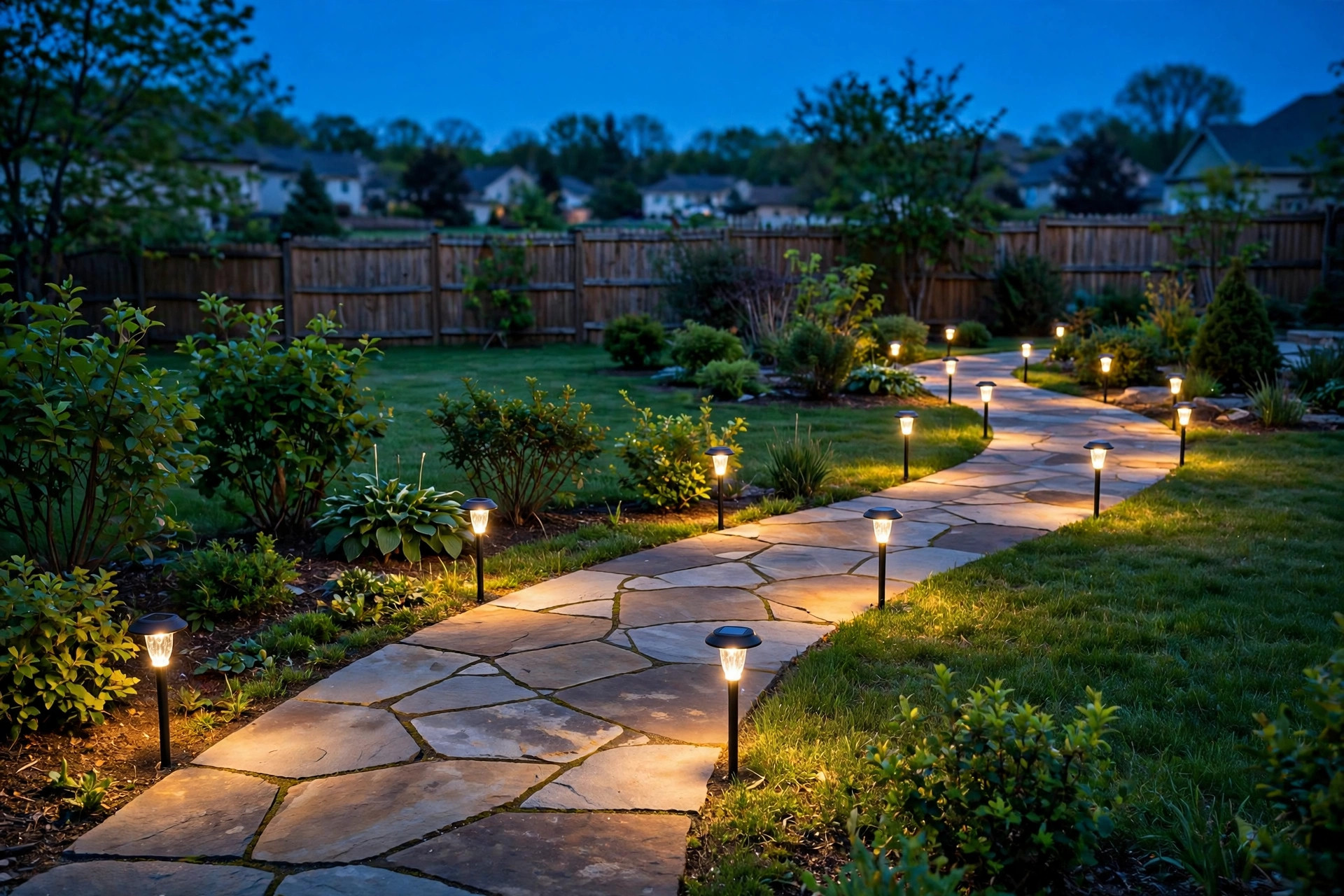

Solar path lights have become one of the most popular outdoor lights in America. They charge during the day from the sun. They turn on by themselves at dusk. They cost nothing to run. This solar path lights reviews buying guide USA explains what to look for, how the types differ, what they cost, and how to keep them working for years.
Most buyers have the same questions. How bright are they? How long do they shine at night? Do they work on cloudy days? Will they last through a winter? This guide answers those questions in plain words. It is written for homeowners, renters with yards, and anyone who wants a safe, pretty walkway without an electrician.
Why Solar Path Lights Matter
A dark walkway is a hazard. Guests trip on uneven steps. Delivery drivers cannot find the front door. A lit path makes a home feel safe and cared for. Wired landscape lights do the job, but they cost more to buy and install. Many homeowners prefer the simple option.
Solar path lights fill that need well. Each light is a small self-contained unit. A solar panel sits on top. A battery stores the charge. An LED bulb gives off the light. A sensor turns the unit on at dusk and off at dawn. You push the stake into the soil. That is the whole installation.
For buyers comparing options, a /landscape-spot-lights-buying-guide-usa/ can help when stronger accent light is wanted. But for lining a walkway, a driveway edge, or a garden border, path lights are the right tool. Reviews from American buyers show high satisfaction when people buy the right brightness for the job.
There is also an environmental benefit. Solar path lights use no grid power. They add no dollars to the electric bill. The U.S. Department of Energy encourages homeowners to look at solar outdoor lighting as a clean, simple choice, as noted in its outdoor lighting guidance at energy.gov.
How Solar Path Lights Work: Solar Path Lights Reviews Buying Guide Usa
The parts are simple. The solar panel collects sunlight during the day. It is usually a small black or dark blue square on the top of the light. The panel turns sunlight into electric charge. The charge goes into a rechargeable battery inside the unit.
When the sun sets, a light sensor detects the drop in brightness. The sensor switches the LED on. The LED draws power from the battery through the night. At dawn, the sensor turns the light off, and charging begins again.
Most units need about six to eight hours of direct sun for a full charge. A full charge usually gives eight to ten hours of light. On cloudy days the charge is weaker and the light may burn for fewer hours. In winter, with short days and a low sun, the run time drops. This is normal for all solar lights, and good reviews often mention it.
Battery type matters. Most solar path lights use nickel metal hydride (NiMH) or lithium ion batteries. NiMH batteries are common in low-cost sets. Lithium ion batteries hold charge better in cold weather. ENERGY STAR notes that quality lighting components make a real difference in performance, as described in its lighting resources at energystar.gov.
Types of Solar Path Lights
Shoppers will find several types. Each type suits a different yard and taste.
Stake lights. These are the classic kind. A head with the panel and LED sits on a tall stake. You push the stake into the ground beside the path. They are cheap and easy to move. Sets of eight or ten are common.
Bollard lights. These are taller and sturdier. They look like short posts. They give more light and suit wide driveways and large gardens. They cost more than stake lights.
Lantern-style lights. These look like old carriage lamps. The panel sits inside a clear or frosted housing. They give a warm, decorative glow. Many homeowners like them near porches and patios. They pair well with /outdoor-wall-lanterns-buying-guide-usa/ for a matched look.
Deck and step lights. These are small flat units. They mount on steps, decks, or low walls. They are less common as path lights but work well to mark edges and stairs.
Color-changing lights. Some units can switch between white and colored light. They are popular for holidays and parties. The colored modes drain the battery faster, so the white mode lasts longer.
When you read solar path lights reviews, note which type the reviewer bought. A five-star review for a stake set does not tell you much about a bollard light. Match the type to your own yard first, then compare reviews within that type.
What to Look For When You Buy
Brightness comes first. Solar path lights measure brightness in lumens. Most path lights give between 5 and 50 lumens. For marking a path edge, 10 to 20 lumens per light is enough. For a dark driveway or a spot far from the porch light, look for 30 lumens or more. Buyers who complain that a light is “too dim” usually bought 5-lumen decorative lights for a job that needed real light.
Color temperature comes next. It is measured in kelvin (K). Warm white is around 2700K to 3000K. It looks like an old incandescent bulb. Cool white is 5000K to 6500K. It looks like daylight. Warm white suits gardens and homes with a cozy look. Cool white suits modern homes and security lighting.
Look at the solar panel size. Larger panels collect more charge. Cheap sets often have tiny panels that fade after a few hours. Reviews that mention lights “dying by midnight” usually point to small panels or weak batteries.
Check the battery capacity. It is measured in milliamp hours (mAh). Higher numbers mean longer run times. Many good sets use 600 to 1200 mAh batteries. Some budget sets use 300 mAh, which will not last the night.
Check the weather rating. Lights should be rated for rain and snow. Many quality lights carry an IP44 or IP65 rating. IP44 handles rain. IP65 handles heavy rain and dust. American buyers in the north should look for cold-weather tolerance. Retailers like The Home Depot and Lowe’s list these ratings in the product details.
Think about spacing. Most makers suggest placing path lights six to eight feet apart. Closer spacing gives a brighter, more even look. Measure your path before you buy so you get enough lights.
Cost and Price in the USA
Solar path lights are one of the cheapest landscape lights. Budget sets of eight to ten stake lights sell for about 20 to 40 dollars. Mid-range sets of six to eight lights sell for 40 to 80 dollars. Premium bollard lights or lantern sets can cost 80 to 150 dollars or more.
Price differences come from the panel, the battery, and the build quality. Stainless steel and aluminum housings last longer than plastic. Glass lenses stay clear longer than plastic lenses. A higher price often means more lumens and a longer warranty.
Warranties matter. Budget sets often carry a 90-day or one-year warranty. Better brands offer two or three years. Keep the receipt and the box. If a light fails in the first year, most makers will replace it.
There are no running costs. There is no electric bill and no bulb to change. The only future cost is a replacement battery every one to two years. Replacement batteries are cheap, often a few dollars each. Many buyers keep a small stock of them.
Installation Tips
Installation takes minutes. But a little care gives much better results.
Place the panel where it gets full sun. This is the most important rule. A light placed under a tree or in the shadow of a fence will charge poorly. Walk the path at midday and note the sunny spots. Those are the right places.
Space the lights evenly. Six to eight feet apart is the common advice. Mark the spots with small flags or stones before you push in the stakes. Step back and look at the line. A straight, even row looks much better than a random scatter.
Angle the heads if they tilt. Many stake lights have heads that can turn. Aim them slightly toward the path surface, not at the neighbor’s windows.
Charge before first use. Most makers advise placing the lights in the sun for a full day with the switch off before the first night. This gives the battery a full charge and sets the baseline for future nights.
Keep the switch position in mind. Almost every solar light has a small on-off switch under the head. It must be in the on position for the light to work at night. Many “dead” lights are simply switched off.
For festive areas, /patio-string-lights-buying-guide-usa/ add a different kind of charm above seating areas, while path lights handle the ground level.
Care and Upkeep
Solar path lights need little care, but they are not care-free. A few habits keep them bright for years.
Clean the panels. Dust, pollen, leaves, and bird droppings block sunlight. Wipe each panel with a damp cloth every month or two. In dusty areas or near trees, clean more often. Dirty panels are the number one cause of weak light in reviews.
Trim nearby plants. Grass and shrubs grow over the summer. They can shade the panels. Keep a clear ring around each light so the sun reaches it.
Change the batteries. Rechargeable batteries wear out. Most last one to two years. Signs of a dead battery are a light that charges all day but shines for only an hour, or a light that flickers. Open the battery compartment and replace the battery with the same type and size. Many guides at The Spruce explain this simple fix.
Bring lights in for harsh winters in very cold states if the maker advises it. Some plastic housings crack in deep freezes. Storing the lights in a garage from December to March can add years to their life. Check the maker advice first, since many modern lights are built to stay out all year.
Check the stakes. Lawnmowers and string trimmers break stakes. Replacement stakes are cheap and widely sold.
Safety
Solar path lights are very safe. They run on low voltage from small batteries. There is no risk of electric shock. There is no hot bulb, since LEDs stay cool. Children and pets can be near them without danger.
The main safety point is light placement. Place lights so the path is clearly visible. Mark steps, curbs, and changes in level. A lit edge at each step prevents falls. Make sure the light heads do not shine into drivers’ eyes on a nearby road.
Choose quality batteries and chargers if you replace parts. Use only the battery type the maker specifies. Do not mix old and new batteries in one unit. Dispose of old rechargeable batteries at a local recycling point, not in the trash.
Frequently Asked Questions
How long do solar path lights stay on at night? Most good sets shine for eight to ten hours on a full charge. Budget sets may shine for four to six hours. Cloudy days shorten the run time. If your lights fade early, clean the panels and check the battery age.
Do solar path lights work in winter? They work, but for fewer hours. Short days mean less charging. Snow on the panel stops charging completely. Brush snow off the panels after a storm. In very cold areas, lithium ion batteries perform better than NiMH batteries.
Are solar path lights as bright as wired lights? No. Wired landscape lights are brighter and more consistent. Solar path lights give soft accent light. They are best for marking paths and borders, not for lighting a whole yard. For stronger accent light, see our guide to /landscape-spot-lights-buying-guide-usa/.
How many lights do I need for my path? Measure the path length. Divide by six to eight feet. A 40-foot path needs about five to seven lights. Buy a few extra for steps and turns. It is better to have one or two spare than to find the set sold out later.
Can I leave solar path lights out in the rain? Yes. Quality lights are built for rain and snow. Look for an IP44 rating or better. After a heavy storm, check that no water got inside the housing. If it did, dry the unit and check the seal.
Do I need to replace the whole light when it dims? Usually not. Dim light after a year or two almost always means a worn battery. Replace the rechargeable battery first. If the panel is cracked or the LED is dead, then replace the unit.
Final Word
Solar path lights are a simple, low-cost way to make a yard safer and more welcoming. Read reviews with care. Look for comments about real brightness, real run time, and how the lights hold up after a year. Buy for your own sun conditions and your own path length. Place them in full sun, clean the panels, and change the batteries when they wear out. Do these small things and your lights will glow for many seasons. Trusted retailers such as Philips, Lamps Plus, and Lumens carry wide selections, and the U.S. Department of Energy offers more background on efficient outdoor lighting at energy.gov.
References
ENERGY STAR. (n.d.). Energy efficient products. https://www.energystar.gov Lamps Plus. (n.d.). Lighting and home decor. https://www.lampsplus.com Lowe’s. (n.d.). Home improvement products. https://www.lowes.com Lumens. (n.d.). Lighting and ceiling fans. https://www.lumens.com Philips. (n.d.). Lighting products. https://www.philips.com The Home Depot. (n.d.). Home improvement products. https://www.homedepot.com The Spruce. (n.d.). Home and garden advice. https://www.thespruce.com U.S. Department of Energy. (n.d.). Energy efficiency and renewable energy. https://www.energy.gov
Was this guide helpful?

About Robert Taylor
The My Garden US editorial team writes practical, in-depth home and garden guides for American homeowners — tested advice, no fluff.
You May Also Like

Bedroom Table Lamps American Homes Guide
September 21, 2026 0 views
Ceiling Fans Lights for Sale USA: A Full Buying Guide for American Homes
August 27, 2026 0 views
Reading Floor Lamps for Sale USA: A Plain Guide for Buyers
August 22, 2026 0 views