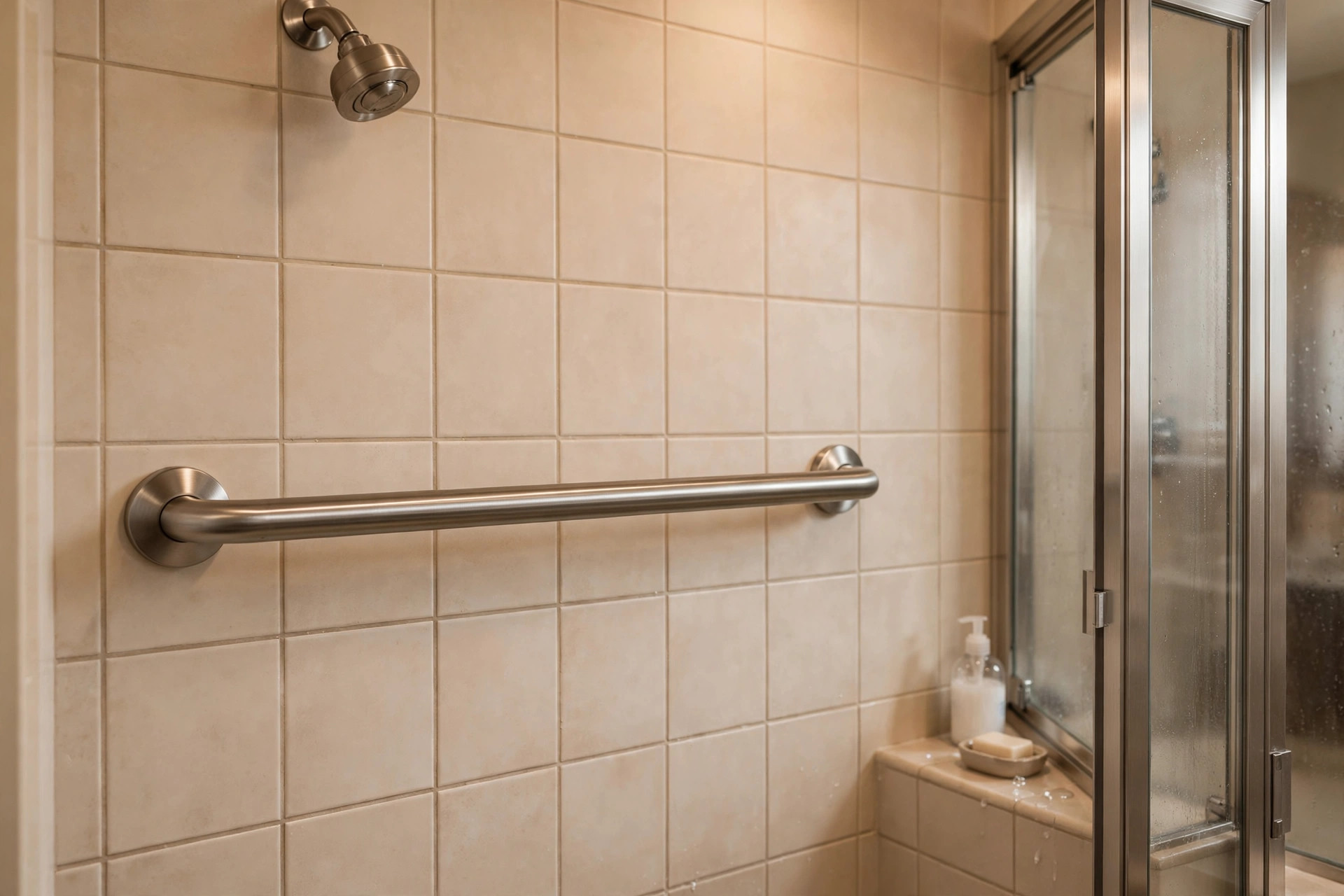
A shower grab bar is one of the smallest changes a person can make in a bathroom, and one of the most important. Falls in the bathroom send hundreds of thousands of Americans to the emergency room each year. Wet tile, soap film, and a slick tub floor make the shower a risky place, even for people in good health. A well chosen and firmly mounted grab bar gives a hand something to hold. This shower grab bars buying guide usa explains what to look for, how to choose the right size and finish, what the job should cost, and how to keep the bar safe for years.
Why Grab Bars Matter
Most bathroom falls happen in a few seconds. A foot slips on wet tile. A knee buckles when stepping over the tub edge. The person reaches out, but the walls are bare. There is nothing to grab except a towel rack or a shower curtain rod, and those are not built to hold body weight.
A true grab bar is built to hold a person. In the United States, good bars are rated to support 250 pounds or more when they are fixed to studs or solid backing. That is a large margin of safety. A towel holder or a soap dish will pull out of the wall under load. A grab bar will not, as long as it is mounted correctly.
Grab bars are not only for older people. Young children learning to bathe alone use them. Pregnant women use them for balance. People recovering from knee or hip surgery use them every day. Anyone who has ever felt unsteady on a wet floor can see the value. The bar is there when it is needed, and it costs little.
What to Look For: Shower Grab Bars Buying Guide Usa
Before buying, it helps to know the basic points that separate a good bar from a poor one. Keep these ideas in mind while you shop.
Weight Rating
Check the package for a weight rating. Most bars sold in the United States are rated for 250 to 500 pounds. Look for a bar that meets the guidelines of the Americans with Disabilities Act, which calls for 250 pounds of force. A higher rating is fine. A bar with no rating printed anywhere is a bad sign.
Diameter
The standard diameter for a shower grab bar is about 1.25 to 1.5 inches. This size fits most hands well. People with small hands or weak grip may prefer a bar closer to 1.25 inches. People with large hands may like 1.5 inches. Try holding a bar in a store if you can. A bar that is too thick for the hand is hard to grip when it is wet.
Grip Surface
Many bars have a smooth finish. Some have a knurled or textured grip that makes the hand less likely to slip. Knurled bars feel rough to the touch. They give extra hold in soapy water. Smooth bars are easier to clean. Either kind works if the bar is mounted well.
Material
Most shower grab bars are made of stainless steel. Stainless steel resists rust in a wet room. Cheaper bars may use plated brass or plastic. Those can look fine at first but may wear faster. For a shower that sees daily use, stainless steel is the safe pick.
Types of Shower Grab Bars
Grab bars come in several shapes. Each shape suits a different spot in the shower.
Straight Bars
The straight bar is the classic form. It is a single tube with flanges at each end. Lengths run from 12 inches to 48 inches. Short bars work near the shower valve or in a corner. Long bars work along a back wall where a person walks in and out of the tub. Straight bars are the easiest to plan and to mount.
Angled Bars
Angled bars bend at one or two points. They give two grip points at once, one horizontal and one sloped. They are popular in walk in showers because the angled part meets the hand at a natural height when stepping down. If you are pairing your grab bar with a walk in shower kit, an angled bar can fit well near the low entry.
L-Shaped and U-Shaped Bars
These bars turn a corner. They run along two walls at once. They suit tight showers where the wall space is short. They also work beside a soaking tub, where a person needs help standing up from a deep seat.
Suction Cup Bars
Suction cup bars press onto smooth tile or glass with no screws. They are easy to move and they do not damage the wall. But they are not true grab bars. They can come loose without warning. They do not meet the weight rating of fixed bars. Use them only as a steadying aid, never to pull full weight. For renters who cannot drill, they are a short term answer, not a final one.
How to Choose the Right Bar
Start with the spot. Stand in the shower and notice where your hand reaches when you step in, when you turn on the water, and when you step out. Mark those spots with tape. Most showers need two bars: one near the entry and one along the back or side wall.
Next, pick the length. A 24 inch bar is a common choice for a side wall. A 36 inch or 42 inch bar suits a long back wall. In a small corner shower, two 12 or 16 inch bars placed at right angles may work better than one long bar.
Then pick the finish. Brushed nickel, chrome, and oil rubbed bronze are the most common. Match the finish to your shower heads and faucets so the room looks planned. The finish does not change the strength, but it changes the look. Brushed finishes hide water spots better than polished chrome.
Finally, check what is behind the wall. A bar is only as strong as its anchor. The best bar will fail if it is screwed into bare drywall. You need wood studs, a solid blocking board, or a rated hollow wall anchor. If you are unsure what is in your wall, a stud finder from a hardware store like Home Depot will show the stud lines.
Cost and Price
Shower grab bars are not costly. A basic stainless straight bar in a common length runs about 20 to 40 dollars at most United States retailers. Designer finishes and longer bars run 40 to 90 dollars. Knurled bars often cost a little more than smooth ones.
Installation is the other half of the cost. A handy homeowner can mount a bar in under an hour. The job needs a drill, a level, a stud finder, and the right anchors. A plumber or handyman will charge 75 to 150 dollars per bar in most markets, more if tile work is tricky. Stores like Lowe’s sell full kits with anchors and instructions.
Buying in a set can save money. Two packs of matching bars are common online. Read reviews before you buy a set. Make sure each bar in the set carries its own weight rating.
Installation Basics
Mounting a grab bar is a small project, but it must be done right. Here are the main steps.
First, find the studs. Use a stud finder to mark each stud line across the mounting area. In most American homes, studs sit 16 inches apart.
Second, hold the bar at the planned height. For a shower entry bar, 33 to 36 inches above the floor is typical. This matches the common reach height and follows public building guidance. A helper makes this step easy.
Third, drill pilot holes through the tile or fiberglass into the stud. Use a masonry or carbide bit for tile. Go slow so the tile does not crack. Tape over the drill spot with masking tape to keep the bit from slipping.
Fourth, drive the mounting screws through the bar flanges into the stud. Tighten each screw firmly. Then tug the bar hard in every direction. It should not move at all.
If there is no stud where you need the bar, use a heavy duty hollow wall anchor rated for grab bars. Better yet, open the wall and add a wood blocking board between the studs. This is more work, but it gives the strongest hold. A detailed walkthrough from This Old House shows how blocking is added during a remodel.
Care and Upkeep
A good bar needs little care. Wipe it with a soft cloth and mild soap once a week. Rinse well. Hard water leaves white spots on chrome and polished finishes. A little white vinegar on a cloth will lift the spots.
Check the bar twice a year. Grip it and pull hard. Look at each flange for movement or gaps. If a flange pulls away from the wall, the screws may have loosened or the anchor may have failed. Take the bar down and remount it with fresh anchors. Do not keep using a loose bar.
Keep the knurling clean on textured bars. Soap scum fills the tiny ridges and makes them slick. A soft brush and warm soapy water will clear it out.
Safety
A grab bar adds safety only when it is used right. Place one bar near the shower entry so a person can hold it while stepping over the tub edge. Place another inside the shower at standing height.
Pair the bar with other simple measures. A non slip bath mat on the tub floor cuts the risk of a fall. A frameless shower door with a firm handle is no substitute for a bar; door glass is not made to take a fall load.
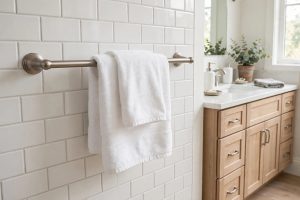
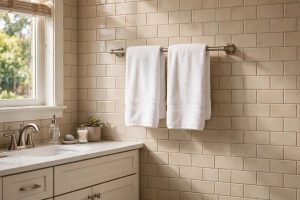
Never mount a bar to a plastic shower surround with plain screws. The thin shell will not hold. Use a solid anchor or back the wall with blocking. Never use a towel bar as a grab bar. It will pull out of the wall when a person falls against it.
The HGTV bathroom guides note that aging in place plans often start with grab bars. They are a low cost first step before larger changes like a bench or a curbless entry.
Frequently Asked Questions
How high should a shower grab bar be?
Most guides suggest 33 to 36 inches above the shower floor for a horizontal bar. This height suits the reach of most adults. If the bar is for one person, set it at a height where their hand lands when they stand flat. For an angled bar, the low end may sit near 30 inches and the high end near 40 inches.
Do I need a stud to mount a grab bar?
You need solid support behind the wall. A wood stud is best. A blocking board between studs is just as good. Special hollow wall anchors made for grab bars are a fair option in tile over drywall. Plain plastic anchors are not enough. They can pull out under load.
Are suction grab bars safe?
Suction bars are useful for light steadying, but they are not a replacement for a fixed bar. They can release without warning as the seal ages or the wall gets soapy. Do not pull hard on them. Do not use them as the only support for a person with poor balance.
What length grab bar should I buy?
A 24 inch bar fits most side walls. A 36 to 42 inch bar fits a long back wall. Measure the wall and mark where your hand falls before you buy. Shorter is fine in a corner. Longer is better where a person walks along the wall.
Can a grab bar match my bathroom finish?
Yes. Most bars come in chrome, brushed nickel, oil rubbed bronze, and matte black. Some makers offer white and almond for a plain look. The Bob Vila site has guides on matching bath hardware finishes across a whole room.
Do grab bars work in a fiberglass shower?
Yes, with the right anchors. A fiberglass surround is too thin to hold screws alone. Use a heavy duty hollow wall anchor rated for grab bars, or open the wall and add wood blocking. Many makers sell bars with anchor kits made for this exact job.
A Short Final Word
A shower grab bar is a plain piece of metal. It does not decorate the room. It does not draw the eye. But it stands ready every day, in the wettest and slickest corner of the house. Choose a solid stainless bar, mount it to a stud, and check it now and then. That small act keeps the people you care about on their feet.
For more ideas on bathroom projects, you may like our guides on /rain-shower-heads-buying-guide-usa/, /frameless-shower-doors-buying-guide-usa/, and /brushed-towel-holders-buying-guide-usa/.
References
American Standard. (n.d.). Bathroom and kitchen products. https://www.americanstandard.com Bob Vila. (n.d.). Home improvement advice. https://www.bobvila.com Delta Faucet. (n.d.). Kitchen and bathroom faucets. https://www.deltafaucet.com HGTV. (n.d.). Home and garden ideas. https://www.hgtv.com Kohler. (n.d.). Bathroom and kitchen fixtures. https://www.kohler.com Lowe’s. (n.d.). Home improvement products. https://www.lowes.com Moen. (n.d.). Faucets and plumbing fixtures. https://www.moen.com The Home Depot. (n.d.). Home improvement products. https://www.homedepot.com The Spruce. (n.d.). Home and garden advice. https://www.thespruce.com This Old House. (n.d.). Home renovation guidance. https://www.thisoldhouse.com
Was this guide helpful?

About Michael Thompson
The My Garden US editorial team writes practical, in-depth home and garden guides for American homeowners — tested advice, no fluff.