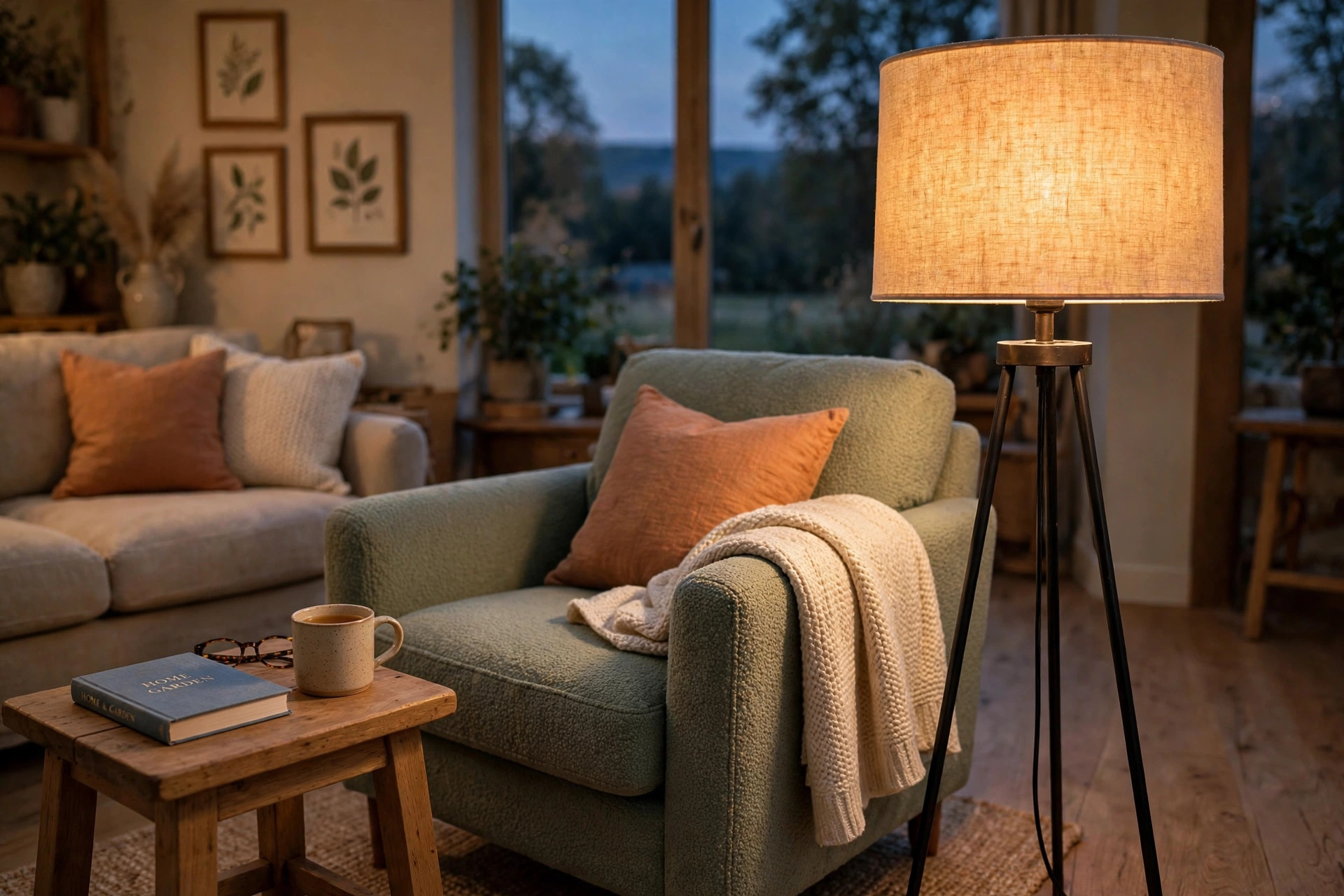

The living room floor lamps for sale USA stores carry today can change a room more than almost any other single piece of furniture. A sofa sets the shape of the room. A rug sets the color. But light sets the mood. The right floor lamp makes a dark corner inviting. It makes reading easier. It makes the whole room feel finished. The wrong lamp tips over, throws harsh glare, or simply does not belong. This guide walks through the choice in plain terms, so you can buy with confidence.
Why a Floor Lamp Matters in the Living Room
Most American homes get their living room light from one source: a ceiling fixture. That single overhead light is fine for cleaning or for finding a lost remote. It is poor for conversation and poor for rest. Overhead light falls straight down. It creates hard shadows on faces. It makes the ceiling bright and the corners dark.
A floor lamp works differently. It stands where you need it. It throws light upward, outward, or downward, depending on the shade. A well placed floor lamp creates pools of warm light. These pools break the room into zones. One zone is for reading in the armchair. Another is for talk near the sofa. A third is for the piano or the bookcase. Good lighting is not about brightness. It is about control.
Floor lamps are also easy to add. You do not need an electrician. You plug the lamp in and you are done. For renters, that is a real advantage.
How to Choose a Floor Lamp: Living Room Floor Lamps for Sale Usa
The living room floor lamps buying guide usa section of many stores runs long. You do not need to read all of it. Five things matter most: height, scale, light type, shade, and switch. Get those five right and the lamp will serve you for years.
Height and Scale
A standard floor lamp stands between 58 and 64 inches tall. That height puts the shade near the eye level of a seated person. If the lamp is too short, the light hits the floor. If it is too tall, it lights the ceiling and nothing else. Measure your sofa and your chairs before you shop. A lamp beside a reading chair should place the bottom of the shade at or just above shoulder height when you sit.
Scale matters too. A small tripod lamp disappears next to a large sectional sofa. A tall arc lamp crowds a small reading nook. Look at the width of the base as well. A base of ten to twelve inches across is stable. A narrow base on a tall lamp is a tipping risk, especially in a home with children or pets.
Light Type and Brightness
Almost every lamp on sale now takes an LED bulb. LEDs use little power and last for years. They come in color temperatures measured in Kelvins. For a living room, choose 2700K to 3000K. That range gives warm white light. It feels like the glow of an old incandescent bulb. Bulbs marked 5000K or “daylight” give a cold blue light that suits a garage, not a living room.
Brightness is measured in lumens, not watts. A reading lamp needs 450 to 800 lumens directed at the page. A lamp meant for mood lighting can be softer, around 300 to 450 lumens. Many floor lamps now come with a dimmer switch. A dimmer is worth the extra cost. It lets you tune the light for reading, talk, or quiet evening hours.
Shade Shape and Material
The shade decides where the light goes. A drum shade sends light up and down in a soft spread. A torchiere shade pushes light straight to the ceiling, which then washes back down. A bell or empire shade throws light mostly downward and works well for reading. An opaque metal shade gives a strong downward beam, like a spotlight.
Material matters as well. Linen and fabric shades soften light and spread it gently. Paper shades are cheap but they yellow with age. Metal shades are sturdy and modern but can glare. Glass shades look fine but break easily. For a family living room, fabric or metal are the safest bets.
The Switch and the Cord
Small details cause daily trouble. A foot switch on the cord is easy to reach when you sit down. A switch on the socket forces you to stand and bend. Some lamps have a touch switch on the pole, which is simple but can trigger by accident. Check the cord length too. A six-foot cord reaches most outlets. A shorter cord may force you to buy an extension cord, which adds clutter and trip risk.
Types of Living Room Floor Lamps
Stores in the USA sell hundreds of styles. Nearly all of them fall into six types. Know the type and you can narrow a large online selection down fast.
Torchiere lamps. The classic upright lamp with a bowl-shaped shade that points up. Torchiere lamps light a room evenly by bouncing light off the ceiling. They are simple, cheap, and dependable. Their weakness is glare if you look up at the shade, and they give poor light for reading.
Arc lamps. A tall base with a long curved arm that reaches over a sofa or chair. An arc lamp hangs its shade right where you read or eat. It makes a strong style statement and suits modern rooms. It needs floor space for the base, and the long arm can wobble if the build is cheap. An affordable arc floor lamp for living room use can be found at stores with budget-friendly modern designs.
Tripod lamps. Three legs hold a single shade. Tripod lamps look good in corners and in Scandinavian or mid-century rooms. They are stable on level floors. They take up more floor space than a single-pole lamp, so they suit larger rooms.
Pharmacy and task lamps. A slender pole with a small adjustable shade, often with a swing arm. These are reading lamps. They give strong light on one spot and little elsewhere. They are ideal beside a favorite chair. They are a poor choice as the only lamp in a room.
Tree lamps. One pole with three or more small shades at different heights. Tree lamps light several spots at once. They suit corners that stay dark. Their style is dated in some rooms and perfect in others. Judge by the room.
Shelf and storage lamps. A lamp pole built into a small shelf or side table. These save space in small apartments. The shelf holds a drink or a book. The light quality is ordinary. The space saving is real.
Cost and Price of Floor Lamps
Floor lamp prices in the USA run from under thirty dollars to over one thousand. Most shoppers spend between sixty and three hundred dollars. Here is what the money buys.
Under fifty dollars, you get simple torchieres and basic pharmacy lamps. They work. The materials are light and the finishes are plain. These lamps are fine for a dorm room or a first apartment.
From fifty to one hundred and fifty dollars, quality improves a lot. Shades fit better. Poles are sturdier. Dimmers appear. This is the sweet spot for most living rooms. Many budget-friendly modern designs fall in this range, and a lighting specialist with deep stock carries dozens of options here as well.
From one hundred and fifty to four hundred dollars, you pay for design. The lamp becomes a furniture piece. Solid brass, real wood, and heavy bases show up. Arc lamps and designer tripods live in this range. Stores known for modern silhouettes and mid-century looks sell heavily here.
Above four hundred dollars, you pay for names and materials. Hand finished metal, hand sewn shades, and imported design drive the price. These lamps can be beautiful. They light a room no better than a two hundred dollar lamp. Buy them for the look, not the light.
Watch for hidden costs. A lamp that needs a special bulb can cost you twenty dollars a year in replacements. A lamp with no dimmer may need a separate dimmer plug. Shipping on a heavy arc lamp can add thirty dollars. Check the return policy before you buy, since a lamp that looks good online can look wrong in your room.
Care and Upkeep
A floor lamp needs little care, but a little care keeps it safe and good looking. Dust the shade every month with a soft cloth or a lint roller. Dust on a fabric shade dims the light and looks gray in daylight. Metal poles can be wiped with a damp cloth. Never spray cleaner directly on the lamp. Spray the cloth instead.
Check the bulb once or twice a year. LEDs rarely burn out, but they do dim slowly. If the light feels weak, try a new bulb before you blame the lamp. Check the cord at the same time. Look for cracks, flat spots, or loose plugs. A damaged cord is a fire risk. Replace the cord or the lamp.
Tighten the pole joints every year or so. Poles loosen with time, especially on arc and tree lamps. A loose pole leans. A leaning lamp tips. A quarter turn with a wrench is all it takes. Keep the lamp away from heaters and fireplaces. Heat dries out cords and warps shades.
If the shade is fabric and it stains, do not wash it in water. A dry sponge or a soft brush is safer. Many fabric shades can be replaced for twenty to forty dollars, which is cheaper than a new lamp and just as effective at refreshing the look.
Safety in the Living Room
Floor lamps are tall and they stand in traffic paths. Safety is mostly common sense, but the rules are worth stating.
Place the lamp where no one trips over the base. Corners and wall edges are best. Keep the cord flat against the wall and out of walkways. If the cord must cross a path, use a flat cord cover. Never run a cord under a rug, where heat builds up and damage goes unseen.
Keep the shade away from curtains and drapes. A hot bulb against fabric is a classic house fire cause. Keep at least twelve inches between the shade and any curtain.
Mind the wattage limit printed on the socket. It is there for a reason. A 60-watt socket with a 100-watt bulb overheats. LEDs draw little power, so this is rarely a problem now, but check anyway if you use old spare bulbs.
Anchor tall lamps in homes with small children or large dogs. A heavy base helps. A lamp that cannot tip cannot fall on a child. Tree lamps and arc lamps, with their high centers of gravity, deserve the most care. For product safety recalls and guidance, the federal safety site publishes notices that are worth a look at cpsc.gov.
Unplug the lamp before you change a bulb or clean the socket. Let a hot bulb cool for a few minutes first. These are small habits. They prevent the two most common lamp injuries: burns and shocks.
Frequently Asked Questions
How tall should a living room floor lamp be? Most living rooms suit a lamp between 58 and 64 inches tall. The bottom of the shade should sit near the shoulder of a seated person. Measure your chair before you shop. For a sofa with a high back, go taller. For a low modern chair, a shorter lamp works.
What kind of bulb is best for a living room floor lamp? An LED bulb in warm white, 2700K to 3000K, suits almost every living room. It gives the cozy glow people expect. Use 450 to 800 lumens for reading and 300 to 450 lumens for mood lighting. A dimmable bulb with a dimmer switch is the most flexible choice.
Where should I place a floor lamp in the living room? Place reading lamps beside or behind the reading chair, with the shade near shoulder height. Place mood lamps in dark corners to open up the room. Keep every lamp out of walkways. If you pair a lamp with other furniture, stores selling classic styles and solid wood and linen pieces often show room layouts that help with placement ideas.
Are arc floor lamps worth the money? An arc lamp is worth it if you need light over a sofa or a large chair and you have the floor space for the base. It replaces an overhead light without any wiring. It is not worth it in a small room, where the long arm crowds the space. Check that the base is heavy before you buy.
Can I use a floor lamp as the only light in a living room? You can, but the room will look flat. One lamp gives one pool of light. Two or three light sources at different heights look better and work better. A floor lamp plus a table lamp, or a floor lamp plus a torchiere in the far corner, is a common and pleasing setup. Read expert reviews of layered lighting if you want ideas.
A Final Word
Buying a living room floor lamp for sale in the USA is not hard once you know the five things that matter: height, scale, light type, shade, and switch. Choose the type that fits your room. Spend in the range that fits your budget. Place the lamp where it cannot tip and where the cord cannot trip. Then enjoy the room. A good lamp does its work quietly, every evening, for years. That is all a piece of furniture needs to do.
If you are furnishing the whole room at once, pair your lamp choice with the rest of the furniture plan. A lamp that matches rustic console tables or a dining room set for a Texas home in tone will make the whole space feel planned rather than assembled. For broader designer lighting ideas, a design-focused lighting store can show how a single lamp fits into a layered room.
References
Article. (n.d.). Modern furniture. https://www.article.com CB2. (n.d.). Modern furniture and decor. https://www.cb2.com Crate and Barrel. (n.d.). Furniture and home decor. https://www.crateandbarrel.com IKEA. (n.d.). Home furnishings. https://www.ikea.com Lamps Plus. (n.d.). Lighting and home decor. https://www.lampsplus.com Lumens. (n.d.). Lighting and ceiling fans. https://www.lumens.com The Spruce. (n.d.). Home and garden advice. https://www.thespruce.com U.S. Consumer Product Safety Commission. (n.d.). Product safety information. https://www.cpsc.gov Wayfair. (n.d.). Furniture and home goods. https://www.wayfair.com West Elm. (n.d.). Modern furniture and home decor. https://www.westelm.com
Was this guide helpful?

About Michael Thompson
The My Garden US editorial team writes practical, in-depth home and garden guides for American homeowners — tested advice, no fluff.
You May Also Like
Modern Wall Bookshelves for Sale in the USA: A Complete Buyer’s Guide
March 19, 2026 0 views
Living Room Floor Lamps USA Online Deals: A Simple Guide
September 27, 2026 0 views
A Practical Buying Guide to Modern Wall Bookshelves for Homes in the USA
July 5, 2026 0 views