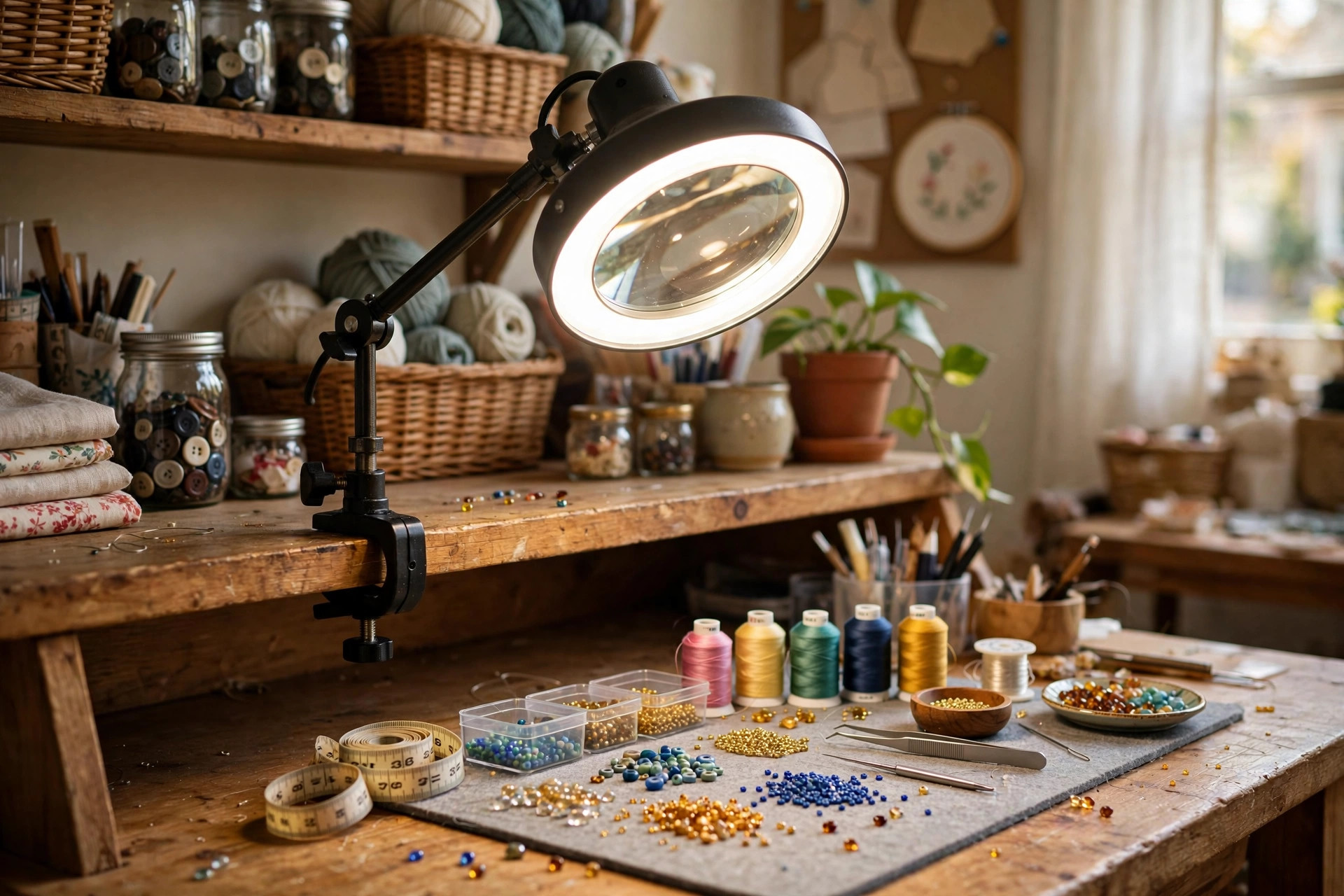
Small work needs sharp eyes. Fine stitching, small beads, tiny paint lines, and close wire work all demand a clear view. A lamp alone is not enough. A plain hand lens leaves one hand short. The best craft magnifier lamp for detailed work solves both problems at once. It holds a lens steady above your project and bathes the spot in bright light. This guide explains what to look for, the main types, what you may pay, and how to keep one in good shape.
Why a Magnifier Lamp Matters
Crafters work on details the naked eye can barely catch. A stitch of a millimeter, a bead hole, a hairline of paint. With age, eyes tire fast. Squinting brings strain, and strain brings mistakes. A magnifier lamp changes the whole task. The lens enlarges the work two or three times. The light removes shadow. Hands stay free to sew, glue, paint, or set stones.
The result is simple to see. Work goes faster. Errors drop. Shoulders stay loose because the crafter no longer hunches close to the piece. For people with older eyes, a magnifier lamp can keep a beloved hobby alive for years. Jewelry makers use one to set tiny clasps. Model builders use one to read small decals. Quilters use one to thread fine needles. If your craft lives in the small, a magnifier lamp earns its place on the desk.
How to Choose the Right Lamp: Best Craft Magnifier Lamp for Detailed Work
Several features decide how well a lamp will serve you. Look at each one before you buy.
Lens Size and Power
Lens power is measured in diopters. A three-diopter lens gives about 1.75 times magnification. Five diopters gives about 2.25 times. Most crafters do well with three to five diopters. More power sounds better, but it shortens the working distance. At high power the lens must sit very close to the piece. That leaves little room for hands and tools. A wide lens is often more useful than a strong one. A five-inch lens shows a whole bead row or a full stitch field. A small lens shows only a coin-sized patch. Pick the widest lens you can afford at moderate power.
Glass lenses weigh more but scratch less. Acrylic lenses are light and cheap but scuff with rough wiping. For daily craft use, glass is the safer pick. It keeps its clarity for years.
Light Source
Old lamps used round fluorescent tubes. New lamps use light emitting diodes. Diodes run cool, last for years, and sip power. They give a crisp white light that shows true thread color. Some lamps let you switch between warm and cool light. Cool light suits bead and stone work. Warm light suits fabric and yarn, where true tone matters less. A good lamp lights evenly from a ring around the lens. Ring light kills the shadow of your own hands. Look for a lamp with a dimmer. Bright light at night can glare, and a dimmer lets you set a kind eye level.
Mount and Reach
A lamp must reach your work and stay put. Clamp mounts grip the edge of a desk or craft table. Floor stands hold the lamp beside a chair. Desk bases sit flat and swing on an arm. The arm is the heart of the lamp. A spring arm holds any pose you set. A cheap gooseneck sags and drifts. Test the arm if you can. Push the head aside and see if it stays.
Main Types on the Market
Three shapes cover most craft rooms. Each has strengths.
Clamp-on lamps. A clamp bites the desk edge and frees the whole desk top. These suit small rooms where every inch counts. They cost less than floor models. The clamp needs a firm edge to hold. Thin or rounded desk edges can slip. Wrap a rag under the clamp pad to protect wood tops.
Desk lamps with weighted bases. A heavy base holds the arm on a flat top. No clamp marks on furniture. These move from desk to table with ease. They take up some work space. Pick one if you craft in different rooms or share the desk with a wood burning kit for DIY crafts.
Floor-standing lamps. A tall stand brings the lens down over a chair or a couch arm. Good for needlework done in an easy chair. Also good for large quilts that hang off the table edge. The base should be heavy and flat so it does not tip. Floor models cost the most but serve two seats at once.
A few lamps add extras. Some hold a phone clip so you can film your work. Some add a small tray for scissors. Treat extras as a bonus, not a reason to buy. The lens and the light are what matter.
Cost and Price
Prices run wide. A basic clamp lamp with a small acrylic lens may cost as little as a family meal out. It will serve a beginner fine. A mid range lamp with a glass lens, a long spring arm, and a dimmer costs more and suits daily use. A large floor model with full features sits at the top of the range.
Do not judge by price alone. Read how buyers rate the arm and the switch. A lamp with a loose arm is useless at any price. A lamp with a stiff switch fails fast under daily clicks. Home craft stores such as Michaels and Joann stock these lamps, and craft supply guides at Dick Blick explain lens terms in plain words. General home stores like Home Depot and Lowes carry work lamps too, and review sources such as Consumer Reports test lamp build quality.
For hobby use, the middle of the range buys the best value. The lens stays true, the arm stays put, and the light runs for years. Buyers who use a lamp for paid work, such as a jewelry making kit for beginners adults turned into a small business, may gain from a top model with a larger lens.
Care and Upkeep
A magnifier lamp asks for little care. Wipe the lens with a soft dry cloth or a lens cloth from an eyeglass shop. Never use rough paper towels. They leave fine scratches that cloud the view over time. Dust the lamp head with a damp rag. Keep the cord clear of the work area so hot tools do not melt it.
Light diodes last for many years of daily use. If the lamp uses a replaceable tube, keep one spare. Store the lamp with the head folded down when not in use. This keeps dust off the lens and protects the arm springs. Check the clamp or base each month. Tighten loose screws before they wear the threads.
A cover helps. A small cloth cap over the lens keeps dust out and stops sun from focusing through the lens onto the desk. Yes, a lens left in a sunbeam can scorch paper or cloth. Cap it when the craft day ends.
Safety
These lamps are safe when used with sense. Keep water away from the head and switch. A damp craft room needs care. Never leave a lamp on and walk away for hours. The light is cool, but the habit is bad.
Watch the cord. Do not run it under rugs or across walkways. A tug can pull the whole lamp down. Mount the clamp with a firm bite, and test it before you trust it over a fresh piece. Eye safety matters too. Look away from the bright ring every half hour and rest the eyes on a far wall. Bright task light is fine, but no eye likes hours without a break.
If you solder or use heat near the lamp, keep the lens back. Heat can warp acrylic lenses and crack glass at the rim. Craft how-to writers at Family Handyman and This Old House give sound shop safety habits that suit a craft corner too. Project idea sites like The Spruce often show lamp placement in craft room photos.
Placing the Lamp in Your Craft Corner
Where you put the lamp matters as much as which lamp you buy. Set the head so the lens hangs above your usual hand position, not off to one side. If you sew, center it over the needle plate. If you bead, center it over the tray where the beads lie. The light should fall straight down on the work. Light from the side casts the shadow of your hands across the piece.
Keep the lamp on the side of your writing hand. A right handed crafter sets the lamp to the right of the desk edge, so the arm swings in from the right. This keeps the cord away from the working hand. Leave six inches of clear desk around the base or clamp. Thread spools and glue bottles creep toward the lamp and can bump the arm out of pose.
Pair the lamp with a plain matte work mat in a soft color. Gray or pale green works well. A busy mat fights the eye, while a white mat glares under bright light. With the lamp placed right and a calm mat under the piece, the detail stands out on its own.
Frequently Asked Questions
What diopter is best for crafts? Three to five diopters suits most crafts. That gives about 1.75 to 2.25 times magnification. Lower power keeps a comfortable space between the lens and your hands. Save higher power for tasks like stone setting where the work barely moves.
Are LED magnifier lamps better than fluorescent? Yes, for most buyers. Diodes give clear light, run cool, and last for years. Old tube lamps work, but tubes burn out and change color with age. A diode lamp with a dimmer is the best pick today.
Can I use a magnifier lamp for reading? You can. The lamp lights the page and enlarges the print. Many older readers keep one by the reading chair. But a lamp built for a desk may be awkward in a chair. Floor models suit reading best.
Do I need a magnifier lamp if I wear reading glasses? Glasses help, but a lamp adds light and frees your posture. Many crafters use both. The glasses give base correction. The lamp adds size and light at the work point. Together they cut eye strain fast.
How do I keep the lamp from tipping? Use a firm clamp on a solid edge, or a heavy flat base. Place the base near the work, not at the far desk edge. Tighten all arm joints. If the arm still drifts, the springs are weak and the lamp needs repair or replacement. Practical build advice appears in craft guides at Bob Vila.
What size lens should I pick? Pick the largest lens you can afford at three to five diopters. A five-inch round lens is a good aim. It shows enough of the piece to keep context while you work. Fine detail tools like a calligraphy pen set for beginners lettering stay in view under a wide lens.
A Final Word
The best craft magnifier lamp for detailed work is the one that fits your bench, your eyes, and your craft. Start with a wide lens, honest light, and a firm arm. Skip flashy extras. Keep the lens clean and capped. Then sit down to your work and notice the change. Small things grow clear. Hands relax. The craft you love gets easier, and that is the whole point of the tool.
References
Blick Art Materials. (n.d.). Art and craft supplies. https://www.dickblick.com Bob Vila. (n.d.). Home improvement advice. https://www.bobvila.com Consumer Reports. (n.d.). Product reviews and ratings. https://www.consumerreports.org Family Handyman. (n.d.). DIY home repair and maintenance. https://www.familyhandyman.com JOANN. (n.d.). Fabric and craft supplies. https://www.joann.com Lowe’s. (n.d.). Home improvement products. https://www.lowes.com Michaels. (n.d.). Arts and crafts supplies. https://www.michaels.com The Home Depot. (n.d.). Home improvement products. https://www.homedepot.com The Spruce. (n.d.). Home and garden advice. https://www.thespruce.com This Old House. (n.d.). Home renovation guidance. https://www.thisoldhouse.com
Was this guide helpful?

About Sarah Mitchell
The My Garden US editorial team writes practical, in-depth home and garden guides for American homeowners — tested advice, no fluff.