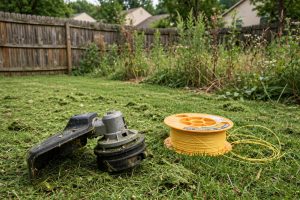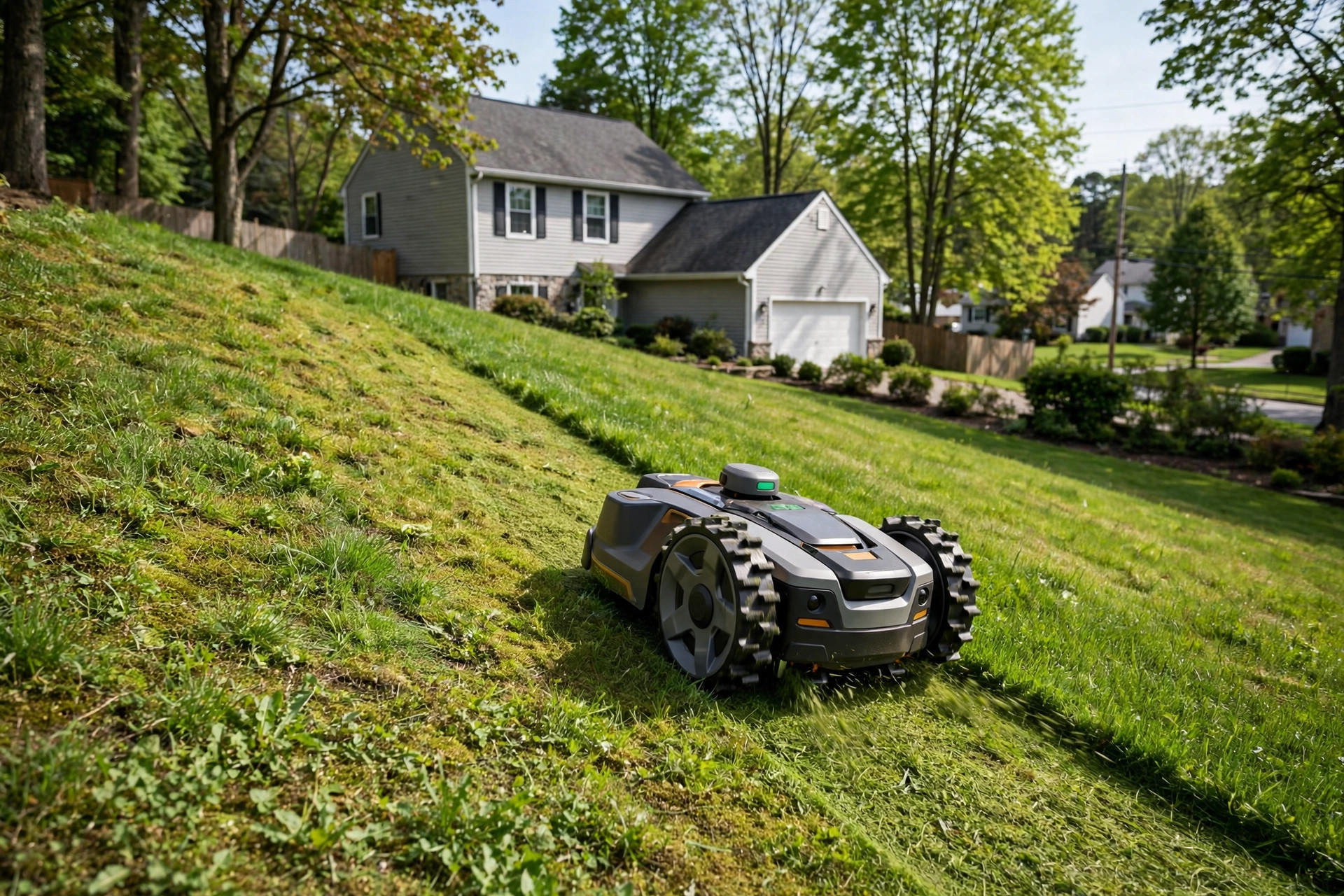

A hill is the hardest test for any lawn machine. Flat yards are easy. Slopes are not. This guide to the best robotic mower for slopes reviews will help you read those reviews with care and pick a machine that can climb, cut, and come home safe. The first 100 words carry the main point. Reviews are useful, but only when you know what to look for. A mower that works well on flat land may fail on a 25 percent grade. A mower built for hills has stronger wheels, a better grip, and a smarter brain. The sections below explain why slopes matter, what features to check, what the machines cost, how to care for them, and how to keep people and pets safe.
Why Slopes Need a Special Mower
Push mowers are hard work on hills. You must hold the machine and fight gravity at the same time. Many people slip. Many backs ache. Riding mowers help, but they can tip on steep ground. A robotic mower looks like a good answer. It works alone. It is low to the ground. It does not need a driver.
But not all robots can handle a hill. A flat-yard robot may spin its wheels on a slope. It may slide down and get stuck at the bottom. It may fail to climb back to its charger. It may cut the grass in ragged patches. The best robotic mower for slopes reviews always talk about this. They test the machine on real hills. They measure the grade it can climb. They report how it behaves when the ground is wet.
The grade is the key number. A 20 percent grade means the land rises 20 feet for every 100 feet of run. Many common robots handle up to 20 percent. Slope machines handle 30, 35, or even 45 percent. Before you read a single review, walk your yard. Look at your steepest patch. A tape measure and a little math will give you the grade. You can also use a free phone app that reads angles.
Wet grass changes everything. A slope that is safe when dry can be a trap when wet. Reviews written by owners often mention this. They say the mower did fine in summer but slid in the spring rain. Look for reviews that span a full season.
What to Look For When You Read Reviews: Best Robotic Mower for Slopes Reviews
Reviews of the best robotic mower for slopes models follow a pattern. They list the slope rating, the wheel design, the battery, the blade system, and the navigation method.
Slope Rating
The slope rating is the maker’s promise. It says how steep a hill the mower can cut. Take this number as a ceiling, not a goal. If your hill is 30 percent, do not buy a machine rated at 30 percent. Buy one rated at 40 or more. Reviews often test the rating. Good reviewers drive the machine to the limit and report the truth. Watch for the words “advertised rating” and “tested rating” in the same review. The gap between them tells you how honest the maker is.
Traction and Wheels
Wheels do the real work on a hill. Slope robots have wide rear wheels with deep treads. The treads bite into the grass. Some machines add weight over the drive wheels. Reviews will praise machines that do not leave wheel marks. A machine that spins and digs will ruin the lawn. Read the comments about ruts and bare spots. They matter more than speed.
Battery and Run Time
A hill drinks power. The motor works harder on every climb. Battery life shrinks on slopes. A machine that runs two hours on flat land may run only 80 minutes on hills. Reviews that give run time on slopes are worth their weight. Also check the recharge time. A fast charger means the mower gets back to work sooner.
Cutting System
Most robotic mowers use small razor blades on a spinning disc. They cut a little grass each day. This works well if the mower visits each patch often. On slopes, the cutting width matters. A narrow mower makes more passes. Reviews often note the cut quality. Look for words like “even”, “smooth”, and “clean”. Avoid models that leave lines of tall grass.
Navigation
Old robots use a wire buried around the lawn. New models use GPS and cameras. Both can work on hills. Wire systems are steady and simple. They never lose signal under trees. GPS systems are easy to set up. They draw a map in a phone app. On a steep hill, the edge is the danger zone. A good system keeps the mower well clear of drop-offs, ponds, and walls. Reviews that test edge behavior are gold.
Weather Handling
Rain makes slopes slick. Some robots have a rain sensor. They go home when the storm starts. Others keep working. On a hill, working in the rain is risky. The mower may slide and the grass may tear. The best robotic mower for slopes reviews praise a strong rain response. If you live in a rainy place, pick a machine that parks itself when wet and waits for the ground to dry.
Main Types of Robotic Mowers for Hills
Robotic mowers for slopes fall into a few clear groups. Knowing the groups helps you read reviews faster.
The first group is the flat-yard robot. These are cheap and common. They handle grades up to about 20 percent. They suit gentle banks. Do not trust them on a true hill. Reviews for these machines are fine if your land is nearly flat.
The second group is the slope specialist. These machines are built for hills. They have strong motors, wide wheels, and slope ratings of 30 to 45 percent. They cost more. They weigh more. Owners of hilly lawns love them. Many of the best robotic mower for slopes reviews focus on this group.
The third group is the all-wheel drive robot. These have four driven wheels. They grip like a small tractor. They handle the steepest yards and rough ground. They are the most costly. They suit large, wild, sloped lots where a normal mower would be unsafe.
The fourth group is the hybrid mower. Some makers build a robot that also cuts like a normal mower on demand. Others build remote-control mowers for slopes. These are cousins of the robot family. They help on hills too steep for any wheel. A related long-tail topic is the fence line trimmer for steep slopes, which handles the edges that no robot can reach.
Size also matters. If your yard is large and flat on top but sloped on the sides, look at machines made for bigger lots. A useful related read is our note on the robot lawn mower for half acre yards. It covers battery and coverage needs for mid-size lawns.
Cost and Price
Purchase Price
Prices run wide. A basic robot for gentle slopes costs about 800 to 1,500 dollars. A slope specialist costs 1,500 to 3,500 dollars. An all-wheel drive machine can cost 3,500 to 6,000 dollars or more. The price tracks the slope rating, the battery size, and the brand name. Big makers such as Toro and John Deere sell proven machines and parts. You can read maker guides on the Toro site and the John Deere site. Engine know-how from Briggs & Stratton also helps you judge motor strength. Independent tests appear at Consumer Reports, a trusted source for product-review topics.
Do not buy on price alone. A cheap machine that cannot climb your hill is wasted money. It will sit in the shed. A right-sized machine saves hours of hard labor each week. The math often favors the stronger machine.
Running Costs
Running costs are low. Electricity is the main one. Most robots cost only a few dollars a month to charge. Blades need change two or three times a year. A set of blades costs 20 to 40 dollars. Wheel treads wear out in two to three years on rough ground. A new set costs 50 to 150 dollars. Wire systems need no monthly fee. Check the fine print before you buy.
Used Machines
Used slope robots sell for half price or less. They can be a fair deal. But batteries fade with age. A three-year-old battery may hold half its charge. Ask the seller how the machine did on hills. Test it on your own slope if you can. A used machine with a fresh battery is often the best value in the market.
Care and Upkeep
A slope robot lives a hard life. Care keeps it climbing. Clean the wheels each week. Grass and mud pack into the treads. Packed treads lose their grip. Wash the underside with a hose. Keep water away from the motor vents. Check the blades. Dull blades tear grass. Torn grass turns brown on a hill where the sun is strong.
The boundary wire needs care too. On slopes, soil moves. Heavy rain can pull a wire to the surface. A mower may cut the wire itself. Walk your boundary once a month. Push any loose wire back into the soil. Keep a small repair kit on hand. A splice takes five minutes.
Winter storage matters. Bring the mower inside when the season ends. Charge the battery to about half. Store it in a dry place that stays above freezing. A battery that sits dead all winter may never wake up. In spring, walk the slope before the first run. Fill any ruts. Remove fallen branches.
Software updates help as well. Makers release updates that fix navigation bugs. Some updates improve hill handling. Keep the mower’s app current. Read the update notes. A free update can make an old machine climb better.
Safety on Steep Ground
Safety comes first on hills. A robotic mower is safer than a riding mower on slopes. It has no driver to hurt. But it still has blades. It still moves. Keep children and pets away while it works. Teach children not to touch it. The blades are small but sharp.
Fences and drop-offs need care. A steep bank above a wall or a road is a hazard. The mower could slide over the edge. Use the boundary to keep it back. Leave a wide margin. Two feet is not enough. Give it six feet or more on a steep drop. Test the boundary by watching the mower for a full hour on its first day.
Night runs are risky on hills. Dew makes grass slick. The mower cannot see as well. Run it in daylight. If your machine has lights, use them, but do not rely on them.
Lightning is a real threat. A charger plugged into an outside outlet can take a strike. Unplug the charger during storms. This protects the machine and the house. A surge guard is a cheap add-on that pays for itself.
If you also trim by hand on the same slope, wear boots with good grip. A self propelled mower can help on the parts the robot cannot reach. Never push a walk mower across a slope. Push it up and down, not sideways. Sideways pushes invite slips.
Common Questions
How steep is too steep for a robotic mower?
It depends on the machine. Most handle 20 percent. Slope models handle 30 to 45 percent. All-wheel drive models handle more. Past 45 percent, most makers say no. Walk the hill. If you cannot stand on it with ease, no robot should cut it. In that case, plant ground cover and let the slope rest.
Can a robotic mower work in the rain on a hill?
Some can, but it is not wise. Wet grass is slick. The mower may slide. The blades may tear the grass. Pick a machine with a rain sensor. Let it park when wet. The lawn will wait. A torn lawn takes weeks to heal.
Will the mower leave marks on my slope?
A good machine will not. A weak machine will. Wheel marks come from spinning wheels. If reviews mention ruts, believe them. Wide tires, slow turns, and dry grass all help. Keep the grass a little tall. Short grass shows every mark.
How do I set the boundary on a hill?
Start at the top. Lay the wire with a margin from the edge. On a steep drop, double the margin. Pin the wire well. Loose wire moves downhill with rain. Walk the full line before the first run. Watch the mower touch each part of the boundary. Fix weak spots the same day.
Do I still need to trim the edges?
Yes. No robot cuts right to the edge on a slope. Makers leave a safety strip. You will trim it by hand. A string trimmer or a fence line tool handles the strip. Plan for ten minutes of edge work each week. It keeps the lawn looking sharp.
How long will a slope robot last?
Five to eight years is common with good care. The battery is the weak link. Most batteries last three to five years. Replacement batteries cost 150 to 400 dollars. Wheels and blades wear faster on hills than on flat land. Buy from a maker with a strong parts network. A machine you cannot fix is a machine you will throw away.
A Short Final Word
The best robotic mower for slopes reviews all point to the same lesson. Match the machine to the hill. Know your grade. Read reviews that test on real slopes. Check the slope rating, the wheels, the battery, and the edge behavior. Spend enough to get the power you need. A robot cannot make a steep lawn flat. But it can keep it cut, week after week, while you watch from the porch. That is a fair trade.
References
Briggs & Stratton. (n.d.). Outdoor power equipment and engines. https://www.briggsandstratton.com Consumer Reports. (n.d.). Product reviews and ratings. https://www.consumerreports.org Deere & Company. (n.d.). Lawn care and grounds equipment. https://www.deere.com Toro. (n.d.). Lawn mowers and yard care products. https://www.toro.com
Was this guide helpful?

About Lisa Anderson
The My Garden US editorial team writes practical, in-depth home and garden guides for American homeowners — tested advice, no fluff.
You May Also Like

Best Shade Tolerant Grass Seed Mix: A Plain Guide for Shady Lawns
September 10, 2026 0 views
Lawn Sweeper for Pine Needles Reviews: What Real Owners Say
April 17, 2026 0 views
How to Winterize a Lawn Mower for Storage
January 17, 2026 0 views