Winter nights get cold in many parts of the United States. A space heater brings quick warmth to a bedroom or a home office. But heaters draw a great deal of power, and people want a way to switch them off from afar. That is why many readers search for smart plug for space heater safety reviews. They want to know which plugs can handle the load, which ones are safe, and how to set one up without risk.
This article looks at the subject in plain terms. It explains what a smart plug is, how it works with a heater, what makes it safe or unsafe, and what buyers report after real use. It also lists the main points to check before you buy.
Why People Want a Smart Plug on a Space Heater
A space heater left running while no one is home is a hazard. People forget. They fall asleep. A phone call runs long. A smart plug adds a layer of control. You can set a timer so the heater turns off after one hour. You can shut it off from work with an app. Some plugs watch how much power flows through them and cut off when the load is too high.
Reviews show that most buyers want three things. They want peace of mind. They want lower power bills. And they want the heat on before they walk into the room. A plug with a schedule can turn the heater on at 5:45 in the evening and off at 10 at night.
What a Smart Plug Is and How It Works: Smart Plug for Space Heater Safety Reviews
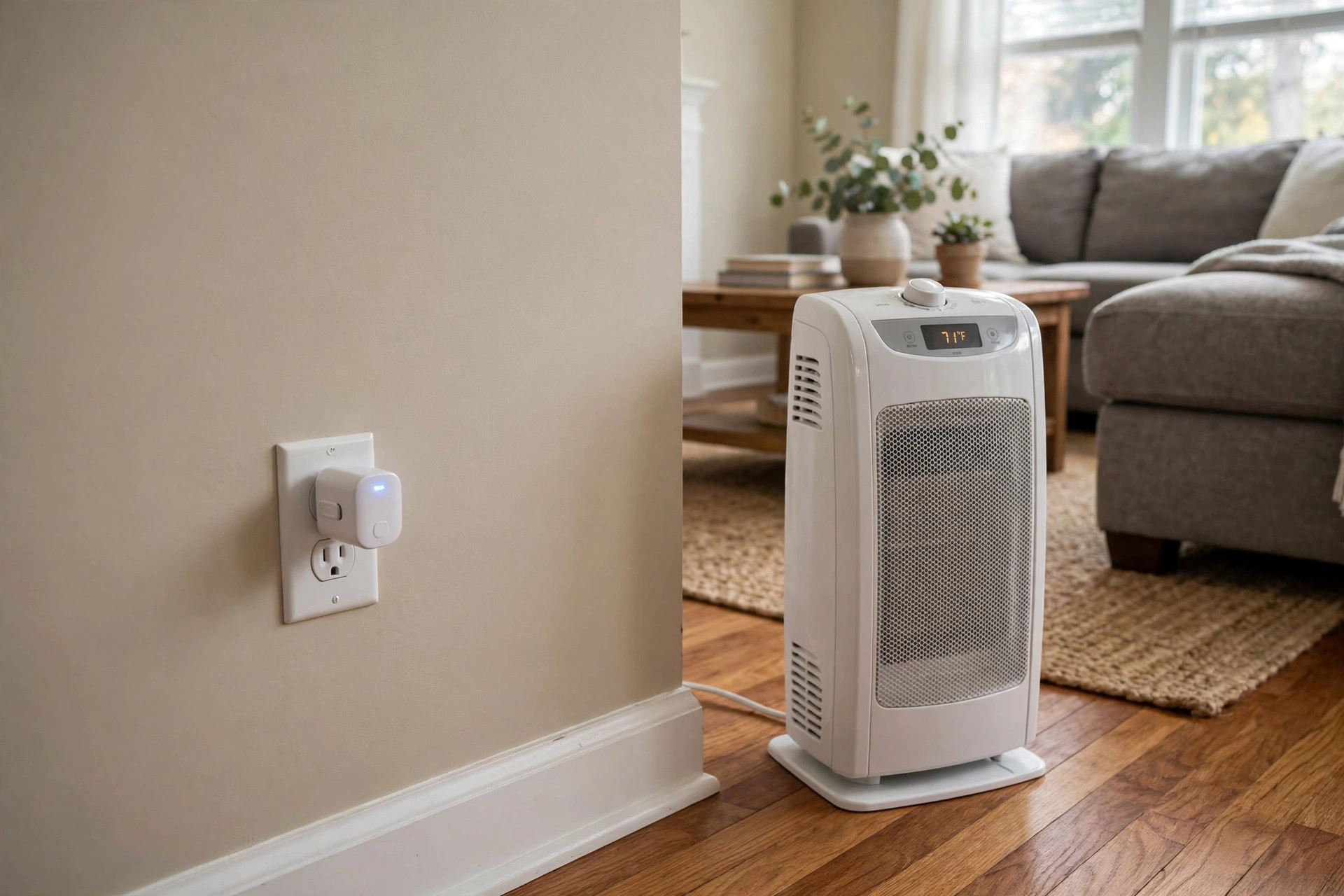
A smart plug is a small block that sits between the wall outlet and the cord of the heater. It joins your home Wi-Fi network. An app on your phone sends it commands. Most plugs also work with voice helpers such as the ones described on Google Store, so you can say a simple command to switch the heater on or off.
Inside the plug there is a small relay. The relay is the switch. When the app tells the plug to turn off, the relay opens and power stops. Some plugs also have an energy meter that reports watts in the app. If you use a smart plug for a 1500 watt heater, that meter tells you what the heater really costs you each night.
The Main Safety Issue: Power Rating
Not every smart plug can run a space heater. This is the single most important fact in any review. Most space heaters in the United States draw 1,500 watts on their high setting. That is close to the limit of a standard 15-amp home circuit.
A common smart plug is rated for 10 amps or about 1,200 watts. Plug a 1,500-watt heater into it, and the plug may overheat. The plastic may melt. In the worst case, it can catch fire. Real user reviews mention this problem again and again. Many one-star reviews describe a melted plug.
A safe plug must be rated for at least 15 amps and 1,800 watts. Some heavy-duty plugs go to 20 amps. Reviews praise plugs that state their rating in bold letters on the box and that carry a UL or ETL mark. Consumer Reports has long urged buyers to check these marks on any device that carries heavy current, and smart plugs are no exception.
The federal safety agency also posts clear guidance on portable heater use. The pages on CPSC remind owners to keep heaters away from curtains and bedding and to plug heaters directly into a wall outlet when possible.
What Safety Reviews Cover
Good reviews test more than the on-off switch. Here is what careful reviewers look at:
– The rated amps and watts printed on the plug. – Whether the plug has a safety certification such as UL or ETL. – Whether the case stays cool after one hour with a 1,500-watt load. – Whether the app offers a timer, a countdown, and an auto-off rule. – Whether the plug reports power use in watts or kilowatt-hours. – Whether the Wi-Fi connection is steady and the plug does not drop off the network.
Sites such as CNET and PCMag test smart home gear in lab settings and publish how devices behave under load. Their reviews often note when a plug runs warm, which is a warning sign with heaters.
Types and Options
Most smart plugs for heater duty fall into a few groups.
Standard Wi-Fi plugs. These join the home network directly. No hub is needed. They are cheap and easy. But most standard plugs top out at 10 or 12 amps, so they are not fit for a full-size heater. They work fine for lamps and fans.
Heavy-duty smart plugs. These are built for high loads, often 15 amps and 1,800 watts. The case is larger, and the contacts are thicker. Reviews favor these for space heaters, window air conditioners, and dehumidifiers. They cost more, but the margin of safety is worth it.
Plugs with energy monitoring. Some heavy-duty plugs add a power meter. You can see the live watt draw in the app. This helps you confirm that the heater runs at the wattage you expect. Many reviewers call this the most useful feature of all.
Zigbee and Z-Wave plugs. These use a hub instead of Wi-Fi. They can be very steady, but you need the hub. For heater duty, a Zigbee or Z-Wave plug still needs the same 15-amp rating.
Timer plugs with auto-off. A few plugs let you set a rule that always turns the heater off after a fixed time, no matter what. Reviewers like this because it protects against a forgotten command.
For a related guide on keeping the rest of the home safe, see how to secure smart home devices and our article on /how-to-secure-smart-home-devices-usa-guide/.
How to Choose: A Simple Checklist
Use this checklist before you buy.
1. Check the amp and watt rating. It must be at least 15 amps and 1,800 watts. 2. Look for a UL or ETL mark on the plug and the box. 3. Choose a plug with a timer and an auto-off rule. 4. Prefer a model with energy monitoring if you want to track cost. 5. Make sure it works with your phone and your voice helper. 6. Read real reviews that mention a space heater by name, not just lamps.
Note one more point. Some heater makers say in their manuals that the heater must plug straight into the wall. If your heater’s manual says that, follow it. Safety guides on The Verge and ADT also stress that fire risk falls when the heater has clear space and a direct outlet.
Cost and Price
Prices vary with rating and features. A basic Wi-Fi plug costs a few dollars. A heavy-duty 15-amp plug with energy monitoring often costs three to five times more. That extra cost pays for thicker parts and a bigger safety margin.
Running cost matters too. A 1,500-watt heater run for four hours a night uses about 6 kilowatt-hours. At a common United States rate, that is near one dollar per night. An energy-monitoring plug shows this number in the app, and many users cut their run time once they see it.
Also compare before you buy. Our article on /best-smart-light-switch-no-neutral-usa/ explains how to read smart home specs, which helps when you compare plug ratings side by side.
Care and Upkeep
A smart plug needs little care, but a plug that serves a heater needs attention. Once a month, pull the plug and look at the prongs. If they are dark or pitted, replace the plug. Feel the case after an hour of heater use. It may be warm, but it should never be hot. Check that the Wi-Fi app still reaches the plug. Update the firmware when the app offers it.
Keep the outlet clean and tight. A loose outlet makes any plug run hotter. If the outlet is loose, have an electrician replace it. Never stack a smart plug on top of a power strip for a heater. The heater’s cord should be short and direct. Home security guides from Ring and SimpliSafe note that tidy, direct wiring lowers fire risk across the home.
Safety Rules That Matter Most
Read these rules and follow all of them.
– Only use a smart plug rated 15 amps and 1,800 watts or more. – Only buy plugs with a UL or ETL safety mark. – Plug the smart plug into the wall outlet. Do not use extension cords or power strips. – Keep the heater three feet from beds, curtains, and paper. – Use the timer or auto-off rule every time. Never trust memory alone. – Turn the heater off when you leave the house or go to sleep, unless the model is made for that use. – Test the plug at the heater’s low setting first, then watch it at high.
Federal safety advice from CPSC repeats the three-foot rule and warns against cords under rugs. Those basics matter more than any smart feature.
FAQ
Can any smart plug run a space heater? No. Most smart plugs are rated for 10 amps or less. A space heater needs a plug rated for at least 15 amps and 1,800 watts with a UL or ETL mark.
Is it safe to leave a smart plug heater on while I am away? It is safer than leaving a heater on with no control, because you can shut it off by app. But heaters still need clear space and a direct wall outlet. Many safety guides say to turn heaters off when no one is home.
Do smart plugs lower the power bill? They can. A timer keeps the heater from running all night. Energy monitoring shows the real cost, which helps you trim run time.
What does auto shut off mean on a smart plug? It means the plug turns itself off after a set time or when it sees too much current. This is a good backup for a heater.
Can I use a smart plug with a power strip for my heater? No. Do not plug a heater, or a smart plug that serves a heater, into a power strip or an extension cord. Use the wall outlet.
Why do some reviews show melted plugs? The buyers used a plug rated below the heater’s draw. A 1,500-watt heater needs a plug rated for at least 1,800 watts. The wrong plug overheats.
For outdoor gear with similar safety concerns, see our article on /best-solar-security-camera-reviews-2026-usa/.
A Short Final Word
A smart plug can make a space heater safer and easier to run. The key is the rating. Buy a heavy-duty plug with a 15-amp rating, a safety mark, a timer, and auto-off. Keep the heater clear of soft goods, use the wall outlet, and check the plug now and then. Read reviews that test with real heaters at full power. Reviews that only test lamps tell you nothing about heat. With those steps, you get the warmth you want and the peace of mind you paid for.
References
ADT. (n.d.). Home security and automation. https://www.adt.com CNET. (n.d.). Technology news and reviews. https://www.cnet.com Consumer Reports. (n.d.). Product reviews and ratings. https://www.consumerreports.org Google Store. (n.d.). Smart home devices. https://store.google.com PCMag. (n.d.). Technology product reviews. https://www.pcmag.com Ring. (n.d.). Smart home security devices. https://www.ring.com SimpliSafe. (n.d.). Home security systems. https://www.simplisafe.com The Verge. (n.d.). Technology news and reviews. https://www.theverge.com U.S. Consumer Product Safety Commission. (n.d.). Product safety information. https://www.cpsc.gov
Was this guide helpful?

About Lisa Anderson
The My Garden US editorial team writes practical, in-depth home and garden guides for American homeowners — tested advice, no fluff.