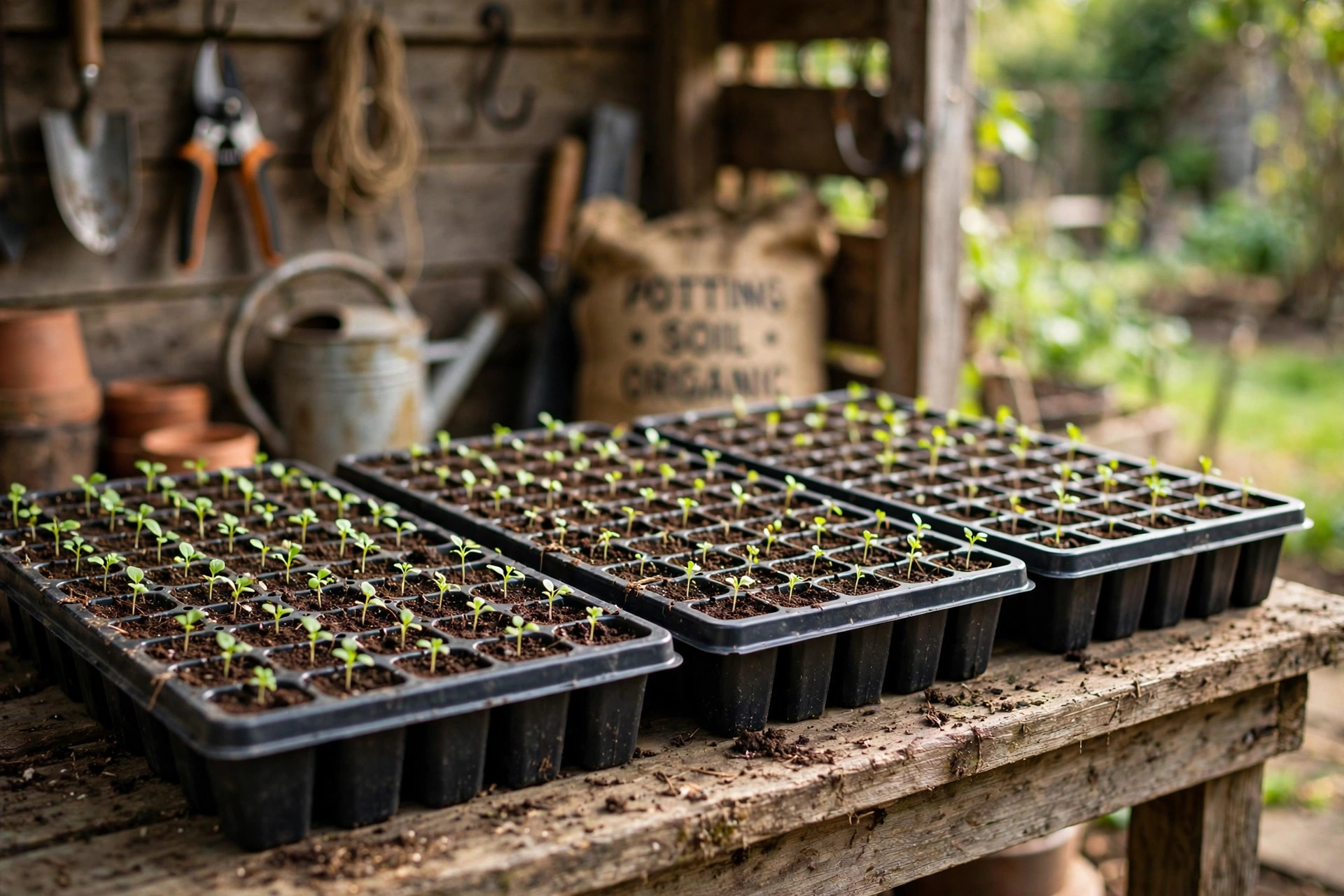

A good seedling starts long before it reaches the garden. It starts in the tray. The right tray holds moist soil, gives roots room to grow, and lets you move young plants without harm. This seed starting trays buying guide usa walks you through the choices in plain terms, so you can buy with confidence and start seeds that grow strong.
Why Seed Starting Trays Matter
Many gardeners sow seeds straight into the ground. That works for beans and squash. For tomatoes, peppers, and many flowers, indoor starts give better results. A tray keeps each seedling in its own pocket of soil. The roots grow down, not sideways. You can water each cell, watch each plant, and pick out the weak ones.
Trays also stretch your season. You can start peppers in March on a warm windowsill and set them out after the last frost. You can start fall greens in July in a cool basement. Without trays, you would wait for the weather. With them, you set the schedule. Seed companies such as Park Seed publish sowing calendars that help you count back from your last frost date.
A cheap tray can undo all this good work. Thin cells crack when you lift them. Poor drainage drowns the roots. Oversized cells waste soil mix. The rest of this guide shows what to look for, what types exist, what they cost, and how to keep them safe and clean.
How to Choose the Right Trays: Seed Starting Trays Buying Guide Usa
Cell Size and Depth
Cell size is the first choice. Small cells, about one inch square, suit lettuce, basil, and most flowers. They use little soil and fit many plants on one heat mat. Medium cells, about two inches square, suit tomatoes, peppers, and marigolds. Large cells, three inches or more, suit melons, squash, and any plant that grows fast roots.
Depth matters as much as width. Deep cells, often called root trainers, suit plants with long taproots such as sweet peas and delphinium. Shallow cells suit quick crops such as lettuce. Match the cell to the plant. A tomato in a one-inch cell will be root-bound in four weeks. A lettuce in a four-inch pot wastes soil and water.
Think about how long the seedling will stay in the tray. Tomatoes may stay indoors six to eight weeks. They need a two-inch cell at least. Herbs bound for a small pot can start in a one-inch cell. Plan backward from transplant day.
Tray Material and Strength
Most trays are plastic. The range runs from flimsy film plastic to heavy-duty polystyrene. Film plastic trays cost little and may last one season. They bend, crack, and twist. Polystyrene trays are rigid and can last ten years or more. They cost more up front but cost less per season.
Check the tray thickness before you buy. Press the corner with your thumb. If it flexes like paper, it will not survive full trays of wet soil. Good trays feel firm. They also stack neatly without locking together so hard that you cannot pull them apart.
Some gardeners prefer trays free of certain plastics. Food-grade polypropylene and HDPE are common and sturdy choices. A few brands sell plant-based or compostable trays. These break down in the soil or the compost pile. They are fine for one season but do not store well.
Drainage and Humidity Domes
Every cell needs a drain hole. Standing water rots seeds and breeds mold. If a tray has no holes, you must add them with a hot nail or a drill. Check the product photo or the label. Holes at each cell corner drain best.
A matching bottom tray with no holes catches the runoff. It also lets you bottom-water. Bottom watering draws moisture up through the soil and keeps the surface dry. Dry surfaces mean less mold. Many starter kits pair a cell tray with a solid base tray and a clear humidity dome.
Humidity domes hold warm, moist air over new seeds. Seeds sprout faster under a dome. But a dome left on too long invites damp air and fungal disease. Lift the dome once half the seeds have sprouted. Vent it daily. The Old Farmer’s Almanac offers The Old Farmer’s Almanac that help you time sowing so seedlings spend less time under domes and more time in good light.
Types of Seed Starting Trays
Standard Plastic Cell Trays
The classic choice is a 10-by-20-inch tray with 72, 50, 36, or 24 cells. The 72-cell tray suits flowers and small herbs. The 50-cell and 36-cell trays suit vegetables with medium roots. The 24-cell tray suits large seeds and fast growers. These trays fit standard heat mats and standard shelves. They are the workhorse of indoor seed starting.
Look for inserts that lift out of the base tray. Some brands sell the cell insert and the base tray as a set. Others sell them apart. Buy them as a set the first time. You will need both.
Soil Blockers and Compressed Peat Options
Some gardeners skip plastic cells and press soil into blocks. A soil blocker is a metal tool that forms neat cubes of damp soil mix. The seedling grows in the cube, and you set the whole cube into the ground. No plastic waste. No root shock. Blocks need practice to pack right, and the tool costs more than a tray.
Compressed peat pellets are another option. These dry discs swell in water and hold one seed each. They sit in a tray with low sides. Roots grow through the mesh and into the soil at transplant time. They are simple and clean. They dry out fast, so check them twice a day. Www.gurneys.com and other seed houses sell these pellets as seed-starting supplies alongside their seed lines.
Peat Pots and Self-Watering Trays
Peat pots hold soil and break down in the ground. You plant the whole pot. Roots pass through the walls. They suit plants that hate root disturbance, such as cucumbers and melons. Peat pots dry out quickly at the rim, so keep them moist and tear off any rim that sticks above the soil line. Our related peat pots seedlings buying guide covers these in more depth.
Self-watering trays use a wick or a capillary mat to pull water up from a reservoir. They keep soil evenly moist and cut daily watering chores. They cost more and need occasional cleaning to stop algae. They suit busy gardeners and office growers.
Cost and Price
Prices vary by material and size. A basic 72-cell film tray with dome and base may cost four to eight dollars. A heavy-duty polystyrene tray set may cost twelve to twenty dollars. Soil blockers run twenty to sixty dollars depending on size. Peat pellets cost a few dollars per dozen. Self-watering kits run fifteen to forty dollars.
Do the math over five years. A five-dollar tray that lasts one season costs five dollars a year. A sixteen-dollar tray that lasts ten seasons costs less than two dollars a year. Heavy-duty trays also hold their shape, which makes transplanting easier. If you plan to start seeds every spring, buy the stronger tray.
Watch for false savings. A large pack of ultra-thin trays may look like a deal. If half of them crack at planting time, the deal fades. Read reviews that mention a full season of use, not just first impressions.
Care and Upkeep
Clean trays between uses. Old soil can carry damping-off fungi and other diseases. Knock out loose soil. Soak the trays in warm water with a mild soap or a dilute bleach solution, about one part bleach to nine parts water. Rinse well and let them dry in the sun. Sunlight adds extra disinfection. Www.thespruce.com has practical guides on The Spruce that walk through each step.
Store trays out of the sun when the season ends. Ultraviolet light breaks plastic down over time. Stack them in a shed or garage. Slip a sheet of newspaper between stacked trays if they stick together.
Check your trays each spring before sowing. Toss any with cracks in the cells or broken corners. A cracked cell dries out faster than its neighbors and gives you uneven seedlings.
Label every tray. A strip of masking tape and a marker will do. Write the plant name and the sowing date. You will forget which tray holds which variety by week three. Trust the label.
Safety
Seed starting is safe work, but a few points deserve care. Wash your hands after handling soil mix. Some mixes contain perlite dust, which irritates the lungs, so open bags outdoors or wear a dust mask. Keep soil mix and fertilizer pellets away from small children and pets.
If you use a heat mat, follow the cord safety rules. Keep cords away from water trays. Use a ground-fault outlet near any sink. Unplug mats when you leave town. The U.S. Consumer Product Safety Commission sets cord and heating standards for home products, and federal research through Www.nifa.usda.gov supports National Institute of Food and Agriculture on safe home gardening practices.
Grow lights run many hours a day. Mount them firm so they cannot fall onto trays. Let bulbs cool before you touch them. Keep lights a few inches above seedlings and raise them as plants grow.
Frequently Asked Questions
How many seeds should I sow per cell?
Sow two seeds per cell for most vegetables and flowers. Thin to the strongest seedling after sprouting. Snip the weaker one at the soil line with small scissors. Pulling can disturb the roots of the one you keep. For expensive seed, sow one per cell and accept a few empty cells.
When should I remove the humidity dome?
Remove the dome when about half the seeds have sprouted, usually three to ten days after sowing. Seedlings need fresh air to grow sturdy stems. If you leave the dome on, stems grow tall and weak and mold may form. Crack the dome open for a day first, then lift it off. Www.gardeningknowhow.com explains Gardening Know How and why air flow matters so much at this stage.
What soil mix should I use in seed trays?
Use a fine seed-starting mix, not garden soil and not heavy potting soil. Seed-starting mix is light, holds moisture, and drains well. Garden soil may carry weed seeds and disease. Moisten the mix before you fill the cells. It should feel like a wrung-out sponge.
Can I reuse seed starting trays?
Yes, if you clean them well. Heavy-duty trays can serve for many seasons. Wash out old soil, disinfect with a mild bleach soak, rinse, and dry in the sun. Thin film trays often crack after one season and are better recycled. Never reuse a tray that held a diseased plant without a full disinfection.
Do I need a heat mat?
Heat mats help warm-season crops such as peppers, tomatoes, and eggplant. These seeds sprout best at 75 to 85 degrees. Cool-season crops such as lettuce and spinach sprout fine at room temperature. A mat speeds sprouting but is not required. Remove seedlings from the mat once they sprout and give them light instead.
How do I harden off seedlings before transplanting?
Hardening off moves plants from indoor comfort to outdoor weather in steps. Set trays outside in shade for two hours on day one. Add an hour or two each day and move them into morning sun. After seven to ten days, they can stay out overnight if no frost threatens. Www.whiteflowerfarm.com offers clear White Flower Farm for moving young plants outdoors without shock.
A Short Final Word
The best tray is the one that fits your plants, your space, and your budget. Start with a sturdy 10-by-20 set, a base tray, and a dome. Learn what your seedlings need. Then add specialty trays as your garden grows. Strong starts make strong gardens.
If you are choosing what to sow first, our heirloom vegetable seeds buying guide can help you pick varieties, and our lavender seed packets buying guide is a good read for fragrant flower starts. For signs of Www.provenwinners.com, the growing notes from Www.monrovia.com on choosing strong nursery stock are worth a look before you shop seed starting trays for sale usa listings.
References
Gardening Know How. (n.d.). Gardening guides and plant care. https://www.gardeningknowhow.com Gurney’s Seed & Nursery Co. (n.d.). Seeds, plants, and garden supplies. https://www.gurneys.com Monrovia. (n.d.). Plants for home gardens. https://www.monrovia.com National Institute of Food and Agriculture. (n.d.). Agricultural research and extension. https://www.nifa.usda.gov Park Seed. (n.d.). Seeds, plants, and gardening supplies. https://www.parkseed.com Proven Winners. (n.d.). Plants and gardening inspiration. https://www.provenwinners.com The Old Farmer’s Almanac. (n.d.). Gardening calendars and advice. https://www.almanac.com The Spruce. (n.d.). Home and garden advice. https://www.thespruce.com White Flower Farm. (n.d.). Plants, bulbs, and garden supplies. https://www.whiteflowerfarm.com Www. (n.d.). Home and garden information. https://www
Was this guide helpful?

About Jennifer Lee
The My Garden US editorial team writes practical, in-depth home and garden guides for American homeowners — tested advice, no fluff.
You May Also Like
Sunflower Seed Packs: Where to Buy in the USA
August 31, 2026 0 views
Garlic Bulbs Planting California Homes USA: A Plain Guide
August 22, 2026 0 views
Monstera Plants Sale Deals Near Me: How to Find Healthy Plants at Fair Prices
August 7, 2026 0 views