
Every spring, gardeners across the USA face the same question. Should they start onions from seed, or should they plant sets? This onion sets planting reviews buying guide usa is written to answer that question in plain words. It covers what onion sets are, how to choose the right kind, what prices to expect, and how to plant them for a full harvest.
An onion set is a small, partly grown onion bulb. It was grown from seed the year before, dried, and put aside. When you plant it, it wakes up and grows into a full onion in one season. Many gardeners like sets because they are easy. They grow fast. They often beat weeds. They give a crop you can count on.
Why Onion Sets Matter for the Home Garden
Growing onions from seed is slow. Seeds need an early start indoors. They need light, warmth, and care for weeks before they go outside. Many home gardeners do not have the time or the room for that. Onion sets solve this problem. You buy a bag of small bulbs. You press them into the soil. You water them. Nature does the rest.
Sets also suit short growing seasons. In the north of the USA, summer is brief. Sets get a head start because they are already half grown. They use the short summer well and still make full onions.
Another point is ease for new gardeners. A new gardener can plant heirloom vegetable seeds one year and feel unsure. The next year, onion sets bring quick success. Green shoots come up in days. That early win keeps a new gardener going, much like a first try with heirloom vegetable seeds.
Reviews from gardeners often praise sets for one more reason. Sets are less fussy about soil warmth than seeds. You can plant them as soon as the ground can be worked.
What Onion Sets Are and How They Work: Onion Sets Planting Reviews Buying Guide Usa
An onion set is about the size of a marble. Some are smaller, like a hazelnut. Some are larger. The size matters, and this buying guide will explain why in a later section.
Inside each set is stored food. When soil warms up, the set sends out roots. Then it sends up green leaves. Each leaf feeds one ring of the final onion bulb. More leaves mean a larger onion.
Sets come in three colors. Yellow sets make yellow onions. White sets make white onions. Red sets make red onions. The color tells you what you will harvest. Yellow onions store best. White onions are mild and good for fresh use. Red onions are crisp and bright in salads.
Most sets sold in the USA are grown in the northern states. They are cured and dried after harvest. Then they are sorted by size and packed in mesh bags. A good bag feels dry. The bulbs are firm. They have papery skins.
How to Choose Onion Sets: What to Look For
Reviews of onion sets often come down to three things: size, firmness, and variety name. Look at each before you buy.
First, size. Choose sets about the size of a marble, roughly three quarters of an inch across. Sets that are too large may go to seed too fast. They throw up a flower stalk instead of a bulb. Sets that are too small may not have enough stored food. They can fail in cold spring soil.
Second, firmness. Pick up a few sets from the bag. They should feel hard and dry. Soft sets may be rotting. Sets with green shoots already growing are fine if the shoot is short. Long, pale shoots mean the bag sat in warmth too long.
Good sets are sold by variety, not just by color. Names like Stuttgarter, Walla Walla, Red Creole, and Copra tell you what to expect. If the bag says only “yellow onion sets,” you are buying blind. Named varieties have known traits. You know how they store. You know how big they grow.
Also check the count. Bags usually hold about one pound or about fifty to one hundred sets. For a family garden, one or two pounds is plenty.
Buying in the store has one advantage. You can touch and see. Buying onion sets online in the USA has another. Online sellers often list the exact variety and give growing notes. Burpee and Park Seed Company both sell named onion sets with clear variety notes. Gardeners in rural areas, far from a good garden center, often find online buying the best path.
Types of Onion Sets: Long Day, Short Day, and Intermediate
This is the most important part of the guide. Onions form bulbs based on day length. Pick the wrong type for your state, and your harvest will fail.
Long day onions need fourteen to sixteen hours of daylight to form bulbs. They suit the northern USA. States from Ohio to Washington do best with long day types. Common long day sets include Stuttgarter, Walla Walla, and Yellow Sweet Spanish.
Short day onions need only ten to twelve hours of daylight. They suit the southern USA. Texas, Florida, and southern California do best with short day types. Common short day sets include Texas Grano, Red Creole, and Bermuda.
Intermediate onions, sometimes called day neutral, need twelve to fourteen hours. They suit the middle states. Kansas, Kentucky, and Virginia do well with intermediate types.
Many bad onion sets planting reviews come from this one error. A gardener in Maine buys short day sets from a national catalog. The bulbs never form. The gardener blames the sets. The true fault was the wrong type for the latitude.
Before you buy, know your zone. The Old Farmer’s Almanac publishes planting calendars by region. The National Institute of Food and Agriculture also shares research on regional growing. Use these tools. Match the set to your day length first. Everything else comes second.
Cost and Price: What Gardeners in the USA Pay
Onion sets are one of the cheapest crops a gardener can grow. That is part of their charm.
In garden centers, a one-pound bag of sets usually costs between four and eight dollars. Prices run higher in big cities and lower in farm country. Mail order sets cost a bit more per pound because of shipping. Two pounds by mail may run twelve to eighteen dollars with postage.
Bulk buying helps. Some growers sell five or ten pound bags. A ten pound bag can plant a large garden for about twenty-five dollars. If you share with neighbors, the cost per person drops low.
Watch for false savings. Very cheap sets in torn bags, stored warm by a store heater, often fail. Spend a dollar or two more for firm, cool stored sets. The harvest pays the difference many times over.
How to Plant Onion Sets Step by Step
Planting onion sets is simple work. Follow these steps in order.
Pick your spot. Onions need full sun. Choose a bed that gets six or more hours of direct sun each day. Do not plant onions where onions grew last year. Move them to a fresh bed to avoid disease.
Prepare the soil. Onions like loose soil that drains well. Work the bed with a fork or tiller to a depth of six inches. Mix in compost. A two inch layer of compost, worked in, feeds the young plants. Avoid fresh manure. It can burn roots.
Time it right. Plant sets in early spring, as soon as the soil can be worked. In the south, that may be February. In the north, it may be late April. The soil should be at least forty degrees. Sets can take light frost. They cannot take waterlogged frozen ground.
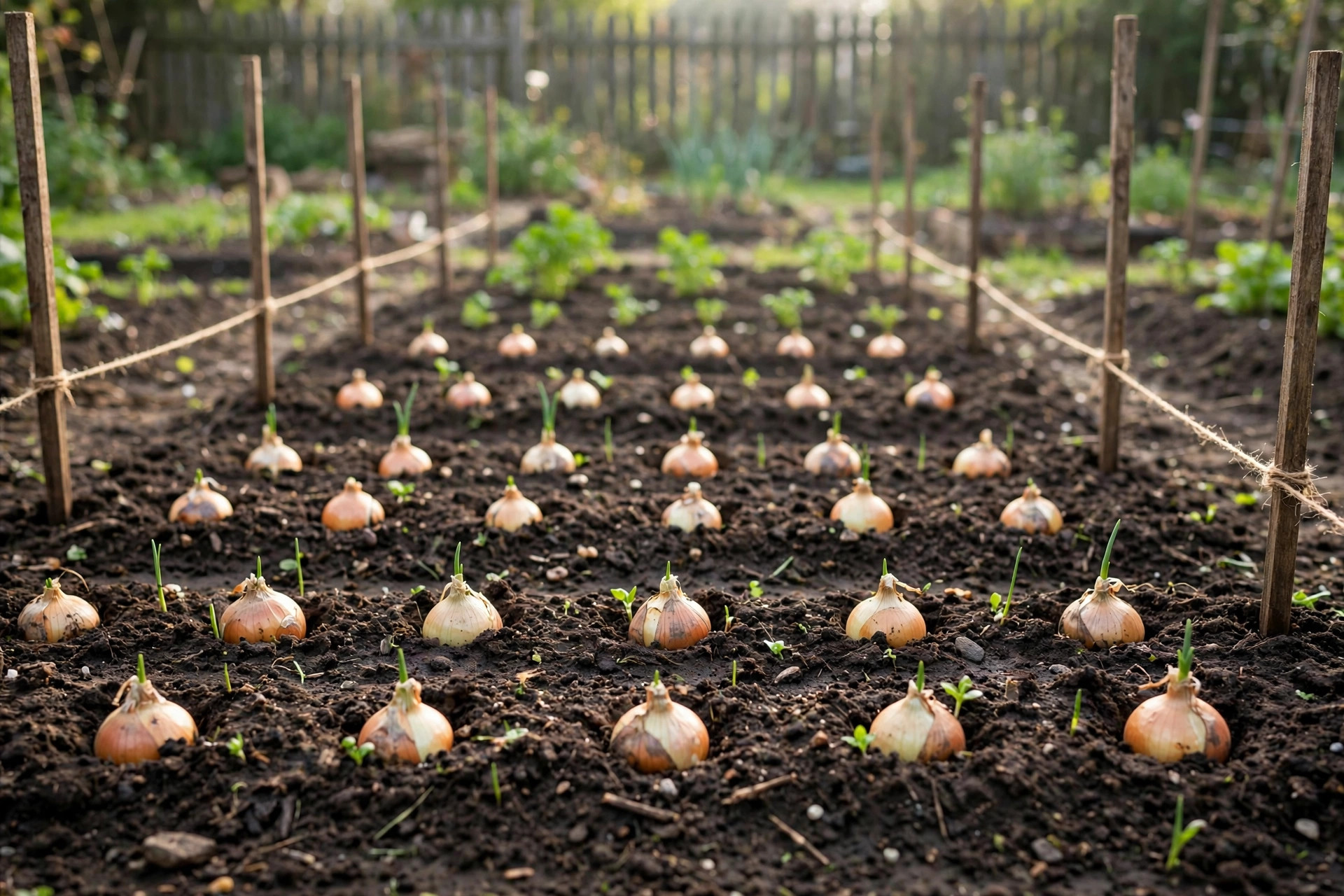
Set the depth. Push each set into the soil so the tip just shows above the surface. The pointed end goes up. The flat root end goes down. Plant them about one inch deep. In sandy soil, go a little deeper. In heavy clay, keep them shallow.
Space them well. For large bulbs, space sets four to six inches apart. For green onions, plant them closer, about two inches apart, and pull every other one early. Rows should be twelve to eighteen inches apart. This gives room for hoeing.
Water at once. After planting, water the row well. This settles the soil around each set. Keep the soil moist, not soaked, for the first two weeks.
Mulch lightly. A thin layer of straw mulch, about two inches, keeps weeds down and holds moisture. Keep the mulch a little away from the necks of the plants. Wet necks can rot.
Gardeners who follow these steps usually see green tips in seven to ten days. The Gardening Know How site and The Spruce both carry step by step planting notes for new growers.
Care and Upkeep After Planting
Once sets sprout, care is steady but light. Water is the main need. Onions have shallow roots. They dry out fast. Give them about one inch of water per week. In hot spells, water more. Stop watering when the tops start to fall over. That means the bulbs are finishing.
Feed them once or twice. A side dressing of balanced fertilizer, about three weeks after planting, helps leaf growth. Do not feed late in the season. Late feeding keeps tops green too long and hurts storage.
Weed often but shallowly. Hoe or pull weeds by hand. Do not dig deep. Onion roots sit near the surface. Deep hoeing cuts them and slows the plant. The thin straw mulch from planting time does much of the work for you.
Watch for pests. Onion maggots are small white worms that eat roots. Covering the row with a light fabric row cover keeps the flies that lay the eggs away. Thrips are tiny insects that silver the leaves. A strong spray of water knocks many of them off.
Watch for disease. Pink root and white rot show in wet soils. Good drainage and crop rotation are the best defense. Do not plant onions in the same bed more than once every three or four years.
Harvest comes when tops fall. When half the tops have flopped over, stop watering. Wait a week. Then lift the bulbs with a fork. Let them cure in the sun for a few days, then in a dry airy spot for two weeks. Good curing makes onions store for months. Yellow varieties like Stuttgarter often keep until spring in a cool dry cellar.
Safety in the Garden
Onion sets are safe to handle. They are not toxic to people. Wash your hands after planting, as with all garden work. Soil can carry bacteria.
Fertilizers need care. Read the label on any fertilizer you use. Wear gloves. Keep bags away from children and pets. Do not use more than the label says. Extra fertilizer does not help and can pollute runoff.
Tools need care too. A garden fork and a hoe are simple, but they can cut. Store them with tines down or hung on a wall. Keep small children away from sharp tools.
Sun and heat matter. Spring planting days can turn warm fast. Drink water. Wear a hat. Take breaks in the shade. Gardening should not make you ill.
If you buy wildflower seed mixes or dahlia bulbs in bulk for the same bed borders, keep labels. Labels tell you what you planted where. They also warn about any seed treatments. Some bulk bulbs carry fungicide dust. Wash hands after handling them.
Frequently Asked Questions
How many onion sets do I need for a family of four?
One to two pounds of sets is enough for most families. That plants twenty to forty feet of row. A good harvest from that much can fill a pantry shelf for months.
Can I plant onion sets in containers?
Yes. Use a pot at least eight inches deep with drainage holes. Fill it with good potting soil. Space sets three inches apart. Water more often than in the ground, since pots dry fast. White Flower Farm and Monrovia both share container growing tips for small space gardeners.
Why did my onion sets grow flower stalks instead of bulbs?
The sets were likely too large, or they faced a cold snap after warm growth. Large sets are more prone to bolting. Buy marble sized sets. If a stalk appears, snap it off at once. The bulb will still form, though it may be smaller.
Are onion sets better than onion plants or seeds?
Each has a place. Sets are easiest and fastest. Seeds give the widest choice of varieties and cost least. Onion plants, sold as bundles of small transplants, sit in the middle. For new gardeners, sets win on ease. Gurney’s sells all three forms, so you can compare them side by side.
When should I stop watering my onions?
Stop when the tops begin to fall over on their own. This usually happens in mid to late summer. Watering after that point can cause rot and hurts storage life. Let the bed dry as the bulbs cure in the ground.
How long do home grown onions keep in storage?
Well cured yellow onions keep three to six months in a cool, dry, dark place. Red onions keep two to three months. White onions keep one to two months and are best eaten fresh. Check stored onions every few weeks and use any soft ones first.
A Short Final Word
Onion sets remain one of the most rewarding buys in the garden center. They cost little. They ask for simple care. They pay back in crisp, full onions by midsummer. Choose the right day length type for your state. Buy firm, marble sized sets of a named variety. Plant early, water well, and weed shallowly.
Read a few onion sets planting reviews before you buy, but trust your own garden most. Soil, sun, and timing differ from yard to yard.
References
Burpee. (n.d.). Seeds, plants, and gardening supplies. https://www.burpee.com Gardening Know How. (n.d.). Gardening guides and plant care. https://www.gardeningknowhow.com Gurney’s Seed & Nursery Co. (n.d.). Seeds, plants, and garden supplies. https://www.gurneys.com Monrovia. (n.d.). Plants for home gardens. https://www.monrovia.com National Institute of Food and Agriculture. (n.d.). Agricultural research and extension. https://www.nifa.usda.gov Park Seed. (n.d.). Seeds, plants, and gardening supplies. https://www.parkseed.com The Old Farmer’s Almanac. (n.d.). Gardening calendars and advice. https://www.almanac.com The Spruce. (n.d.). Home and garden advice. https://www.thespruce.com White Flower Farm. (n.d.). Plants, bulbs, and garden supplies. https://www.whiteflowerfarm.com
Was this guide helpful?

About David Wilson
The My Garden US editorial team writes practical, in-depth home and garden guides for American homeowners — tested advice, no fluff.
You May Also Like

Organic Herb Seeds Deals Near Me: A Simple Guide for American Gardeners
February 17, 2026 0 views
Fiddle Leaf Figs Reviews Buying Guide USA
September 16, 2026 0 views
Wildflower Seed Mixes Deals Near Me: A Practical Buyer’s Guide
January 5, 2026 0 views