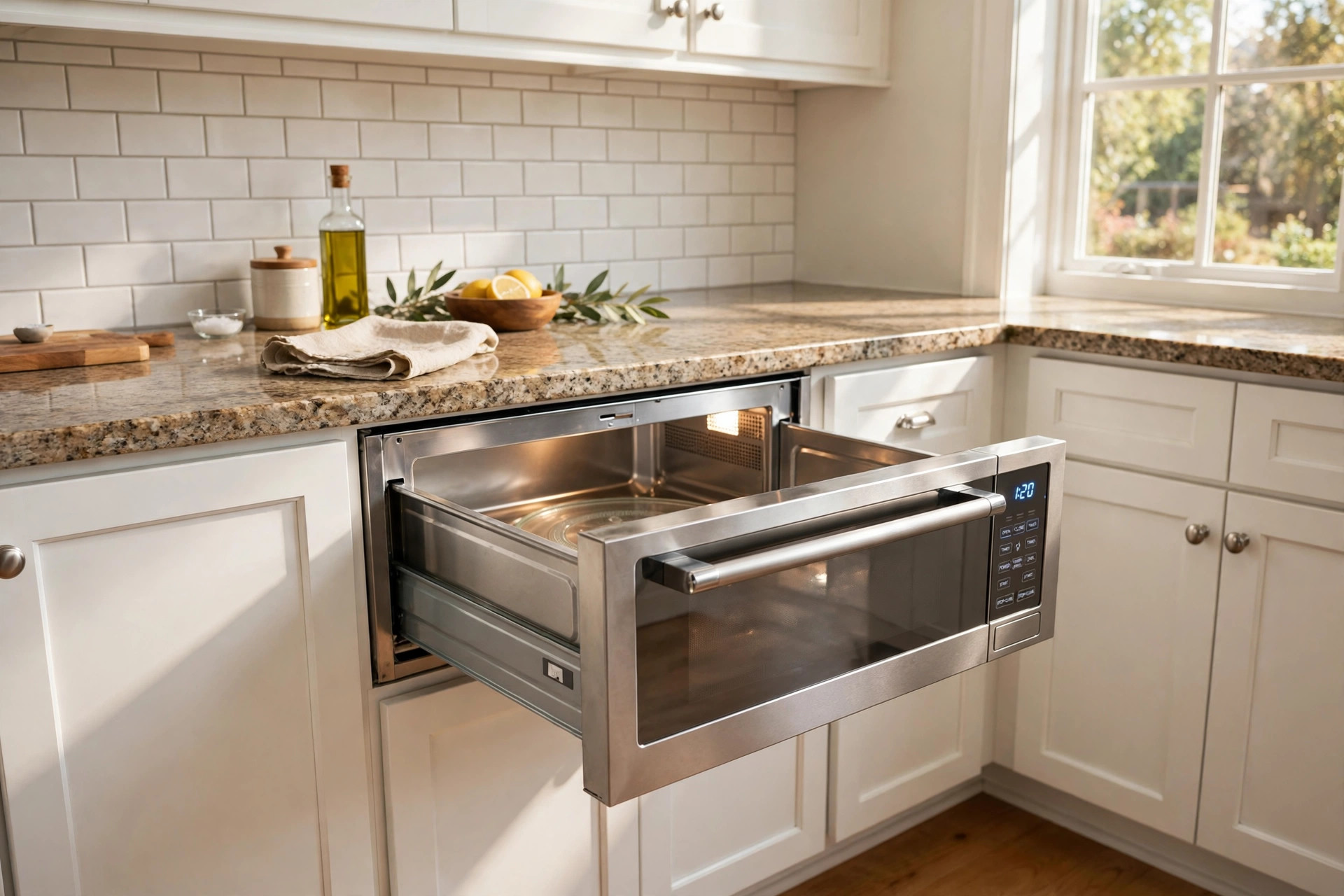

Kitchen design in America changed a great deal over the past forty years. Appliances once sat on the counter or hung over the range. Today many home owners want them hidden, built in, and easy to reach. The microwave drawer grew out of this trend. It looks like an ordinary cabinet drawer, but it pulls open to reveal a microwave oven. When shoppers search for microwave drawer units for sale USA, they find a product that blends function with clean cabinet lines.
This guide explains what these units are, why they sell well, and what to check before you buy. It covers sizes, features, prices, installation, care, and safety. The goal is plain advice in plain words, so you can compare models with confidence.
Why Microwave Drawer Units Matter
A standard microwave hangs above the stove or takes up a foot of counter space. Both spots have problems. An over-range unit sits high, and short adults or children must reach up to use it. A countertop unit eats space that could hold a cutting board or a coffee maker. The drawer microwave solves both problems at once. It mounts under the counter, where it stays out of the way and within easy reach.
Many buyers first notice the look. With the drawer closed, the kitchen shows only a smooth steel or black glass panel that matches the cabinets. The counter above stays clear. Designers like this because the eye sees long, calm lines instead of a bulky box. Home owners who remodel for resale like it too, since buyers notice the clean result at once.
There is also a safety gain. Lifting a hot bowl from a high microwave causes spills. Burns happen most often when the dish sits above chest level. A drawer opens at waist height. The cook slides the dish out toward the body instead of lifting it down. Older adults and children find this easier. Consumer Reports tests appliances for real-world use, and its buying guides note that undercounter placement can reduce strain for many users.
The market reflects this appeal. Drawer microwaves are no longer rare. Major brands sell them at large retailers across the country, and Home Depot and Lowes stock several models. Prices have fallen from the early days. That wider choice is why searches for microwave drawer units for sale USA keep growing.
What to Look For When You Buy: Microwave Drawer Units for Sale Usa
Start with size. Most microwave drawers measure 24 inches or 30 inches wide. The 24-inch width fits a standard base cabinet. The 30-inch width gives more room inside and suits a wide island. Measure your cabinet opening first, not the whole cabinet. Leave room for air flow around the unit, as the manual requires. A tape measure and the maker’s cutout drawing are all you need for this step.
Check interior capacity next. Drawer microwaves hold less than big countertop models. A common size is 1.2 cubic feet. That fits a dinner plate, a soup bowl, or a coffee mug, but not a large casserole dish. Think about the dishes you use most and match them to the interior size.
Power matters too. Drawer microwaves run from about 950 to 1200 watts. Higher wattage heats faster and more evenly. Most home models sit near 950 watts, which is enough for daily tasks like warming leftovers, melting butter, and heating drinks. Energy Star offers tips on efficient appliance use, and its guides help buyers compare how standby and cooking power affect home energy bills.
Look at the controls. Most drawers use a touch panel on the front face. Some angle the panel up so it is easy to read from above. Look for a sensor reheat button, which adjusts time on its own. A keep-warm setting helps when dinner runs late. Child lock buttons matter in homes with small children.
Finish options deserve thought. Stainless steel matches most kitchens. Black stainless hides fingerprints better. Some makers sell panel-ready units that accept a cabinet front, so the drawer vanishes into the woodwork. Pick the finish when you shop, because it cannot be changed later.
Types and Options
Standard 24-Inch Drawers
The 24-inch drawer is the most common size. It fits in a base cabinet like the ones under a counter or in a kitchen island. This size suits most homes. It gives enough room for plates and bowls without wasting space. Most microwave drawers for kitchen islands in the USA use this width, since islands often hold the main prep area.
Wide 30-Inch Drawers
The 30-inch drawer holds more. It accepts larger plates and taller mugs. Cooks who warm big serving dishes will like it. The price runs higher, and the cabinet cutout is wider. Check that your cabinet maker can frame the opening before you order.
Undercounter Versus Built-In Wall Mount
Drawer microwaves install below the counter. Some owners instead place a built-in microwave in a tall wall oven cabinet. Both hide the appliance. The drawer costs less and reaches easier. The wall unit keeps the base cabinets free. Your kitchen layout decides which is better. Islands and peninsulas suit drawers well, while a tall bank of ovens suits wall mounts.
Brand and Feature Levels
Entry models heat food and little more. Mid-range models add sensor cooking, melt and soften presets, and a keep-warm mode. Top models add flush installation and quieter fans. Review sites like Bob Vila and The Spruce compare features across brands and price bands.
Panel-Ready and Trim Options
Some units accept a custom wood front. This lets the drawer match cabinets exactly. Others ship with a trim kit that frames the unit in steel. Decide on the look before the cabinets are ordered, since the cutout size differs slightly between standard and panel-ready models.
Cost and Price
A new microwave drawer costs more than a countertop unit. Expect to pay from about 900 dollars to 1,800 dollars for the appliance itself. Entry models from store brands sit at the low end. Premium models with sensor features and flush mounts sit at the high end. Sales around major holidays often cut 10 to 20 percent from the list price, so timing your purchase can help.
Installation adds to the cost. A simple swap into an existing cabinet may cost 150 to 300 dollars for an electrician or handyman. A new cutout in finished cabinets costs more, often 300 to 600 dollars, because the carpenter must frame the opening and match the finish. If the cabinet needs a new outlet on its own circuit, add that cost too.
Delivery and haul-away fees add another 50 to 150 dollars at most large stores. Some retailers bundle delivery, installation, and old appliance removal for one price. Ask for the full quote in writing before you sign. When you compare microwave drawer units for sale USA, compare the total cost, not just the tag price.
If you plan a full kitchen remodel, pair your research on appliances with research on storage. Many buyers who choose a drawer microwave also read kitchen pantry cabinets reviews buying guide usa to plan cabinet fronts that match, and check stainless range hoods reviews buying guide usa when they want all the steel in the kitchen to look the same.
Installation and Fit
Good installation starts with the cutout drawing. The maker prints exact width, height, and depth numbers. Give these to your cabinet maker before the cabinets are built. The drawer needs a dedicated electrical outlet, usually a 120-volt grounded outlet on a 15-amp circuit. It should sit in the cabinet bay behind the unit.
Air flow is critical. The unit needs clear space on all sides, as the manual states. Blocked vents cause heat buildup and can shorten the life of the appliance. Do not pack insulation or store boxes tight against the sides.
Level the unit when you set it. A drawer that tilts will not open and close with a smooth feel. Most models have leveling legs for this. After the unit is level, check that the drawer front lines up with the cabinet doors around it. Small shims fix small gaps.
An electrician should make the final connection if a new circuit is needed. Local codes vary by state and city. A permit may be required when new wiring runs through walls. This Old House covers remodel codes and cabinet fitting in plain terms, and helps home owners talk with contractors about local rules.
If you place the drawer in an island, think about traffic. The open drawer needs about 15 inches of clear floor space in front. Keep it away from the main walk path if you can. Near the prep sink is ideal, since cooks move dishes between the two.
Care and Upkeep
Daily care is simple. Wipe spills with a damp cloth soon after they happen. Food that bakes on is harder to remove. A mild dish soap and water clean most messes. Do not use steel wool or harsh powders on the interior or the front panel, since they scratch the finish.
The drawer slides on rails. Keep the rails clean. Crumbs and grit in the track make the drawer feel rough. Vacuum the track edge now and then and wipe it with a dry cloth. A drop of food-safe lubricant on the rails once a year keeps the motion smooth, but check the manual first, since some makers advise against it.
Clean the touch panel with a soft cloth. Spray cleaner on the cloth, not on the panel. Liquid that seeps behind the buttons can harm the electronics. The vent at the front or back of the unit needs dusting a few times a year. Dust on the vent forces the fan to work harder. Once a year, check the drawer seal for cracks or loose spots. If the drawer does not close flat, call for service.
Safety
Microwave drawers are safe when used as directed. The low mounting height cuts the risk of spills from lifting hot food. Still, follow the basic rules. Use only microwave-safe dishes. Glass, ceramic, and labeled plastic are fine. Never put metal, foil, or dishes with gold trim inside. Metal can spark and harm the unit.
Keep the vents clear. The unit must breathe. Do not drape towels over the front or stack boxes against the sides. Heat buildup shortens the life of the electronics and can be a fire risk in rare cases.
Use the child lock. The controls sit at a height small children can reach. The lock stops curious fingers from starting the unit or opening it during cooking. Teach children that the drawer is hot after use, just like an oven.
When the unit needs service, call a trained technician. Microwave repairs involve high voltage parts that hold a charge even when unplugged. This is not a do-it-yourself job. Unplug the unit and stop using it if it sparks, smells of burning, or runs with the drawer open.
Frequently Asked Questions
Can a microwave drawer replace a regular microwave?
Yes. It does the same job: reheating, defrosting, and simple cooking. The interior is smaller than a large countertop model, so very large dishes may not fit. For most daily tasks it works the same or better, since the low height makes loading easy.
Do microwave drawers need special cabinets?
They need a base cabinet cut to the right size. Standard base cabinets accept 24-inch models with a simple cutout. The maker supplies the exact cutout drawing. A cabinet maker or skilled carpenter can frame the opening. The cabinet must be deep enough for the unit plus the power cord.
Are drawer microwaves hard to repair?
They are less common than standard models, so parts can cost more and take longer to arrive. Many repairs are still simple, such as a new touch panel or a door switch. Buy from a brand with a strong service network in your area. Keep the warranty papers in a safe place.
Can you install a microwave drawer in an island?
Yes, and the island is one of the best spots for it. The drawer sits near the prep area, where cooks need it most. The island cabinet must have the right cutout and a dedicated outlet. Plan the island wiring early in the remodel, since adding circuits later costs more.
How long do microwave drawer units last?
Most last eight to twelve years with normal care. Good air flow, gentle use of the drawer rails, and quick cleanup of spills all help. Units that run daily in large families may wear sooner. A longer warranty on the magnetron signals maker confidence in the core part.
Do they use more power than countertop models?
No. Power use depends on wattage, not on the shape of the unit. A 950-watt drawer uses about the same energy as a 950-watt countertop model.
A Short Final Word
A microwave drawer is a quiet upgrade. It clears the counter, keeps hot food at a safe height, and gives the kitchen a built-in look that buyers notice. It costs more than a countertop unit and needs a proper cabinet cutout, but for many kitchens the trade is worth it.
Shop with a tape measure, read the cutout drawing, and compare total costs with installation. Check the warranty and the service network. When you browse microwave drawer units for sale USA, you now know what the numbers mean and what questions to ask. That knowledge turns a confusing purchase into a simple one.
If you are planning a wider kitchen upgrade, it helps to study the big appliances too. Many home owners compare notes in french door refrigerators texas homes usa when they want the whole kitchen to match, and they read buying guides for ovens, hoods, and storage before they sign any order.
See Whirlpool for more detail.
References
Bob Vila. (n.d.). Home improvement advice. https://www.bobvila.com Consumer Reports. (n.d.). Product reviews and ratings. https://www.consumerreports.org ENERGY STAR. (n.d.). Energy efficient products. https://www.energystar.gov Lowe’s. (n.d.). Home improvement products. https://www.lowes.com The Home Depot. (n.d.). Home improvement products. https://www.homedepot.com The Spruce. (n.d.). Home and garden advice. https://www.thespruce.com This Old House. (n.d.). Home renovation guidance. https://www.thisoldhouse.com Whirlpool. (n.d.). Home appliances. https://www.whirlpool.com
Was this guide helpful?

About Sarah Mitchell
The My Garden US editorial team writes practical, in-depth home and garden guides for American homeowners — tested advice, no fluff.
You May Also Like

Under Sink Filters Texas Homes USA: A Plain Guide for Cleaner Tap Water
May 10, 2026 0 views
Dishwasher Third Rack American Homes Guide
January 22, 2026 0 views
Microwave Drawer Units: Where to Buy in the USA
July 26, 2026 0 views