A well planned kitchen starts with small details. This luxury spice rack organizers buying guide looks at one of the most useful details of all: where and how your spices live. A good spice rack keeps every jar visible, every label easy to read, and every seasoning close to the stove or the prep counter. A fine one is built from solid wood, heavy metal, or tempered glass. It fits the cabinet or the countertop as if it were made for it.
Many cooks buy spices and then lose track of them. Jars roll in drawers. Labels fade or peel. A luxury rack solves these problems with careful design: tiered shelves that tilt jars toward you, rotating bases that turn with a light touch, and drawer inserts shaped to hold each jar in place.
Why a Luxury Spice Rack Organizer Matters
Spices are among the most used items in any kitchen and among the hardest to keep in order. The average home cook keeps twenty to forty jars. Without a system, the jars drift. They end up in different cabinets or pushed behind taller bottles. The result is waste. Old spices get bought twice. Fresh spices go stale because they cannot be found in time.
Order changes all of this. When every jar has a home, you can see at a glance what is low and what has expired. Spices keep their strength best in dark, cool, airtight storage, and a well built rack helps with all three. Drawer inserts and closed cabinets shield jars from light. Glass jars with tight seals keep air out and flavor in.
There is also the matter of how a kitchen feels. A rack made of solid walnut or brushed brass looks like furniture, not like clutter. It makes the kitchen calmer to work in and nicer to show. A guide to kitchen cabinet organizers for American homes can help you plan the rest of the cabinet at the same time, so the spice rack fits into a larger system.
What to Look for When Choosing a Luxury Spice Rack: Luxury Spice Rack Organizers Buying Guide
Material and Build Quality
Fine racks are made of fine materials. Solid hardwoods such as walnut, oak, cherry, and acacia are the classic choice. They are strong, heavy, and warm to the eye. They can be oiled and refinished, so they age well instead of wearing out.
Metal racks have a different feel. Brushed stainless steel and matte black steel suit modern kitchens. Brass and copper finishes add warmth. Look for real metal, not thin sheet painted to look like metal. Real metal has weight and will not bend under a full load of jars.
Glass and acrylic racks are light and simple. They let you see through the rack, which keeps the countertop looking open. Many of the best designs mix materials: a walnut frame with brass rods, or a steel body with walnut shelves.
Size and Capacity
Count your jars before you shop. A small rack holds twelve to sixteen jars. A medium one holds twenty-four to thirty-six. Large racks hold fifty or more. Plan for a little growth. Most cooks add new spices over the years, and a rack that is full on day one will be crowded by year two.
Measure the space where the rack will go. For a cabinet, measure height, width, and depth with the door closed. For a drawer insert, measure the inside of the drawer. Write the numbers down and carry them with you. A rack that is half an inch too tall is no use at all.
Jar size matters too. Standard spice jars hold two to four ounces and stand about four to five inches tall. Make sure the rack fits the jars you already own, or plan to buy new jars as part of the project. Many fine racks are sold with their own matching jars and labels, which gives the whole set a finished look.
Style and Mounting Type
Spice racks come in five main mounting styles, and the right one depends on your kitchen and your habits.
Countertop racks stand on the counter. They keep spices at hand during cooking. Tiered designs tilt the jars toward you so labels are easy to read. Rotating carousels turn with a light spin.
Drawer inserts sit inside a kitchen drawer. They hold jars flat or slightly tilted, labels up. They keep the counter clear and protect spices from light.
Cabinet-mounted racks screw to the inside of a cabinet door or stand on a cabinet shelf. Door-mounted racks use space that would otherwise be wasted. Pull-down shelves bring high cabinets within reach. Pull-out shelves slide forward so nothing is lost in the back.
Wall-mounted racks hang on the wall or on a rail. They free the counter and the cabinet both. Magnetic racks hold metal-lid jars to a wall board. Wall mounting turns the spice collection into a visible part of the kitchen design.
In-drawer turntables are a hybrid: a small rotating tray that sits in a drawer. They suit medium collections and shallow drawers.
Think about how you cook. If you season by feel at the stove, a countertop rack near the range is best. If you plan meals at the counter and like a clear workspace, a drawer insert may suit you better.
Labeling and Visibility
The point of a rack is to see and reach every jar at once. Look for designs that show every label. Tiered shelves, tilted inserts, and rotating bases all serve this goal. Uniform jars help too. When all jars are the same shape and size, the rack looks neat and the labels line up.
Good labels are worth the small effort. Chalkboard labels, printed vinyl labels, and engraved lids all read well. Put the name of the spice on the top or the front, where the eye falls first. A fine rack with unlabeled jars is only half finished.
Types of Luxury Spice Rack Organizers
Solid Wood Tiered Racks
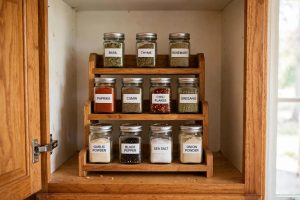
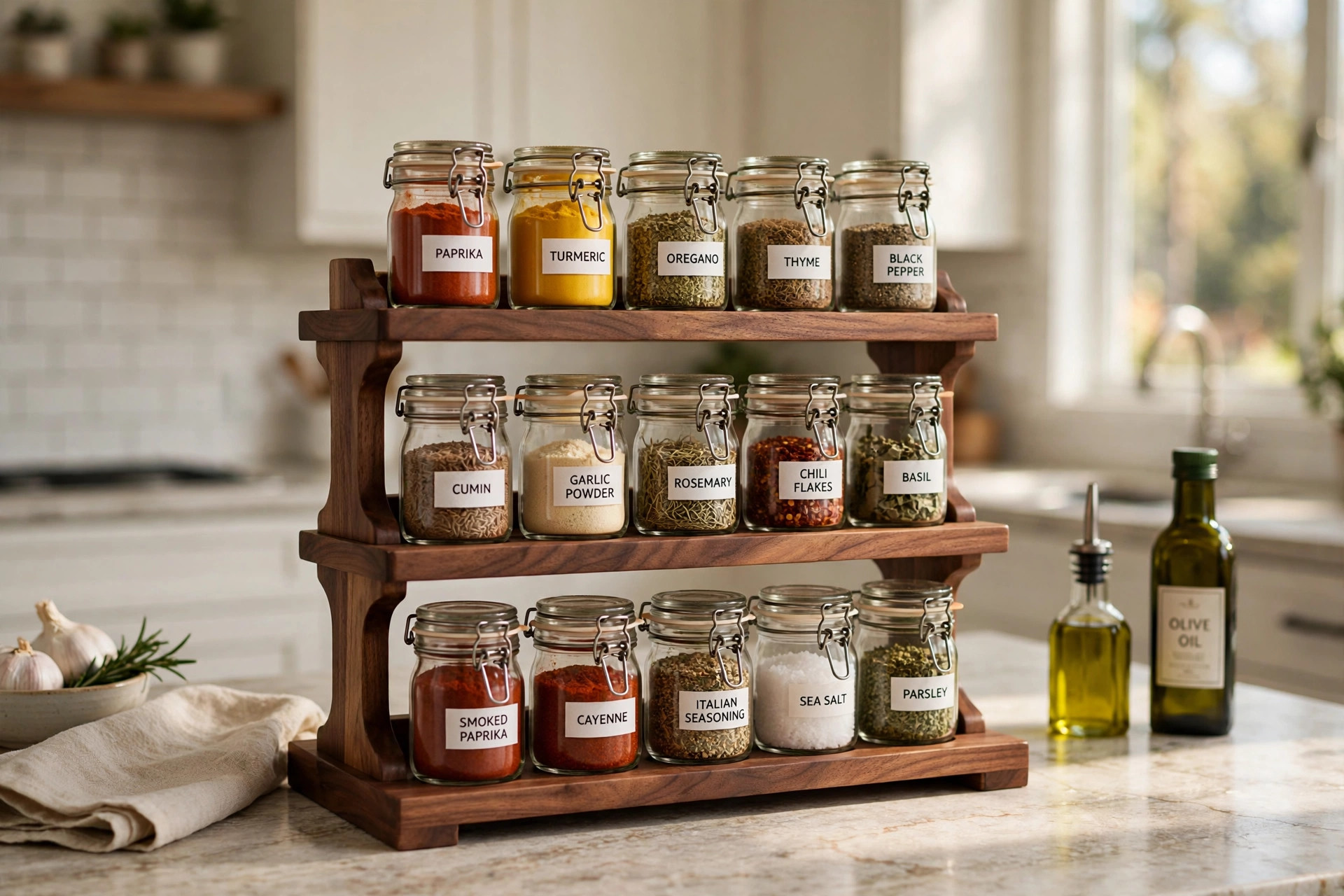
These are the workhorses of the luxury class. Three or four steps of solid wood, each step holding a row of jars tilted slightly toward the cook. Walnut is the most prized wood for this style, with oak and cherry close behind. Prices reflect the joinery: dovetail corners and a smooth oil finish cost more than glued boards, and they are worth it. A good wood rack will outlast two or three sets of jars.
Rotating Carousels
A carousel spins on a central bearing. The best ones spin with one finger and stop where you leave them. Look for a heavy base that will not tip and a smooth bearing that will not grind. Wood and steel carousels suit larger kitchens. Slim acrylic carousels suit small counters.
Drawer Inserts
Inserts are trays that fit inside a drawer and hold jars in rows. Solid wood inserts hold jars at a fixed angle. Adjustable inserts use dividers that move to fit different jar sizes. Measure twice: drawer interiors vary, and a quarter inch of error can keep an insert from sitting flat.
Pull-Out Cabinet Shelves
These mount on runners inside a cabinet and slide out toward you. They bring the back of the cabinet to the front, which ends the problem of lost jars. The best runners are full-extension steel slides rated for the weight of a full load.
Wall-Mounted and Magnetic Racks
Wall racks turn storage into display. Walnut rails with brass hooks, steel boards with magnetic jars, and floating shelves all have their place. Magnetic racks are the most fun: jars stick to the board and lift off with a gentle pull. Use them with small jars and mount them where they will not be bumped.
Matching Jar Sets
Some luxury racks come as full sets: the rack plus matching glass jars, airtight lids, and printed labels. Check that the jars are real glass with tight seals and that the labels cover the spices you actually use.
Cost and Price Ranges
Luxury spice racks cost more than basic ones, and the price reflects material, joinery, and finish. A fair guide to the market looks like this:
Under fifty dollars. Simple racks in pine, bamboo, or powder-coated steel. Serviceable and neat, but rarely heirloom quality. Labels and jars are often sold separately.
Fifty to one hundred fifty dollars. The heart of the luxury market. Solid hardwood tiered racks, smooth-spinning carousels, and fitted drawer inserts in walnut or maple. Most buyers find their rack in this range.
One hundred fifty to three hundred dollars. Large racks, full jar sets with labels, pull-out cabinet systems with soft-close slides, and custom-sized inserts. These are investment pieces for serious kitchens.
Above three hundred dollars. Custom-built or made-to-order racks, matched to a cabinet or a kitchen design. Handmade joinery, rare woods, and built-in lighting. Worth it for a kitchen you plan to keep for many years.
Jars and labels add to the cost if they are not included. A set of twenty-four good glass jars with airtight lids runs twenty to forty dollars. Printed labels run ten to twenty dollars.
Care and Upkeep
A fine rack needs only simple care. Dust it with a soft cloth once a week. Wipe wood with a damp cloth and dry it at once. Oil solid wood once or twice a year with food-safe mineral oil to keep it from drying out. Wipe steel and brass with a soft dry cloth. Use a mild soap on sticky spots, then dry well.
Keep spices fresh with a simple routine. Write the purchase date on each jar when you refill it. Ground spices keep their strength for about a year. Whole spices last two to three years. When a spice loses its smell, replace it. Store the rack away from the stove if you can. Heat and steam wear spices down fast.
Refill from bulk bags rather than buying new jars each time. It costs less and keeps the set looking uniform. A small funnel makes refilling clean and quick. If a jar cracks or a lid stops sealing, replace it at once.
Safety
Spice racks are simple things, but a few safety points are worth noting. Mount wall racks and cabinet-door racks with screws long enough to bite into the stud or the solid part of the door. A full rack of glass jars is heavy, and a weak mount can pull free. Test the mount by loading the rack fully before you trust it.
Keep glass jars away from the edge of high shelves. In earthquake country, use a low rail or a lip on open shelves so jars cannot walk off during a shake.
Keep the rack away from open flame and strong heat. Do not store spices on a shelf directly above the stove. The heat bakes the spices, and grease from cooking coats the jars and the rack.
Frequently Asked Questions
How many spice jars should a luxury rack hold? Count what you own, then add room for a quarter more. Most home cooks are well served by a rack that holds twenty-four to thirty-six jars. A rack that is slightly too big is better than one that is slightly too small.
Is a drawer insert or a countertop rack better? Drawer inserts keep the counter clear and protect spices from light, which is best for freshness. Countertop racks keep spices at hand while you cook, which is best for speed. A stackable bathroom vanity organizer guide uses the same thinking for another busy part of the home.
What is the best wood for a spice rack? Walnut, oak, cherry, and maple are all fine choices. Walnut is the most prized for its deep color and grain. Oak is the hardest wearing. All four take oil finishes well and will last for decades with simple care.
Should I buy a rack with jars included? A matching set is the easiest path to a finished look. Check three things: the jars are real glass with airtight lids, the labels cover the spices you actually use, and the jar size matches your buying habits.
How do I keep spices fresh in an open rack? Use airtight jars, keep the rack out of direct sun and away from the stove, and buy in quantities you will use within a year. A basket-style approach to pantry order, like the one in this wicker storage basket guide, applies here too: group by use and label everything.
Can I install a pull-out spice shelf myself? Most pull-out kits are made for home installation with a screwdriver, a drill, and a level. Read the weight rating and measure the cabinet first. If the design needs cutting or there is plumbing in the way, call a carpenter.
A Short Final Word
A luxury spice rack is a small purchase that pays back every day. It saves time while you cook. It saves money by cutting waste. It keeps spices fresher, and it makes the kitchen a calmer place to work. Choose solid materials, measure your space, count your jars, and buy a little more capacity than you think you need. Then label every jar and enjoy a kitchen where everything has its place. For more help planning the rest of your storage, trusted home stores and design guides are a good next stop: browse ideas at IKEA, The Container Store, Wayfair, and The Home Depot, compare designs at Lowe’s, read project guides at Family Handyman and The Spruce, see small-space ideas at Apartment Therapy, and check test ratings at Consumer Reports. For recipes that put your organized spices to work, The Spruce Eats offers thousands of tested dishes.
References
Apartment Therapy. (n.d.). Home design ideas and inspiration. https://www.apartmenttherapy.com Consumer Reports. (n.d.). Product reviews and ratings. https://www.consumerreports.org Family Handyman. (n.d.). DIY home repair and maintenance. https://www.familyhandyman.com IKEA. (n.d.). Home furnishings. https://www.ikea.com Lowe’s. (n.d.). Home improvement products. https://www.lowes.com The Container Store. (n.d.). Storage and organization products. https://www.containerstore.com The Home Depot. (n.d.). Home improvement products. https://www.homedepot.com The Spruce. (n.d.). Home and garden advice. https://www.thespruce.com The Spruce Eats. (n.d.). Recipes and cooking guides. https://www.thespruceeats.com Wayfair. (n.d.). Furniture and home goods. https://www.wayfair.com
Was this guide helpful?

About David Wilson
The My Garden US editorial team writes practical, in-depth home and garden guides for American homeowners — tested advice, no fluff.