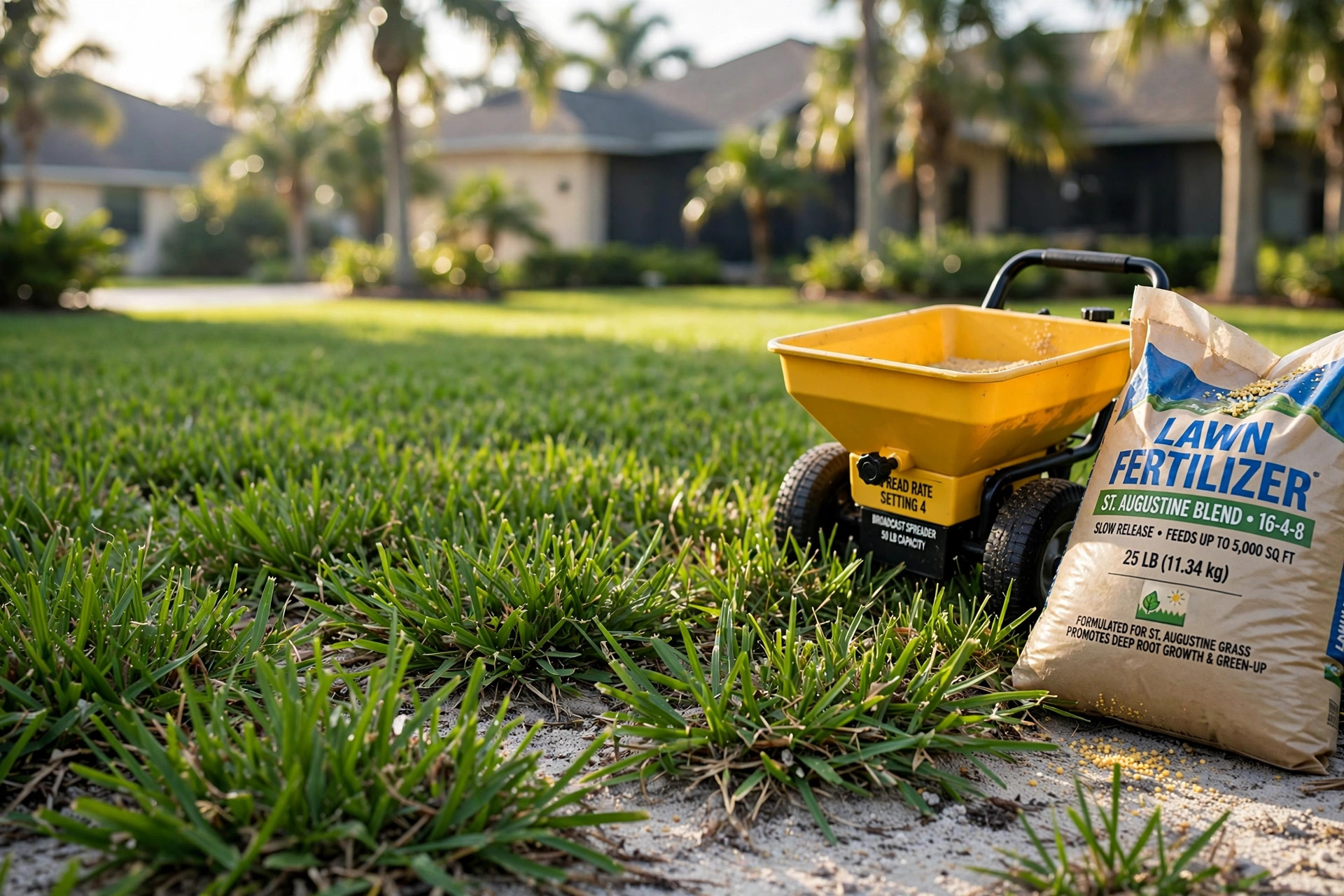

Florida soil and grass do not act like soil and grass in most other states. Much of the state sits on sand. Water drains through it fast. Food for plants drains out with the water. That is why lawn fertilizer for sandy soil florida is its own subject. A bag that works well in Ohio may give poor results here. The rules are different. The timing is different. The amounts are different. This guide sets out the plain facts. It covers why Florida sand needs a special plan, how to pick a product, what the choices are, what it costs, and how to stay safe.
Why Sandy Soil in Florida Needs a Different Plan
Florida sand holds very little water and very few nutrients. Rain falls hard in summer. It washes through the root zone in hours. In a clay soil up north, a nutrient can sit near the roots for weeks. In Florida sand, the same nutrient may be gone in days. That is the first fact a homeowner must accept. Heavy feeding once a season does not work. Light feeding, given often, works better.
The grass itself is different too. Most Florida lawns are St. Augustine grass, with some bahia, zoysia, and centipede grass. These are warm-season grasses. They grow from spring through fall and slow down in winter. They want nitrogen most when they are growing fast. Feed them in the warm months. Feed them less, or not at all, when they are quiet in winter.
There is another fact that surprises new residents. Many Florida counties limit when and how much fertilizer you may put on a lawn. Some ban nitrogen and phosphorus during the summer rainy season. The rules protect lakes, rivers, and bays. Fertilizer that runs off a lawn can feed algae in the water. Check your county rule before you buy a bag. The rule is often posted on the county extension office website. This step takes ten minutes. It can save you a fine and it helps keep local water clean.
How to Choose the Right Product: Lawn Fertilizer for Sandy Soil Florida
Start with a soil test. Your county extension office offers low-cost soil testing. You mail in a small sample of soil from your yard. A lab reports the pH and the levels of key nutrients. The report tells you what the soil lacks. This removes guesswork. Without a test, many people buy a fertilizer high in phosphorus. Florida sand is often not short of phosphorus. Adding more does not help the grass. It only raises the risk of runoff.
Read the three numbers on the bag. They show nitrogen, phosphorus, and potassium, in that order. A bag marked 16-4-8 has 16 percent nitrogen, 4 percent phosphorus, and 8 percent potassium. For most Florida lawns, choose a formula with little or no phosphorus unless your soil test says you need it. A common choice is something like 15-0-15 or 16-0-8. The exact numbers matter less than the pattern: good nitrogen, good potassium, little or no phosphorus.
Look for slow-release nitrogen on the label. Slow-release forms include sulfur-coated urea, polymer-coated urea, and methylene urea. The label may say “controlled release” or “slow release.” These forms give the grass small amounts of food over weeks. In sand, that is a real advantage. Quick-release nitrogen can burn the grass and wash away with the next storm. Slow-release costs a bit more per bag. It pays for itself by working longer.
Iron matters too. Many Florida lawns turn yellow even when they get enough nitrogen. The cause is often a lack of available iron, common in sandy and high-pH soil. A lawn fertilizer with iron for greening can fix this fast. Iron greens the blades without pushing fast growth. Read the label for chelated iron. It is easier for the plant to take up in Florida conditions.
Size the bag to your lawn. Measure your yard in square feet. Most product labels state how many square feet one bag covers. Do not guess. A bag bought for 5,000 square feet will underfeed a 10,000 square foot yard. Overlap also wastes product. Many homeowners mark their spreader setting from the label and test it on a driveway first.
Types and Options on the Shelf
Granular Fertilizer
Granular fertilizer is the dry pellet or grain form. You spread it with a broadcast or drop spreader. It is the most common choice for Florida homes. Most slow-release products come in this form. It stores well in a dry shed. It is simple to apply evenly. The main risk is uneven spread, which leaves stripes of dark and light green. Calibrate the spreader. Walk at a steady pace. Overlap passes slightly.
Liquid Fertilizer
Liquid fertilizer comes as a concentrate you mix with water, or as a hose-end bottle that attaches to the garden hose. It works fast. The grass takes it up through the leaves and roots within days. Iron supplements often come in liquid form. The downside is that it fades fast. In sandy soil, a liquid feed may last only two or three weeks. It also demands care. Spray on a calm morning. Rinse the hose and sprayer after use. Do not spray before a heavy rain.
Organic and Natural Options
Organic options include composted manure, feather meal, soybean meal, and blended organic lawn foods. They release nutrients slowly as microbes break them down. They also add organic matter to the sand, which helps it hold a bit more water and food over time. That is a real long-term gain for Florida soil. The trade is speed. Organics green the lawn slowly. They may also cost more per pound of nitrogen. Some homeowners blend organic and synthetic products: organics for steady soil health, synthetics for quick green-up.
Specialty Products for St. Augustine Grass
St. Augustine is the most planted lawn grass in Florida. If your lawn is St. Augustine, look for products aimed at it. The best fertilizer for st augustine grass texas advice from Texas lawn guides carries over well, because both states grow warm-season grasses on lean soil. The core idea is the same: steady nitrogen in the growing season, good potassium for root strength, and iron when the blades look pale. Do not use weed-and-feed products carelessly on St. Augustine. Some herbicide mixes can injure it, especially in heat.
Cost and Price
A typical granular lawn fertilizer for a Florida home costs between fifteen and sixty dollars a bag, depending on size and formula. A 40-pound bag of a basic 16-4-8 may run near the low end. A 50-pound bag of a premium slow-release 15-0-15 runs higher. Slow-release and organic products cost more up front. They need fewer applications, so the yearly cost is often close.
Plan on three to five applications per year for most Florida lawns. The total yearly cost for a do-it-yourself program on a 5,000 square foot lawn often lands between eighty and two hundred dollars. That covers product only. A spreader, if you do not own one, costs thirty to eighty dollars and lasts for years.
Hiring a lawn service changes the math. Professional fertilizing programs in Florida often cost forty to eighty dollars per visit for an average yard, with six or so visits per year. That puts yearly cost near three hundred to five hundred dollars. The service handles timing, calibration, and local rules. For a busy homeowner, that is worth it. For a careful do-it-yourselfer, the product-only cost is far lower.
Care and Upkeep Through the Year
When to Feed
Feed when the grass is actively growing. In most of Florida, that means March through October. A common schedule: first feeding in March or April, second in May or June, third in July or August, and a final light feeding in September or October. Adjust to your county rule. Some counties ban nitrogen from June through September. In those places, shift feedings to spring and fall.
Do not feed dormant grass in deep winter. The plant cannot use the food. It will wash away. A single fall feeding helps the roots store energy for winter. That is enough until spring.
How Much to Use
Most Florida lawns need about one pound of actual nitrogen per 1,000 square feet per feeding. The bag label and a small bit of math give you the product amount. If the bag is 16 percent nitrogen, you need about 6.25 pounds of product per 1,000 square feet to deliver one pound of nitrogen. Many homeowners find a kitchen scale handy for the first try. Mark the spreader setting on the bag with a marker so you do not have to look it up again.
Watering After Feeding
Water lightly after applying granular fertilizer. About a quarter inch of water moves the pellets off the blades and into the soil. It also starts the release process. Do not soak the lawn. Heavy watering right after feeding pushes nutrients below the root zone in sand. If rain is coming within a day or two, you may skip watering and let nature do it. If a hard storm is coming, wait to feed. A washout wastes the product and sends it toward the street drains.
Mowing and Topdressing
Mow high. For St. Augustine, keep blades near three to four inches. Taller grass shades the soil, holds moisture, and grows deeper roots. Leave the clippings on the lawn. They return nitrogen to the soil for free. Over a season, clippings can supply up to a quarter of the lawn’s nitrogen need.
Every year or two, consider topdressing the lawn with good soil. A thin layer of compost or quality topsoil, about a quarter inch, brushed into the grass adds organic matter to the sand. Do this in spring when the grass is growing fast. It pairs well with a feeding. The combination builds a better root zone over time.
Safety for People, Pets, and Water
Keep children and pets off the lawn until the product is watered in and the grass is dry. Read the label for the exact wait time. Store bags in a locked shed or garage, off the floor, away from moisture. A torn bag in a damp garage turns into a hard lump and can spill.
Wear gloves when you spread granular product. Wash your hands after. If you use liquids, wear eye protection. Rinse any skin contact with water. Keep the spreader away from driveways and sidewalks. Sweep stray pellets back onto the grass. Pellets that sit on concrete wash into storm drains with the next rain.
Never spread before a heavy rain. Never spread on a flooded or waterlogged lawn. Keep a ten-foot gap between the spreader and any lake, pond, canal, or ditch. These small habits make a large difference for Florida waterways. Equipment makers like Toro and Briggs & Stratton publish safe-use guides for spreaders and lawn tools that are worth a read. Broader yard equipment guidance is also available from John Deere.
Frequently Asked Questions
How often should I fertilize my lawn in Florida sand?
Three to five times per year works for most lawns. Feed during active growth, roughly March through October. Slow-release products stretch the gap between feedings. Check your county fertilizer rule first, since some counties ban summer feeding.
What is the best fertilizer formula for sandy soil?
Look for a formula with good nitrogen, good potassium, and little or no phosphorus, such as 15-0-15 or 16-0-8, with slow-release nitrogen. Add iron if the grass looks yellow. A soil test from your county extension office will tell you exactly what the soil needs.
Can I use the same fertilizer in Florida that I used up north?
You can, but results will be poor. Northern lawns are cool-season grasses on heavier soil. Florida lawns are warm-season grasses on sand. The timing, the formula, and the release speed all differ. Buy a product meant for warm-season southern lawns.
Why is my Florida lawn yellow after fertilizing?
The likely cause is iron shortage, which is common in sandy soil. Try an iron supplement. Another cause is too much water washing nutrients away. A third cause is mowing too short. Raise the mower deck to three or four inches for St. Augustine grass.
Is granular or liquid fertilizer better for sand?
Granular slow-release fertilizer is the better base program for sandy soil. It lasts longer between feedings. Liquid fertilizer is a good quick fix for pale grass or iron shortage. Many homeowners use both: granular for the season, liquid for touch-ups.
Do I need to water my lawn right after fertilizing?
Water lightly, about a quarter inch, to move granules off the blades. Do not soak the lawn. Heavy watering in sand pushes the food below the roots. If rain is due within a day, you can let the rain do the work, but skip feeding ahead of a hard storm.
A Final Word
Florida sand is a hard place to grow grass, but thousands of homeowners do it well every year. The method is simple. Test the soil. Pick a slow-release formula made for warm-season grass. Feed lightly and often through the warm months. Mow high. Water with care. Keep product out of the street and the water. Follow this plan and the lawn will reward you with steady green color from spring to fall.
References
Briggs & Stratton. (n.d.). Outdoor power equipment and engines. https://www.briggsandstratton.com
Deere & Company. (n.d.). Lawn and garden equipment. https://www.deere.com
Toro. (n.d.). Lawn mowers, irrigation, and outdoor equipment. https://www.toro.com
Was this guide helpful?

About Michael Thompson
The My Garden US editorial team writes practical, in-depth home and garden guides for American homeowners — tested advice, no fluff.
You May Also Like
Best Fertilizer for St Augustine Grass Texas: A Complete Guide
February 17, 2026 0 views
Landscape Design Software for Homeowners: A Plain Guide
September 22, 2026 0 views
How to Choose a Fence Line Trimmer for Steep Slopes
August 14, 2026 0 views