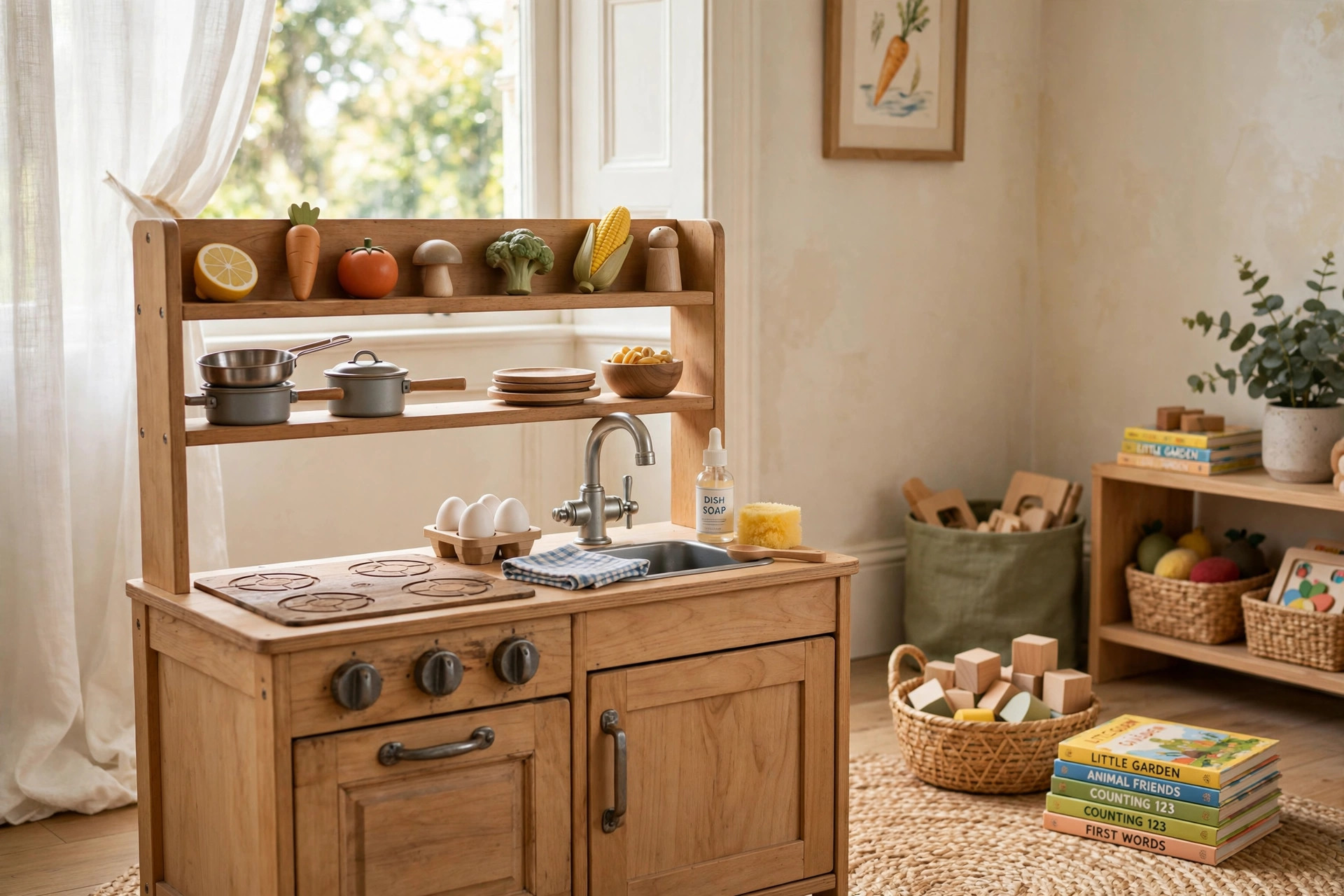

A kids play kitchen set for pretend cooking is one of the most loved toys a family can own. It gives a child a small world of her own. She can stir soup, bake bread, and serve dinner to her dolls. Parents watch and see more than a game. They see a young mind at work. The simple act of pretending to cook teaches words, numbers, and manners. It also gives a child a safe place to copy the adults she loves.
This guide walks through every step. It explains why these sets matter, what to look for in a store, the types on the market, what they cost, and how to keep one in good shape. It also covers safety in plain terms and answers the questions parents ask most.
Why It Matters
A child learns by doing. When she stands at a play stove, she is not only passing the time. She is building skills that will serve her for years.
First, pretend cooking grows language. A child names foods, tools, and actions. She says pot, spoon, stir, pour, bake. She asks a friend, “Do you want tea?” She learns to take turns in talk. These small lines of talk add up. Speech experts have long said that play is the work of childhood. A play kitchen gives that work a stage.
Second, it builds early math. The child counts plates for four guests. She sorts fruit into baskets. She learns big and small, full and empty, more and less. These ideas come long before school math. They come at the stove, with a toy ladle in hand.
Third, it teaches care for others. A child who cooks for her teddy bear is learning to think of someone else. She asks what the bear would like. She serves, shares, and cleans up. Parents who eat the pretend meal and say thank you are teaching manners without a lesson plan.
Finally, a kids play kitchen set for pretend cooking keeps a child busy in a good way. It draws her away from screens. It invites friends and siblings to play together. In a home with a toddler table and chair set for playroom, the kitchen and the table can form one small home where play lasts for hours.
The American Academy of Pediatrics has written for years about the value of free, open play. A play kitchen is one of the purest forms of it. There are no rules to win. There is only making, serving, and starting again.
What to Look For When You Buy: Kids Play Kitchen Set for Pretend Cooking
Stores and sites offer many play kitchens. The choices can be hard to sort. A few clear points will make the task easy.
The Right Size for the Room and the Child
Measure the spot where the set will stand. Most play kitchens are two to four feet wide and three to four feet tall. A corner set fits tight rooms. A long set needs an open wall.
Think of the child too. A two-year-old needs a low stove she can reach. A five-year-old may want a taller set with more parts. Many sets list an age range on the box, such as 3 to 8 years. Trust that range. It comes from testing.
Build Quality That Lasts
A good set feels firm when you press on it. The doors should close flat. The knobs should turn without sticking. Wooden sets are heavy and steady. They cost more, but they can pass from one child to the next. Plastic sets are light and easy to move. They wash fast and suit young toddlers who are rough with toys.
Check how the set joins together. Screws and dowels hold better than thin pegs. If you buy used, sit the set upright and shake it gently. It should not rock.
Features Worth Having
Most sets come with a stove, an oven, a sink, and a fridge. Extras add to the fun. A clicking knob, a light-up burner, or a phone on the wall can charm a child. But do not pay for too many extras. A child will invent her own extras with pots and spoons.
Some sets come with toy food and dishes. These starter sets save a first shopping trip. Others come bare, and the family picks its own pots. Either way is fine.
Materials and Finish
Look for paint that is smooth and free of chips. The box should say the paint is non-toxic and the set meets toy safety rules. Wood should be sanded smooth, with no rough spots on edges. Plastic should be thick enough that it does not bend under a small hand.
Types of Play Kitchen Sets
Play kitchens come in several styles. Each has its fans.
Wooden Play Kitchens
Wooden sets are the classic choice. They look like small real kitchens. They often come in soft white, gray, or natural wood. They weigh more than plastic sets, so they do not tip when a child leans on them. A wooden set can sit in a living room and still look like fine furniture. Many parents say a wooden set is the one toy they are proud to show guests.
Plastic Play Kitchens
Plastic sets are bright and full of sound. They beep, bubble, and sizzle with the push of a button. They are light, so a parent can move one from room to room. They wipe clean with a damp cloth. For a child under three, plastic is often the best pick. It forgives rough play.
Corner and Compact Sets
Not every home has room for a wide set. Corner kitchens use the space where two walls meet. Compact sets put a stove, sink, and fridge into one narrow tower. These fit small flats and shared bedrooms. A compact set pairs well with a kids bookshelf with bins for toy storage beside it, so pots, food, and books all have a home.
Accessory and Add-On Sets
Some families start with a basic kitchen and grow it over time. They add a toy fridge, a washing machine, or a shopping cart. Others buy full food sets: wooden fruit, metal pots, and small aprons. Add-ons make fine gifts for birthdays and holidays. The kitchen grows with the child.
For a full playroom, some parents add a kids teepee tent for indoor playroom decor near the kitchen. The tent becomes the dining room, and the kitchen becomes the place where meals are made. Children move between the two and build whole stories.
Cost and Price
Prices for a kids play kitchen set for pretend cooking vary widely. A small plastic set can cost thirty to sixty dollars. A mid-size set with more parts runs sixty to one hundred and fifty dollars. A large wooden set can cost one hundred and fifty to four hundred dollars or more.
What drives the price? Size, material, and brand. Wood costs more than plastic. Sets with real lights and sounds cost more than plain ones. A well-known name on the box can add to the price.
Shop sales around holidays. Many big stores cut toy prices in November and December. Used sets are a smart buy too. Check local sale groups and second-hand shops. A used wooden set at half price is often a better buy than a new cheap one. Clean it well before the child plays.
Do not forget the cost of extras. Toy food, pots, and dishes can add twenty to fifty dollars. Some sets include them. If not, buy a small starter set and let family gifts fill the rest.
Care and Upkeep
A play kitchen gets heavy use. Spills of real water, crumbs, and sticky hands are part of life. A little care keeps it looking new.
Wipe the set each week with a damp cloth. A drop of mild soap in the water is enough. Dry the surface after, so wood does not swell. For plastic, a stronger wipe is fine. Avoid harsh sprays and bleach. They can dull paint and leave a smell.
Check screws once a month. Play makes joints loose over time. Tighten them with a screwdriver. If a door hangs crooked, a half turn of the screw often sets it right.
Toy food and dishes need washing too. Plastic food can go in warm soapy water. Soft food made of felt should be spot cleaned. Throw away any toy with a cracked edge or a loose small part.
Sunlight fades paint over time. If the set stands by a bright window, move it back a foot or two. A room corner with a small rug under the kitchen marks the play zone and keeps the floor clean.
When the child outgrows the set, pass it on. Wipe it down, tighten the screws, and give it to a friend or a charity shop. A good wooden set can serve three or four families.
Safety
Safety comes first with any toy a child uses each day. A kids play kitchen set for pretend cooking should meet national toy safety rules. Look for a label on the box or in the listing. In the United States, toys should meet the ASTM F963 standard. The U.S. Consumer Product Safety Commission keeps recalls and safety guides for toys and nursery goods.
A few plain rules cover most risks:
– Small parts are the main danger. Toy food and dishes should be too big for a small child to swallow. Keep the set away from babies who mouth objects unless the parts are all large. – The set must stand firm. Push on the top. If it tips, fasten it to the wall with the strap that comes in the box. A wall anchor tip from family safety guides applies to toy furniture too. – Batteries in light-up sets must sit behind a screwed cover. Check the cover now and then. Swallowed button batteries are a grave danger. – Sharp edges have no place in a toy. Run your hand along every edge when you build the set. Sand any rough spot on wood. – Keep real heat away. Never let a child put real food or water in a toy oven, even as a joke. Real water in a toy sink is fine, but empty it after play so wood does not soak.
Building the set well is part of safety. Follow the manual step by step. Do not skip screws. If a part is missing or broken, call the maker before the child plays.
Frequently Asked Questions
What age is right for a play kitchen?
Most makers suggest ages three and up. At three, a child can stand, reach, and play with small parts with care. Some simple plastic sets are marked for eighteen months and up. For children under three, pick a set with large parts and no tiny pieces. Parenting guides for toddlers note that pretend play blooms between ages two and four, which is the sweet spot.
Wooden or plastic: which is better?
Neither is best for every home. Wood is strong, quiet, and handsome. It suits a playroom that is also a living space. Plastic is light, bright, and noisy in a fun way. It suits young toddlers and small budgets. Many families own one of each over the years.
How much room does a play kitchen need?
Plan for a space at least a foot wider than the set on each side, so the child can stand and open doors. A standard set needs about four feet of wall. A corner set needs less. Measure before you buy, and leave room for a chair or a small table.
Do play kitchens help with learning?
Yes. Play kitchens support speech, early math, and social skills. A child practices words, counts, and sharing. Play kitchen ideas from home experts often show how to pair the kitchen with toy shopping and cooking games for richer play. Teachers in preschools have used them for decades for this reason.
Where can I buy a good set?
Big home stores, toy stores, and large online shops all sell play kitchens. IKEA and Wayfair carry many styles, from plain wood to full sets. Pottery Barn Kids sells classic wooden designs. Makers like KidKraft focus on play kitchens in many sizes. Compare prices and read parent reviews before you choose.
How do I clean toy food and dishes?
Wash plastic pieces in warm water with a little dish soap. Rinse well and air dry. Wipe wooden food with a damp cloth and dry at once. Felt food should be spot cleaned with a damp cloth. Toss any piece that cracks or breaks into sharp bits.
A Final Word
A kids play kitchen set for pretend cooking is more than a toy. It is a small kitchen where a child learns big things. She learns words at the stove. She learns numbers at the table. She learns care when she serves her guests. Pick a set that fits your room, your child, and your budget. Build it with care. Keep it clean. Then step back and watch. The meals she cooks are pretend. The skills she gains are real.
References
American Academy of Pediatrics. (n.d.). HealthyChildren.org. https://www.healthychildren.org BabyCenter. (n.d.). Toddler play and learning guides. https://www.babycenter.com IKEA. (n.d.). Home furnishings. https://www.ikea.com KidKraft. (n.d.). Play kitchens and children’s toys. https://www.kidkraft.com Pottery Barn Kids. (n.d.). Kids furniture and decor. https://www.potterybarnkids.com The Spruce. (n.d.). Home and garden advice. https://www.thespruce.com U.S. Consumer Product Safety Commission. (n.d.). Product safety information. https://www.cpsc.gov Wayfair. (n.d.). Furniture and home goods. https://www.wayfair.com What to Expect. (n.d.). Pregnancy and parenting guidance. https://www.whattoexpect.com
Was this guide helpful?

About Emily Rodriguez
The My Garden US editorial team writes practical, in-depth home and garden guides for American homeowners — tested advice, no fluff.
You May Also Like

Nursery Wall Art Set for Baby Boy Room: A Simple Buying Guide
August 26, 2026 0 views
Best Nursery Glider for Plus Size Moms: A Complete Buying Guide
August 31, 2026 0 views
Kids Loft Bed with Futon Underneath Teens Actually Like
August 7, 2026 0 views