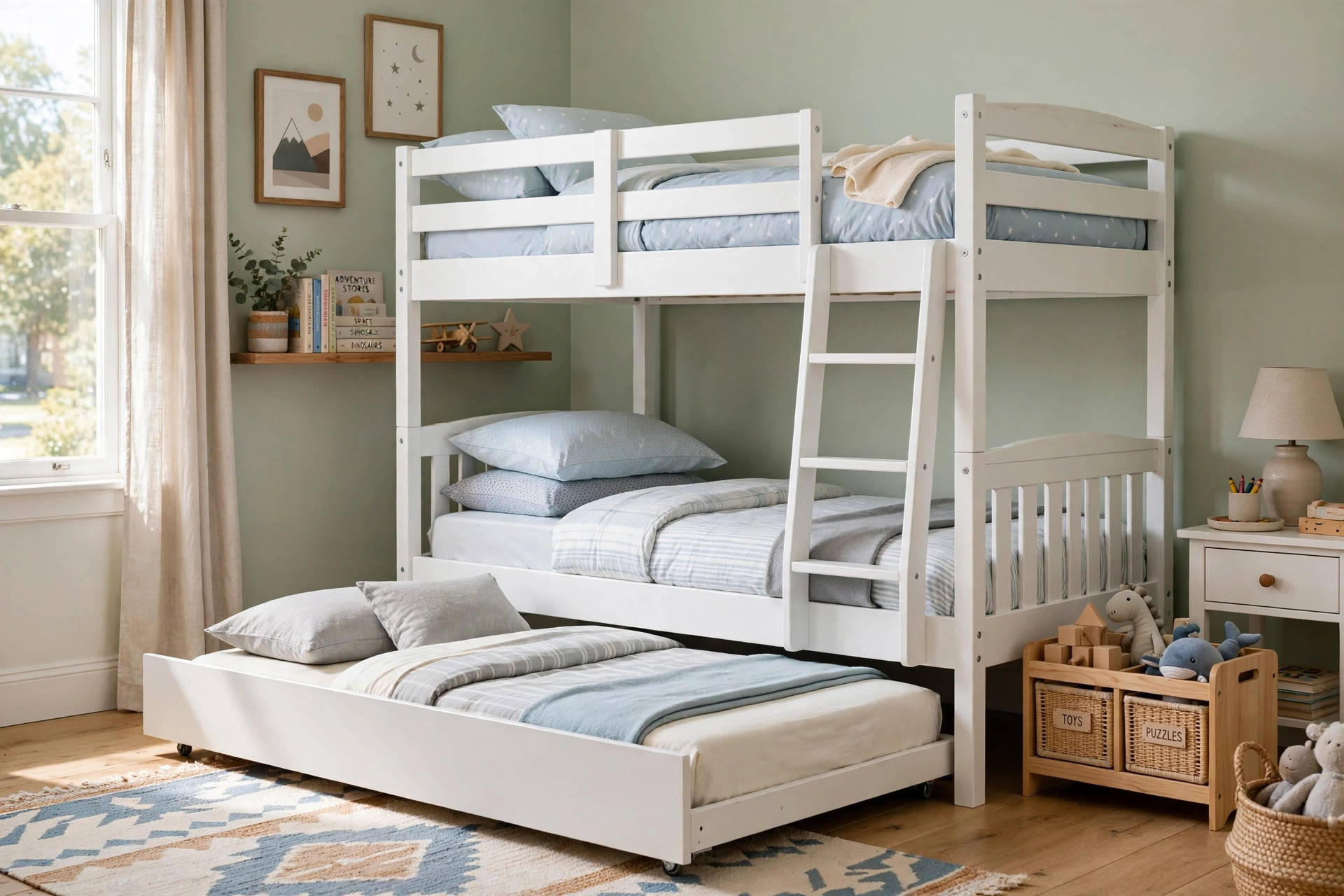

When the doorbell rings on a Friday night and your child answers it, there is often a friend at the door with a pillow and a sleeping bag. A kids bunk bed with trundle for sleepovers was made for evenings like that. The trundle slides out from under the lower bunk, and in a few seconds there is a third bed ready on the floor. It slides back in the morning, and the room is a normal bedroom again.
Parents like this bed because it solves a simple problem. Children need sleep space for guests, but most bedrooms do not have room for three full beds. The trundle solves the problem without a blow-up mattress on the floor or a couch that nobody sleeps well on. In the sections below you will learn why these beds matter, what to look for, what types are sold, what they cost, and how to keep them safe.
Why a Kids Bunk Bed with Trundle for Sleepovers Matters
Sleepovers are a normal part of growing up, and a kids bunk bed with trundle for sleepovers makes these nights easy for the whole house.
The first reason is space. A standard twin bed takes up about twenty square feet of floor. Three twin beds take up a whole room. A bunk bed with a trundle gives three sleeping spots but uses the floor space of just one bed during the day. That leaves room for toys, a desk, and a play area.
The second reason is sleep quality. A guest on a trundle sleeps on a real mattress, not an air mattress that sinks by morning or a pile of blankets. When guests sleep well, the whole house sleeps well. Fewer complaints at midnight mean fewer tired parents at breakfast.
The third reason is cost. One piece of furniture that does the work of three beds costs less than three separate beds, and you plan one bedding set around one arrangement. Over the years your child is at home, that is a real saving.
The fourth reason is flexibility. Some trundles pop up to the height of the lower bunk and lock in place, so the two lower beds sit side by side. Either way, you have options on sleepover night and a clean, simple room on school nights.
What to Look for When You Choose: Kids Bunk Bed with Trundle for Sleepovers
Buying a kids bunk bed with trundle for sleepovers is like buying any large piece of furniture. The details matter more than the first impression. Walk through these points before you order.
Size and room fit
Start with a tape measure. Measure the length and width of the room, and note where the door swings, where the closet opens, and where the windows sit. A twin-over-twin bunk with a trundle is usually about 80 inches long and 42 inches wide. The trundle needs about 40 more inches of clear floor in front of it when it is pulled out.
Also measure the ceiling height. The child on the top bunk should be able to sit up without hitting the ceiling, which usually takes at least 33 inches between the top of the upper mattress and the ceiling.
Weight limits
Every bunk bed has a weight limit for the top bunk, the bottom bunk, and the trundle, printed in the manual and often stamped on the frame. The top bunk usually holds 150 to 250 pounds and the trundle 100 to 175 pounds. If older teenagers will use the bed, buy a frame rated for adults.
Materials
Solid wood is the classic choice. Pine is light and cheap but dents easily, while birch and beech are harder and hold up better over years of climbing. Metal frames are strong and light but can squeak. Look for smooth finishes with no rough spots and corners that are rounded or capped.
How the trundle moves
A good trundle rolls out on wheels without dragging on the carpet. Some trundles have drawers built into the face, which adds storage but makes the unit heavier. For carpet, look for larger wheels; for hard floors, look for wheels with locks so the trundle does not slide at night.
Style and finish
Pick a finish that grows with the child. White, gray, and natural wood go with almost any bedding and wall color. Many families pick neutral frames and change the look with bedding and wall art instead.
Types and Options
A kids bunk bed with trundle for sleepovers comes in several basic layouts. Knowing the types helps you narrow the search.
Standard twin-over-twin with trundle
Two twin beds are stacked, and the trundle under the bottom holds a third twin mattress. It is the cheapest option and fits in almost any room.
Twin-over-full with trundle
The top is a twin and the bottom is a full-size bed, with a trundle underneath. It gives more room on the bottom, which helps when a parent lies down to read at bedtime, but it takes up more floor space.
L-shaped bunk with trundle
The beds sit at a right angle, which opens floor space in the corner of the room. This layout looks nice but needs a larger room.
Loft bed with trundle
A loft raises one bed high and leaves the space below open for the trundle, plus room for a desk or shelves. It works well in small rooms, but it is higher than a standard top bunk, so it suits older children.
Pop-up trundle
A pop-up trundle lifts on folding legs to the height of the lower bunk, forming a flat double bed with the lower bunk. Pop-up trundles cost more, but they are the most comfortable option for guests.
Retailers such as IKEA and Wayfair carry many of these layouts, and specialty shops like Pottery Barn Kids focus on finishes aimed at children.
Cost and Price
A kids bunk bed with trundle for sleepovers costs more than a plain bunk, but less than two separate beds plus a guest bed. Prices in the United States tend to fall into three bands.
Budget frames run about 300 to 600 dollars. These are usually pine or metal with simple finishes, and they suit younger children who will use the bed for a few years. Mid-range frames run about 600 to 1,200 dollars, using harder woods with better hardware and smoother trundle tracks; most families land in this band. High-end frames run 1,200 to 2,500 dollars or more, with hardwoods, strong joinery, and extras like storage drawers or a pop-up trundle. Do not forget the mattress. A trundle needs a thin mattress, usually six to eight inches, so it fits under the lower bunk. The top bunk mattress should be six inches at most, so the guardrails sit high enough above it. Budget about 100 to 200 dollars per mattress, and buy all three at once so the sizes match. Sites like Consumer Reports publish test results for furniture that apply well to bunk beds.
Care and Upkeep
A kids bunk bed with trundle for sleepovers is a sturdy thing, but it needs a little care to stay safe and quiet. Set a routine and stick to it.
Tighten the bolts twice a year. Climbing and jumping loosen the connections over time, and a loose bolt is what turns a solid bed into a wobbly one. Wipe the frame with a damp cloth every month, using a little mild soap in warm water instead of harsh cleaners. Check the trundle wheels every few months, since hair and string wrap around small wheels and stop them from rolling. A drop of oil on the wheel axles keeps them quiet. Rotate the mattresses when you change the sheets to even out wear, and air the trundle mattress by leaving it pulled out for a few hours now and then. For cleaning tips aimed at family homes, Apartment Therapy and The Spruce publish practical room-care routines.
Safety
A kids bunk bed with trundle for sleepovers is safe when it is bought right and used right. These are the rules that matter most.
The top bunk is for children six years and older. This is the rule from the U.S. Consumer Product Safety Commission, and it is based on real injury data. Younger children should sleep on the lower bunk or the trundle. The health site HealthyChildren.org explains the same rule in plain language for parents. Guardrails must run along both sides of the top bunk, with no gaps wider than a few inches at the ends, and they should stand at least five inches above the top of the mattress. The trundle sits close to the floor, so falls are not a big worry there. Show young children how to pull it out slowly with both hands, and never let them stand on it or ride it like a cart. Teach the house rules on day one: no jumping from the top bunk, no hanging from the rails, one person on the ladder at a time. Keep the area around the trundle clear of toys and cords so it can roll out freely at night.
Frequently Asked Questions
What mattress size fits a kids bunk bed with trundle for sleepovers? Most use standard twin mattresses on all three levels. The trundle takes a thin mattress, usually six to eight inches, so it clears the frame when it slides in. The top bunk mattress should be six inches at most to keep the guardrails effective.
What age is right for the top bunk? Six years old is the minimum recommended age for the top bunk. Younger children sleep on the lower bunk or the trundle, which sits near the floor.
Can a kids bunk bed with trundle for sleepovers be split into separate beds? Many can. A lot of makers design their bunks so the two levels separate into two free-standing twin beds. Check the product page for words like “convertible” or “detachable.”
How much weight can the trundle hold? Most trundles hold between 100 and 175 pounds. That is enough for a child or a small teenager. If adults will sleep on it, look for a heavy-duty model rated for 200 pounds or more, and check that the wheels and frame are built for the load.
Is a trundle comfortable for a real guest? Yes, when the mattress is decent. A six-inch mattress on a solid trundle platform sleeps about as well as a normal twin bed and beats an air mattress by a wide margin.
Does a kids bunk bed with trundle for sleepovers work in a small room? Three beds take the floor space of one, which leaves room to play and study. A kids study desk with chair set adjustable can often fit in the space a third bed would have eaten up. If the room is truly tiny, a loft with a trundle leaves even more room below.
A Short Final Word
A kids bunk bed with trundle for sleepovers is one of the smartest buys a family with young children can make. It turns an ordinary bedroom into a place that can welcome a friend at a moment’s notice, without giving up floor space on ordinary days. Pick a solid frame, buy the right thin mattresses, and teach the safety rules early. The bed will pay you back in happy Friday nights for years.
If you are still styling the room around the new bed, a best kids bed tent for cozy sleep space can make the top bunk feel like a hideout, and a nursery glider chair with ottoman for breastfeeding is useful in the early years before the bunk arrives. For advice on children’s sleep routines, What to Expect has guides that pair well with a new bed setup.
References
American Academy of Pediatrics. (n.d.). HealthyChildren.org. https://www.healthychildren.org Apartment Therapy. (n.d.). Home design ideas and inspiration. https://www.apartmenttherapy.com Consumer Reports. (n.d.). Product reviews and ratings. https://www.consumerreports.org IKEA. (n.d.). Home furnishings. https://www.ikea.com Pottery Barn Kids. (n.d.). Kids furniture and decor. https://www.potterybarnkids.com The Spruce. (n.d.). Home and garden advice. https://www.thespruce.com U.S. Consumer Product Safety Commission. (n.d.). Product safety information. https://www.cpsc.gov Wayfair. (n.d.). Furniture and home goods. https://www.wayfair.com What to Expect. (n.d.). Pregnancy and parenting guidance. https://www.whattoexpect.com
Was this guide helpful?

About Robert Taylor
The My Garden US editorial team writes practical, in-depth home and garden guides for American homeowners — tested advice, no fluff.
You May Also Like
Nursery Diaper Caddy Organizer Portable: A Complete Guide
October 4, 2026 0 views
The Best Nursery Rug Washable for Easy Cleaning
January 20, 2026 0 views
The Best Kids Bookshelf Rotating for Small Room Spaces
May 10, 2026 0 views