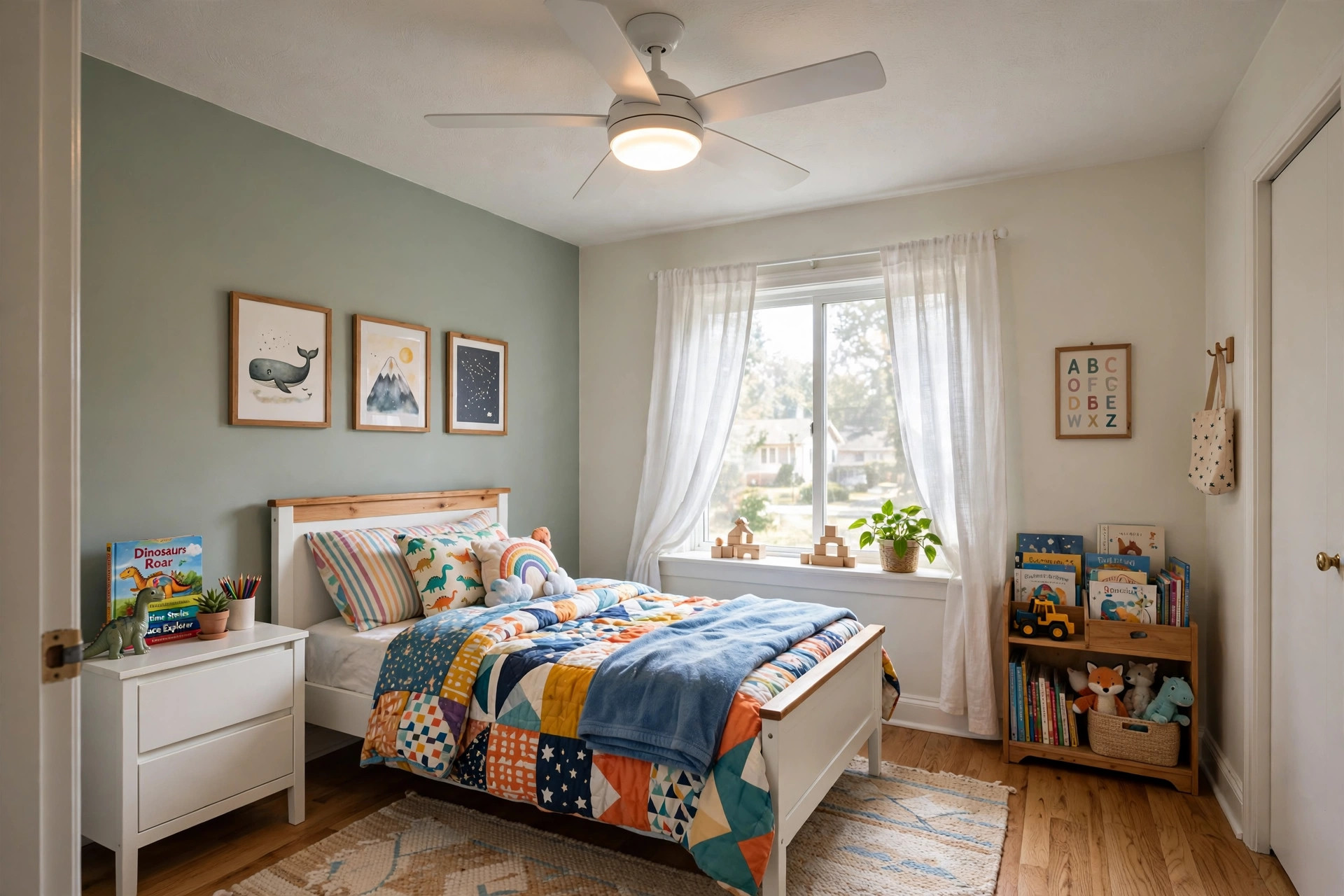

A kids bedroom fan with light for ceiling does two jobs at once. It moves the air so the room feels cool. It also gives light for play, reading, and homework. Many parents pick this one fixture instead of buying a separate fan and a separate lamp. It saves space. It saves money. It keeps the ceiling clear for the rest of the room.
Choosing the right fan for a child is not hard. But a child room is not the same as a master bedroom. The fan must be quiet. The light must be soft enough for sleep. The height must be safe for small children who like to toss toys. This guide walks through each point in plain words.
Why a Ceiling Fan with Light Belongs in a Kid’s Room
A child’s room gets warm fast. Sun comes in through the window. Bodies give off heat during play. A fan moves the air and makes the room feel cooler by several degrees. The U.S. Department of Energy notes that a ceiling fan lets a home owner raise the thermostat and still feel cool. That saves money on cooling bills in summer.
A light built into the fan takes the place of a table lamp. Table lamps take up space on a desk or a night stand. They can fall off. A ceiling light has no cord within reach. It shines down over the whole room.
One fixture also means one wiring point. Most American homes already have a light box in the ceiling of each bedroom. An electrician can hang a fan with a light kit from that same box. The job is often simple and quick.
A plain white fan works well too, and it blends in with the walls. You can read more about kid room choices at The Spruce, which covers nursery and child decor in plain terms.
How to Choose the Right One: Kids Bedroom Fan with Light for Ceiling
Not every fan fits every room. These are the points that matter most.
Size and Blade Span
Measure the room first. A fan that is too small will not move enough air. A fan that is too large will look wrong and may feel like a storm.
– A room up to 75 square feet: use a 29 to 36 inch fan. – A room 76 to 144 square feet: use a 36 to 44 inch fan. – A room 144 to 225 square feet: use a 44 to 50 inch fan.
Most kids bedrooms fall in the middle group. A 44 inch fan is the most common choice. Check the box for the span before you buy.
Light Type and Brightness
Older fans used small bulbs that gave dim yellow light. New fans use LED lights. LEDs last for years. They use little power. They stay cool to the touch, which matters in a child room.
Look for a light kit with 800 lumens or more for the main light. That is about as bright as one old 60 watt bulb. For a small room, 800 to 1,100 lumens is fine. Some fans let you change the color of the light from warm to cool. Warm light, around 2700 Kelvin, feels soft and helps a child wind down at night. Cool light, around 4000 Kelvin, is better for homework and play. A fan with a switch for both gives you both moods.
A dimmer helps too. You can turn the light low for story time. For night feedings or late check ins, a low light is less harsh than a full bright lamp. Many parents pair a ceiling fan light with a nursery night light with dimmer for feeding on the night stand for the youngest years.
Noise Level
A child must sleep in this room. A loud fan will ruin naps. Check the sound rating on the box. It is given in decibels. A good fan for a bedroom runs under 50 decibels on high speed. Many run at 35 to 45 decibels. That is close to a soft whisper.
DC motor fans are quieter than AC motor fans. They also use less power. They cost more at first. But the quiet is worth it in a child room. Consumer Reports tests fans for noise and air flow, and their buying guides can help you compare models.
Remote Control and Pull Chains
Pull chains hang down from the fan. They are fun for a child to pull. That is the problem. A child can pull too hard and break the switch. A child may also hang from the chain. A remote control is safer and easier.
Many fans now come with a remote. Some work with a wall switch instead. A wall switch keeps the control out of reach of small hands. If you want fun for an older child, look for a remote with large buttons. Keep the remote on a high shelf when the child is small.
Types and Options
Fans come in several styles. Each has good and bad points.
Standard mount. The fan hangs from a short down rod. This is the most common type. It works with ceilings that are 8 feet or higher.
Flush mount, also called hugger mount. The fan sits close to the ceiling. This is best for low ceilings. It is also the safest for a child room. The blades sit high. Small hands cannot reach them. Tossed toys are less likely to hit them.
Down rod mount. The fan hangs from a long rod. This is for high or sloped ceilings. Skip this type in a small child room.
Blade shapes. Standard paddles are fine. Some kids fans have shaped blades like airplanes, flowers, or dinosaurs. They cost more. They may move less air than plain blades. Pick the style your child likes, but check the air flow number first.
Light kits. Some fans have a built-in light you cannot change. Some have a kit you can add later. A kit you can change gives more choice. You can swap the shade to match new bedding or paint.
For a child room, the best pick is often a flush mount fan with a built-in LED light and a remote. It is safe, quiet, and simple. Browse styles at Wayfair or IKEA to see what flush mount kids fans look like in real rooms.
Cost and Price
A kids bedroom fan with light for ceiling can cost anywhere from 60 dollars to 400 dollars. Most good ones for a child room fall between 100 and 250 dollars. Here is what the price buys.
– Under 100 dollars. Basic AC motor fans with pull chains and simple light kits. They move air fine. They may be louder. They may wobble more. – 100 to 250 dollars. Better motors, quieter sound, remotes, dimmable LED lights, and kid friendly colors. This is the sweet spot for most families. – Over 250 dollars. DC motors, very quiet, smart controls, high end finishes. Nice to have, but not needed for a child room.
On top of the fan, you may pay for setup. If the ceiling box is already rated for a fan, an electrician may charge 100 to 200 dollars to hang it. If the box must be changed, the cost goes up. A fan rated box is stronger than a light only box. Never hang a fan from a box that is not rated for a fan. It can fall.
Running costs are low. A ceiling fan uses about 15 to 75 watts. An LED light adds 10 to 20 watts. That is far less than a window air unit. ENERGY STAR lists fans that meet strict power rules, and those models can trim a few more dollars off the bill each year. You can compare long term costs at What to Expect, which has family budget guides for nursery and child room gear.
Safety First
A ceiling fan in a child room must be safe above all. Follow these rules.
Height. The blades must sit at least 7 feet above the floor. In a child room, higher is better. Small children throw balls. Older children jump on beds. A flush mount fan keeps blades near the ceiling and out of reach.
Secure mount. The fan must hang from a box rated for ceiling fans. It must not wobble. A wobbling fan can loosen over time. Tighten the screws once a year. If the fan shakes, stop using it and fix the mount.
Blade guards for very young children. Some parents add a simple guard or pick a fan with enclosed blades for a toddler room. An enclosed blade fan looks like a drum. It is safe but moves less air.
No reachable cords or chains. Use a remote or a wall switch. Cut pull chains short or remove them if a toddler lives in the room. Long chains are a strangling risk.
Light heat. Old bulbs got hot. A child could not touch the fixture. Modern LED kits stay cool. Still, check that the shade is snug and cannot fall. The U.S. Consumer Product Safety Commission posts recalls for fans and lights. Check their site before you buy, and search the model name for past recalls.
Night safety. Keep the floor clear under the fan. Do not put a crib or a toddler bed right under the blades. Leave some space. HealthyChildren.org, run by the American Academy of Pediatrics, gives room safety tips for each age.
Care and Upkeep
A ceiling fan needs little care. Dust the blades every month or two. Dust makes the fan heavy on one side. That causes wobble and noise. Use a long duster or a damp cloth. Wipe the light shade too. Dust on the shade dims the light.
Once a year, check the screws on the blades and the mount. Tighten what is loose. Look at the light kit. If the LED flickers, the driver may be failing. Most LED kits last 15 to 20 years, so this is rare.
Clean the remote. Children press buttons with sticky hands. Wipe it with a damp cloth. Change the battery once a year.
If the fan starts to hum, the problem is often a loose screw or a bulb that is not seated. Turn off the power at the breaker before you touch anything inside the light kit. If you are not sure, call an electrician.
Putting It Together with the Rest of the Room
A fan with a light sets the tone for the room. Match it to the rest of the decor. A white fan works with almost any bedding. A wood tone fan warms up a room with cream walls.
Think about the other lights too. A ceiling fan light is bright and central. It can feel harsh at bedtime. Add a small lamp on the night stand with warm light for stories. A nursery lamp with soft warm light for night is a good match for the early years. For older kids, a best kids night light projector for bedroom can throw stars on the ceiling after the main light goes off.
Layer the light. Use the fan light for play and homework. Use a small lamp for calm time. This teaches a child that dim light means sleep is near.
Pottery Barn Kids shows full room sets where a ceiling fan light works with lamps and shades. It is a good place to get ideas for color and style.
Frequently Asked Questions
Can a ceiling fan with a light go in a nursery?
Yes, if it is hung high and safe. Use a flush mount fan. Keep the crib away from the area under the blades. Pick a model with a dimmable LED so you can keep the light low at night. Check that the motor is quiet. A loud fan will wake a baby.
What size fan does a 10 by 12 foot kids room need?
A 10 by 12 foot room is 120 square feet. A 44 inch fan fits well. Some 42 inch fans also work. Measure the span on the box before you buy. Do not guess.
Are LED light kits better than bulb kits for a child room?
LED kits are better in most cases. They last longer. They stay cool. They use less power. They often dim down to a soft glow. Bulb kits let you change the bulb, but the child cannot touch a hot bulb safely.
Can I hang the fan myself?
A handy home owner can hang a fan if the box is already fan rated and the wires are marked. Turn off the breaker first. Follow the manual step by step. If the box is not fan rated, or the wires are unclear, call an electrician. A falling fan is a real danger.
Do ceiling fans help a child sleep?
Many children sleep better with a fan. The soft hum covers small house noises. The air flow keeps the room from feeling stuffy. Keep the speed low at night. Point the air down in summer. Reverse it in winter so it pushes warm air down without a draft.
How long should a kids ceiling fan last?
A good fan lasts 10 to 15 years or more. The LED light kit may outlast the fan. Clean it and tighten it once a year. Replace the remote battery when it gets weak. A fan that wobbles or hums loudly after years of use may need a new mount or a full swap.
Final Word
A kids bedroom fan with light for ceiling is a smart buy for most families. It cools the room. It lights the room. It takes the place of two fixtures. Pick a quiet flush mount model with a dimmable LED and a remote. Hang it high and secure. Check recalls before you buy. With one good fan, the room stays cool in summer, bright for play, and soft for sleep.
References
American Academy of Pediatrics. (n.d.). HealthyChildren.org. https://www.healthychildren.org Consumer Reports. (n.d.). Product reviews and ratings. https://www.consumerreports.org ENERGY STAR. (n.d.). Energy efficient products. https://www.energystar.gov IKEA. (n.d.). Home furnishings. https://www.ikea.com Pottery Barn Kids. (n.d.). Kids furniture and decor. https://www.potterybarnkids.com The Spruce. (n.d.). Home and garden advice. https://www.thespruce.com U.S. Consumer Product Safety Commission. (n.d.). Product safety information. https://www.cpsc.gov U.S. Department of Energy. (n.d.). Energy efficiency and renewable energy. https://www.energy.gov Wayfair. (n.d.). Furniture and home goods. https://www.wayfair.com What to Expect. (n.d.). Pregnancy and parenting guidance. https://www.whattoexpect.com
Was this guide helpful?

About Lisa Anderson
The My Garden US editorial team writes practical, in-depth home and garden guides for American homeowners — tested advice, no fluff.
You May Also Like

A Nursery Wall Shelf for Books and Decor: A Complete Buying Guide
May 10, 2026 0 views
Nursery Wall Decals Clouds for Ceiling Decor: A Calm Sky Above the Crib
April 22, 2026 0 views
The Best Kids Chair for Desk Ergonomic Support: A Parent’s Guide
August 6, 2026 0 views