---
Table of Contents
Table of Contents
A backpack sprayer is the workhorse of the home orchard. It carries enough mix to treat several trees, keeps the weight on your shoulders instead of your arm, and costs far less than powered equipment. But tall trees test its limits. Spray that never reaches the top of the canopy is wasted spray. This guide shows how to get real coverage on tall fruit trees with a backpack sprayer: the right sprayer, the right nozzle, the right technique, and the safety rules that matter. This article explains spray tall fruit trees in simple terms.
Spray Tall Fruit Trees: Know Your Limits
When it comes to spray tall fruit trees, getting the details right makes all the difference.
Many homeowners find that spray tall fruit trees is easier than they expected once they know the basics.
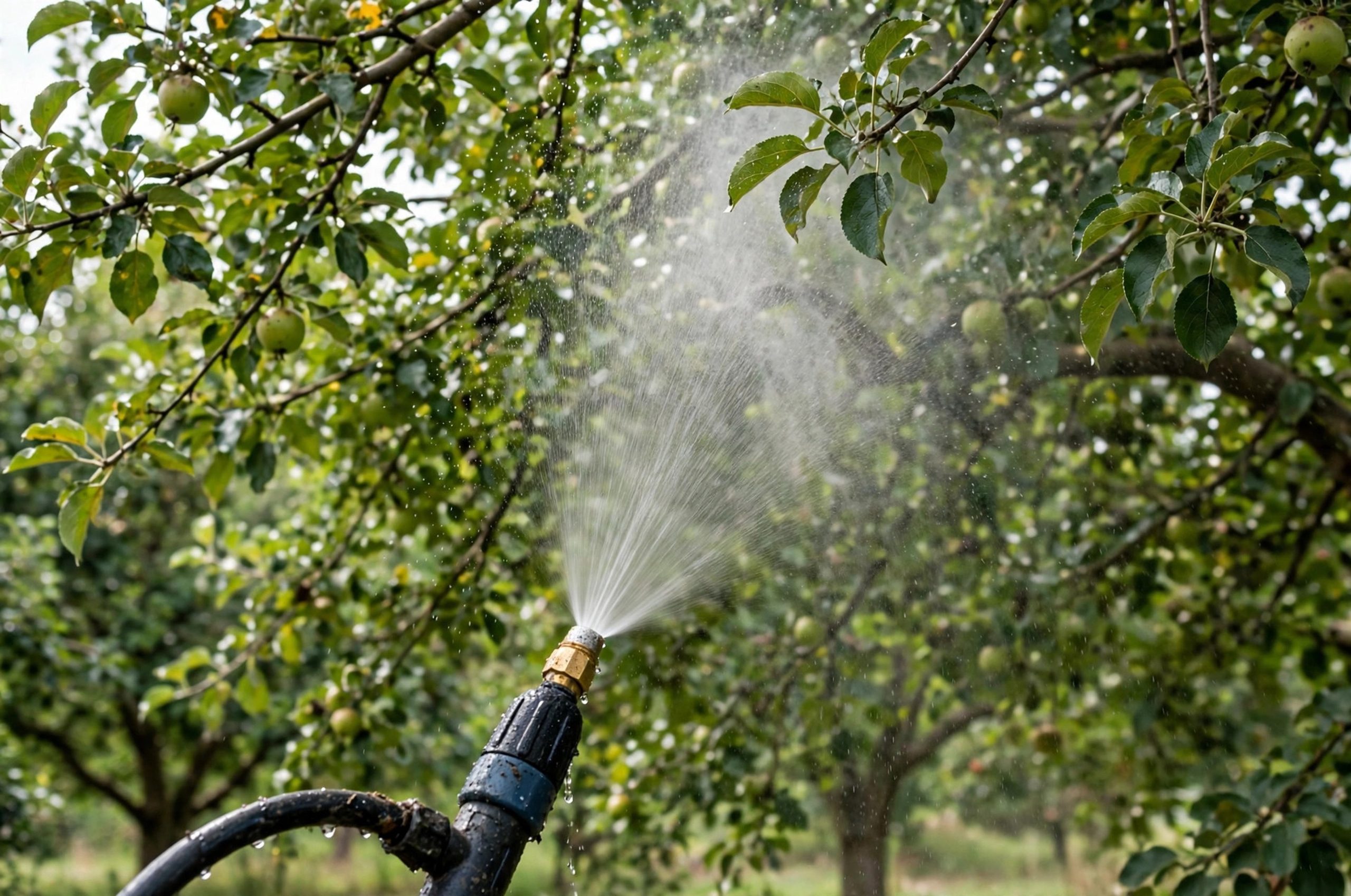
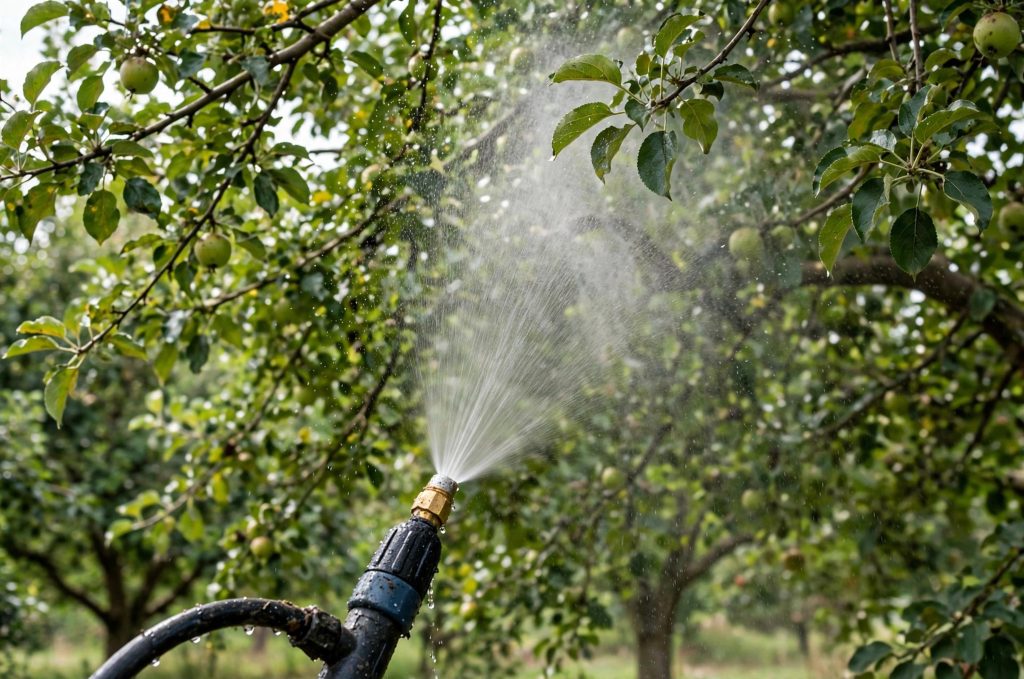
A standard backpack sprayer with a two-foot wand reaches about 10 to 12 feet into the canopy with a fine mist. Trees taller than that need help: a wand extension, higher pressure, or a different tool. As experienced orchardists on GardenWeb note, much past 12 feet is hard to cover with a well-atomized spray pattern. Shooting a solid stream at the top of a tall tree is inefficient and wasteful. The spray should arrive as a mist that coats the leaves, not a jet that runs off.
If your trees are standard-size and over 15 feet tall, consider whether a backpack sprayer is the right tool at all. Options include pruning the trees shorter, which also makes harvest easier, or stepping up to a powered mist sprayer. For semi-dwarf and dwarf trees, which most home orchards grow, a backpack sprayer is perfect.
Ohio State Extension's orchard sprayer guide explains that the most important factors in any sprayer are delivering the right rate, putting right-sized droplets on the target uniformly, and minimizing loss to the ground and air. That applies to a four-gallon backpack as much as a tractor rig. Read the Ohio State guide.
Pick the Right Backpack Sprayer
Many homeowners find that spray tall fruit trees is easier than they expected once they know the basics.
The key to spray tall fruit trees is choosing the right approach for your space and budget.
Tank size. Four gallons is the standard for orchard work. It treats several semi-dwarf trees per fill without constant refilling. A full four-gallon tank weighs over 30 pounds, so make sure you can carry it comfortably. One orchard tools roundup calls a four-gallon backpack the backbone of any serious backyard orchard routine.
Pump type. Piston pumps build higher pressure, up to 90 psi in some models, which helps push mist into tall canopies. Diaphragm pumps handle wettable powders better and last longer with gritty mixes. For liquid concentrates on fruit trees, a piston pump is usually the better pick.
Pressure regulation. Look for an adjustable pressure regulator. Steady pressure means steady droplet size, and steady droplets mean even coverage. Ohio State specifically recommends keeping spraying pressure consistent, since low pressure gives larger droplets and lower rates.
Nozzle assortment. The sprayer should come with several nozzle types: a flat fan, a hollow cone, and an adjustable cone at minimum. Different nozzles suit different jobs, and tall trees need different nozzles than low bushes.
Comfort. Padded shoulder straps, a waist belt, and a pump handle that fits your height. You will wear this thing for an hour. Comfort is not a luxury. The Solo 425 Comfort adds padded straps, a four-level pressure adjustment knob, and a pump lever that fits left or right handed use.
The Solo 425 is a popular four-gallon piston model for orchard work. It produces up to 90 psi, has a four-position pressure regulator, Viton seals for chemical resistance, and ships with four nozzles including flat fan and hollow cone types. The 28-inch wand gives decent reach, and the lock-on valve reduces hand fatigue on long jobs. See the Solo 425 details.
Nozzles and Wands for Tall Trees
The key to spray tall fruit trees is choosing the right approach for your space and budget.
With a little planning, spray tall fruit trees can fit even a busy schedule.
Hollow cone nozzles make a fine, swirling mist that coats leaves well. They are the top pick for insecticide and fungicide sprays on fruit trees.
Flat fan nozzles make a flat sheet of spray. They suit herbicide work under trees more than canopy spraying.
Adjustable cone nozzles twist from a fine mist to a straight stream. For tall trees, the stream setting can punch spray up into the top of the canopy, though coverage is less even than a mist.
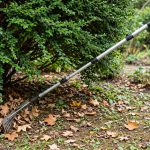
Wand extensions add a foot or two of reach. For trees in the 12 to 15 foot range, an extension plus a mist nozzle gets coverage where a standard wand falls short.
TeeJet-compatible tips let you swap in professional nozzle tips with known flow rates, which makes calibration easier.
The University of Georgia's orchard sprayer bulletin (PDF) shows that commercial air-blast sprayers aim most of their spray at the top half of the tree, where most of the fruit and foliage sits. With a backpack sprayer, copy that idea: spend your effort and spray on the upper canopy, not the trunk. See the UGA orchard sprayer guide.
Calibrate Before You Spray
With a little planning, spray tall fruit trees can fit even a busy schedule.
Before you start, it helps to understand how spray tall fruit trees works in real homes.
Calibration sounds technical, but it is simple. You need to know how much spray your rig puts out so you mix the right amount and do not over- or under-treat.
1. Fill the tank with plain water. 2. Pump to your working pressure and spray into a bucket for one minute. 3. Measure the ounces collected. That is your per-minute output. 4. Time how long it takes you to spray one tree thoroughly at a steady walking pace. 5. Multiply to get gallons per tree.
Ohio State's backpack sprayer guide stresses two rules: keep a consistent walking speed and keep the pressure the same throughout. Both keep your application rate uniform. Consider a small pressure gauge on the wand so you can see the pressure as you work. Read more on sprayer operation.
Take your time with spray tall fruit trees and the result will last.
Spraying Technique for Tall Trees
Before you start, it helps to understand how spray tall fruit trees works in real homes.
A good plan for spray tall fruit trees saves time, money, and frustration.
Work from the outside in. Start at the drip line and work toward the trunk, then circle the tree. Spray both sides of the canopy.
Aim up and let the mist settle. Hold the wand at an upward angle and let the fine mist drift down through the leaves. This coats both sides of the foliage.
Move steadily. Do not park the nozzle on one spot. Keep the wand moving so no area gets drenched while another stays dry.
Watch the wind. Spray on calm mornings. Wind over 5 miles per hour carries fine mist off target. Never spray when wind blows toward people, pets, or neighboring gardens.
Spray to the point of drip, not runoff. Leaves should glisten with spray, not stream with it. Runoff wastes product and pollutes soil.
Treat the tops. Pests and diseases often start high in the canopy. Make a dedicated pass for the upper branches with your extension wand or stream setting.
One home orchardist's rule of thumb: if you cannot see mist reaching the top leaves, you are not treating the top leaves. Adjust your reach, your pressure, or your tree height until you can.
Signs of Good Coverage
A good plan for spray tall fruit trees saves time, money, and frustration.
After a spray, check your work. Leaves should show an even, light coating with no dry patches and no heavy runoff streaming off the edges. A simple trick is to clip a few water-sensitive paper cards in the canopy before you spray. They change color where spray lands and show you exactly what the top, middle, and inside of the canopy received. If the top cards stay dry, you need more reach or a finer mist setting. Adjust and spray again next round. Good coverage you can see beats guessing every time.
Timing Matters More Than Equipment
For most people, spray tall fruit trees comes down to a few smart choices.
The best sprayer cannot fix bad timing. Most home orchard sprays work best at specific growth stages: dormant, bud swell, petal fall, and cover sprays through the season. Spraying at the wrong stage wastes effort and can harm pollinators. Check your local extension's spray schedule for your fruit types. And never spray open blossoms during the day when bees are working.
Safety Rules
If you are new to spray tall fruit trees, start with the simplest option and build from there.
Fruit tree spraying involves chemicals, height, and ladders. Respect all three.
- Read the label. Every product label is the law. Follow the mix rate, the protective gear, and the re-entry time exactly.
- Wear protective gear. At minimum: long sleeves, long pants, chemical-resistant gloves, eye protection, and closed shoes. A respirator is smart for fine mists.
- Do not spray from a ladder with a full backpack. The weight shifts your balance. Prune trees to a reachable height instead, or spray from the ground with an extension.
- Keep people and pets away. Clear the area before you spray and keep them out until the label says it is safe.
- Clean up after. Triple-rinse the tank, run clean water through the hose and nozzle, and store the sprayer empty. Leftover mix corrodes seals and clogs nozzles.
- Store chemicals locked up, away from kids, pets, and food.
For more orchard gear, see our guides to the best backpack sprayer for weed killer, backpack battery sprayer reviews, drip irrigation for fruit trees, and how to prune fruit trees for beginners. That is all it takes to handle spray tall fruit trees with confidence.
References
When it comes to spray tall fruit trees, getting the details right makes all the difference.
FarmStandApp. (n.d.). 8 tools for spraying backyard orchard fruit trees. https://www.farmstandapp.com/640158/8-tools-for-spraying-backyard-orchard-fruit-trees/
GardenWeb. (n.d.). Best sprayer for home orchardist. https://www.gardenweb.com/discussions/1477893/best-sprayer-for-home-orchardist
Ohio State University Extension. (n.d.). Best practices for effective spraying in orchards and vineyards (FABE-539). https://ohioline.osu.edu/factsheet/fabe-539
Ohio State University Extension. (n.d.). Sprayers for effective pesticide application in orchards and vineyards (FABE-533). https://ohioline.osu.edu/factsheet/fabe-533
Solo USA. (n.d.). 425 backpack sprayer, 4 gallon, piston. https://us.solo.global/product/425-backpack-sprayer-4-gallon-piston/
Solo USA. (n.d.). Backpack sprayer 15L – 425 Comfort. https://shop.solo.global/en/Backpack-sprayer-15L-425-Comfort/42531
University of Georgia Cooperative Extension. (n.d.). Orchard sprayers (Bulletin 979). http://fieldreport.caes.uga.edu/wp-content/uploads/generated-pub-pdfs/B-979.pdf
University of Georgia Cooperative Extension. (n.d.). Orchard sprayers. https://fieldreport.caes.uga.edu/publications/B979/orchard-sprayers/
Was this guide helpful?

About My Garden US
The My Garden US editorial team writes practical, in-depth home and garden guides for American homeowners — tested advice, no fluff.