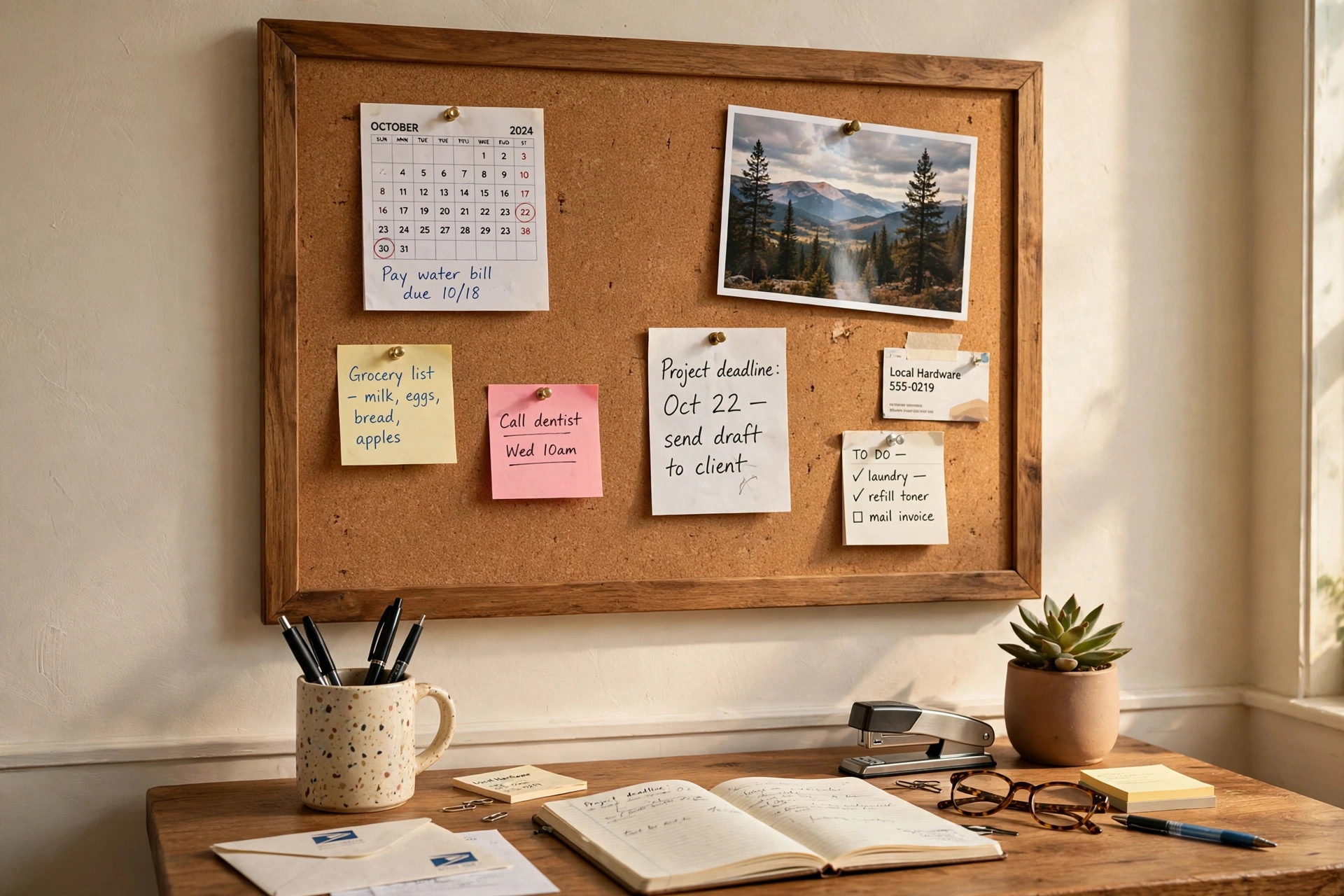

A home office bulletin board with wooden frame is a simple tool that does honest work. It holds your notes, your dates, and your small reminders where you can see them all day long. It does not need batteries or a password.
Many people try to run a whole home office from a phone screen. That works for some tasks, but it fails for the notes you must see every hour. A doctor’s card, a project date, a phone number you call each week: these small slips vanish inside a phone. A home office bulletin board with wooden frame puts them back in your line of sight. You glance up and you know what comes next.
The wooden frame is the part that makes the board belong in a home. Bare cork boards look like office supply closets. A frame of pine, oak, or walnut turns the same board into a piece of decor. This guide will help you pick the right board, hang it well, and keep it in good shape for years.
Why a Wooden Frame Board Matters in a Home Office
A home office asks a lot of a small room. One corner may serve as your desk, your file room, and your meeting space. In such a room, every wall item must earn its place. A home office bulletin board with wooden frame earns its place three ways: it organizes, it reminds, and it decorates.
Organization is the first reason. Loose paper piles up fast on a home desk. Bills sit on top of receipts. A child’s permission slip lands on top of a work invoice. When you pin the active papers to the board, the desk stays clear for real work. The best desk organizer set for small office desk handles the small supplies, and the board handles the paper you must not lose.
Reminders are the second reason. The human eye catches what is big and central. A red pin on a board pulls your attention in a way that a phone alert does not. Workers who pin weekly goals and due dates report fewer missed deadlines. The board becomes a quiet manager. It asks nothing of you. It only shows what you told it to show.
Decoration is the third reason. Home offices often look cold. A monitor, a keyboard, and a plastic chair do not warm a room. Wood does. A home office bulletin board with wooden frame adds the same warmth that a wooden desk or a bookshelf adds. Writers on home decorating at The Spruce often note that natural wood tones soften a room.
There is also the matter of choice between a board and a whiteboard. A home office whiteboard for remote team planning suits lists that change each day. But whiteboard ink fades, and markers dry out. A cork board suits papers that stay put for weeks: school schedules, meeting notes, and tax letters. Many home offices keep both, one for the daily churn and one for the steady papers.
What to Look for When You Choose One: Home Office Bulletin Board with Wooden Frame
Shopping for a home office bulletin board with wooden frame is not hard, but a little care goes far. The board must hold pins firmly, the frame must stay square, and the whole piece must hang flat on your wall. Here is what to check before you buy.
The Wood of the Frame
Frames come in many woods. Solid pine is light, cheap, and easy to stain. Oak is heavier and harder, with a bold grain that suits traditional rooms. Walnut is dark and formal. Cherry falls between, warm and reddish. Some boards use engineered wood with a wood-look finish. These cost less but chip more easily at the corners.
Check the corners where the frame meets. A mitered corner, cut at a 45-degree angle and glued tight, looks clean and holds well. Corners held only by staples can loosen in a year. Run your finger along the frame edge. It should feel smooth, with no rough spots or splinters.
The Surface of the Board
The classic surface is cork, a natural bark material that grips pins and heals small holes. Natural cork works well but can crumble at the edges over time. High-density cork boards last longer and hold pins more firmly.
Fabric-covered boards use linen or felt over a pin-friendly core. They look softer and come in colors that match a room. Dark fabric hides pin holes better than pale fabric. Felt boards hold pins well but show dust.
Combination boards give you cork on one half and a dry-erase surface on the other. These suit people who want both pinned papers and erasable notes in one frame. The dry-erase half needs weekly cleaning or old ink stains it.
The Size of the Board
Measure your wall before you shop. A board that is too large crowds a small room. A board that is too small fills up in a week and loses its use.
For a desk nook, an 18-by-24-inch board works well. For a standard desk setup, 24 by 36 inches is the common choice. It holds a month of notes with room to spare. For planning work with maps and charts, some buyers choose 36 by 48 inches, but such a board needs a strong wall anchor and often needs two people to hang it.
Think about viewing distance. A board hung behind a monitor should be close enough to read a pinned note without standing up. Reviewers at Wirecutter often stress measuring the real space first, and that advice fits here too.
The Backing and the Hangers
A good board has a rigid backing, usually hardboard or plywood, so it stays flat. Thin cardboard backings warp in humid rooms. Flip the board over in the store if you can. The back should feel solid.
Look for metal D-rings or a strong hanging wire. Cheap plastic tabs snap under weight. The board should sit flat against the wall with no gap at the top. If you hang a heavy board, drive the screws into wall studs or use rated drywall anchors. Staples sells hanging kits with anchors matched to common board weights.
Types and Options
The framed cork board is the standard, but several kinds serve special needs.
Natural cork boards are the least costly and the most common. They suit notes, photos, and light papers. Their color is warm tan, which fits most wood frames.
Linen and fabric boards cost more and look like upholstery. They suit living rooms and bedrooms that double as offices. A home office in a bedroom often looks better with a linen board than with raw cork.
Felt letter boards use a felt surface with wooden or plastic letters. They show a quote or a weekly motto rather than pinned notes.
Calendar and planner boards print a month grid under glass or on cork. They suit households that track many events at a glance.
Combination boards join cork and whiteboard in one frame, as noted above. They suit workers who both pin papers and sketch plans.
Boards with a shelf ledge add a narrow wooden tray at the bottom of the frame. The tray holds markers, glasses, or a small plant. These cost more but save desk space.
Cost and Price
A home office bulletin board with wooden frame is not an expensive buy. Prices depend on size, wood, and brand.
Small boards, around 18 by 24 inches with a pine frame, sell for about 20 to 35 dollars. Mid-size boards, 24 by 36 inches with a hardwood frame, sell for about 40 to 75 dollars. Large boards or boards with walnut and cherry frames sell for 75 to 120 dollars or more. Custom sizes from frame shops cost more still, often 150 dollars and up.
Watch for hidden costs. Hanging hardware sometimes sells separately. A hanging kit with anchors and level costs 8 to 15 dollars. Push pins, decorative tacks, and clips add another 5 to 10 dollars. Big retailers like IKEA and Wayfair list frame materials in the product details, so compare those lines before you order.
Price is not the only measure of value. A cheap board with a soft frame may need replacement in two years. A well-made board lasts ten or more. Product testers at PCMag make the same point about office gear in general: a modest step up in quality often pays for itself in a longer service life.
Care and Upkeep
A home office bulletin board with wooden frame needs little care, but a few habits keep it looking new.
Dust the frame each month with a dry cloth. Wood frames collect dust along the top edge. A damp cloth works for sticky spots, but dry the wood right after so water does not raise the grain.
Rotate your pin spots. Pins driven into the same cork spot week after week wear a loose hole. Move notes around the board so no single area takes all the wear. Pull old pins out straight rather than at an angle to protect the cork.
Clean fabric boards with a lint roller or a soft vacuum brush. Do not wet linen or felt, as water can leave rings. For dry-erase halves of combination boards, wipe with a soft eraser weekly and use whiteboard cleaner monthly.
Check the hangers once a year. Boards settle and screws loosen. Lift the bottom of the board and check that the wire or D-rings still feel tight. Tighten any loose screws with a screwdriver. If the board hangs above a desk where you lean each day, this check matters more.
Fix small scratches in the frame with a matching wood stain pen. These pens cost a few dollars at home stores and hide nicks well. For deep gouges, a light sanding with fine paper followed by stain and wax works, though most boards never need this much work.
Safety in the Home Office
Boards are light compared to shelves, but safety still counts, especially in homes with children.
Hang the board with the right hardware for its weight. A small board can hang from two picture hooks. A large hardwood board needs studs or rated anchors. A falling board can chip a desk, break a monitor, or strike a person. Take the weight rating on the hardware package seriously.
Keep pin tips in mind. Standard push pins have sharp steel points. In a home with small children, use flat-headed tacks or safety pins with covered tips, and hang the board above a child’s reach. A cork board at toddler height invites pulled pins and mouths.
Mind the placement near heat and light. Do not hang a board directly above a radiator or a space heater. Heat dries cork and warps frames. Direct sun fades fabric and wood finishes over time.
Ergonomics matter too. The board should sit where you can see it without twisting your neck. Research on workstations from Herman Miller and Steelcase stresses that the tools you use most should face you straight on. The Occupational Safety and Health Administration also notes that a well-set workstation reduces strain. A board placed too high or too far to the side invites the same neck trouble as a badly placed monitor. Pair the board with sensible furniture, such as an ergonomic standing desk from UPLIFT Desk, and keep your wall tools within easy sight lines.
A home office wall clock with silent movement makes a good neighbor for the board. Clock and board together give you time and tasks at one glance, with no ticking noise to break your focus.
Frequently Asked Questions
How do I hang a home office bulletin board with wooden frame on drywall? Find a stud with a stud finder if the board is heavy, and drive screws into the stud. For lighter boards, use rated drywall anchors. Two hangers, spaced wide, keep the board level. Use a small level to check before you tighten fully.
What size board is best for a small desk? An 18-by-24-inch board fits most desk nooks. If you pin papers daily, step up to 24 by 36 inches. Measure the free wall space first and leave a few inches of margin.
Can I use a wooden frame board in a rented apartment? Yes, in most cases. Small boards hang from hooks that leave only tiny holes, which most leases allow. For heavy boards, ask your landlord before drilling. Some renters use strong removable adhesive strips, but check the weight limit and test the strips before trusting them with a hardwood frame.
How long does a cork board last? A good cork board lasts five to ten years with normal use. Rotating pin spots and keeping the board out of direct sun extend its life. When the cork stops gripping pins, you can buy cork sheets and re-cover the board inside the same wooden frame.
Cork or fabric: which is better? Cork costs less and suits heavy pin use. Fabric looks softer and hides pin holes. Choose cork for a busy work board and fabric for a board that also serves as decor. Many buyers own one of each.
Do wooden frame boards work with push pins and thumbtacks? Yes. Both sink easily into cork and into the core of most fabric boards. Very dense high-density cork needs a firm push. Avoid long nails, which can punch through the backing.
A Final Word
A home office bulletin board with wooden frame is one of the oldest tools in office life, and it still earns its keep. It costs little, asks nothing, and works every day. Pick a frame you like to look at, a size that fits your wall, and hardware that holds its weight. Hang it where your eyes land while you work. Pin what matters and clear what does not. The board will do the rest, quietly, for years.
References
Herman Miller. (n.d.). Office furniture and ergonomic seating. https://www.hermanmiller.com IKEA. (n.d.). Home furnishings. https://www.ikea.com Occupational Safety and Health Administration. (n.d.). Worker safety and health. https://www.osha.gov PCMag. (n.d.). Technology product reviews. https://www.pcmag.com Staples. (n.d.). Office supplies and furniture. https://www.staples.com Steelcase. (n.d.). Office furniture and workplace research. https://www.steelcase.com The Spruce. (n.d.). Home and garden advice. https://www.thespruce.com UPLIFT Desk. (n.d.). Standing desks and ergonomic office furniture. https://www.uplift-desk.com Wayfair. (n.d.). Furniture and home goods. https://www.wayfair.com Wirecutter. (n.d.). Product reviews from The New York Times. https://www.nytimes.com/wirecutter
Was this guide helpful?

About Sarah Mitchell
The My Garden US editorial team writes practical, in-depth home and garden guides for American homeowners — tested advice, no fluff.
You May Also Like

How to Choose a Home Office Storage Box for Tax Records USA
May 19, 2026 0 views
Small Desk Organizer With Phone Charging Dock: A Complete Guide
January 10, 2026 0 views
Small Corner Standing Desk for Apartment Living
January 27, 2026 0 views