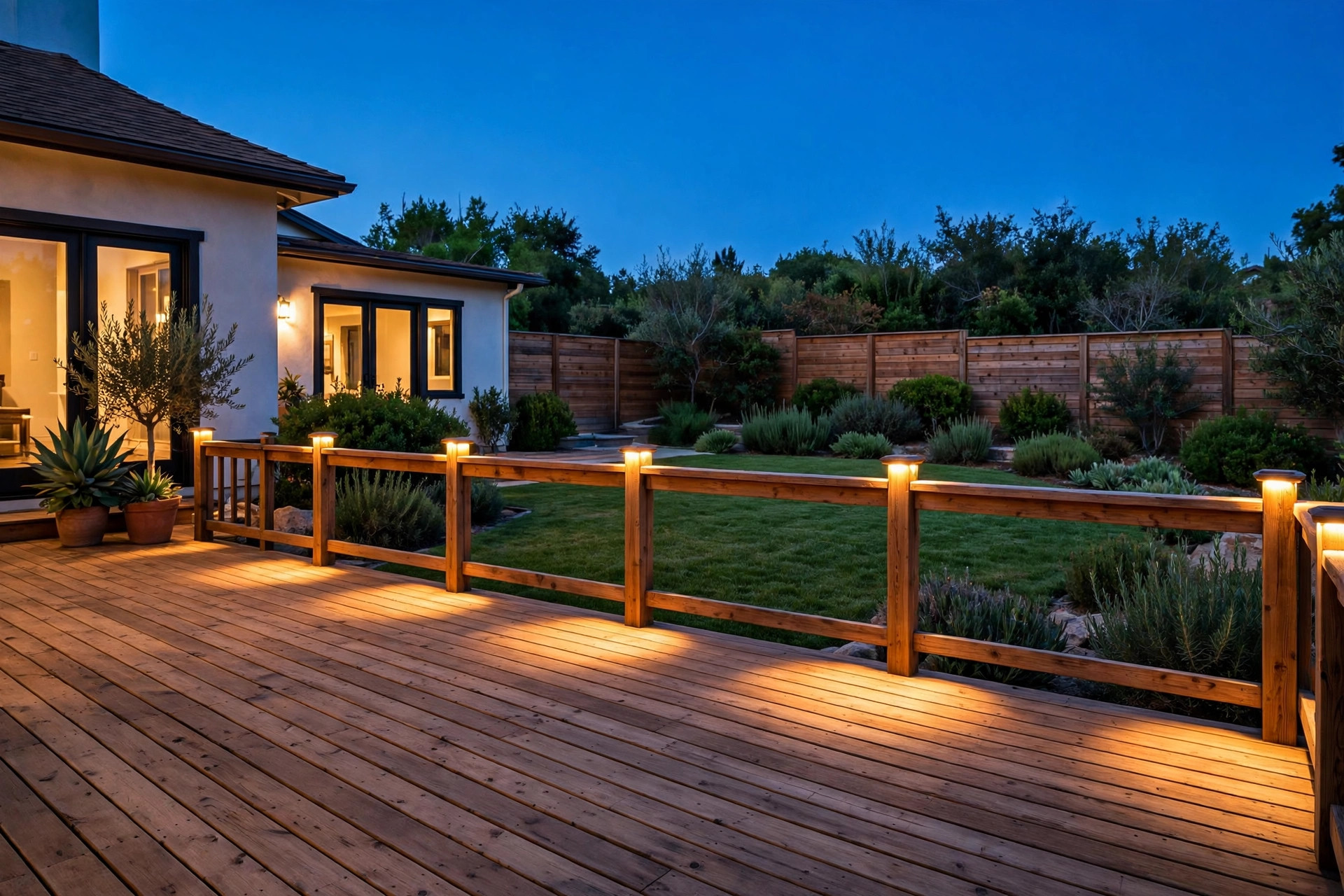

Many evenings in California end on the deck. The sun drops behind the hills. Dinner moves outside. Friends stay late. Then the yard turns dark, and the deck becomes hard to use. Deck cap lights solve this simple problem. They are small lamps that sit on top of deck posts. They cast soft light down the posts and across the deck boards. They make the space safer and far more pleasant after sunset.
This guide covers deck cap lights for California homes in the USA from start to finish. It explains why they matter, how to choose them, what they cost, how to put them in, and how to care for them. It also answers common questions that homeowners ask before they buy.
Why Deck Cap Lights Matter
A deck without light is a dark platform. Steps disappear. Edges vanish. Guests stumble. Children trip. A few small lamps change all of that. Deck cap lights mark each post with a warm pool of light. The outline of the deck becomes clear. People see where to walk and where the steps begin.
Safety is the first reason to install them. The second is beauty. Low light along the railing gives a deck a calm, finished look. It is the difference between a plain backyard and an evening retreat. The third reason is use. A lit deck gets used more often. Barbecues run later. Conversations last longer. The home gains living space without any new construction.
California decks see heavy use most of the year. The climate stays mild. Outdoor living is part of daily life in much of the state. Lighting that works well in this setting pays for itself in comfort. Homeowners who read guides from The Spruce often find that small outdoor lamps rank high on their lists of simple improvements with real daily value.
How to Choose the Right Lights: Deck Cap Lights California Homes Usa
Buying deck cap lights is easy when you know what to check. Start with five points: fit, brightness, color, power source, and weather rating.
Fit and Size
Deck cap lights must fit your posts. Most American decks use four-by-four or six-by-six posts, and California homes are no exception. Measure the top of your posts before you shop. Many lights come in common sizes, and some include adapter rings for odd sizes. A loose cap will rattle in the wind. A cap that is too small will not seat at all. Retailers like The Home Depot and Lowe’s list post-size fit clearly on their product pages, so check that line before you add anything to your cart.
Brightness and Color
Brightness in deck cap lights is modest by design. These are accent lamps, not floodlights. Look for a soft glow that marks the post and lights a small area around it. Too bright, and the light will hurt your eyes and bother the neighbors. Warm white is the most popular color. It flatters wood and skin. Cool white looks modern but can feel harsh outdoors. Many owners pair their deck lamps with smart Wi-Fi bulbs for your home on the patio to keep the whole yard in one warm tone.
Solar or Low Voltage
Most deck cap lights come in two power types. Solar lights carry a small panel on top. They charge by day and glow by night. They need no wiring. Low-voltage lights connect to a transformer that plugs into an outdoor outlet. They give steady, brighter light every night.
Solar lights suit sunny California yards well. Most of the state gets strong sun for most of the year. But trees and shade can starve a solar panel. If your deck sits under a big oak, solar caps may fade before midnight. Low-voltage lights avoid that problem. They cost more to install but shine reliably. The U.S. Department of Energy notes that low-voltage LED landscape lighting uses very little power, so the running cost stays small.
Types of Deck Cap Lights
Manufacturers sell several styles. Each has its fans.
Classic flat caps are low squares or rounds that sit nearly flush on the post. They give a clean, modern look. They suit newer decks with straight lines.
Tiered caps stack two or three plates with a small gap between them. Light spills out through the gaps. They look traditional and decorative. They suit wood decks with a classic style.
Pyramid caps rise to a point. Some include a small lamp under the point. They shed rain well and suit craftsman and ranch houses common across California.
Post lanterns are taller. They look like small lanterns on the post top. They throw more light and make a stronger statement. They work well on entry posts and stair newels.
Downlight caps aim the light straight down the post. They create a column of light on each post and a soft circle on the deck floor. Many owners prefer this style for its quiet, even look.
Materials matter too. Plastic caps cost the least and resist rust, but cheap plastic can crack after years of sun. Metal caps in aluminum or powder-coated steel last longer and look finer. Copper caps develop a natural patina that many California homeowners love, though they cost more. Specialty shops like Lumens and Lamps Plus carry higher-end metal and copper options for those who want them.
Cost and Price
Deck cap lights cover a wide price range. Basic solar plastic caps sell for a few dollars each. Mid-range solar or low-voltage LED caps run ten to thirty dollars each. Premium metal, copper, or designer caps can cost forty dollars or more per light.
A typical California deck has eight to sixteen posts. Do the math before you buy. Sixteen mid-range lights at twenty dollars each come to three hundred and twenty dollars. That is before wiring supplies if you choose low voltage. A low-voltage transformer and cable add fifty to one hundred and fifty dollars for a small system.
Installation is the other cost. Solar caps install with screws in minutes, so most owners do it themselves. Low-voltage systems take more work: a transformer, buried or clipped cable, and connections at each post. A handy owner can finish it in a day. An electrician will charge a few hundred dollars for the same job. Even so, the total project stays modest next to most deck upgrades. For ideas on matching fixtures across the whole yard, owners often browse lighting makers like Philips to see how deck, path, and porch lights can share one style.
Installation Basics
Plan before you drill. Count your posts. Decide which posts get lights. Many owners light every post for an even look. Others light every other post to save money. Either works. Stair posts and entry posts deserve lights first, since steps need the most visibility.
For solar caps, the work is simple. Clean the post tops. Set the cap in place. Drive the screws through the pre-drilled holes. Make sure the solar panel faces the sky and not the house wall. Clear any leaves that shade the panel.
For low-voltage caps, start at the outlet. Mount the transformer near an outdoor outlet, above the reach of sprinklers. Run the cable along the deck frame to each post. Most systems use a simple two-wire cable that clips or staples under the rails. Connect each light with the supplied connectors. Keep connections off the ground and out of standing water. Plug in the transformer and test at dusk. Adjust any light that looks crooked.
Work slowly and check local rules. Some California cities and homeowners’ associations limit outdoor light brightness or hours to protect the night sky and neighbors. A quick call to the city planning desk can prevent a costly redo.
Care and Upkeep
Deck cap lights ask for little care, but a little care keeps them bright for years.
Clean the lenses once or twice a year. Dust, pollen, and spider webs dim the light. A soft cloth and mild soap do the job. Avoid harsh cleaners on plastic lenses; they can cloud the surface.
Check solar panels each spring. Wipe them clean so they charge fully. Trim branches that grew over them during the year. Replace the small rechargeable batteries every two to three years, or when a light fades early. Most solar caps use standard sizes you can find at any hardware store.
Check low-voltage systems each year. Look at the cable for cuts from lawn tools or chewing pests. Tighten any loose connectors. Make sure the transformer stays dry and its vents stay clear. Replace any lamp that has gone dim; LEDs last long but not forever.
After storms, walk the deck and look at each cap. Wind can loosen screws. Hail can crack cheap plastic. A five-minute check after bad weather prevents small problems from growing.
Safety
Deck cap lights are low-voltage or solar, so they carry little electrical risk. Still, follow basic rules.
Buy lights listed by a recognized testing lab. The listing mark shows on the box or the fixture. It means the product passed safety tests. Outdoor fixtures should carry a rating for wet locations. The U.S. Consumer Product Safety Commission warns that outdoor electrical products must suit their setting, so do not use indoor-only lights on a deck.
Keep transformers and connections dry. Do not run cable where cars or mowers can hit it. Do not overload a transformer beyond its rated wattage; add up your lamps and stay under the limit. If you must run cable through soil, bury it at the depth the instructions state.
Solar lights get warm but not hot. Low-voltage LED lamps stay cool to the touch. Even so, keep flammable material like dry leaves away from every fixture. California summers bring fire season, and dry debris near any electrical device is a poor mix.
For general guidance on efficient outdoor lighting, ENERGY STAR offers plain-language advice on choosing lamps that use less power and last longer.
Frequently Asked Questions
How many deck cap lights do I need? Count your railing posts. Most owners light all of them for an even ring of light. On a long deck, every other post can look fine and cuts the cost. Always light the posts at the top and bottom of stairs.
Do solar deck cap lights work on cloudy days? They work, but weaker. The panel stores less charge, so the light may dim earlier. In most of California this is a minor issue, since cloudy stretches are short. In shaded or coastal fog zones, low-voltage lights give more dependable results.
Will deck cap lights bother my neighbors? They should not, if you choose modest brightness and warm color. Point the light down, not out. Avoid cool white lamps that throw a harsh glare. Many California neighborhoods value dark skies, so keep the glow gentle. Readers comparing regional styles sometimes look at deck cap lights for Texas homes to see how builders in sunnier states handle the same question.
Can I mix deck cap lights with other outdoor lights? Yes. Many owners combine them with step lights, path lights, and porch lamps. Keep the color temperature consistent so the yard looks planned, not patched. A sensor porch lights guide for American homes can help you match the entry lighting to your new deck lamps.
How long do deck cap lights last? Quality LED caps last five to ten years or more. The LED itself often outlives the housing. Cheap plastic housings may crack in three to five years under strong sun. Metal housings last much longer. Solar batteries need replacement every few years, which is normal and cheap.
Do I need a permit to install deck cap lights? Usually not for solar caps or plug-in low-voltage systems, since no new house wiring is involved. Rules vary by city. If your project ties into the home’s electrical panel or runs new circuits, check with your local building department first.
A Final Word
Deck cap lights are a small project with a large payoff. They make the deck safer after dark. They make it more beautiful. They invite the family outside on warm California evenings. Choose the right size, pick warm light, and match the power type to your yard’s sun and shade. Install them with care, keep them clean, and they will glow for years. A deck that shines at night is a deck that gets used, and in California, that is the whole point of having one.
References
ENERGY STAR. (n.d.). Energy efficient products. https://www.energystar.gov Lamps Plus. (n.d.). Lighting and home decor. https://www.lampsplus.com Lowe’s. (n.d.). Home improvement products. https://www.lowes.com Lumens. (n.d.). Lighting and ceiling fans. https://www.lumens.com Philips. (n.d.). Lighting products. https://www.philips.com The Home Depot. (n.d.). Home improvement products. https://www.homedepot.com The Spruce. (n.d.). Home and garden advice. https://www.thespruce.com U.S. Consumer Product Safety Commission. (n.d.). Product safety information. https://www.cpsc.gov U.S. Department of Energy. (n.d.). Energy efficiency and renewable energy. https://www.energy.gov
Was this guide helpful?

About Robert Taylor
The My Garden US editorial team writes practical, in-depth home and garden guides for American homeowners — tested advice, no fluff.
You May Also Like
Vanity Light Bars: A Practical Guide for American Homes
June 8, 2026 0 views
A Complete Guide to Outdoor Wall Lanterns for American Homes
January 22, 2026 0 views
Dining Room Chandeliers for Sale USA: A Plain Buying Guide
June 30, 2026 0 views