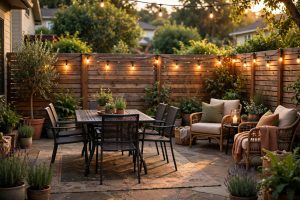

A warm glow under a patio umbrella can change the whole evening. The best solar umbrella lights for patio spaces charge all day from the sun and switch on by themselves when the light fades. There is no wiring to run, no electrician to call, and no power bill to pay. This guide explains how these lights work, what to look for when you shop, and how to keep them shining for years.
Why the Best Solar Umbrella Lights for Patio Spaces Are Worth It
Evening is the best time to use a patio. The heat of the day is gone. Dinner tastes better outdoors. Talks run longer. But without light, the party ends at sunset. A patio umbrella that stands up to wind gives you shade by day. Add solar lights to it, and you get a lit outdoor room by night.
Solar umbrella lights attach to the pole or the ribs of your patio umbrella. Most use small LED bulbs. A solar panel on top of the umbrella, or built into the light itself, collects sunlight during the day. A small battery stores the power. A light sensor turns the bulbs on at dusk and off at dawn. The whole system is self-contained. You do not need to be handy to set one up.
Cost is another reason these lights are popular. Basic models cost less than a dinner out. Even good quality sets are modest in price. After you buy them, the fuel is free. LED bulbs draw very little power, so a single day of sun can give you six to ten hours of light. Compare that with hiring someone to run outdoor wiring, and the savings are clear.
Comfort matters too. Harsh floodlights can make a patio feel like a parking lot. Solar umbrella lights give soft, warm light close to where people sit. It is enough to read by, eat by, and talk by. The warm tone flatters faces and food. It draws insects far less than a bright porch light, which is a real gift on summer nights.
How Solar Umbrella Lights Work: Best Solar Umbrella Lights for Patio
Every set has three parts. The solar panel turns sunlight into electricity. The rechargeable battery stores it. The LED bulbs turn it back into light. Most sets use lithium-ion batteries, which hold more charge than older nickel types. LEDs use very little energy, so the stored power lasts long into the night.
A photo sensor, sometimes called a dusk-to-dawn sensor, watches the light level. When the sun sets, the sensor closes a switch and the bulbs come on. At sunrise, they go off again. Many models have an on/off switch as well, so you can leave them off when you travel. Some have a mode button that changes the brightness or sets a timer.
The panel needs direct sun to charge well. A panel on top of the umbrella gets the most sun, since it sits high and clear. Clip-on panels that hang on the ribs also work, as long as no tree branch or roof shades them. Six hours of good sun is the common target for a full charge. In winter, shorter days mean less run time. That is normal and not a sign of a fault.
Types of Solar Umbrella Lights for Your Patio
String Lights on the Ribs
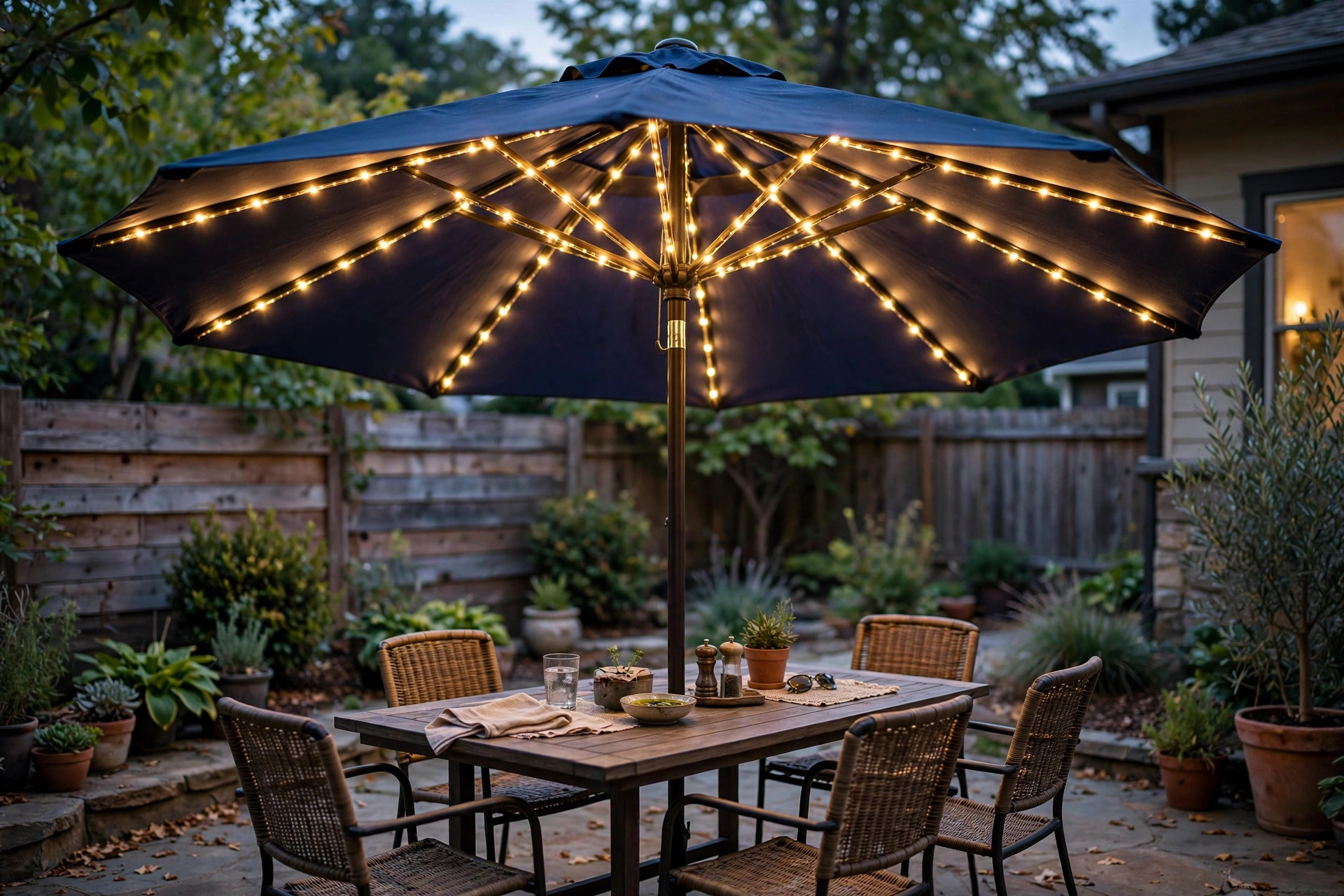
These are the most common type. Tiny LED bulbs on a thin wire string follow each rib of the umbrella. Clips hold the wire in place. When lit, the umbrella looks like a star burst of light. The effect is soft and pretty. Strings usually run on one central battery box that clamps to the pole.
Ring or Puck Lights on the Pole
These clamp around the umbrella pole under the canopy. They shine down on the table like a pendant lamp. This style gives the strongest task light, good for reading or playing cards. Some models come with a separate solar panel on a cord, so you can place the panel where the sun is best.
Integrated Umbrella Lights
Some patio umbrellas come with built-in solar lights. The panel sits on top of the finial. The bulbs sit in the ribs from the factory. If you are buying a new umbrella, this is the simplest choice. If you already own an umbrella, add-on kits do the same job for less money.
Lantern Style Accents
Small solar lanterns that hang from the umbrella hub add a decorative touch. They give less light than strings or rings, but they look charming. Many people pair one lantern with a brighter ring light for both beauty and function.
For the rest of the yard, you may want solar patio lights that build ambiance along paths and beds. They use the same sun-powered idea and pair well with umbrella lights.
What to Look for When You Choose
Brightness and Color Temperature
Brightness is measured in lumens. For a table setting, look for a total of 100 to 200 lumens. That is bright enough to see plates and cards without glare. Color temperature is measured in kelvin. Warm white, around 2700 to 3000 kelvin, feels cozy. Cool white, above 5000 kelvin, feels clinical. For a patio dinner, warm white is the clear winner.
Battery Capacity and Run Time
Check the run time the maker states. Good sets promise six to eight hours on a full charge. Read user reviews to see if the promise holds. A bigger battery, often listed in milliamp hours, usually means longer run time. Lithium-ion cells are the best choice for most buyers.
Solar Panel Size and Placement
A larger panel charges faster. A panel that sits on top of the umbrella gets unshaded sun. If your patio is partly shaded, look for a model with a panel on a cord that you can move into the sun. This one feature can double your run time.
Fit and Mounting
Measure your umbrella pole before you buy. Most poles are about one and a half inches thick. Clamps made for that size fit most market and cantilever umbrellas. Rib lights need a rib to clip to. If your umbrella is a side table model with an umbrella hole, make sure the light clamp does not block the pole where the table sits.
Weather Rating
Outdoor lights get wet. Look for an IP rating, which tells you how well the unit resists water. IP44 means it handles splashes. IP65 means it handles rain well. For a product that lives under an umbrella, IP44 is enough in most places. In storm country, higher is better. Check what Consumer Reports says about outdoor product durability when you compare brands.
Modes and Controls
Simple is fine. An on/off switch and a dusk sensor cover most needs. Some models add a timer or two brightness levels. Avoid models with fussy remote controls unless you truly need them. The best light is the one you never have to think about.
Cost and Price Ranges
Solar umbrella lights are kind to budgets. Simple string sets cost around ten to twenty dollars. Mid-range ring lights with larger batteries cost twenty to forty dollars. Premium sets with metal housings and big panels can cost fifty dollars or more.
Price usually tracks quality. Cheap sets often have small panels and weak batteries. They may glow for three hours and fade. Mid-range sets give the best value for most patios. They charge well, run all evening, and last several seasons. Premium sets make sense for large umbrellas or for people who entertain often.
Running cost is zero. The sun is free. LED bulbs last for years and rarely need replacement. The battery is the part that wears out first, usually after two or three years. Many models let you swap in a new rechargeable battery, which costs a few dollars. This small repair can double the life of your lights.
Retailers like The Home Depot and Lowe’s carry wide selections in stores and online. Wayfair and Article offer curated outdoor lines. Specialty outdoor brands such as Polywood and Frontgate sell higher-end patio gear that pairs well with good lighting.
Installing Your Solar Umbrella Lights
Installation takes minutes. Most people need no tools. Start with a full charge. Place the solar panel in direct sun for a full day before the first use. Many batteries arrive half empty from the warehouse. A full first charge trains the battery and gives the best early performance.
For rib string lights, open the umbrella fully. Clip the strings along each rib from the hub outward. Keep the wire snug but not tight. Mount the battery box on the pole where it is easy to reach. For pole ring lights, clamp the ring just under the canopy. Aim the bulbs down at the table. For models with a corded panel, run the cord up the pole and lay the panel on top of the umbrella or stake it in a sunny spot nearby.
Test at dusk. Cover the solar panel with your hand to trick the sensor if you test in daylight. The lights should switch on. If they do not, check the switch position. Most models have an on position and an auto position. Auto is the setting you want for dusk-to-dawn use.
Keep cords clear of the crank and tilt mechanism. The umbrella still needs to open and close. Give the wire a little slack near moving joints. This small care step prevents most failures.
Care and Upkeep Through the Seasons
Solar lights are low care, not no care. A dirty panel charges poorly. Wipe the panel with a damp cloth every month or two. Dust, pollen, and bird droppings all block sun. A clean panel can add an hour or more of run time.
Take the lights down before big storms if you can. Umbrellas fold, but lights are easy to forget. Strong wind can rip clips off ribs. Hail can crack a panel. Five minutes of care before a storm saves the cost of a new set.
In fall, wipe everything down before storage. Remove the batteries if the model allows it. Store the lights in a dry place for winter. Cold does not hurt LEDs, but it shortens battery life. If you leave them out in a mild climate, they will still work, just for fewer hours. Bob Vila and The Spruce both publish good seasonal checklists for patio gear that apply here.
Every year or two, replace the rechargeable batteries. When run time drops below three hours on a full charge, the battery is spent. Match the battery type and size printed on the old cell. Never use throwaway alkaline batteries in a solar light. They can leak and they will not recharge.
Safety Tips
Solar umbrella lights are among the safest outdoor lights you can buy. They run on low voltage. There is no mains power, no extension cord, and no shock risk in the rain. Still, a few habits keep things safe.
Buy lights from known sellers. Very cheap no-name sets can have poor battery protection. A good battery has a circuit that stops overcharge. Look for this in the product description. Do not puncture or crush a lithium battery. If a battery swells or smells sweet and sharp, stop using it and recycle it.
Keep lights away from open flame. A candle on the table under a ring light is fine at a safe distance, but do not let flame touch plastic housings. For grilling areas, give the lights space from the grill hood, which throws serious heat.
If you run a corded panel, lay the cord where no one trips. Along the pole and across the umbrella top is best. Never run a cord across a walkway. These are small habits, but they matter.
Frequently Asked Questions
Do solar umbrella lights work in cloudy weather?
Yes, but for fewer hours. Panels still collect some energy on overcast days. Expect roughly half the normal run time after a cloudy day. After two or three dark days in a row, the lights may stay dim or skip a night. This is normal. A sunny day resets them.
How long do the batteries last?
Most rechargeable batteries last two to three years with regular use. Signs of age are short run time and dim light even after sunny days. Replacement batteries are cheap and widely sold. Swapping them takes a minute.
Can I leave the lights on the umbrella all winter?
You can in mild climates, but storage is better in cold ones. Freezing temperatures wear batteries down faster. If you store them, bring the whole set indoors to a dry shelf. Leave the switch off.
Will the lights fit a cantilever or offset umbrella?
Many will. Ring lights clamp to any pole of the right thickness. Rib strings need ribs, which cantilever umbrellas have. The challenge is the solar panel, which may sit tilted on an offset canopy. Models with a corded panel work best here, since you can place the panel flat in the sun.
Are solar umbrella lights bright enough to read by?
A good ring light with 150 lumens or more is bright enough for comfortable reading at the table. String lights alone are softer and better for mood than for tasks. If reading matters, choose a pole-mounted ring or puck style, or pair strings with one brighter light.
Do these lights attract bugs?
Warm white LEDs draw far fewer insects than cool white bulbs or old incandescent porch lights. They do not eliminate bugs entirely, but most patio owners notice a clear improvement. Citronella candles still help on heavy bug nights.
A Short Final Word
The best solar umbrella lights for patio evenings do one job well. They turn your umbrella into a lamp that feeds on sunshine. Choose warm white light, a panel that sees real sun, and a battery big enough for your evening hours. Install it in minutes, wipe the panel now and then, and swap the battery when it tires. For a small price and zero wiring, you gain hours of outdoor time every single night. That is a trade any patio owner should take.
References
Article. (n.d.). Modern furniture. https://www.article.com Bob Vila. (n.d.). Home improvement advice. https://www.bobvila.com Consumer Reports. (n.d.). Product reviews and ratings. https://www.consumerreports.org Frontgate. (n.d.). Outdoor furniture and decor. https://www.frontgate.com Lowe’s. (n.d.). Home improvement products. https://www.lowes.com Polywood. (n.d.). Outdoor furniture. https://www.polywood.com The Home Depot. (n.d.). Home improvement products. https://www.homedepot.com The Spruce. (n.d.). Home and garden advice. https://www.thespruce.com Wayfair. (n.d.). Furniture and home goods. https://www.wayfair.com
Was this guide helpful?

About Sarah Mitchell
The My Garden US editorial team writes practical, in-depth home and garden guides for American homeowners — tested advice, no fluff.
You May Also Like
Outdoor Shoe Storage Bench for Porch: A Practical Buying Guide
January 12, 2026 0 views
Outdoor Pouf for Patio Seating Reviews: What Buyers Say Before You Buy
March 21, 2026 0 views
Best Outdoor Bench for Garden Reviews: A Practical Buyer’s Guide
September 19, 2026 0 views