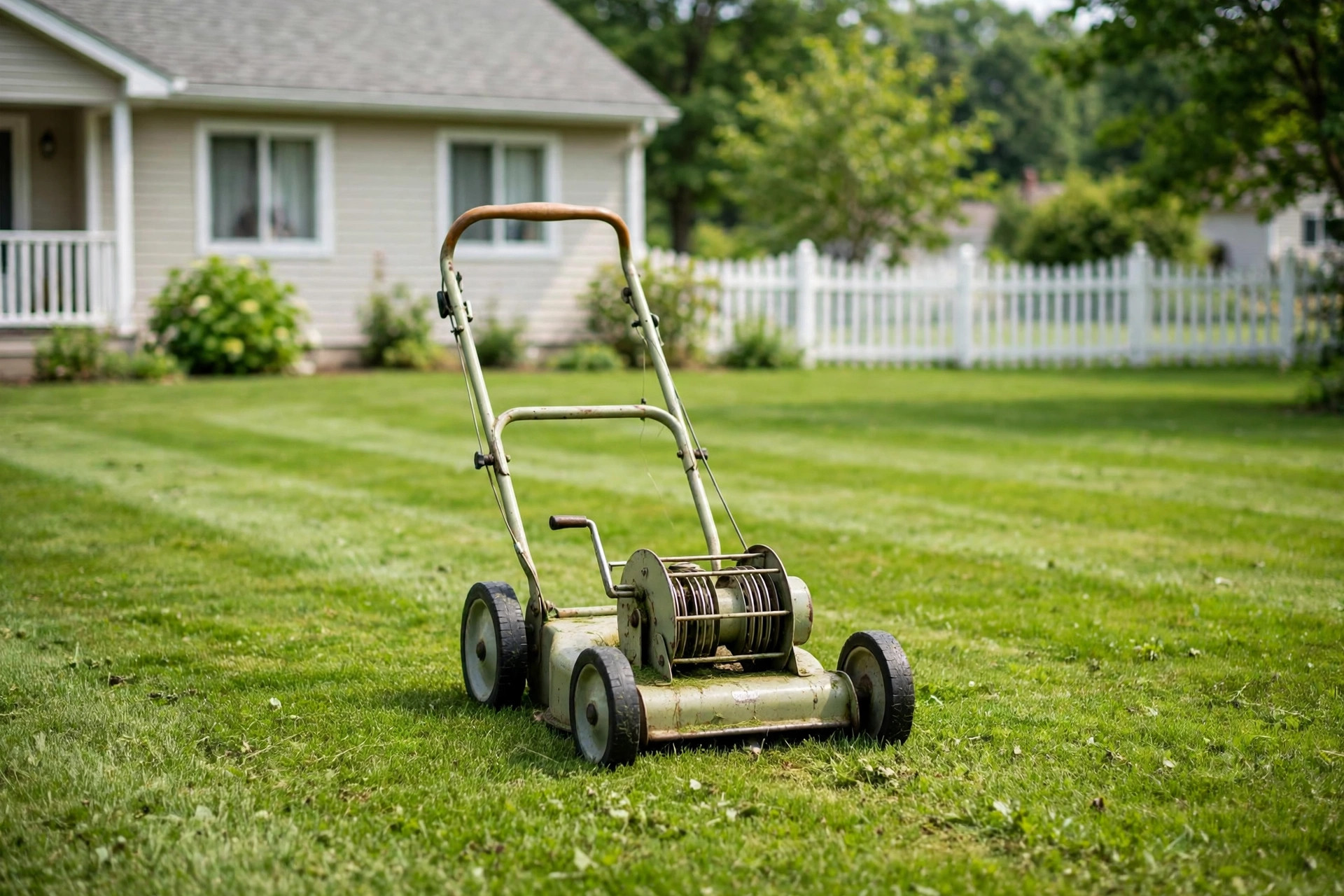

A Simple Machine That Still Does the Job
A reel mower is one of the oldest tools in lawn care. It has no engine. It has no cord. It cuts grass with a set of curved blades that spin as you push. For a small yard, this simple tool can be the best reel mower for small lawns in terms of value, quiet work, and clean cuts.
Many homeowners buy gas mowers out of habit. Then they learn that a small lawn takes only twenty minutes to mow. The gas mower is loud. It needs oil, fuel, and spark plugs. It is heavy to lift in and out of the garage. A reel mower solves all of this. You push it. It cuts. You hang it on the garage wall when you are done.
This guide will help you find the best reel mower for small lawns. It covers how these mowers work, what features matter, the main types, costs, upkeep, and safety. It ends with answers to common questions.
Why a Reel Mower Suits a Small Lawn: Best Reel Mower for Small Lawns
The Right Size for the Job
A small lawn is usually under 8,000 square feet — a yard you can mow in half an hour. A powered mower is more than the job needs. A reel mower matches it: you walk at your own pace, hear the birds, and never wake the neighbors. It is also lighter to lift and easy to hang on the garage wall.
A Kinder Cut
Rotary mowers tear grass with a fast blade. A reel mower cuts like scissors: the spinning reel pushes each blade of grass against a fixed bedknife. Clean cuts heal faster, lose less water, and resist disease better. If you want a green lawn without chemicals, a clean cut is a good start.
No Fuel, No Fumes, No Noise
Reel mowers run on human power. There is no gas can, no oil change, no spring tune-up — just a soft swish as you walk. You can mow early or late without worry, and the mower is always within town noise rules. Pushing it is also steady, pleasant exercise.
How a Reel Mower Works
A reel mower holds a drum of curved blades, usually three to seven, between two wheels. When the wheels turn, the blades turn faster, sweeping past a fixed straight blade called the bedknife. Grass caught between them is snipped like scissors. A steady walking pace gives a good cut — no hard pushing needed. Most reel mowers cut from one to three inches, set with small levers at the wheels. Reel mowers work best on lawns mowed often; very tall or wet grass can jam the blades, so mowing once or twice a week keeps the job easy.
What to Look for When You Buy
Cutting Width
Reel mowers for home use come in widths from about 14 to 20 inches. A wider mower covers ground faster. A narrower mower is lighter and turns more easily around flower beds. For a small lawn, 16 to 18 inches is a good middle ground.
Blade Count
A five-blade reel gives a finer cut for soft, dense lawns. A seven-blade reel is for very fine turf, like a putting green. For most homes, a five-blade model is the best reel mower for small lawns.
Height Range
Look for a mower that adjusts from at least one inch to three inches. Cool-season grasses like fescue do best near three inches. Warm-season grasses like bermuda can go lower. A wide range lets you set the height for your grass type and the season.
Weight and Build
A good reel mower weighs between 15 and 25 pounds. Steel frames last longer than plastic ones. Look for blades made of hardened steel. Check that the handle is long enough for your height. You should be able to push with your back straight.
Wheels and Traction
Large wheels roll over bumps and thick grass better. Some mowers have a front roller bar instead of small caster wheels. A roller bar leaves clean lawn stripes and helps the mower ride over uneven ground. If your yard has dips and roots, choose bigger wheels or a roller.
Grass Catcher or Not
Some reel mowers come with a catch bag. Others do not. Catching clippings gives a very neat look. Leaving them feeds the lawn with nitrogen. Most lawn experts say leaving clippings is better for the grass. If your home group wants a spotless look, a bag helps.
Types of Reel Mowers
Push Reel Mowers
This is the classic kind. You push it by hand. It is the cheapest option, often under 150 dollars, and the lightest. For a small flat lawn, a push reel mower is all you need.
Powered Reel Mowers
These use a small electric motor to spin the blades while you walk behind. They cost more, usually 300 to 600 dollars, and handle taller grass and slight slopes better.
Gang Reels and Antiques
Gang reels — reel units pulled behind a tractor — are for large lawns and sports fields, too much for a small yard. Used cast-iron antiques are tough but heavy; check the blades and the spin before you buy, since a new light model often cuts better for less money than a rebuild.
How a Reel Mower Compares to Other Mowers
It helps to see where a reel mower stands next to other choices.
A walk behind mower with grass catcher sale will cut tall or wet grass faster. Gas and electric rotary mowers also edge better along driveways. But they cost more to run. They need blades sharpened or replaced. They make noise. For yards under a quarter acre, the reel mower often wins on cost and peace.
A robot lawn mower for half acre yards mows by itself. That is a big plus for busy people. But robot mowers cost ten times more than a reel mower. They need wire or GPS setup. A reel mower needs nothing but you.
If you keep lawn mower blade sharpening service near me in mind, note that reel mowers also need blade care. It is just simpler and cheaper. We will cover it below.
Cost and Price
New push reel mowers cost between 80 and 250 dollars; the best-known brands sit near 120 to 180 dollars, and review sites like Consumer Reports can help you compare models. Powered reel mowers start near 300 dollars. Makers like Briggs & Stratton build the small engines used in powered outdoor equipment.
Running cost is near zero. There is no gas or oil. There is no air filter or spark plug. Blade care costs little. A sharpening kit is about 25 dollars. A shop sharpening costs 30 to 60 dollars and is needed every one to three years.
Compare this to a gas walk-behind mower. The mower itself costs 250 to 400 dollars. Fuel and oil add 30 to 60 dollars a year. Tune-ups add more. Over ten years, the reel mower can save you several hundred dollars.
Used reel mowers sell for 20 to 80 dollars. Check the blades for deep rust or chips, and spin the reel by hand: it should turn smooth and snip lightly against the bedknife. If it binds or has gaps, plan on a rebuild or a new mower.
Setting Up Your Reel Mower
Assembly is simple. Most models need only a wrench and twenty minutes. Do not over-tighten the handle bolts. Set the cutting height on a flat drive, starting at two and a half to three inches. Check the blade gap with the paper test: slide paper between a reel blade and the bedknife, turn the reel by hand, and each blade should cut cleanly. Adjust per the booklet if it tears. Walk the yard before each mow and pick up sticks, stones, and toys, since a reel mower jams on sticks and chips blades on stones.
Mowing With a Reel Mower
Walk at a Steady Pace
Push at a normal walking speed. Do not run. A steady pace lets the blades snip every blade of grass. If you see streaks of uncut grass, slow down. Do not push harder. Speed does not help. Smooth motion does.
Overlap and Direction
Overlap each pass by two or three inches for clean edges, and change direction each week — north-south one week, east-west the next — to stop ruts and keep the grass standing straight.
Frequency and Moisture
Mow when the grass is about one third taller than your set height — usually every five to seven days in spring. Never let the grass get so tall that the mower rides over it. Always mow when the grass is dry; wet grass clumps, sticks to the blades, and cuts poorly. Wait until the morning dew dries, or a day after rain.
Handle Slopes With Care
Gentle slopes are fine. Steep slopes are hard work and can be unsafe. Push across the slope, not straight up and down, if you must mow it. Keep your footing. If the slope is steep, use a string trimmer for that part instead.
Care and Upkeep
Clean After Each Mow
Brush or hose the grass off the blades and wheels. Do not leave clippings on the mower. Wet clippings cause rust. Wipe the blades dry if you rinsed them. This takes three minutes and adds years to the mower.
Keep the Blades Sharp
Sharp blades are the whole game. Dull blades bend grass instead of cutting it, leaving brown tips and ragged edges. Run the paper test every month in mowing season, touch up with a 25-dollar sharpening kit when the cut gets rough, and plan a full sharpening every one to three years.
Safety and Upkeep Extras
Sharpening a reel mower is easy: paint lapping compound on the blades and spin the reel backward with a drill or crank, as the booklet shows. A local lawn mower blade sharpening service near me search will find shops, and reel work usually costs less than rotary work. Oil the wheel gears and height adjusters twice a season, and store the mower dry with the blade gap loosened for winter.
Safety
Reel mowers are safer than powered mowers — the blades only move when you push, and there is no engine to start by accident. Still, respect the sharp blades:
– Keep hands and feet away from the reel. Never reach under the mower. – Wear closed shoes, clear the yard of sticks and stones first, and keep children and pets at a distance. – Never unjam blades with your fingers. Stop, pull the mower back, and clear it with a stick. – Store the mower where small children cannot reach the blades.
Makers of lawn equipment post safety tips on their sites. Toro posts mower safety guides on its home page. John Deere also shares lawn care and safety notes on its home page.
Mowing Through the Seasons
In spring, the reel mower shines: mow every five to seven days and keep cool-season grass near three inches. In summer heat, raise the height, water deep and rare, and mow in the cool of the morning or evening. In fall, keep mowing until growth stops and clean the mower before storage. In cold states it rests for winter; in warm states, keep mowing slowly at a higher height.
Common Mistakes to Avoid
Waiting too long between mows. Tall grass jams the reel. Mow on schedule.
Setting the height too low. Scalping the lawn stresses the grass. It lets weeds in. Higher is healthier.
Mowing wet grass. It cuts badly and clumps. Wait for dry grass.
Ignoring dull blades. Brown tips mean dull blades. Sharpen them.
Forgetting yard cleanup. One hidden stick can chip a blade. Walk the yard first.
Pushing too fast. Speed does not cut better. A steady walk does.
Who Should Buy a Reel Mower
A reel mower fits small, fairly flat yards mowed weekly, and owners who like quiet, low-cost yard work. It is not the best choice over a half acre, on steep hills, or when travel lets the grass grow tall — a powered mower makes more sense there. For most small lawns, it is hard to beat: cheap to buy, almost free to run, a clean cut, and years of service. Sometimes the oldest tool is still the smartest one.
FAQ
How long does it take to mow a small lawn with a reel mower?
A yard of 2,000 to 3,000 square feet takes about twenty to thirty minutes. Larger small yards near 8,000 square feet take about forty-five minutes. Your pace and the grass height matter most.
Can a reel mower cut thick or tall grass?
It cuts thick grass if you mow often. It struggles with grass that is very tall or gone to seed. If the grass got away from you, cut it high with a rotary mower first, then keep it up with the reel mower.
Do reel mowers work on all grass types?
They work well on most common lawn grasses. Fine grasses like fescue and bluegrass cut beautifully. Coarse grasses like St. Augustine cut fine with a sharp reel. Very bumpy yards are harder, since the wheels must stay level.
How often do reel mower blades need sharpening?
Check them once a month in the season. Most owners sharpen once a year; heavy use may need two. The paper test tells you when — if the blades tear paper, sharpen them.
Are reel mowers good for the environment?
Yes. They make no exhaust and spill no oil or gas. They are quiet, and leaving clippings on the lawn cuts fertilizer use. A reel mower is one of the greenest ways to care for a lawn.
Can I use a reel mower if I am older or not very strong?
Many older owners use them. The mowers weigh 15 to 25 pounds, and pushing is light on flat ground. Try one at a store first. If your yard is flat and small, it should be fine.
A Short Final Word
The best reel mower for small lawns is not a mystery. It is a light, well-built push mower with five blades, a good height range, and a price you can live with. Keep the blades sharp. Mow often. Mow dry grass. Do these things and the mower will give you a clean, quiet, green lawn for years. Sometimes the oldest tool is still the smartest one.
References
Briggs & Stratton. (n.d.). Power products and outdoor power equipment. https://www.briggsandstratton.com Consumer Reports. (n.d.). Product reviews and buying guides. https://www.consumerreports.org Deere & Company. (n.d.). Agricultural and turf equipment. https://www.deere.com Toro. (n.d.). Lawn mowers and landscape equipment. https://www.toro.com
Was this guide helpful?

About Sarah Mitchell
The My Garden US editorial team writes practical, in-depth home and garden guides for American homeowners — tested advice, no fluff.
You May Also Like

Weed Barrier Fabric Reviews for Gardens: What Really Works
March 9, 2026 0 views
Landscaping Fabric Under Mulch: Pros and Cons
February 20, 2026 0 views
How to Remove Tree Roots From Lawn Without Harming the Tree
March 19, 2026 0 views