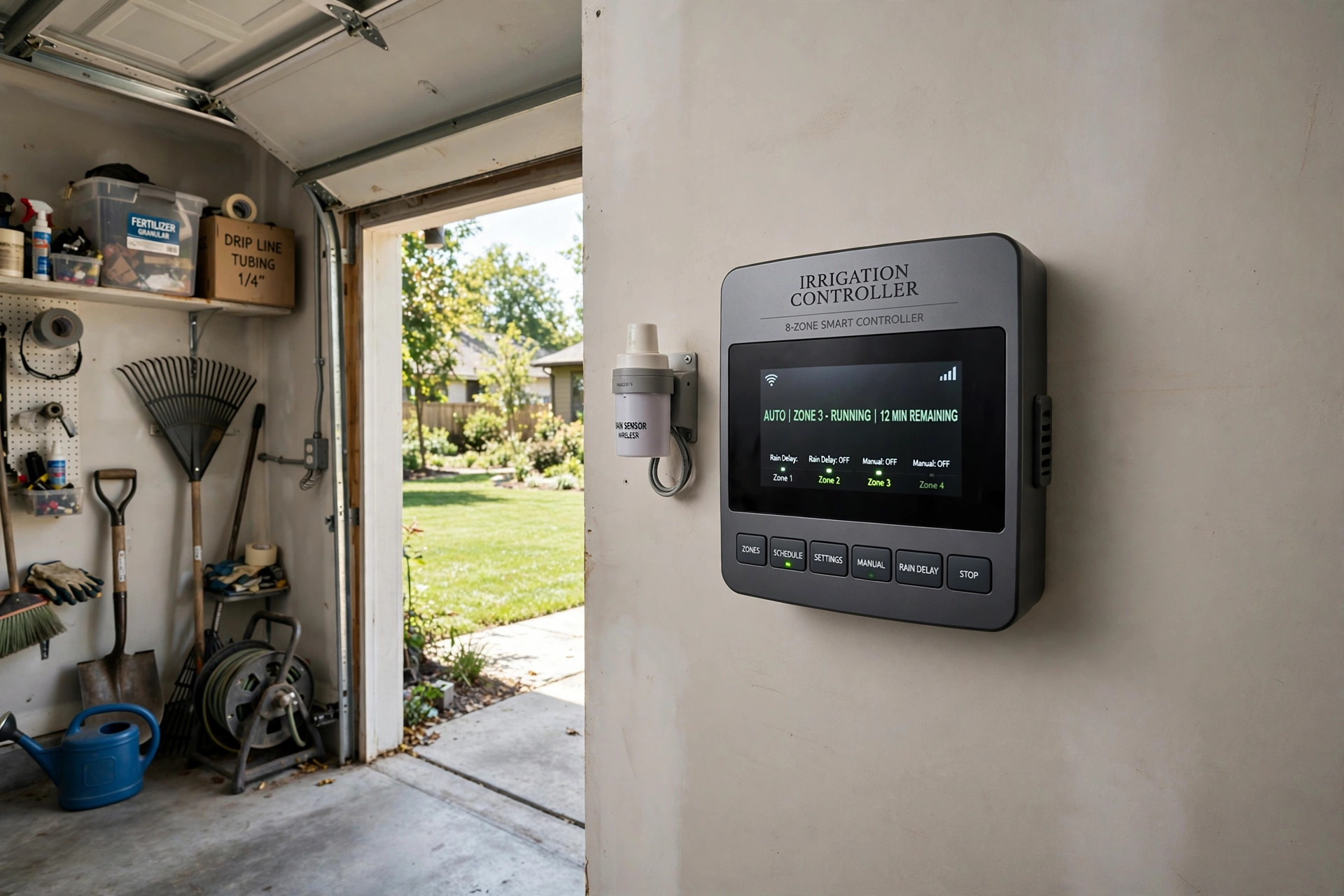
A lawn needs water, but it does not need the same water every day. The best irrigation controller with rain sensor understands this simple fact. It turns sprinklers on and off on a schedule. It also stops the water when rain arrives. The result is a green lawn, lower water bills, and less waste. For many American homeowners, this small device pays for itself in a single summer.
This guide explains what these controllers do, what to look for, what types exist, what they cost, how to care for them, and how to stay safe while installing one. It is written for the ordinary homeowner. No trade skill is needed to follow along.
Why an Irrigation Controller with a Rain Sensor Matters
Water is the largest cost of lawn care for most homes. A sprinkler system that runs on a fixed clock will water on days when rain has already done the job. It will water during a storm. It will water on cool days when the grass needs nothing. Studies by water utilities have found that half of the water used outdoors goes to waste. Much of that waste comes from timers that cannot react to weather.
A rain sensor is a small device, often mounted on a fence post or a gutter. It collects rain in a cup. When the cup fills to a set point, the sensor tells the controller to skip the watering cycle. When the cup dries out, the controller goes back to its schedule.
The benefit is easy to see. The lawn gets water when it needs it. It does not get water when it does not. The water bill drops. The grass grows deeper roots because it is not drowned. Runoff into the street is reduced, which is better for local streams and storm drains. In some cities, a working rain sensor is required by law. Many water districts offer rebates that pay part of the cost of a smart controller.
What to Look For: How to Choose: Best Irrigation Controller with Rain Sensor
Choosing the best irrigation controller with rain sensor for your home starts with a few simple questions.
Number of zones. A zone is a group of sprinklers that turn on together. A small lawn may have four to six zones. A large property may have twelve or more. Count your zones before you shop. Buy a controller that handles at least one or two zones more than you have now. This leaves room for later additions, such as a new flower bed.
Rain sensor included or separate. Some controllers ship with a rain sensor in the box. Others are built to work with a sensor but do not include one. A wireless rain sensor costs about thirty to sixty dollars. A wired sensor costs less but needs a cable run to the controller. If you choose a model without a sensor in the box, make sure the controller has a sensor input port.
Wired or wireless sensor. A wired sensor needs no batteries and rarely fails. The trade-off is the wire itself, which must run from the sensor to the controller. A wireless sensor is easy to mount far from the controller. It needs a battery every one to two years. For most homes, a wireless sensor is the simpler choice.
Weather smarts. Basic models follow a clock and pause for rain. Smart sprinkler controllers for USA homes go further. They pull local weather data through a home Wi-Fi network. They adjust watering for heat, wind, and humidity. They can skip watering when the forecast shows rain. These models cost more. They also save more water.
Ease of use. A good controller has a clear display and simple buttons or a phone app. Some apps are excellent. Some are poor. Read user reviews before you buy, and check independent test results at Consumer Reports. A controller that is hard to program will end up running the wrong schedule, which defeats the purpose.
Power and wiring. Most residential controllers use standard low-voltage valve wiring. Check that your existing valve wires match the controller’s terminal layout. If you are replacing an old controller, take a photo of the old wiring before you remove it. This photo will save you an hour of work.
Types and Options
Irrigation controllers with rain sensors fall into three broad groups.
Clock-style indoor controllers. These are the classic models. They mount inside a garage or a shed. They have a dial or buttons and a small screen. They run a fixed weekly schedule. Paired with a rain sensor, they skip watering after rain. They are the cheapest option. They are also the least flexible. They cannot adjust for heat waves on their own.
Outdoor weather-resistant controllers. These mount on an outside wall. They are built to survive sun, rain, and heat. Many mid-range models in this group accept a rain sensor and can also connect to weather data.
Wi-Fi smart controllers. These are the newest group. They connect to your home network. A phone app runs the schedule. Many pull weather data every day. Most work with a physical rain sensor as a backup. If the internet goes down, the rain sensor still stops the water. These controllers offer the highest savings and the most features. They need a strong Wi-Fi signal at the mounting point.
Within each group, models differ in zone count, display quality, app design, and warranty length. A longer warranty often marks a better-built product. Look for at least two years. The major lawn equipment makers, such as Toro and Deere, publish useful guides to matching controllers with existing valves and sprinkler heads.
Cost and Price
Prices vary by type and zone count. Here is a plain guide to what American homeowners pay.
A basic indoor controller with six to eight zones costs about forty to ninety dollars. A wired rain sensor adds about twenty to forty dollars. A wireless rain sensor adds about thirty to sixty dollars.
An outdoor weather-resistant controller with eight to twelve zones costs about ninety to one hundred eighty dollars. A rain sensor is sometimes included in the box at this price level.
A Wi-Fi smart controller with eight to sixteen zones costs about one hundred fifty to three hundred fifty dollars. A physical rain sensor may still need to be bought separately.
Installation costs depend on whether you do the work yourself. Swapping an old controller for a new one is a simple job. It takes about one hour. The cost is the price of the controller and the sensor. A full lawn sprinkler installation cost estimate runs much higher, often two thousand to five thousand dollars for an average yard, because it includes pipes, valves, sprinkler heads, and labor. If you already have a working system, you only need the new controller. Briggs & Stratton offers background reading on outdoor power and yard equipment that pairs well with a new irrigation setup.
Running costs are low. A rain sensor uses no electricity in the wired form. A wireless sensor uses a small battery each year or two. The controller itself uses a few dollars of electricity per year.
Care and Upkeep
A controller with a rain sensor needs little care. A short check each season keeps it working well.
Spring start-up. In spring, turn the controller back on after winter. Run each zone by hand for two minutes. Watch the sprinklers. Fix broken heads and clogged nozzles. Check that the rain sensor cup is clean and free of leaves. Confirm that the sensor still triggers the skip function. You can test it by pouring a cup of water into the sensor cup and running a manual cycle.
Summer watch. In summer, check the schedule. Grass needs about one to one and a half inches of water per week in most regions. Less is needed in cool months. If the grass is green and firm, the schedule is fine. If brown spots appear, increase run times by ten percent and watch for a week.
Fall shut-down. In cold regions, drain the system before the first hard freeze. Turn off the water to the valves. Run each zone for one minute to push water out. Set the controller to the off or rain mode for winter. This takes ten minutes and prevents burst pipes.
Sensor care. Clean the rain sensor cup once or twice a year. Remove leaves, dirt, and spider webs. A dirty cup can stick in the full position. When it sticks, the controller skips watering even on dry days. A quick rinse fixes it.
Battery replacement. A wireless rain sensor will warn you when its battery runs low. Some models beep. Others show a light. Replace the battery at the first warning. Do not wait. A dead sensor means the controller waters through storms.
Safety
Irrigation controllers use low voltage, but safety still matters.
Turn off the power at the breaker before you open a wired controller or touch its terminals. Low-voltage terminals are safe to handle, but the transformer inside the cabinet connects to house power. Keep your hands clear of that part.
Do not mount an indoor-rated controller outdoors. Rain can reach the wiring and cause a short. Use an outdoor-rated cabinet for any wall outside the house.
Mount the rain sensor where falling rain can reach it. Do not place it under an eave or a tree branch. A sheltered sensor will never fill. It will never stop the water. That defeats its purpose.
When you dig to reach valve wires, call the local utility marking service first. Valve wires run shallow. Other lines may run near them. In the United States, dialing 811 connects you to the free marking service in most states.
If your water pressure is very high, add a pressure regulator at the main valve. High pressure can blow sprinkler heads off and flood a zone. A regulator costs little and protects the whole system.
Frequently Asked Questions
How does a rain sensor actually work? Most rain sensors use a small cup with absorbent disks. Rain fills the cup and swells the disks. The swelling pushes a switch open, which breaks the signal to the valves. The controller then skips the scheduled watering. When the rain stops and the disks dry out, the switch closes again. Normal watering resumes. You can adjust how much rain triggers the switch, usually from one-eighth to three-quarters of an inch.
Can I add a rain sensor to my old controller? In most cases, yes. Almost every controller sold in the last twenty years has a sensor terminal. You wire the sensor into that terminal. The controller’s manual will show the wiring diagram. If your controller is very old and lacks a sensor port, you can still wire the sensor in series with the common valve wire. This works, but it is better to upgrade to a modern controller at the same time.
Do smart controllers still need a physical rain sensor? It is wise to keep one. A smart controller reads weather data from the internet. That data comes from a weather station that may be miles away. Rain at the station does not always mean rain at your house. A physical sensor on your fence measures what falls on your lawn. It is the final check. Many experts recommend both: weather data for planning and a sensor for the local truth.
How much water will I really save? Savings depend on your climate and your old habits. Homes in rainy regions save the most, because the sensor skips many cycles. Water utilities report savings of twenty to forty percent on outdoor use after a rain sensor is added. A household that waters a quarter-acre lawn might save five thousand to ten thousand gallons per year. Your water bill will show the difference within two billing cycles.
Is it hard to install a controller myself? Replacing a controller is a beginner-level job. You turn off the power, label each wire, move the wires to the new controller one by one, and mount the rain sensor. Most people finish in under two hours. If you want to learn how to install pop up sprinklers yourself from scratch, that is a larger project. It takes a weekend and some digging. Start with the controller swap first. It builds confidence.
What is the best place to mount the rain sensor? Mount it in the open, about five to six feet above the ground. A fence post at the edge of the lawn works well. A gutter bracket also works. Keep it away from sprinkler spray. If a sprinkler head hits the sensor, the sensor will think it is raining and skip real watering cycles. Aim all nearby heads away from it.
A Short Final Word
The best irrigation controller with rain sensor is the one that fits your yard, your budget, and your habits. For a small lawn and a tight budget, a basic clock controller with a wired sensor does the job. For a larger yard, a Wi-Fi smart controller with a wireless sensor pays back faster. Either way, the rain sensor is the heart of the system. It is the part that turns a blind clock into a device that respects the weather. Install one, test it each spring, and your lawn will thank you with deep roots and a rich green color.
References
Briggs & Stratton. (n.d.). Outdoor power equipment. https://www.briggsandstratton.com Consumer Reports. (n.d.). Product reviews and ratings. https://www.consumerreports.org Deere & Company. (n.d.). Lawn care equipment. https://www.deere.com Toro. (n.d.). Irrigation and lawn care products. https://www.toro.com
Was this guide helpful?

About Robert Taylor
The My Garden US editorial team writes practical, in-depth home and garden guides for American homeowners — tested advice, no fluff.