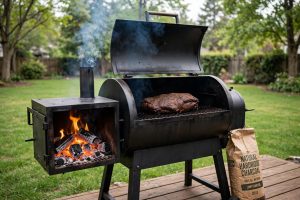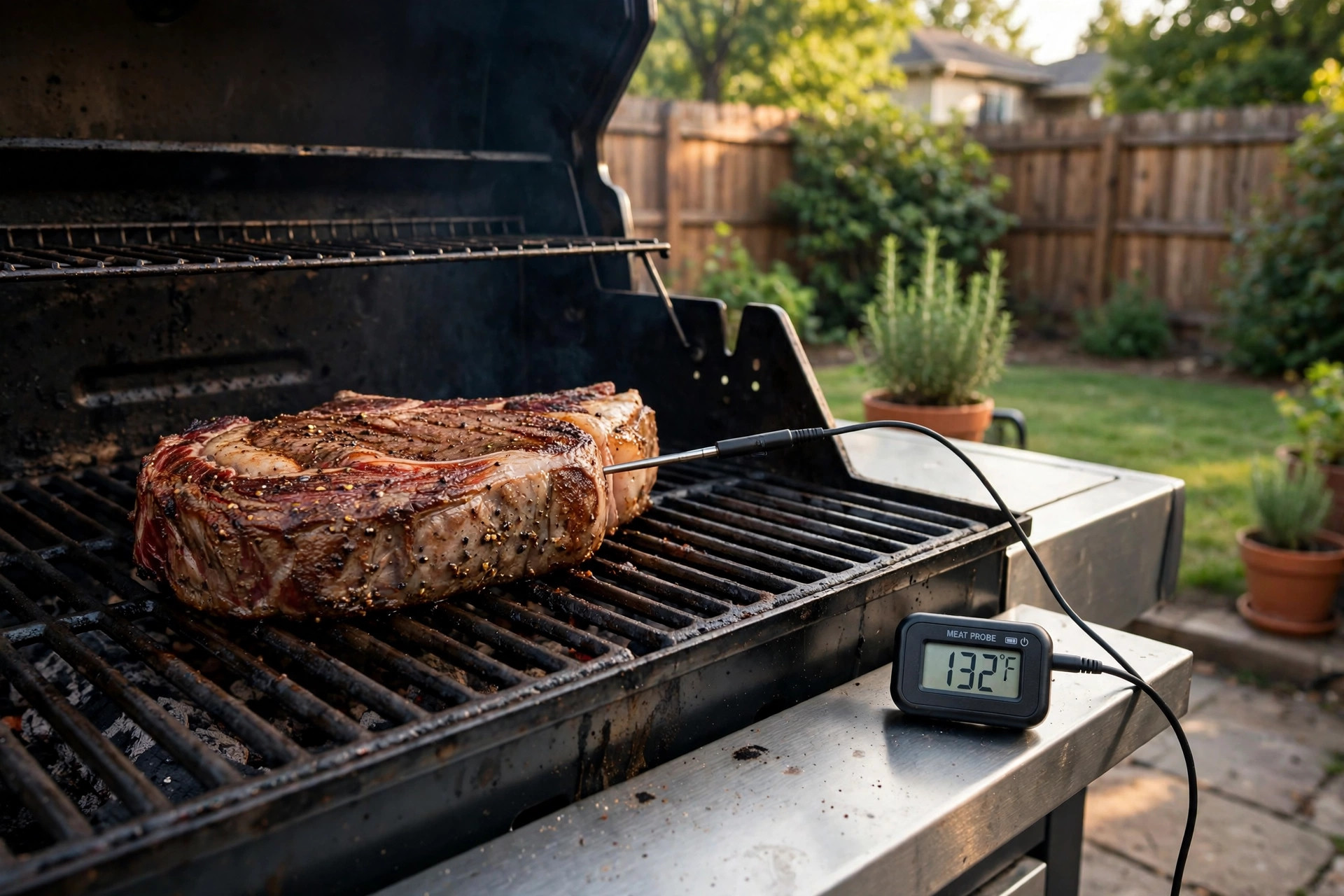

A thick steak is a fine thing to cook. It rewards care and punishes guesswork. The outside turns brown and rich while the center stays cool and raw if the heat is too fierce. The opposite error is just as easy. The steak cooks through, but the crust never forms. In both cases the cook relies on touch, on time, and on hope. The best grill thermometer for thick steaks removes the hope from the matter. It gives a number. That number tells the truth.
This guide explains how to choose the right thermometer for thick cuts of beef. It covers probe types, reading speed, accuracy, and price. It also covers how to use the tool at the grill so that a two-inch steak comes out right the first time. Many grillers learn the hard way that thick meat cannot be judged by color alone. A thermometer is the one tool that never lies about what is happening inside.
Why Thick Steaks Need a Thermometer
Thin steaks cook through in minutes. The heat reaches the center almost as soon as the crust forms. A thin cut can be judged by sight and touch with fair accuracy. Thick steaks do not work that way. A steak that is two inches or more has a center that heats slowly. The outer layers can look perfect while the middle is still raw. Even a skilled cook can be fooled.
Food safety matters too. A thick steak is usually seared on the outside and served with a pink center. That is safe when the meat is a whole cut. But when a steak is mechanically tenderized or butterflied, the inside can carry bacteria. The only sure test is temperature. A thermometer reading of the center gives the cook proof that the meat reached a safe point.
There is also the matter of money. Thick steaks are dear. A ribeye or a strip two inches thick can cost three times what a thin cut costs. No cook wants to ruin such a cut. The best charcoal grill for backyard bbq gives a fine fire, but fire alone does not tell the cook when the meat is done. A thermometer protects the investment. It turns a costly risk into a steady habit.
How to Choose the Best Grill Thermometer for Thick Steaks
Not all thermometers suit thick meat. Some read too slowly. Some probes are too short to reach the center. Others break down in the heat of a grill lid that runs hot. The buyer should weigh a few plain facts before spending.
Probe Length and Thickness
The probe must reach the center of the steak. A probe shorter than three inches will not reach the middle of a thick cut from the side. Long, thin probes work best. They slide in from the side of the steak and rest at the center. Thin probes also leave small holes. A fat probe lets juices run out. For thick steaks, a probe of at least four inches with a slim shaft is the right shape.
Read Speed
A slow thermometer keeps the grill lid open too long. Each opening lets heat escape. That matters less with gas and more with charcoal. An instant read grill thermometer with a reading time of two to four seconds is the usual choice for grilling. Leave-in probes work too. They stay in the meat during cooking and send the reading to a base unit or a phone. Both types serve thick steaks well. Many cooks own one of each.
Accuracy and Temperature Range
A good thermometer reads within one or two degrees of the true temperature. Cheap units can stray by five degrees or more. Five degrees is the gap between rare and medium rare. For thick steaks, where the window between raw and done is narrow, accuracy counts. The range should reach at least 500 degrees Fahrenheit at the probe tip. Grill grates run hot, and the probe should not fail near the flame.
Display and Ease of Use
The numbers must be easy to read in bright sun and at night. Large digits help. A backlight helps after dark. Water resistance matters at the grill, where splash and steam are common. A simple button layout beats a clever one. When the cook has one hand on the tongs, the other should work the thermometer without study.
Types of Grill Thermometers
There are three common types. Each has a place at the grill.
Instant-read thermometers give a reading in seconds. The cook opens the lid, pushes the probe into the steak, and reads the number. They are the simplest tools. Many modern instant-read units read in under three seconds. They are fine for spot checks but they require the lid to be open. Weber and Char-Broil both sell grills with built-in or clip-on thermometer options, and their guides stress that instant reads remain the most trusted check.
Leave-in probe thermometers stay in the meat while it cooks. A cable runs from the probe to a display unit outside the grill, or the reading goes by radio to a phone. This type shines with thick steaks. The cook sets a target temperature and waits for the alarm. The lid stays shut. The Traeger and Napoleon pellet and gas grills pair well with such probes, since long cooks on thick cuts need steady heat and a closed lid.
Dial thermometers are the old kind. They have a metal face and a needle. They work, but they read slowly and the scale is hard to read to the degree. They belong more in the kitchen oven than at the hot grill. Most serious grillers have moved to digital.
For thick steaks, a leave-in probe with a second instant-read for spot checks is the strong pairing. The leave-in unit watches the slow climb. The instant-read confirms the final number in a second spot.
Cost and Price
Prices run wide. A basic digital instant-read thermometer costs about fifteen to thirty dollars. These read in five to ten seconds and serve the average backyard cook well. A fast instant-read with a two-second reading and strong water resistance costs thirty to sixty dollars. Units made by firms that test Big Green Egg accessories and other serious gear often sit in this band.
Leave-in probe sets cost twenty to eighty dollars. A single-probe set is cheap. A set with two or four probes costs more. Some high-end sets link to a phone app and log the cook. These can run near a hundred dollars. Home Depot carries the full range, from the cheapest stick units to full wireless sets, which lets a buyer handle the probes before buying.
The dear price is not always the right price. For a cook who grills thick steaks once a month, a thirty-dollar instant-read is enough. For a cook who grills every weekend, a leave-in set saves enough ruined meat to pay for itself. Think of the price against the cost of one ruined porterhouse. A thermometer is cheap insurance.
How to Use a Thermometer on a Thick Steak
Buy the tool is the first step. Use it well is the second. Thick steaks ask for a method.
First, heat the grill and bring the steak near room temperature for twenty to forty minutes. A cold steak cooks unevenly. Place the steak on the hot grates and sear each side. Then move it to a cooler part of the grill or lower the heat. This is the classic two-zone method. It is the best way to cook a thick cut without burning the crust.
If using a leave-in probe, insert it after the sear, pushing it into the side of the steak so the tip rests at the center. Do not touch bone. Bone runs hot and gives a false high reading. Set the target five degrees below the goal. Meat keeps cooking after it leaves the grill. This carryover heat adds five to ten degrees to a thick steak as it rests.
If using an instant read, check the center after the estimated cook time. Push the probe into the side of the steak to the middle. Read the number. Close the lid between checks. The pellet grill vs gas grill pros cons guide notes that pellet grills hold heat well during checks, while charcoal grills lose heat faster, so work quickly on charcoal.
Know the numbers. Rare is about 125 degrees Fahrenheit at pull, medium rare about 135, medium about 145. These are pull temperatures before the rest. After a five to ten minute rest under loose foil, the steak rises to its final state. Many cooks target 130 to 135 degrees for a thick ribeye. AmazingRibs.com publishes careful tables of doneness and explains why the pull temperature matters more than the time on the grill.
Check two spots. A thick steak does not heat perfectly evenly. A second reading near the first confirms the cook. If the two readings differ by more than a few degrees, trust the lower one. The center of the meat is the last place to warm.
Care and Upkeep
A thermometer lasts for years with simple care. Never leave a non-probe thermometer inside a closed grill. The body cannot take the heat. Wash the probe shaft after each use with warm soapy water. Do not soak the display unit unless it is rated waterproof. Wipe it down instead.
Change batteries before the cook, not during. A dying battery gives slow, wrong readings. Some units take button cells. Some take AA batteries. Keep a spare set in the grill kit. Calibrate now and then. Put the probe in a glass of ice water and stir. It should read 32 degrees Fahrenheit. If it reads off by more than two degrees, adjust it if the unit allows, or replace it. The Spruce Eats and Consumer Reports both advise regular ice-water checks as the simplest way to trust the numbers.
Store the probe in its sheath. Probes bend. A bent probe may read wrong. Keep the unit in a dry place away from the rain. Many probes fail because water gets into the cable where it meets the display. That joint is the weak point. Dry it after each cook.
Safety
Hot grease and open flame are part of grilling. Keep the thermometer body away from the flame. Use long tongs, not fingers, to move meat while the probe cable is attached. The cable is thin and hot to the touch. Do not let the probe cable touch a burner or a hot coal. The sleeve can melt.
Food safety rules still apply. Wash hands after touching raw meat. Do not use the probe on raw meat and then on cooked food without washing it. Cross-contamination is a real risk. Thick steaks that are served rare rely on a clean probe and a clean cut.
Rest the meat. A thick steak needs five to ten minutes of rest before cutting. The juices settle. The temperature evens out. Cutting too soon lets the juices run onto the board. The thermometer earns its keep here too. Watch the rise during the rest and learn how much carryover a given grill produces. That knowledge makes the next cook easier.
Frequently Asked Questions
What is the best grill thermometer for thick steaks? A leave-in digital probe with a thin, long shaft is the best choice for thick steaks. It watches the slow rise of the center temperature while the lid stays closed. Pair it with a fast instant-read unit for final checks.
How deep should the probe go into a thick steak? The tip of the probe should rest at the center of the thickest part. For a two-inch steak, insert the probe from the side to about one inch of depth. Avoid bone and fat pockets, which read hot or cold and mislead the cook.
What temperature should a thick steak be pulled from the grill? Pull a thick steak five degrees below the target. For medium rare, pull at about 130 degrees Fahrenheit and let the rest carry it to 135. For medium, pull near 140 degrees. Thick cuts carry over more than thin ones.
Can a cheap thermometer work on thick steaks? A cheap digital thermometer can work if it reads within a couple of degrees and the probe is long enough. The risk is slow reading and poor accuracy. Calibrate it with ice water first. If it cannot hold a steady reading, it is not worth the savings.
Is a wireless probe worth the money? For cooks who grill thick cuts often, yes. A wireless probe sends the reading to a phone or a base unit, so the cook can step away from the heat. It also tracks the climb over time, which teaches the cook how a thick steak behaves on a given grill.
How do I know my thermometer is accurate? Use the ice water test. Fill a glass with ice and water, stir, and insert the probe. It should read 32 degrees Fahrenheit. Boiling water should read 212 degrees at sea level. If either test is far off, replace the unit.
A Final Word
Thick steaks ask for patience and a number. The fire, the crust, and the rest all matter, but only the thermometer tells the cook what is true inside the meat. Choose a long thin probe, a fast reading, and an honest display. Learn the pull temperatures. Respect the rest. The best grill thermometer for thick steaks is the one that is always at the grill, in clean working order, and used without fail. Cook by the number, and the steak will repay the habit.
References
AmazingRibs.com. (n.d.). Barbecue and grilling science. https://www.amazingribs.com Big Green Egg. (n.d.). Kamado grills and outdoor cooking. https://www.biggreenegg.com Char-Broil. (n.d.). Gas and charcoal grills. https://www.charbroil.com Consumer Reports. (n.d.). Product reviews and ratings. https://www.consumerreports.org Napoleon. (n.d.). Fireplaces, grills, and heating products. https://www.napoleon.com The Home Depot. (n.d.). Home improvement products. https://www.homedepot.com The Spruce Eats. (n.d.). Recipes and cooking guides. https://www.thespruceeats.com Traeger. (n.d.). Wood pellet grills. https://www.traeger.com Weber. (n.d.). Grills and outdoor cooking. https://www.weber.com
Was this guide helpful?

About Lisa Anderson
The My Garden US editorial team writes practical, in-depth home and garden guides for American homeowners — tested advice, no fluff.
You May Also Like
Best BBQ for Camping Trips Reviews: What to Buy and Why
April 24, 2026 0 views
Best Portable Charcoal Grill for Beach Trips: A Complete Buying Guide
September 8, 2026 0 views
How to Season Cast Iron Grill Grates: A Plain, Step-by-Step Guide
May 13, 2026 0 views