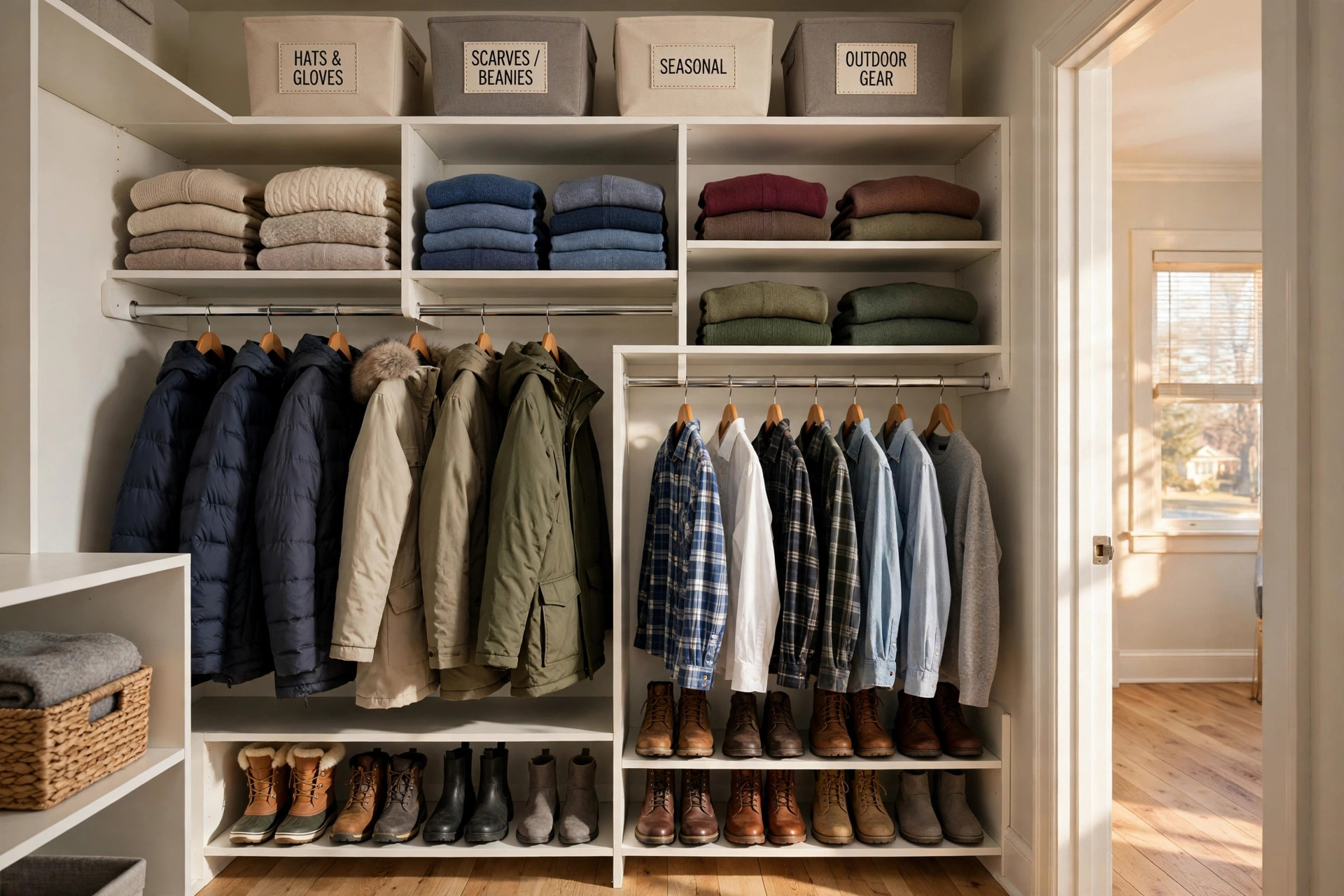

A closet in the Midwest works harder than a closet almost anywhere else. The best closet organizer systems for midwest homes must hold heavy winter coats, boots, scarves, and sweaters for half the year. Then they must swap to light shirts and shorts for a short, hot summer. That swing in seasons shapes every choice you make.
Many older homes in states like Ohio, Indiana, Illinois, Michigan, Wisconsin, Iowa, Minnesota, Missouri, and Kansas were built with small closets. Builders in the 1950s and 1960s did not plan for today’s wardrobes. A single rod and one shelf is all you get. That is why a good organizer system matters so much here. It takes the same small space and doubles or even triples what it can hold.
This guide walks through the whole subject in plain terms. You will learn why climate matters, what to look for, the main types of systems, what they cost, how to care for them, and how to stay safe during setup. By the end you will know which system fits your home, your budget, and your family.
Why It Matters
A disorganized closet wastes time and money. The average person spends about ten minutes a day searching for clothes. That adds up to more than two full days a year. A well-planned system puts every item in a known place. Morning routines move faster. Ironing falls away because clothes hang straight instead of lying in piles.
There is also the cost of damage. Midwest winters are long and damp. Coats and boots tracked in with snow and road salt can sit wet in a closet for days. Without racks that let air move, leather cracks and fabric mildews. A closet system with open shelving and boot trays lets moisture escape. That alone can add years to the life of a good winter coat.
Space is the third reason. Land is cheap in much of the Midwest, yet older houses have small closets. Rather than knock down walls, most families do better with an organizer that uses vertical space. A double-hang rod section takes the same wall width and holds twice the shirts. Shelves stacked to the ceiling hold out-of-season bins. Every inch gets a job.
How the Midwest Climate Shapes Your Choice: Best Closet Organizer Systems for Midwest Homes
Two facts about the region drive most buying decisions. First, humidity swings hard between seasons. Summers in the upper Midwest are humid. Basements and first-floor closets can grow musty. Winter brings dry indoor air from forced-air furnaces, then wet boots and snow-covered coats. Second, the wardrobe itself is large. A family of four in Minneapolis may own forty heavy coats, jackets, and snow pants between them.
These facts point to a few clear rules. Choose materials that resist moisture, such as powder-coated steel, sealed laminate, or well-finished solid wood, rather than raw particleboard, which swells at the edges in damp air.
Good advice on keeping a home dry in humid months is easy to find at The Spruce, which covers moisture and mold prevention in plain detail.
What to Look For When You Choose
Start with measurements. Measure the width, depth, and height of the closet. Note the door swing and any vents or outlets inside. Most reach-in closets are about 24 inches deep, which fits standard hangers with a little room to spare. Walk-ins give you more freedom.
Next, count what you own. Sort clothes into hanging items and folded items. Count shoes and boots. List extras like bags, belts, hats, and sports gear. A family closet needs more shoe space than a single adult’s. Write the numbers down. They tell you how much rod, shelf, and drawer space to buy.
Then set a budget. Systems run from under one hundred dollars for a simple rod-and-shelf kit to several thousand for custom built-ins. A mid-range wire or laminate system for one reach-in closet usually costs a few hundred dollars. Compare kits on price and parts at Home Depot and Lowe’s, where many leading brands are sold side by side.
Key Features Worth Paying For
– Adjustability. Shelves and rods that move on notched uprights let you change the layout as children grow or wardrobes shift. – Weight ratings. Check how much each shelf holds. Winter coats are heavy. A shelf rated for 50 pounds will sag under a row of wool overcoats. – Finish quality. Sealed edges and coated metal last longer in damp air. Run a finger along the edge of a shelf. If it feels rough or raw, moisture will get in. – Drawers that close. Felt-lined drawers protect watches, belts, and small items. Soft-close slides are a comfort worth the small extra cost. – Shoe and boot storage. Angled shelves show shoes at a glance. Flat shelves or cubbies work better for tall winter boots.
Independent test results help here. Consumer Reports publishes ratings on storage furniture and closet systems, with notes on durability and ease of assembly.
Types of Closet Organizer Systems
Wire Systems
Wire systems are the most common and the least costly. They use vinyl-coated steel uprights, shelves, and baskets that clip into wall brackets. Air moves freely through them, which suits damp climates. They install in an afternoon with basic tools.
The trade-offs are real. Wire shelves can leave marks on knit sweaters. Hangers slide around on smooth wire rods. Baskets look less finished than wood drawers. Still, for a first upgrade in a rental or a starter home, wire systems give the most storage per dollar. Step-by-step installation help is available from Family Handyman.
Laminate and Wood Panel Systems
Laminate systems use engineered wood panels with a printed finish that looks like oak, maple, or white paint. They look like built-in furniture. Towers with drawers, cubbies, and a bench seat are common. Many big-box stores sell kit versions you cut to fit.
These systems feel solid and look sharp in a master bedroom. They cost more than wire and weigh more, so wall anchors matter. In damp basements, choose sealed laminate and keep the base off the floor on small feet. Design ideas and layout plans appear regularly on This Old House.
Freestanding Wardrobes and Armoires
Some Midwest bedrooms have no closet at all, or one too small to fix. Freestanding wardrobes solve that. They stand against a wall like a piece of furniture, with rods, shelves, and drawers inside. They move with you if you relocate.
Anchor every tall unit to the wall. Tip-over injuries are a real danger, especially with children. A related corner layout guide may help if your space is awkward: see our article on corner closet organizers reviews and buying guide.
Modular and Custom Systems
Modular systems mix and match parts: towers, corner units, hampers, tie racks, and jewelry trays. You start with a base kit and add pieces over time. True custom systems are measured and built for one closet by a local shop or a national design service. They cost the most but use every inch, including sloped ceilings and odd corners.
For a family with growing children, modular is often the sweet spot. It grows with you. Our guide to space saving kids closet organizers for midwest homes shows how to plan for small rooms that must hold a lot.
Specialty Inserts
Inserts upgrade an existing closet without a full rebuild: double-hang rod kits, pull-down rods for high spaces, over-the-door hooks, and shelf dividers. They are cheap and fast. Many homeowners start here and move to a full system later.
Cost and Price: What to Expect
Prices vary by size, material, and brand, but typical ranges hold steady across the region:
– Wire kit for one reach-in closet: $80 to $250. Hardware and brackets included. – Laminate kit for one reach-in closet: $200 to $600. Drawers add $50 to $150 each. – Walk-in closet system, laminate: $600 to $2,000 depending on length and parts. – Custom designed and installed: $1,500 to $5,000 or more for a large walk-in. – Freestanding wardrobe: $150 to $800.
Labor adds cost if you hire help. A handyman typically charges by the hour, and a simple reach-in takes two to three hours. Many homeowners do it themselves over a weekend. Before you buy, compare full kit prices in our closet organizer systems price comparison usa article to see where each brand lands.
Watch for hidden costs: wall anchors, trim pieces, lighting, and paint for patching old holes. Add about 10 percent to your parts budget for these extras. Buy in late winter or early spring, when stores clear storage lines, and start with one closet before outfitting the whole house.
Care and Upkeep Through the Seasons
A closet system needs little care, but a small routine keeps it strong for years.
Spring. Wipe metal rods and brackets to remove winter salt residue. Check wall anchors for looseness after a season of heavy coats. Rotate winter gear to high shelves or labeled bins. Vacuum dust from shelves.
Summer. Watch for mustiness in basement closets. Leave closet doors open on humid days when you can. Cedar blocks or lavender sachets help, but airflow matters most. This is the best time to deep-clean shelves and re-tighten screws.
Fall. Bring winter gear back down. Check that boot trays and drip mats are in place. Test that rods still feel solid under a full load of coats. Replace any bent wire brackets before the heavy season starts.
Winter. Shake snow off coats before hanging them. Keep a small towel near the closet for wet boots. Do not pack the closet so tight that air cannot move between garments.
Laminate surfaces clean with a damp cloth and mild soap. Never soak particleboard edges. Wire shelves wipe down the same way. Wood shelves benefit from an occasional coat of furniture polish to seal the surface.
Practical upkeep checklists for closets and bedrooms are published by Good Housekeeping, and Bob Vila offers seasonal home maintenance guides that include storage areas.
Safety
Safety starts with installation. Find wall studs with a stud finder before mounting heavy uprights. Use the right anchors for drywall when no stud is available. A loaded closet system is heavy, and it must hold firm.
Anchor tall furniture to the wall. This rule covers freestanding wardrobes, tall towers, and any unit over 27 inches high. Use the anti-tip straps that come in the box. Keep heavy items on low shelves so the unit stays bottom-heavy.
Mind the air. Some engineered wood products release small amounts of formaldehyde. Look for low-emission or CARB-compliant labels. Ventilate the room during and after installation. If a strong chemical smell lasts more than a few days, air the closet longer before filling it.
Keep the floor clear. Boots, bags, and boxes on the floor are trip hazards in a dark closet. A motion-sensor light inside the closet is cheap and prevents stumbles. If your closet has an outlet, do not overload it with heaters or steamers.
Frequently Asked Questions
How much does a closet organizer system cost for a Midwest home? A wire kit for one reach-in closet runs $80 to $250. A laminate kit runs $200 to $600. Full walk-in systems range from $600 to $2,000, and custom jobs start around $1,500. Add about 10 percent for hardware, anchors, and trim.
Which material is best for humid Midwest summers? Powder-coated steel wire and sealed laminate hold up best. Both resist moisture and wipe clean. Avoid raw particleboard with exposed edges, which swells in damp air. Solid wood with a good finish also works well.
Can I install a closet system myself? Yes, in most cases. Wire and laminate kits are made for do-it-yourself installation with a drill, level, tape measure, and stud finder. A single reach-in closet takes an afternoon. Custom systems and large walk-ins may be worth hiring out.
How do I store winter coats in a small closet? Use the highest shelf or a top cubby for off-season coats in breathable garment bags. Keep only current-season coats on the main rod. Double-hang rods leave room below for boots on trays. Vacuum bags save space for puffy jackets but do not use them for wool or down long-term.
Do wire shelves damage clothes? They can leave crease marks on knits and sweaters left for months. Shelf liners, available cheaply at most home stores, solve this. Use liners on any wire shelf that holds folded clothes.
How often should I reorganize my closet? Twice a year works well in the Midwest: once in spring when winter gear goes up, and once in fall when it comes back down. Each changeover is a good time to donate what no longer fits or gets worn.
A Short Final Word
The best closet organizer systems for midwest homes are not the fanciest or the priciest. They are the ones that fit your walls, hold your winter weight, breathe through humid summers, and adjust as your family changes. Measure first. Count what you own. Buy for the heaviest season, not the lightest. Do that, and a small 1960s closet can serve a modern family with room to spare.
The Container Store’s organization guides offer more layout ideas once your system is in, and room-by-room inspiration helps when you move on to the next closet.
References
Bob Vila. (n.d.). Home improvement advice. https://www.bobvila.com Consumer Reports. (n.d.). Product reviews and ratings. https://www.consumerreports.org Family Handyman. (n.d.). DIY home repair and maintenance. https://www.familyhandyman.com Good Housekeeping. (n.d.). Product reviews and home advice. https://www.goodhousekeeping.com Lowe’s. (n.d.). Home improvement products. https://www.lowes.com The Container Store. (n.d.). Storage and organization products. https://www.containerstore.com The Home Depot. (n.d.). Home improvement products. https://www.homedepot.com The Spruce. (n.d.). Home and garden advice. https://www.thespruce.com This Old House. (n.d.). Home renovation guidance. https://www.thisoldhouse.com
Was this guide helpful?

About Emily Rodriguez
The My Garden US editorial team writes practical, in-depth home and garden guides for American homeowners — tested advice, no fluff.
You May Also Like

Wicker Storage Baskets Price Comparison USA: A Practical Guide to Paying the Right Price
February 2, 2026 0 views
Premium Pantry Food Storage Containers Buying Guide
April 23, 2026 0 views
Rolling Storage Carts Reviews and Buying Guide
August 31, 2026 0 views