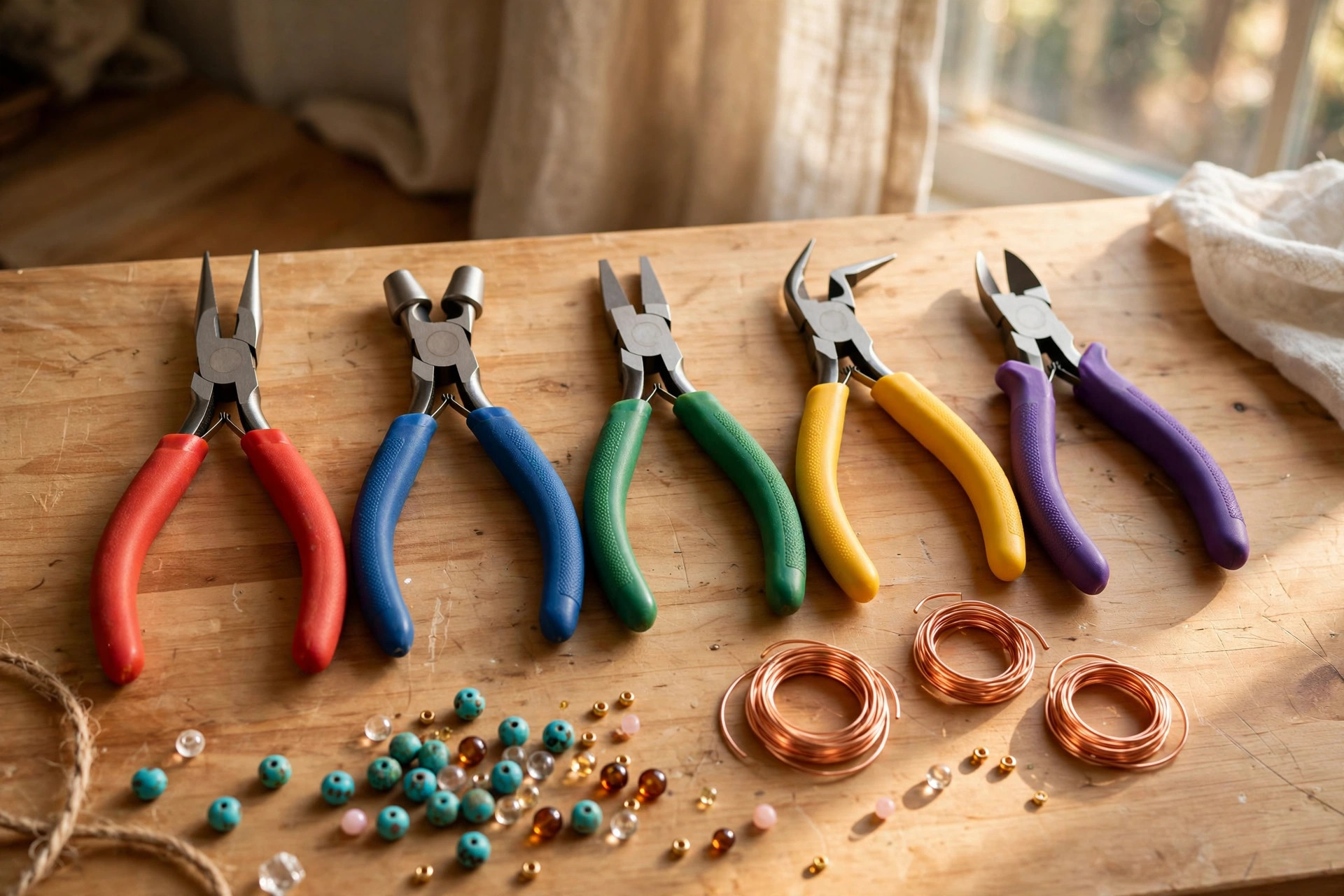

The best jewelry pliers set for wire wrapping is the first real tool a wire worker needs. Beads and wire are easy to buy. Good pliers are what turn that wire into a ring, a pendant, or a pair of earrings that will last. A set made for jewelry work is small in the hand, light in weight, and shaped to bend wire without scratching it. This guide explains which tools belong in the set, how to pick a good one, what to pay, and how to keep the tools in good shape for years.
Why a Real Set Matters
Wire wrapping asks a lot from a pair of pliers. The jaws must grip a wire that may be thinner than a hair. The tips must reach into tight loops. The steel must be hard enough to bend copper, brass, and sterling silver without bending itself. Regular hardware pliers are too big and too rough for this work. Their teeth leave marks on soft wire, and their bulk will not fit inside a small coil. A set made for jewelry, on the other hand, has smooth jaws and fine tips, and the handles are sized for fingers rather than palms.
There is another reason to buy a set instead of one pair. No single pair can do every job. You need one pair to cut, one to grip, one to shape round loops, and one to hold flat parts while the other shapes. Buying the best jewelry pliers set for wire wrapping as a matched group means the handles feel the same in your hand, the steel is the same grade, and you will not find yourself stuck in the middle of a project for want of the right shape. Beginners who start with a full set finish more pieces and spoil less wire.
What to Look for When You Buy: Best Jewelry Pliers Set for Wire Wrapping
Smooth Jaws
The first thing to check is the inside of the jaws. Good jewelry pliers have jaws that are smooth, without ridges or teeth. Ridges are made to grip nails and pipe. On wire they cut small dents into the metal, and those dents show on the finished piece. Hold the pliers up to the light. The jaw faces should be flat and even. Many makers polish the jaws on their finer tools, and that polish protects soft silver wire best of all.
Spring-Loaded Handles
Long work sessions are easier when the pliers open by themselves. Many jewelry pliers have a small leaf spring between the handles. The spring pushes the jaws open after each squeeze. This saves your hand from doing the same work twice and cuts down on strain over an hour of looping. If you plan to make more than a few pieces, look for this feature. It is common on mid-range sets and costs little extra.
Comfortable Grips
Handles come covered in dipped plastic, foam, or two-color rubber. Dipped plastic is the cheapest and wears smooth with time. Foam and rubber are kinder to the hand and do not slip when your fingers are warm. None of this changes the quality of the steel, but comfort matters. Wire wrapping is slow work. A grip that hurts will make you rush, and rushing ruins loops. Pick the set up if you can and close it a few times before you decide.
Box Joints and Alignment
Watch how the two halves of the pliers meet. The joint should close fully and the tips should meet evenly, with no gap at the nose. When the tips do not meet, wire slips out of the grip at the worst moment. A box joint, where one arm passes through a slot in the other, wears better over time than a simple lap joint. This is a small detail, but it separates a set that lasts five years from one that loosens in six months.
The Tools a Set Should Include
Most sets sold for wire wrapping hold between five and eight pieces. Five tools cover nearly every job. A good starter set from Michaels or JOANN will usually include these.
Chain Nose Pliers
These have flat inner jaws that taper to a fine point. They hold wire, open and close jump rings, and flatten bends. You will reach for them more than any other tool. Some makers call them flat nose pliers. The chain nose version, with a tapered tip, is the better choice for wire work because it can get into small spaces.
Round Nose Pliers
These have two round, tapered jaws. They make loops, coils, and wrapped ends. Every wrapped loop on a pendant bail or an earring hook starts with round nose pliers. Look for a pair where the jaws taper to a small point. A fine point makes small loops, and small loops look neat.
Flat Nose Pliers
Flat nose pliers have wide, flat inner jaws that do not taper. They hold wire firmly and make sharp right-angle bends. They are also the tool you use to straighten a wire that has kinked. If your set has both chain nose and flat nose pliers, you will rarely be short of a grip.
Bent Chain Nose Pliers
The jaws of this tool bend at an angle about halfway down. The bend lets you work inside a tight coil or under a bezel without your hand blocking your view. It is not strictly needed for a first set, but workers who make complex pieces use it daily. Many full sets include it, and it is worth having.
Side Cutters
You need a way to cut wire cleanly. Side cutters made for jewelry work cut copper, brass, and silver wire up to about 16 gauge without effort. The cutting edges should meet fully and close like scissors. Do not cut steel memory wire or pins with these small cutters. That hard wire will nick the edges, and nicked cutters will never cut soft wire cleanly again.
Nylon Jaw Pliers
Some sets add pliers with smooth nylon jaws. These grip wire without marking it at all. They are useful for pulling wire straight and for holding finished work while you attach findings. They are a nice extra rather than a must, but they show that the maker understands jewelry work.
What It Costs
Prices for the best jewelry pliers set for wire wrapping vary widely. A basic five-piece set from a craft store costs about eight to twenty dollars. These sets are fine for learning and for occasional use. The steel is softer and the joints may loosen with heavy use, but they will make good loops for a long time if you treat them well.
A mid-range set costs twenty to fifty dollars. The steel is harder, the jaws are polished, and the handles are more comfortable. This is the range most serious hobbyists buy. Sets from dedicated jewelry suppliers such as Rio Grande sit in this range and above, and they are built for daily work.
Professional sets cost fifty to one hundred fifty dollars or more. Each tool may be sold separately at this level. The steel is the finest, the tips align perfectly, and the tools can be repaired rather than replaced. Few beginners need this. Start in the middle, and buy up only when you can feel the limits of your current tools.
Care and Upkeep
Pliers last a long time when they are cared for. Wipe the jaws clean after each session with a soft cloth. Wire leaves tiny metal dust on the steel, and that dust can scratch the next piece you make. A drop of light oil on the joint every few months keeps the action smooth. Do not force the handles apart past their normal range. The leaf springs can bend if you over-open them.
Store the set so the jaws do not knock together. A tool roll or a lined box works well. Many crafters keep their pliers in the same drawer as their beads, and the jaws pick up dings from loose metal. A small pouch for each tool costs little and saves much. If a tip chips or bends, replace that one tool. You do not need a whole new set.
Pair your tools with good lighting for the fine work. A best craft magnifier lamp for detailed work makes it far easier to see small loops and check that your wraps are tight. Many wire workers also keep a glass painting kit for beginners suncatchers diy mindset for their craft table, setting aside one clean area where small parts will not roll away.
Safety at the Bench
Wire wrapping is safe work, but a few habits keep it that way. Cut wire ends fly when the cutters snap shut. Wear plain safety glasses, especially when cutting wire thicker than 20 gauge. Point the cut away from your face and from others in the room. Keep a small dish for cut ends. Sharp wire bits on a table will find a bare foot.
Do not cut steel memory wire, beading wire with steel cable inside, or hardened steel pins with jewelry side cutters. The edges will chip, and a chip can send a small piece of steel flying. Keep a separate pair of heavy cutters for hard metals. When you shape thick wire, grip it near the bend point so it does not spring. And as with any craft done around children, keep sharp tools out of reach. Families with young helpers should look into best craft scissors for left handed kids for safe cutting tasks at the craft table.
FAQ
How many pliers do I really need to start wire wrapping?
Three will do: chain nose pliers, round nose pliers, and side cutters. With those you can cut wire, make loops, and hold your work. A five-piece set adds flat nose and bent nose pliers, which make the work faster and neater. Most beginners are happiest with the five-piece set because it covers every basic technique taught in beginner books and classes.
What is the difference between chain nose and flat nose pliers?
Both have flat inner jaws, but chain nose pliers taper to a fine point while flat nose pliers keep their width. The tapered tip of the chain nose reaches into small loops and holds wire at fine angles. The flat nose grips a larger area and is better for making sharp bends and holding wire flat. Most sets include both because they do different jobs.
Can I use regular hardware pliers for wire wrapping?
You can, but the results will disappoint you. Hardware pliers have toothed jaws that leave marks on wire, and they are too large for small loops. Some workers use one large pair for bending thick frame wire, but all the fine work needs jewelry pliers. For the price of a pizza, a proper starter set from Hobby Lobby will outperform a toolbox drawer full of hardware pliers.
Why do my loops look rough and scratched?
Rough loops usually come from toothed or dirty jaws. Check that your pliers have smooth jaws, and wipe them before you work. Another cause is gripping too hard. Let the tool hold the wire, and do the shaping with a light touch. Wrapping a small piece of masking tape around the jaws is an old trick for extra protection on soft silver, though smooth pliers alone are usually enough.
What gauge wire should a beginner use with a new pliers set?
Start with 20 gauge copper craft wire. It is soft enough to bend easily, cheap enough to waste while you practice, and thick enough to hold a shape. Move to 22 or 24 gauge for delicate wraps, and to 18 or 16 gauge for frames and bails once your hands are sure. Your side cutters will handle all of these, but do not test them on steel wire.
How do I know when my pliers need replacing?
Replace a tool when the tips no longer meet, when the jaws wobble side to side, or when a cutter leaves a pinched burr on every cut. Small problems can sometimes be fixed. A drop of oil helps a stiff joint, and a fine file can smooth a small burr on a jaw. But when the steel itself is worn or a tip has snapped, a new tool is the honest answer. Guides at The Spruce and Blick Art Materials also note that worn tools are the main cause of spoiled craft projects.
A Short Final Word
The best jewelry pliers set for wire wrapping is not the most expensive one. It is the one with smooth jaws, fine tips, comfortable handles, and all five core tools: chain nose, round nose, flat nose, bent nose, and side cutters. Buy in the twenty to fifty dollar range, keep the jaws clean, and store each tool so it does not knock against metal. Good habits with simple tools will take a beginner further than the finest set in careless hands. For more ideas on setting up a lasting craft space, the home project guides at This Old House and the tool aisles at The Home Depot are both worth a visit.
References
Blick Art Materials. (n.d.). Art and craft supplies. https://www.dickblick.com Hobby Lobby. (n.d.). Arts, crafts, and home decor. https://www.hobbylobby.com JOANN. (n.d.). Fabric and craft supplies. https://www.joann.com Michaels. (n.d.). Arts and crafts supplies. https://www.michaels.com Rio Grande. (n.d.). Jewelry making tools and supplies. https://www.riogrande.com The Home Depot. (n.d.). Home improvement products. https://www.homedepot.com The Spruce. (n.d.). Home and garden advice. https://www.thespruce.com This Old House. (n.d.). Home renovation guidance. https://www.thisoldhouse.com
Was this guide helpful?

About Emily Rodriguez
The My Garden US editorial team writes practical, in-depth home and garden guides for American homeowners — tested advice, no fluff.
You May Also Like
Pottery Wheel for Home Beginners: A Plain Guide to Clay Art
August 8, 2026 0 views
Cross Stitch Kit for Beginners Adults Patterns: A Complete Starter Guide
March 15, 2026 0 views
The Best Scroll Saw for Woodworking Crafts Home Makers Trust
May 11, 2026 0 views