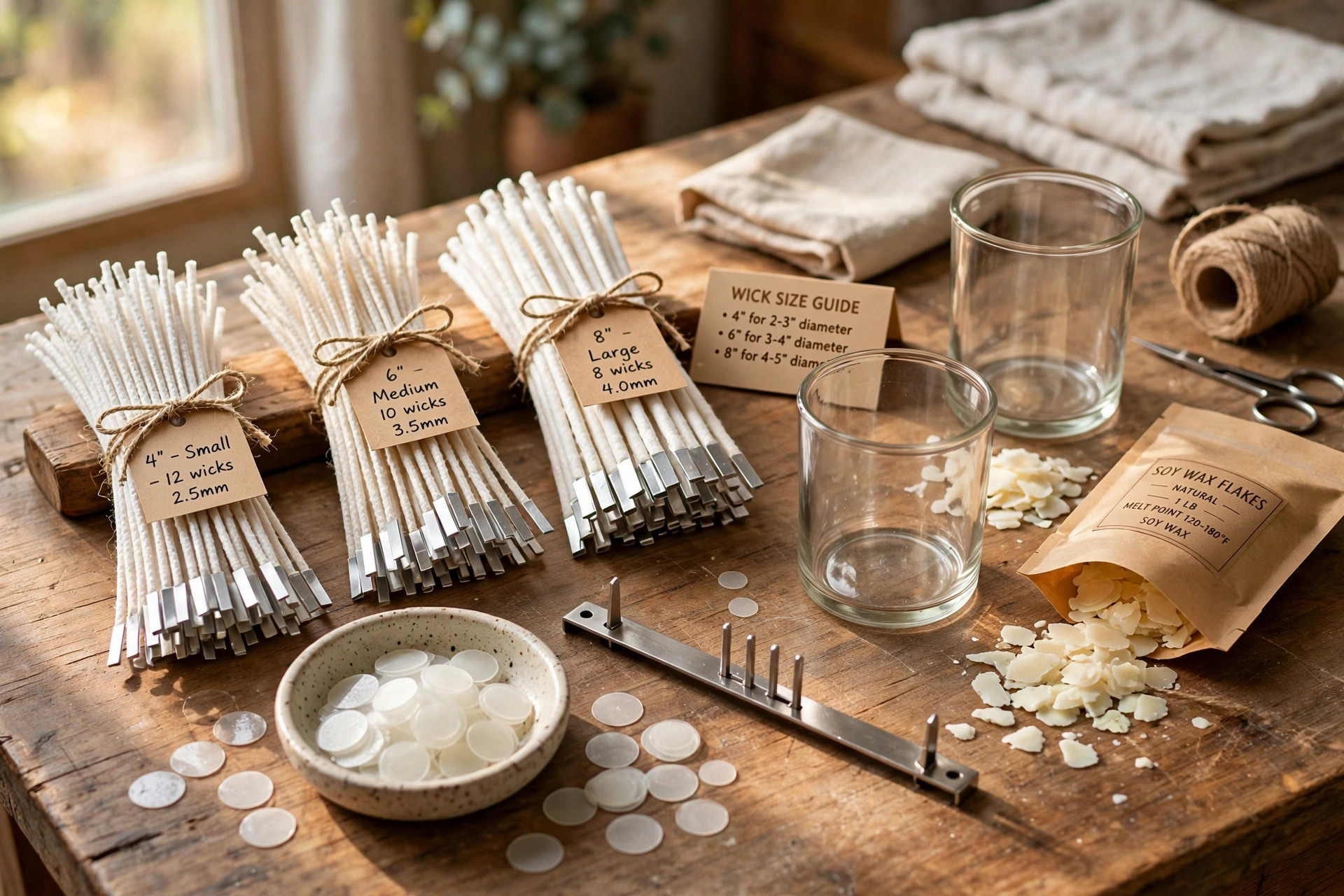

A candle wick kit for soy candle making home is one of the simplest tools a beginner can buy. Soy wax is easy to melt, easy to pour, and easy to clean up. But the wick is what makes or breaks a candle. Pick a wick that is too small and the flame will drown. Pick one that is too large and the flame will smoke, flicker, and tunnel down the jar. A kit takes the guesswork out of this choice. It gives you wicks in several sizes, plus the small parts that hold each wick in place while the wax hardens.
Home candle making has grown into a popular evening hobby. Many people start with soy wax because it burns slower and cleaner than paraffin. A wick kit made for soy wax matches this slower melt. The wicks in such a kit are usually pure cotton, lead free, and zinc free. They come pre-tabbed, which means a small metal base is already crimped to the bottom of each wick. You peel, stick, pour, and light. That is the whole craft in its simplest form.
This guide explains what a candle wick kit for soy candle making home contains, how to choose one, how to use it, what it costs, how to keep it safe, and how to care for it. Every section is written in plain terms so a first-time maker can follow along without any prior craft experience.
Why the Wick Matters in a Soy Candle
The wick is the engine of the candle. Wax is only the fuel. When you light a candle, the heat melts a small pool of wax around the wick. The liquid wax climbs up the wick by capillary action and feeds the flame. Soy wax is thicker than paraffin. It needs a wick that can draw up this heavier fuel at a steady rate.
A candle wick kit for soy candle making home takes this science and turns it into a set of ready choices. Instead of one wick size, you get many. A typical kit holds wicks from about 2 inches to 8 inches long, in three or four thickness levels. You match the wick to the diameter of your jar. A 2-inch jar takes a thin wick. A 4-inch jar takes a thicker one. Some kits include a soy candle wick size guide card that shows this match at a glance.
The right wick also gives you a full melt pool. A full melt pool is a circle of liquid wax that reaches the edge of the jar within about two hours. If the pool never reaches the edge, the candle tunnels, and wax is wasted along the walls. If the pool grows too fast, the jar gets hot and soot forms. A kit with several sizes lets you test and find the sweet spot for each container you own.
Wicks also affect scent throw. Scent throw is how far the smell of the candle travels. A weak flame cannot heat enough wax to release fragrance. A strong flame heats too much and burns off the scent notes. The correct wick heats the pool gently and lets the fragrance oil lift into the air. Crafters who shop for supplies at stores like Michaels often find starter kits that pair wicks with fragrance oils for this reason.
What to Look For in a Candle Wick Kit: Candle Wick Kit for Soy Candle Making Home
Not every kit is equal. Here is what to check before you buy.
Wick Material and Type
Most kits for soy wax use cotton wicks. Cotton burns at a moderate rate and suits the slow melt of soy. Cotton wicks for soy candles are sold either as flat braid or as cored wicks. Flat braid wicks curl at the tip as they burn, which trims the ash on its own. Cored wicks hold their shape better and are often used for fragrance-heavy candles.
Some kits also include wooden wicks. A wooden wick crackles as it burns, like a small fireplace. It needs a wider cut and a different sizing rule. If you are new, start with cotton. You can add wooden wicks later once you understand the basics.
Size Range
A good kit covers jar diameters from 1 inch to 4 inches. Look for at least three thickness levels, labeled by code numbers such as CD 8, CD 10, CD 12, or ECO 8, ECO 10, ECO 14. These codes tell you how thick the wick is. Do not worry about the code system. Just follow the size chart that comes in the box.
Accessories in the Box
A true kit has more than wicks. Look for these parts:
– Wick stickers: small double-sided glue dots that fix the metal tab to the bottom of the jar. – Wick holders: metal or bamboo bars with holes that hold the wick upright and centered while the wax sets. – Wick tabs: spare metal bases, in case some wicks arrive untabbed. – Size chart: a printed card that matches wick size to jar diameter.
A candle wick holder kit add-on is worth its price. Centering the wick matters more than most beginners expect. A wick that leans to one side burns unevenly and tunnels.
Quantity and Price Value
Kits range from 50 pieces to 500 pieces. A 100-piece kit with holders and stickers is enough for a season of home making. Larger kits suit gift makers who pour dozens of candles at a time. Compare the price per wick rather than the box price.
Many crafters browse big retailers such as Walmart or The Home Depot to compare kit sizes side by side with other DIY craft supplies for home projects.
Types of Wicks in Soy Candle Kits
Cotton Flat Braid Wicks
These are the workhorse of soy candle making. They are made from twisted cotton threads woven flat. They curl toward the edge of the flame as they burn, which lets the ash break off and keeps the wick trimmed. This self-trimming action makes them forgiving for beginners.
Cored Cotton Wicks
A cored wick has a fine wire or stiff fiber at its center. The core keeps the wick standing straight in liquid wax. Makers use these for very soft soy blends and for candles with heavy fragrance loads. Some cores use zinc, which is safe and lead free.
Wooden Wicks
Wooden wicks are thin strips of cherry or maple wood. They burn wide and low and make a soft crackling sound. They need a clean, straight cut and work best in wide jars. Few starter kits include them, but many makers switch to wood after their first year.
Pre-tabbed Wicks for Home Candles
Pre-tabbed wicks for home candles are simply wicks that arrive with the metal tab already fixed. The tab stops the flame from reaching the bottom of the jar and gives the sticker something to hold. Almost every soy kit sold today uses pre-tabbed wicks. Loose wicks with separate tabs belong to older pro kits.
How to Use a Candle Wick Kit: A Simple Method
Follow these steps for a clean first pour.
1. Pick your jar. Measure the inside diameter at the widest point. Choose a wick one step thicker than the size chart suggests for soy, then test. 2. Fix the tab. Peel a wick sticker and press it to the bottom center of the jar. Set the wick tab down on the sticker and press for ten seconds. 3. Center the wick. Thread the wick through the holder bar and rest the bar across the rim. Pull the wick snug so it stands straight. 4. Melt the wax. Melt soy wax flakes in a pouring pot over low heat. Soy melts between 120 and 180 degrees Fahrenheit. Stir in fragrance oil off the heat at the temperature your oil maker suggests. 5. Pour slowly. Pour the wax into the jar in one steady stream. Leave about half an inch of headspace at the top. 6. Cool and trim. Let the candle cool overnight. Remove the holder and trim the wick to one quarter inch above the wax.
Test burn the candle for two hours before you make more of the same size. Check the melt pool. If it reaches the edge with no soot, your wick choice is right. If it tunnels, move one size up. If it smokes, move one size down. Keep notes so each jar size has a fixed wick.
Guides from sources like Bob Vila remind makers that a slow, even pour and a level table do more for candle quality than any single tool.
Cost and Price
A candle wick kit for soy candle making home is one of the cheapest parts of the hobby. Prices fall into three bands.
– Starter kits (50 to 100 wicks): about 7 to 15 dollars. These include stickers, a holder or two, and a size chart. – Mid-size kits (200 to 300 wicks): about 15 to 25 dollars. These suit makers who give candles as gifts. – Bulk kits (400 wicks and up): about 25 to 40 dollars. These suit small sellers.
The wick itself is a tiny part of the cost of one candle. Wax, jars, and fragrance oil cost far more. A single wick from a kit often costs less than ten cents. This is why testing is cheap. Pour three test candles with three wick sizes and burn them before you commit to a batch.
If you like other paper and cutting crafts, a pair of craft scissors for fabric cutting is a handy bench tool for trimming wick tabs and cutting labels, much like the precision tools discussed in craft circles alongside paint by numbers kits for adult relaxation.
Care and Upkeep
Wick kits need almost no care, but a few habits keep them working well.
Keep wicks in their bag or box, away from damp rooms. Cotton wicks absorb moisture from the air. A damp wick sputters and smokes. A dry closet shelf is perfect storage.
Keep the size chart where you can find it. Taping it inside a cabinet door near your craft table saves time on every pour.
Clean your wick holders after each use. A quick wipe with a paper towel removes wax film and keeps the bar sliding smoothly over jar rims.
Check metal tabs for rust if you store kits for a long time. A rusted tab can stain light wax. Toss any tabs that show orange spots.
If you also hang plants or decorate shelves near your craft area, you may enjoy pairing candle making with other simple kits such as a macrame plant hanger kit with wooden beads, which suits the same slow weekend rhythm.
Safety
Candle making is safe when you follow a few rules.
– Never leave melting wax unattended. Soy wax has a low melt point, but a forgotten pot can still boil over. – Use a thermometer. Do not guess the temperature. Overheated wax can scorch and smoke. – Keep wicks one quarter inch long. A long wick makes a tall flame and black soot. – Burn test candles away from curtains. Keep twelve inches of clear space around every flame. – Let children watch, not pour. Hot wax sticks to skin. Adults should handle the pouring pot. – Trim before every burn. A mushroom-shaped tip means the wick needs cutting.
Fire safety groups note that most home candle fires come from candles left burning alone, not from the making process. Still, treat hot wax with the same care you give a hot stove.
Frequently Asked Questions
How many wicks does a candle need?
Most jars take one wick. Jars wider than 4 inches may need two or three wicks spaced evenly. Your kit size chart will show multi-wick layouts.
Can I use the same kit for beeswax or paraffin?
You can, but the size match will change. Beeswax is denser and often needs a thicker wick. Paraffin is thinner and may need a thinner one. Test each wax type separately.
What does CD 10 mean on a wick label?
CD is a wick series made for natural waxes. The number is the size. Higher numbers are thicker. CD 10 is a medium size that fits many 3-inch jars.
Why does my candle tunnel even with the right wick?
Tunneling often comes from short first burns. The first burn sets the memory of the candle. Burn it long enough to melt the full surface before you blow it out.
Do I need to trim the wick before the first light?
Yes. Kits ship wicks long so they fit many jar heights. Trim every wick to one quarter inch before lighting.
How long do unused wicks last?
In a dry box, cotton wicks last for years. The metal tabs may dull with time but still work fine.
A Short Final Word
A candle wick kit for soy candle making home turns a small science problem into a simple matching game. Measure the jar, pick the wick, stick it down, and pour. The kit costs little, lasts a long time, and removes the most common cause of failed candles. Start with cotton, test every size, keep notes, and trim each wick before lighting. With those habits, your home will soon smell of warm vanilla, cedar, and whatever else you pour into the pot.
Related guides on this site include best beginner sewing machine for home crafts, cricut machine buying guide for crafters usa, and best hot glue gun for craft projects home.
References
Blick Art Materials. (n.d.). Art and craft supplies. https://www.dickblick.com Bob Vila. (n.d.). Home improvement advice. https://www.bobvila.com Etsy. (n.d.). Handmade and craft marketplace. https://www.etsy.com Family Handyman. (n.d.). DIY home repair and maintenance. https://www.familyhandyman.com JOANN. (n.d.). Fabric and craft supplies. https://www.joann.com Michaels. (n.d.). Arts and crafts supplies. https://www.michaels.com The Home Depot. (n.d.). Home improvement products. https://www.homedepot.com This Old House. (n.d.). Home renovation guidance. https://www.thisoldhouse.com Walmart. (n.d.). Everyday low prices. https://www.walmart.com
Was this guide helpful?

About James Carter
The My Garden US editorial team writes practical, in-depth home and garden guides for American homeowners — tested advice, no fluff.
You May Also Like
The Best Craft Storage Cart With Drawers Rolling: A Complete Guide
February 22, 2026 0 views
DIY Soap Dispenser Kit for Bathroom Crafts: A Complete Guide
August 14, 2026 0 views
The Best Yarn for Baby Blankets: Soft, Washable Choices That Last
April 25, 2026 0 views