
A pet gate freestanding for wide doorways usa owners choose again and again is one of the simplest tools for a calmer house. It does not need screws, wall cups, or a drill. It stands on its own feet, spreads wide, and keeps dogs and cats where they should be. Wide doorways, open floor plans, and broad entries between rooms are common in American homes, and a standard small gate often cannot cover them. This guide explains what to look for, what it costs, and how to keep it safe and in good shape for years.
Why a Freestanding Gate Matters
Most American homes today have open layouts. The kitchen flows into the living room. The hallway opens into a wide family room. Walls are fewer and doorways are broader than they were in older houses. A normal pressure-mounted gate, which fits a narrow hall, will not reach across a six-foot or eight-foot opening.
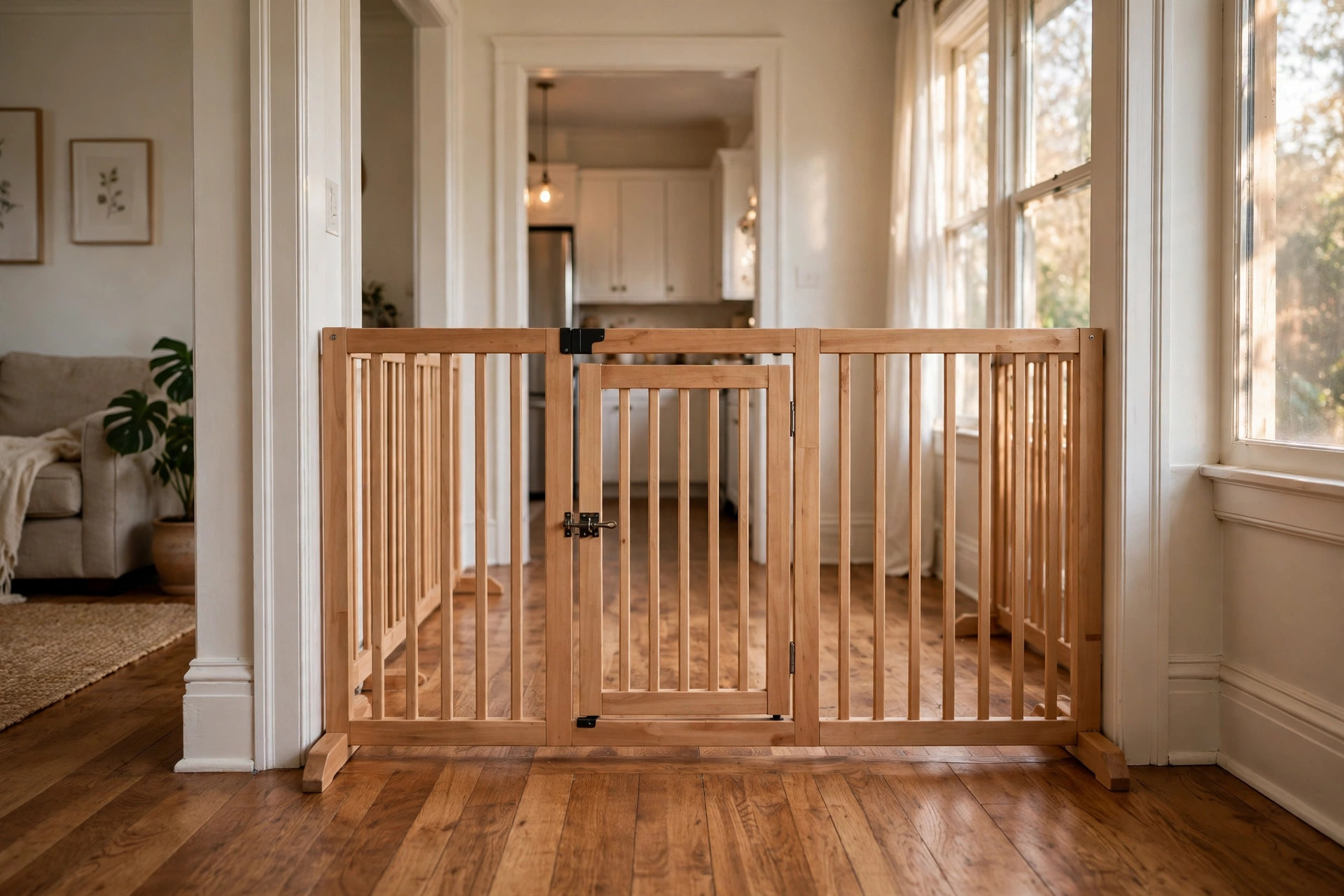
A freestanding pet gate answers this problem. It is a wide panel, often in three or four linked sections, with support feet on both sides. The panels fold at hinges, so the gate can zigzag a little and stand firm without touching the walls. When the owner needs the space back, the gate folds flat in seconds and slides behind a couch or into a closet.
Families use these gates for many reasons. A new puppy needs to stay in the kitchen during training. An older dog may need to stay off the stairs. A cat may need a room of its own away from a loud dog. In a house with small children, a sturdy gate can keep a large dog away from the play area. The gate does not replace training, but it gives the owner control while training takes hold. Pet care guides from the American Kennel Club note that safe confinement is one of the first steps in raising a well-behaved puppy.
Freestanding gates also suit renters. Many leases forbid holes in walls or trim. A gate that needs no mounting leaves no marks and causes no trouble when the renter moves out.
How to Choose the Right Size: Pet Gate Freestanding for Wide Doorways Usa
The first step is to measure. A tape measure is all that is needed. Measure the doorway at its widest point, floor to floor, and also note the height that will keep the pet inside. A small terrier may stay put behind a gate twenty-four inches tall. A large retriever or a cat that jumps will need a gate thirty-six inches tall or more.
Width is the more important number for this kind of gate. Many models span from around forty inches to well over seventy inches. Some can be set at an angle so they cover even wider openings. The owner should look for a gate whose listed range matches the measured width, with room on each side. A gate that is pulled too tight will not stand well. A gate that is much wider than needed will have extra folded panels that can swing loose.
Check the feet as well. Wide gates stay upright because of heavy, flat feet on both faces. Rubber pads on the feet protect wood and tile floors. If the floor is smooth tile or polished hardwood, rubber feet matter more, since metal or hard plastic feet can slide.
Materials and Build Types
Freestanding pet gates for wide openings come in wood, metal, and plastic. Each has strengths.
Wood
Wooden gates are the most popular choice for living rooms. They look like furniture and blend with trim and flooring. Most are made of pine or rubberwood with a stained or painted finish. They are heavy enough to stand steady, which is an advantage for wide spans. The drawback is that a strong dog can chew wooden slats, and heavy gates can be hard to carry from room to room. Retailers such as Home Depot and Lowe’s carry several wooden freestanding models in their pet departments.
Metal
Metal gates are usually made of steel tube with a powder-coated finish. They resist chewing and stand up to large dogs. Many come in black or white finishes that suit modern rooms. They are often the most stable of the three types because of their weight. The trade-off is that they can scratch floors if the feet lose their rubber caps, so the owner should check the caps now and then.
Plastic
Plastic and resin gates are light and easy to move. They work well for smaller dogs and cats, and they are easy to wipe clean. They are the least steady for very wide openings, since they weigh less. For a wide doorway with a big dog, wood or metal is the safer choice.
Some gates mix materials, such as a wood frame with metal mesh panels. These can give both looks and strength.
Walk-Through Doors and Extra Features
Many wide freestanding gates include a walk-through door. This is a small hinged door in the center panel that lets people pass without lifting or moving the whole gate. In a busy kitchen doorway, this feature is worth the extra cost. Look for a door with a latch that closes by itself and locks with one hand.
Other useful features include a step-over bar that sits low at the base, a two-way swing for the walk-through door, and panels that lock at angles. Some gates come with optional wall-mount brackets so they can be used freestanding or mounted. A few models have a small pet door built in for cats, which is handy in a house with both cats and dogs. Homeowners who need stairway protection may also look at a pet gate with a cat door for stairway safety as a related option.
Stability should come first. A gate that looks fine but tips when a large dog leans on it is not a safe gate. Product listings and buyer reviews on sites like Chewy, PetSmart, and Petco often note whether a gate stays upright with a strong dog, and these notes are worth reading before a purchase.
Cost and Price in the United States
Prices for a pet gate freestanding for wide doorways in the United States range widely. A small, basic plastic gate may cost under forty dollars. A wide wooden gate with a walk-through door often falls between eighty and one hundred eighty dollars. Large metal gates for very wide openings can reach two hundred dollars or more.
The price reflects the width, the material, and the finish. Wooden gates with furniture-grade finishes cost more than plain pine. Gates that convert between freestanding and wall-mounted use cost more than freestanding-only models. Sales at large retailers such as Walmart and Chewy often bring the price down by twenty to forty dollars during holiday periods.
Owners should think of the gate as a long-term purchase. A well-made gate can serve for ten years or more, through several pets. Buying a gate that is too small or too light to do the job usually means buying twice.
Safety First
A pet gate is a safety tool, and it must be used with care. Animal welfare groups such as the ASPCA remind owners that confinement tools should never cause fear or harm. The gate should be checked each day for loose hinges, cracked slats, or worn feet. A gate that rocks or leans is a gate that can fall, and a falling gate can hurt a pet or a child.
Never use a freestanding gate at the top of stairs. A pet or a child who pushes against it can knock it over and tumble down the steps. For stairways, a gate that mounts to the wall is the safe choice.
Slat spacing matters. Wide gaps let a small dog squeeze through or catch a head between the slats. Vertical slats are safer than horizontal ones for climbers, since horizontal bars give a paw-hold. The gate should be tall enough that the pet cannot jump it. A jumper who clears the gate once will try again.
Puppies and kittens should be watched the first few days a gate is in use. Some young animals chew hinges or latches. If the pet shows stress, short sessions behind the gate with a treat can build a good habit. For dogs with strong anxiety, a dog crate designed for escape-prone anxious dogs may be a better tool than a gate for times when no one is home.
Care and Upkeep
A freestanding gate needs little care. Wooden gates should be wiped with a damp cloth and dried at once. Harsh cleaners can dull the finish. Metal gates can be wiped with a mild soap solution; if paint chips, the spot can be sealed with a small amount of matching paint so rust does not start. Plastic gates can be washed with soap and water and set in the sun to dry.
Hinges are the moving part that wears out first. A drop of household oil on each hinge once or twice a year keeps them swinging free. Check the latch of the walk-through door, too. A latch that sticks will tempt the owner to leave the door ajar, which defeats the purpose of the gate.
When the gate is not in use, fold it flat and store it in a dry place. Leaving a wooden gate folded in a damp garage can warp the panels. Pet health sites like PetMD and The Spruce Pets note that clean, well-kept pet equipment is part of a healthy home routine, and a gate is no exception.
FAQ
Will a freestanding gate work on carpet? Yes, in most cases. The feet sink slightly into carpet, which can actually add grip. On very thick carpet, check that the feet sit flat and the gate does not rock.
Can a freestanding gate hold back a large dog? A heavy wood or metal gate can hold a large dog that is calm. A dog that charges or jumps needs a mounted gate, or training to respect the boundary. No freestanding gate should be trusted with an untrained, powerful dog unsupervised.
Does a freestanding gate damage floors? It should not, if the feet have rubber pads and the pads are in place. Check the pads when the gate is moved. Replace worn pads before they scratch.
How wide an opening can one gate cover? It depends on the model. Many cover sixty to seventy-two inches. Some can be set at angles to cover more. For very large open-plan spaces, two gates can be set in a line, though a mounted barrier is steadier for such spans. For outdoor areas, a no-dig dog fence for a large yard is a different tool worth a look.
Is a walk-through door worth the extra money? For a doorway used many times a day, yes. Lifting a heavy gate aside gets old fast. A self-closing walk-through door saves time and keeps the gate in place.
Can I leave the gate up all the time? Yes. Many owners leave the gate standing for months. Fold and store it only when the room is needed open, such as for a party or for cleaning.
Final Word
A pet gate freestanding for wide doorways is a quiet workhorse of the American pet home. It needs no tools, leaves no marks, and moves where it is needed. The owner who measures first, chooses a sturdy material, and checks the gate now and then will get years of safe service from it. For wide openings in living rooms, kitchens, and halls, it is often the simplest answer and the right one.
References
American Kennel Club. (n.d.). Dog care and training resources. https://www.akc.org ASPCA. (n.d.). Pet care and animal welfare resources. https://www.aspca.org Chewy. (n.d.). Pet supplies. https://www.chewy.com Lowe’s. (n.d.). Home improvement products. https://www.lowes.com Petco. (n.d.). Pet supplies and services. https://www.petco.com PetMD. (n.d.). Pet health information. https://www.petmd.com PetSmart. (n.d.). Pet supplies and services. https://www.petsmart.com The Home Depot. (n.d.). Home improvement products. https://www.homedepot.com The Spruce Pets. (n.d.). Pet care guides and product reviews. https://www.thesprucepets.com Walmart. (n.d.). Everyday low prices. https://www.walmart.com
Was this guide helpful?

About James Carter
The My Garden US editorial team writes practical, in-depth home and garden guides for American homeowners — tested advice, no fluff.
You May Also Like

Best Dog Toothpaste Enzymatic for Bad Breath: A Complete Guide
May 20, 2026 0 views
The Best Dog Crate for Anxious Dogs: Escape Proof Choices That Keep Pets Calm and Safe
January 8, 2026 0 views
Outdoor Chicken Coop for Backyard Hens USA: A Practical Guide
February 9, 2026 0 views