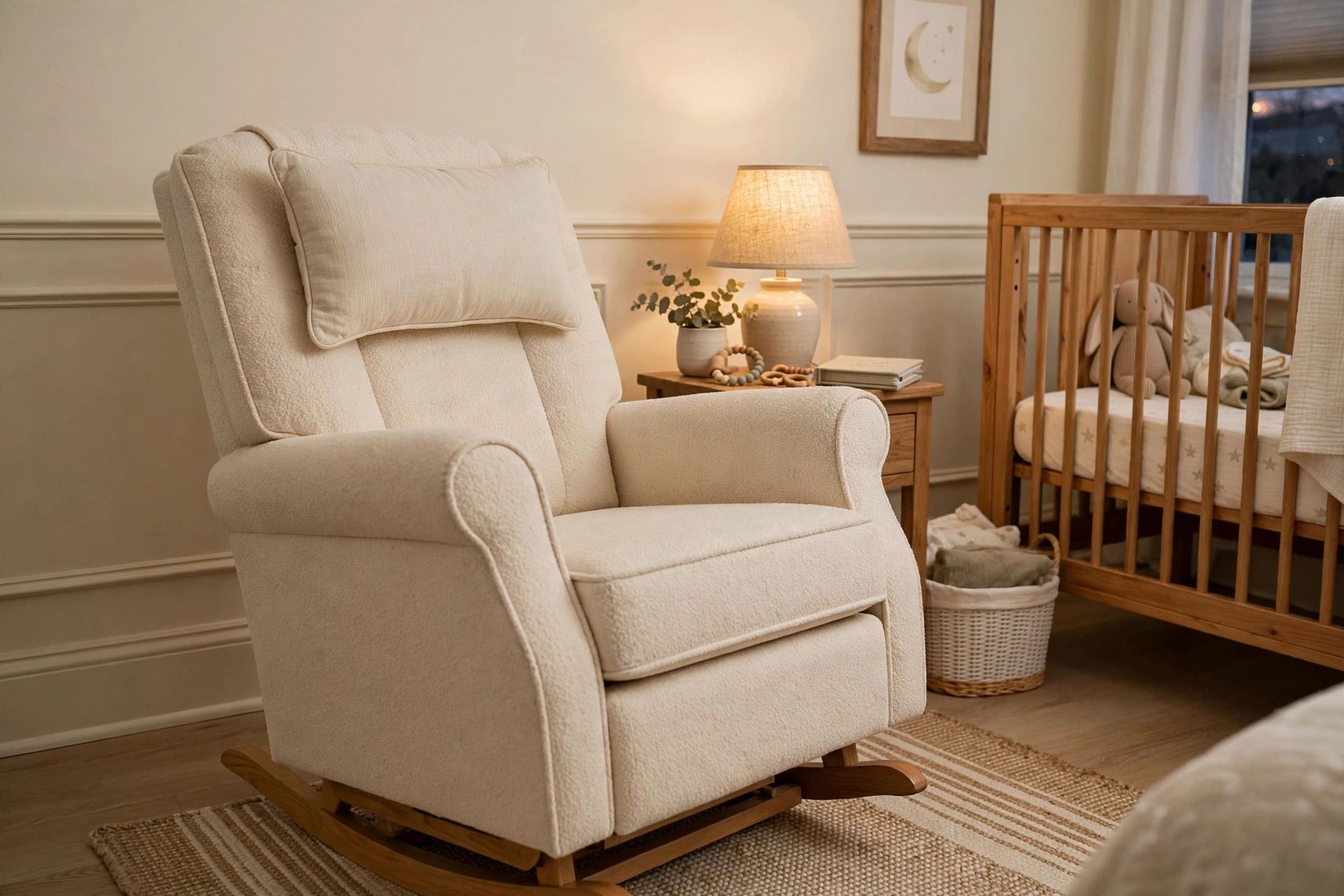

A nursery rocker with lumbar support pillow is one of the most useful pieces of furniture a new parent can own. In the first months of a baby’s life, a mother or father may spend four, five, or even six hours a day in a rocking chair. Feedings happen around the clock. Rocking a fussy infant to sleep takes time. Without the right support, the lower back takes the full strain. A rocker fitted with a lumbar support pillow changes that picture. It cradles the curve of the lower spine, keeps posture upright, and lets the parent relax while holding the baby close.
This guide covers everything you need to know before you buy. You will learn why lumbar support matters during nursing, what to look for in a rocker, the types available, typical costs, care tips, and safety rules. Whether you are setting up your first nursery or replacing an old chair, the advice below will help you choose well.
Why Lumbar Support Matters in the Nursery
Feeding a baby is gentle work, but it is also long work. A newborn may nurse or take a bottle eight to twelve times a day. Each session can last twenty to forty minutes. Parents often lean forward to bring the baby to the breast or bottle. They crane their necks downward to watch the baby’s face. Over weeks and months, this posture flattens the natural inward curve of the lower back. Muscles in the lumbar region grow tight and sore.
The lumbar spine is the section of the back just above the hips. It carries the weight of the upper body. When you sit upright with proper support, the lumbar curve holds its natural arch. When you slouch, the discs and muscles between the vertebrae take extra load. A lumbar support pillow fills the gap between the chair back and the lower spine. It pushes gently against the curve and keeps it in place even when you lean in toward the baby.
Many parents report that their back pain began in the nursery. They blame the rocking chair, but the chair is only half the story. The real cause is a chair back that is too straight, too tall, or too soft to hold the lumbar curve. A nursery rocker with lumbar support pillow solves the problem at the source. The pillow does the work your tired muscles cannot do at three in the morning.
Good support also helps with letdown and bonding. When a mother is tense, her shoulders rise and her jaw tightens. Tension can slow the letdown reflex that releases milk. A chair that supports the back lets the whole body settle. The room feels calm.
What to Look for When You Choose: Nursery Rocker with Lumbar Support Pillow
Back Height and Recline Angle
The backrest should reach at least to your shoulder blades. A back that is too short leaves the upper spine unsupported. Some rockers have a tall back with a built-in headrest. These are best for parents who fall asleep in the chair during night feedings. A slight recline, between one hundred and one hundred fifteen degrees, is the most comfortable angle for holding a baby. Rockers that lock the recline are safer for parents who doze off.
The Lumbar Pillow Itself
Not all lumbar pillows are equal. The best ones are shaped, not flat. They have a curved or barrel form that fits into the waist. The filling should be firm enough to hold its shape under pressure. Memory foam and dense fiber fill both work well. Avoid pillows that are too thick. A pillow that pushes the back too far forward will cause its own strain. Look for a pillow with adjustable straps so you can raise or lower it to match your waistline.
Seat Depth and Width
Seat depth matters more than most buyers expect. If the seat is too deep, your back pulls away from the chair back. If it is too shallow, your thighs take the weight. The rule is simple. Sit all the way back. Two or three inches of seat should show between the edge of the seat and the back of your knees. Seat width should leave room for a nursing pillow. Most parents find that a width of twenty-two to twenty-four inches works.
Armrest Height
Armrests carry the weight of the baby during feedings. They should be high enough that your elbows rest without lifting your shoulders. Padded armrests are worth the extra cost. Look for armrests that are wide enough to hold a nursing pillow steady. Some rockers have armrests that move with the chair. Others are fixed to the base. Moving armrests keep the motion smooth and are less likely to pinch.
Rocking Motion and Base
A traditional nursery rocker has curved runners. A glider has a mechanism that moves the seat back and forth on a flat track. Both are fine for the back. Gliders tend to be quieter. Quiet motion matters when you are settling a baby who has just fallen asleep. Check the base before you buy. It should be wide and heavy. The chair must not tip or wobble when you lean forward to lift the baby out of the crib.
Types of Nursery Rockers With Lumbar Support
The Classic Wooden Rocker
The classic wooden rocker is the chair many grandparents remember. It has a wooden frame, spindles, and curved runners. Modern versions come with padded cushions and a matching lumbar pillow. Wooden rockers are strong and last for years. They suit traditional nurseries. The downside is weight. They are hard to move from room to room.
The Upholstered Glider Rocker
The upholstered glider is the most popular nursery chair in the United States today. It is fully padded, from the seat to the armrests to the backrest. It glides on a smooth track instead of rocking on runners. Most gliders include a lumbar pillow as a separate cushion. The padding makes long feedings comfortable. The wide fabric choices match any nursery theme. On the downside, fabric gliders stain easily.
The Reclining Rocker
A reclining rocker adds a footrest and a locking backrest. You can push back, raise your feet, and rest between feedings. Many models have the lumbar pillow built into the back cushion. These chairs are larger than standard rockers, so measure your nursery before you buy. They are a good choice for parents who plan to spend a lot of time in the chair during the day as well as at night.
The Swivel Rocker
A swivel rocker turns a full circle on its base. You can face the crib, then turn to face the window, without standing up. The swivel base is handy in small rooms where the chair cannot move. Some swivel rockers also recline. The lumbar support pillow on these models is usually removable, so you can wash the cover when it needs it.
For a closer look at pairing options, read our guide to the nursery glider chair with ottoman for breastfeeding. If your nursery is tight on floor space, the best rocking chair for nursery small spaces may suit you.
Cost and Price Range
A nursery rocker with lumbar support pillow is available at nearly every price point. Simple wooden rockers with cushion sets start around one hundred fifty dollars. Mid-range upholstered gliders, which make up most nursery sales, run from two hundred fifty to six hundred dollars. Premium reclining gliders with built-in lumbar support and matching ottomans can cost eight hundred to one thousand two hundred dollars.
What drives the price up? Solid wood frames cost more than engineered wood. High-density foam lasts longer than basic batting. Performance fabrics that resist stains add to the price. Brand names add their own premium. What drives the price down is thin padding, light frames, and basic fabrics.
You do not need the most expensive chair to protect your back. A mid-range glider with a well-shaped lumbar pillow will do the job. If your budget is tight, buy a basic sturdy rocker and add a separate lumbar pillow. A good pillow costs twenty to forty dollars on its own. This trick turns almost any chair into a supportive nursery seat.
Watch for package deals. Many retailers sell the rocker and ottoman together at a discount. An ottoman is worth having. It raises your feet and makes it easier to stand up while holding the baby. Some parents also pair the chair with a soft nursery night light with dimmer for feeding to keep the room calm during night sessions.
Shopping advice sites such as The Spruce publish nursery furniture buying guides that compare current models. The U.S. Consumer Product Safety Commission keeps a list of recalled nursery products worth checking before you buy secondhand.
Care and Upkeep
A nursery chair sees daily use for at least a year, often longer. Regular care keeps it clean and safe.
Vacuum the seat and back weekly with an upholstery attachment. Crumbs, lint, and dust collect in the seams. Treat spills right away. Blot, do not rub. Rubbing pushes the stain deeper into the fabric. Use a mild soap solution for most fabrics.
Wash the lumbar pillow cover as often as you wash the baby’s sheets. Milk, spit-up, and sweat all reach the pillow. Most covers unzip for machine washing. Wash on a gentle cycle with mild detergent. Let the cover air dry or tumble dry on low heat.
Check the hardware twice a year. Tighten any loose bolts on the base and the armrests. A rocking chair that wobbles is a chair that needs repair. On wooden rockers, check the runners for cracks. On gliders, listen for squeaks in the track. A drop of silicone lubricant on the moving parts will quiet most noise.
Keep the chair out of direct sunlight. Sun fades fabric and dries out wooden frames. If the chair sits near a window, rotate it now and then.
For general nursery furniture ideas and care tips, the home editors at IKEA and Wayfair both publish useful room guides.
Safety in the Nursery
Safety rules for a nursery rocker are simple but firm.
First, the chair must be stable. It should not tip forward when you lean to pick up the baby. Test this in the store if you can. Press down on the front edge of the seat. A good chair will stay planted.
Second, watch the pinch points. Glider tracks and reclining mechanisms have moving parts. Small fingers find them. Choose a chair with covered mechanisms or keep the chair out of reach of toddlers when it is not in use.
Third, never fall asleep with the baby in your arms on a soft chair. The American Academy of Pediatrics warns that sleeping on a couch or armchair with an infant raises the risk of injury. If you feel yourself drifting off, place the baby back in the crib. The parenting site What to Expect explains safe sleep practices in plain language.
Fourth, keep cords away from the chair. Phone chargers, lamp cords, and monitor cables all pose a strangulation risk.
Fifth, check the chair for recalls. The U.S. Consumer Product Safety Commission maintains a searchable database of recalled products, including nursery furniture. Check any secondhand chair before you bring it home.
The health site HealthyChildren.org, run by the American Academy of Pediatrics, offers free guidance on nursery setup and safe sleep.
Frequently Asked Questions
Do I really need a lumbar support pillow, or will any cushion do?
Any cushion is better than none, but a shaped lumbar pillow works best. Flat cushions collapse behind you and do little for the lower curve of the spine. A pillow made for the lumbar region holds its form and keeps the curve in place through long feedings.
Can I add a lumbar pillow to a rocker I already own?
Yes. Most lumbar pillows attach with straps that wrap around the chair back. Measure your chair back first. The pillow should sit at your waistline when you are seated. A separate pillow is also the cheapest way to upgrade an older chair.
Which is better for back pain, a glider or a rocker?
Both can be good. The key is the backrest and the pillow, not the motion. That said, many parents with back pain prefer gliders. The motion is smooth and the backrest often reclines. Test both types in a store before you decide.
How long will I use the nursery rocker?
Most families use the chair daily for the first year. Many keep it much longer. Parents read bedtime stories in it for years. A sturdy rocker often moves to the living room once the baby outgrows the nursery.
What fabric is best for a nursery rocker?
Look for a fabric that cleans easily. Microfiber and performance fabrics resist stains. Cotton blends feel soft but stain more easily. Avoid rough textures that will irritate the baby’s skin. Removable, washable covers are the most practical choice.
Is a swivel base safe?
A swivel base is safe when the chair is well made. The base should be heavy and wide. The chair should turn smoothly without tipping. Keep the area around the chair clear so little hands and feet stay out from under the moving base.
Pottery Barn Kids and Target both carry wide nursery glider lines with lumbar pillow options. Amazon offers a large range of separate lumbar pillows that fit most chair backs.
A Short Final Word
A nursery rocker with lumbar support pillow is a small investment with a large daily payoff. Your back will thank you in the fourth week, the twelfth week, and the months beyond. Choose a chair with a solid base, a backrest that reaches your shoulders, and a pillow shaped for the lumbar curve. Keep it clean, check the hardware, and follow basic safety rules. The chair will serve you through the hardest and sweetest months of new parenthood, and it will be ready for the next child when the time comes.
References
Amazon. (n.d.). Online shopping. https://www.amazon.com American Academy of Pediatrics. (n.d.). HealthyChildren.org. https://www.healthychildren.org IKEA. (n.d.). Home furnishings. https://www.ikea.com Pottery Barn Kids. (n.d.). Kids furniture and decor. https://www.potterybarnkids.com Target. (n.d.). Retail store. https://www.target.com The Spruce. (n.d.). Home and garden advice. https://www.thespruce.com U.S. Consumer Product Safety Commission. (n.d.). Product safety information. https://www.cpsc.gov Wayfair. (n.d.). Furniture and home goods. https://www.wayfair.com What to Expect. (n.d.). Pregnancy and parenting guidance. https://www.whattoexpect.com
Was this guide helpful?

About Michael Thompson
The My Garden US editorial team writes practical, in-depth home and garden guides for American homeowners — tested advice, no fluff.
You May Also Like
Best Kids Bed Rail for Top Bunk Safety: A Parent’s Guide
February 17, 2026 0 views
Nursery Glider Slipcover for Easy Washing: A Complete Guide
April 26, 2026 0 views
A Toddler Table with Storage Bins Underneath Brings Order to Playtime
June 28, 2026 0 views