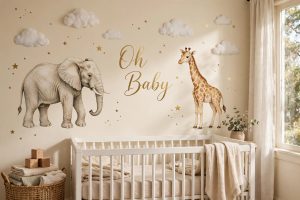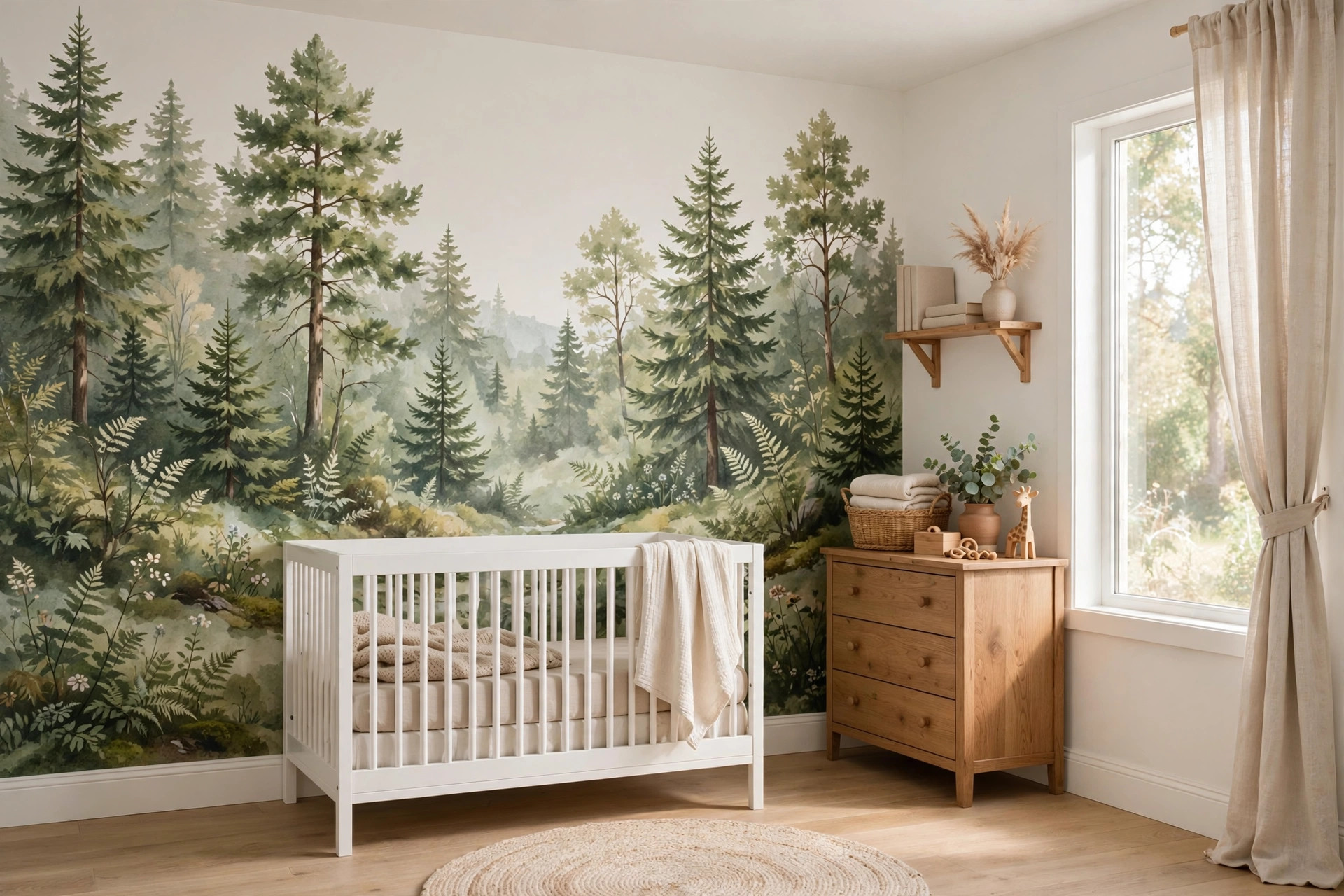
A nursery wall mural peel and stick forest design can change the whole feel of a baby room. It shows tall trees, soft hills, and calm woodland light on one wall. The mural sticks to the wall with a light adhesive backing. It comes off clean when the time comes. There is no paste, no glue, and no mess.
Many parents pick a forest theme for the nursery. Green tones feel calm and restful. Tree shapes give the eye something soft to follow. A forest scene also grows well with the child. It suits a newborn and still looks right years later. This guide explains how to choose a peel and stick forest mural for baby room walls, how to hang it, what it costs, and how to keep it safe and clean.
Why a Forest Mural Suits a Nursery
A nursery is a room for rest. Soft, natural images help set that mood. A forest mural fills a blank wall with tall pines, birch trunks, and gentle layers of green. The look is peaceful without being plain.
Forest designs also work for any child. They do not lean toward pink or blue. They suit a boy, a girl, or a shared room. Many parents like that freedom. It makes the room easy to plan.
Another point in favor of the forest theme is time. Cartoon prints can feel too young after a few years. A removable woodland wall mural nursery print still looks fine when the baby becomes a toddler. It can stay on the wall until the child asks for a change. That saves money and work in the long run.
The mural can also tie the room together. Match the greens in the print to a soft green wall paint on the other walls. Pick crib sheets and a rug in matching tones. A best nursery rug soft for crawling babies in a warm neutral shade sits well under a forest scene. The whole room feels planned, not patched together.
What to Look for Before You Buy: Nursery Wall Mural Peel and Stick Forest
Not all peel and stick murals are the same. A careful look at a few details will save trouble later. The points below matter most.
Size and Scale
Measure the wall before you shop. Write down the width and height in inches. Many murals come in panels that join side by side. Check the total coverage of the set. It should match or slightly exceed your wall size. A small gap at the edge is hard to hide. A little extra material can be trimmed with a knife.
Think about scale too. Some forest prints show trees at life size. Others show a distant treeline. Life-size trunks make a small room feel taller. Distant trees feel softer. Look at customer photos to see the print in a real room. That gives a true sense of scale.
Material and Adhesive
Most peel and stick murals use one of two materials. Vinyl film is thin and smooth. Fabric film is a little thicker and has a soft matte finish. Both use a low-tack adhesive that allows the piece to be moved and removed.
Fabric-based murals hide small wall bumps better. They also tear less when you pull them off the backing. Vinyl murals give sharper color. They can show every bump in the wall. For a nursery, either can work. The key point is that the adhesive should be repositionable. That lets you lift a panel and try again if it goes up crooked.
Print Quality and Color
Look for high-resolution printing. A blurry tree trunk will stand out at full wall size. Check the product page for close-up photos. Sharp lines and smooth color blends are good signs.
Color matters in a baby room. Bright, harsh greens can feel loud. Muted sage, pine, and moss tones feel calm. Many parents check nursery design advice for new parents before they pick a palette. Bring a paint chip or fabric swatch when you compare prints online. Hold it next to your screen. That simple step keeps the mural and the room in the same color family.
Types of Forest Peel and Stick Murals
Forest murals come in several styles. Each one suits a different taste and budget. The three main types are described below.
Full-Wall Photographic Prints
These murals use real photographs of forests. Tall pines stretch from floor to ceiling. Light filters through the branches. The effect is deep and lifelike. This style suits parents who want a bold, natural look.
Photo prints work best on one large wall. They need a smooth surface to look right. Any bump can break the illusion. They also cost more than other styles because the panels are large.
Illustrated Woodland Scenes
Illustrated murals show hand-drawn trees, hills, and animals. The lines are soft. The colors are gentle. A fox or an owl may hide among the trees. This style feels warm and storybook-like.
Many parents pick this style for a baby room. It is cheerful without being loud. It also pairs well with nursery wall art set for baby boy room prints on nearby walls. Matching woodland bedding and decor is easy to find for this style.
Panel and Tile Formats
Some murals come as separate tiles or strips instead of one large sheet. Each tile shows part of the forest. You place them in a grid. This format is easy for one person to hang. It also lets you cover only part of a wall.
Tiles suit renters. If one tile gets damaged, you can replace it alone. Shoppers looking at kids bedroom wall decals removable for renters often like this format for the same reason. It comes off the wall with no marks.
Cost and Price
A nursery wall mural peel and stick forest print can cost as little as thirty dollars or as much as three hundred. Size is the main driver of price. A small accent panel set costs the least. A full-wall photo mural costs the most.
Material also affects price. Fabric murals tend to cost more than vinyl. Custom sizes cost more than stock sizes. A made-to-measure print for an odd wall will add to the bill.
To keep costs down, cover one wall only. The mural wall becomes the focus of the room. Paint the other walls in a matching tone. That mix looks rich and costs less than covering the whole room. Watch for sales at large retailers. Home improvement store sites often run seasonal deals on wall decor.
Budget for a few tools too. You may need a squeegee, a sharp knife, and a level. Basic supplies such as a squeegee and a utility knife are sold at any home improvement store. These tools cost little and make the job much easier.
How to Apply the Mural
Hanging a peel and stick mural is a job most people can do in an afternoon. Take your time. Slow work gives a clean result.
Start with the wall. It must be clean, dry, and smooth. Wash it with a damp cloth and let it dry. Fill nail holes with filler and sand them flat. If the wall was painted recently, wait at least three weeks. Fresh paint needs time to cure. A mural can pull fresh paint off the wall.
Read step-by-step wall mural guides before you begin. They cover the small details. Also check wall preparation advice for older walls with texture.
Plan the layout first. Unroll the panels on the floor. Check that the forest image lines up across panel edges. Mark a level line on the wall with a pencil. This line is your guide for the first panel.
Peel the backing from the top of the first panel. Press the top edge to the wall along your level line. Smooth it down with a squeegee. Work from the center out to the edges. This pushes air bubbles out. Peel the backing down a little at a time as you go.
Line up the second panel with the first. Most forest prints have a slight overlap or a butt joint. Match the tree trunks at the seam. Small pattern breaks are normal. Stand back every few panels to check the whole scene.
Trim the edges with a sharp knife. Cut along the ceiling line, the baseboard, and around outlets. Turn off the power before you cut near outlets. Press the cut edges down with the squeegee.
Care and Upkeep
A peel and stick mural needs little care. Dust it now and then with a dry cloth or a soft duster. Avoid wet cleaning unless the maker says it is safe. Water can loosen the adhesive at the edges.
Keep the room at a normal temperature. Strong heat from a vent can soften the adhesive. If a vent blows straight at the mural, redirect it. Moisture is also a risk. Do not hang a peel and stick mural in a steamy bathroom wall area. A nursery is usually fine.
Edges may lift over time. Press them back down with your hand. A little heat from a hair dryer on a low setting can help the adhesive grip again. Hold the dryer a foot away and move it slowly. Then press the edge flat.
If one panel gets stained, order a replacement panel from the same maker. Use the same print run if you can. Colors can shift slightly between runs. This is one more reason to note the product name and order date.
Safety in the Nursery
Safety comes first in any baby room. A forest theme nursery wall decor choice should be checked on a few points.
Pick murals printed with low-VOC or water-based inks. These release fewer fumes. Air the room out for a day after hanging the mural. Open the window and let fresh air move through.
Keep the crib a safe distance from the mural wall. Babies pull and chew. A crib pushed against the wall lets a curious toddler peel at the mural edge. Leave a gap of at least a foot between the crib and the wall.
Check that the mural has no loose small parts. Tiles and decals should stick flat. Test the edges with your finger. If a corner lifts, press it down or trim it. A small loose piece is a choking risk for a crawling baby.
Think about the whole room too. A modern nursery dresser with anti-tip hardware, crib and glider options that meet current standards, and soft lighting all add up. Small nursery layout ideas can help you place each piece with room to move.
Frequently Asked Questions
Will a peel and stick forest mural damage the wall paint?
In most cases, no. The adhesive is made to come off clean. The risk rises if the paint is fresh, cheap, or peeling. Let new paint cure for three weeks before you hang the mural. Test a small corner in a hidden spot first. If the paint holds, the full mural will be fine.
How long does a peel and stick mural last in a nursery?
Most murals last three to five years indoors. Sunlight is the main enemy. Strong sun can fade the inks over time. A north-facing wall or a room with curtains will keep the colors true longer. Heat and moisture also shorten the life of the adhesive.
Can I move the mural to another wall later?
Many fabric-based murals can be moved once or twice. Peel the panel off slowly and keep it clean. Dust on the sticky side will weaken the grip. Vinyl murals are harder to move. They can stretch or lose stickiness. Save the backing paper if you plan to move the mural.
Is a forest mural a good choice for a small nursery?
Yes. A forest scene can make a small room feel larger. Vertical tree trunks draw the eye up. That makes the ceiling feel higher. Light, airy forest prints work best in tight rooms. Dark, dense forest prints can make a small room feel closed in. For more on planning tight rooms, look at nursery furniture and lighting guides for small spaces.
Do I need tools to hang the mural?
Basic tools help a lot. A plastic squeegee smooths out bubbles. A sharp utility knife trims the edges. A level keeps the first panel straight. A step stool reaches the top of the wall. None of these cost much. They turn a hard job into a simple one.
What if the panels do not line up perfectly?
Small gaps happen, especially on long walls. Line up the most visible part of the scene first. Tree trunks and the horizon line matter most. Minor breaks in leaves or grass are hard to notice. If a seam shows, press it flat and step back. Most flaws vanish at normal viewing distance.
A Short Final Word
A nursery wall mural peel and stick forest print is a simple way to give a baby room a calm, natural heart. It goes up in an afternoon. It comes down without damage. It suits any child and any style. Measure the wall, pick a print you love, and hang it with care. The forest will be there every morning, quiet and green, as your child grows.
References
Apartment Therapy. (n.d.). Home design ideas and inspiration. https://www.apartmenttherapy.com Benjamin Moore. (n.d.). Paints and stains. https://www.benjaminmoore.com Bob Vila. (n.d.). Home improvement advice. https://www.bobvila.com CB2. (n.d.). Modern furniture and decor. https://www.cb2.com Crate and Barrel. (n.d.). Furniture and home decor. https://www.crateandbarrel.com Pottery Barn Kids. (n.d.). Kids furniture and decor. https://www.potterybarnkids.com The Home Depot. (n.d.). Home improvement products. https://www.homedepot.com This Old House. (n.d.). Home renovation guidance. https://www.thisoldhouse.com West Elm. (n.d.). Modern furniture and home decor. https://www.westelm.com What to Expect. (n.d.). Pregnancy and parenting guidance. https://www.whattoexpect.com
Was this guide helpful?

About Jennifer Lee
The My Garden US editorial team writes practical, in-depth home and garden guides for American homeowners — tested advice, no fluff.