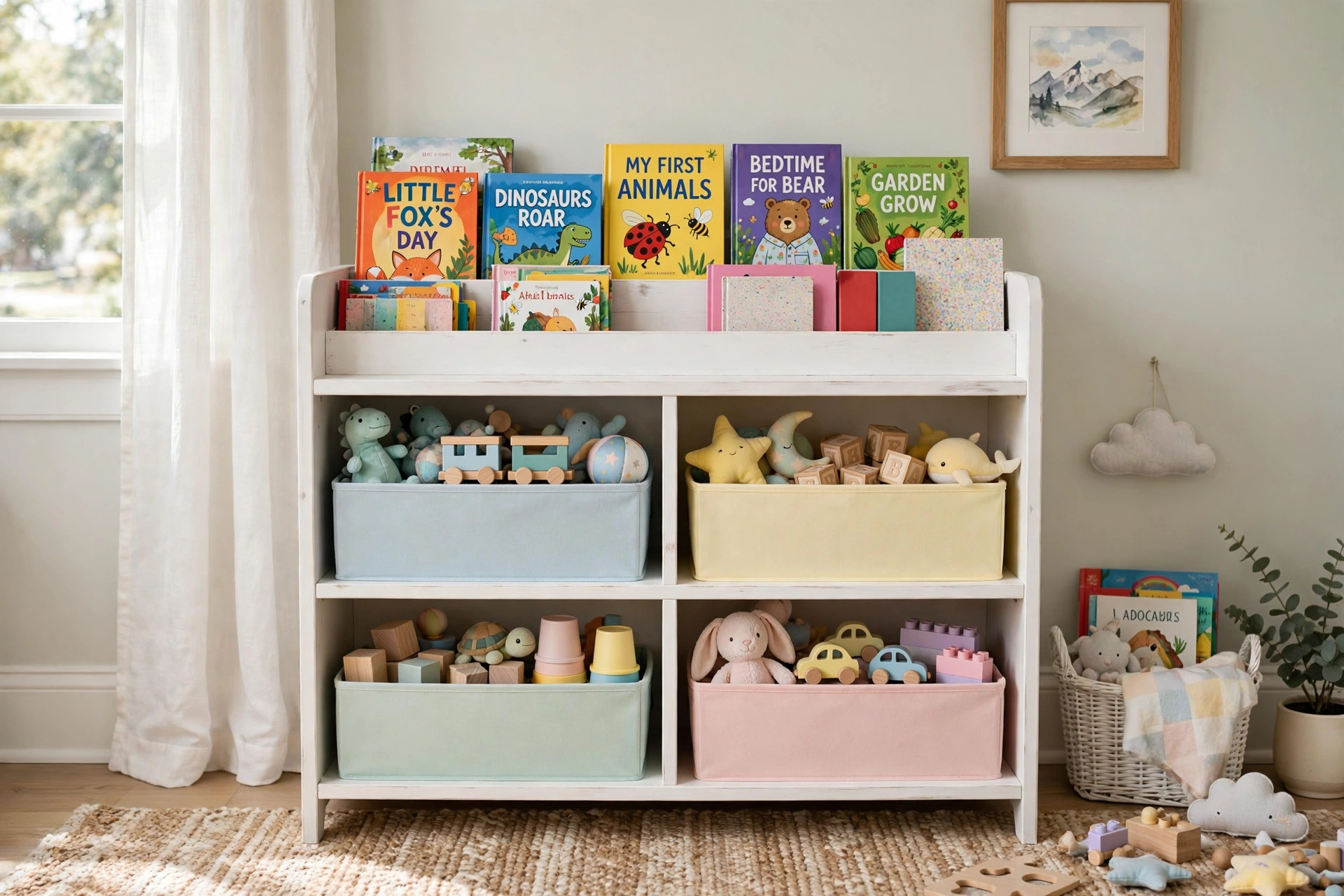

A kids bookshelf with bins for toy storage may be the most useful piece of furniture a parent can buy for a playroom or a child’s bedroom. It holds books where small hands can reach them. It holds toys where small hands can find them and, just as important, where those toys can be put back. One piece of furniture does the work of two. In a small room, that matters a great deal.
Most parents know the evening scene. Blocks cover the floor. Books lie open and face down. A kids bookshelf with bins for toy storage solves this problem in a plain and direct way. Shelves across the top hold books with their covers facing out, so a child can see and choose. Bins across the bottom hold the blocks, the cars, and the dolls.
Why a Kids Bookshelf with Bins for Toy Storage Matters
A child’s room works best when it has a clear order. Children, even very young ones, learn to care for their things when every item has a home. A kids bookshelf with bins for toy storage gives each thing its home. Books go on the shelf. Toys go in the bins. A parent can point to the bins at the end of the day, and the child knows what to do.
Reading grows from such habits. When books stand with their covers facing out, a child chooses by the picture. A book with its cover showing invites a small hand to pull it down. The low front shelf puts this method to work at home. More choices within reach mean more time spent with books.
The bins serve a second purpose beyond order. They teach sorting. One bin can hold blocks, another art supplies, a third soft toys. Parents can label the bins with pictures so a child who cannot yet read still knows where each toy belongs. This daily practice builds care and pride in a small room the child can truly own.
Space is the third reason this piece matters. Many families do not have a large playroom. The child’s bedroom must serve for sleep, play, and reading all at once. A separate bookcase and a separate toy chest would crowd a small floor. A kids bookshelf with bins for toy storage combines both into one low unit, often no wider than three feet and no taller than a small table. It fits against a wall and leaves the middle of the room free for play.
What to Look for When You Choose One: Kids Bookshelf with Bins for Toy Storage
Not all of these units are made alike. A careful buyer looks at size first. Measure the wall where the piece will stand. Measure the floor space in front of it, since bins slide out and children sit in front of them. A unit that looks small in a store may feel large in a real bedroom. Write the numbers down and bring a tape measure when you shop.
Height matters for safety and for daily use. The top shelf should sit low enough that a small child can reach the books without climbing. For toddlers, a unit under three feet tall is best. For school-age children, a taller piece is fine, but it must be fixed to the wall with the straps or brackets that come in the box. A tall shelf that is not fixed can tip, and tip-over injuries are a real and serious risk. The U.S. Consumer Product Safety Commission keeps safety rules and recall lists for children’s furniture, and it is wise to check them before you buy.
Next, look at the bins. Some are soft fabric cubes that slide into square openings. Some are open plastic tubs. Some are wooden drawers. Fabric bins are light and safe for small children, since they cannot pinch fingers. Plastic bins wipe clean in a moment, which matters for sticky or painted toys. Wooden drawers look fine and last long, but they cost more.
Check the shelf depth. Picture books are wide, and a shelf that is too shallow lets them fall forward. A shelf depth of at least eight inches holds most children’s books with ease. The front rail that keeps books upright should be high enough to stop them from sliding out, yet low enough that a child can lift a book over it. A rail of two to three inches strikes the right balance for most ages.
The frame itself deserves a close look. Solid wood costs more but stands up to years of hard use. Engineered wood costs less and works well if it is thick and well joined. Rock the unit gently. A good piece feels stiff and solid, not loose and wobbly. Check the corners for sharp edges; round corners are kinder to small heads and knees.
Children touch, chew, and lean on their furniture. Look for a finish marked non-toxic and low in volatile organic compounds. If you buy a painted unit, check that the paint is lead-free. These facts appear on the product label or the maker’s website.
Types and Options on the Market
The market holds several common forms of the kids bookshelf with bins for toy storage, and each suits a different home.
The most common form is the low cube unit. It stands about two to three feet tall and holds two rows of square openings. The top row often serves as an open book ledge, while the lower rows hold fabric bins. These units are wide rather than tall, which keeps them stable. They suit toddlers and young children best.
A second form is the tall tower with bins. This unit stands four to five feet high, with shelves for books at the top and bins at the bottom. It suits a school-age child who reads chapter books and still keeps toys. It must be fixed to the wall.
A third form is the corner unit. It fits into the angle where two walls meet and uses space that would otherwise go to waste. Corner units often have angled shelves and deep bins. They suit very small rooms, though they can be harder to reach into, so they work best for older children.
A fourth form is the themed unit. Makers shape these to look like a dollhouse, a train, or a castle. Children love them, but a child may outgrow the theme in a few years, so parents should weigh delight against long use.
There are also units that pair well with other nursery and playroom pieces. A family setting up a full room may wish to read about a best kids chair for desk ergonomic support for the homework corner, a nursery chandelier for baby girl room decor for soft light above the reading nook, or a best kids room humidifier for dry air for comfort through dry winter months. Each of these pieces shares the same goal: a room that serves the child well.
Cost and Price: What You Should Expect to Pay
Prices for a kids bookshelf with bins for toy storage run from modest to high, and the range tells you much about what you get.
At the low end, from about thirty to seventy dollars, you find simple units of thin engineered wood with fabric bins included. These serve well for a year or two of light use. Large retailers such as Target and Walmart carry many versions of this form at fair prices.
In the middle range, from about eighty to one hundred and eighty dollars, you find sturdier frames, thicker panels, and better bins. IKEA offers low storage units with bins that families have used for years, and Wayfair lists hundreds of choices across this price band with full size charts.
At the high end, from about two hundred to five hundred dollars and more, you find solid wood, fine joinery, and finishes made for nurseries. Pottery Barn Kids sells bookcases and storage pieces built to last.
A note on value: the bins wear out before the frame does. Fabric bins fade, tear, and lose their shape after a few years of daily use. If the maker sells spare bins in standard sizes, the whole piece gains years of life for a small later cost.
Shipping and assembly add to the true price. Large units ship in heavy flat boxes, and many sellers charge for delivery. Read the fine print before you compare prices.
Care and Upkeep Through the Years
A kids bookshelf with bins for toy storage asks for little care, but a small routine keeps it sound for years.
Dust the shelves each week with a dry cloth. Once a month, pull the bins out and wipe the inside of each opening with a damp cloth. Crumbs and sand collect in the corners, and a quick wipe stops them from grinding into the finish.
Fabric bins can be vacuumed with a soft brush head. Most can be spot-cleaned with mild soap and water. Check the maker’s label before you wash one fully, since some bins lose their stiff shape in a full wash.
Tighten the screws twice a year. Children lean, climb, and push, and screws loosen with time. A ten-minute check with a screwdriver each spring and fall keeps the piece firm. While you work, check the wall strap. It should sit tight with no slack.
Rotate the books with the seasons. A child reads the books in front and ignores the ones behind. Every few months, move the back books to the front and add a few new ones from the library. The same holds for the bins: move a bin of long-ignored toys to the top row, and the child may play with them as if they were new.
When the child outgrows the unit, do not throw it away. A kids bookshelf with bins for toy storage serves well in a garage, a laundry room, or a home office. The bins hold tools, rags, or files as easily as they held blocks.
Safety: The Points That Matter Most
Safety comes first with any furniture a child uses alone. Four points deserve full attention.
First, fix tall units to the wall. Use the anti-tip strap or bracket in the box, and fix it into a wall stud, not into drywall alone. The U.S. Consumer Product Safety Commission warns that unsecured furniture causes thousands of injuries to children each year. This one step prevents the worst harm a bookcase can do.
Second, check for small parts. Some units ship with small caps, plugs, or knobs. A toddler can pull these off and put them in the mouth. Remove small decorative parts, or choose a unit made without them.
Third, mind the bins. Heavy bins full of wooden blocks can fall on a small foot. Teach the child to pull bins straight out and set them on the floor, not to tip them down from above. Open bins with no lids are safer than bins with heavy lids, since lids can slam on fingers. If a unit has doors, check that they cannot trap a child’s head or fingers.
Fourth, check for recalls. Before you buy, and once a year after, search the model name on the recall pages of the U.S. Consumer Product Safety Commission. Makers recall pieces for faulty straps, weak joints, or unsafe paint. A recall often means a free repair kit. It takes five minutes and costs nothing.
Frequently Asked Questions
What age is a kids bookshelf with bins for toy storage best for?
It suits children from about eighteen months to ten years. Toddlers use the low bins and the front book ledge. School-age children use the upper shelves for chapter books and school supplies. Fix tall units to the wall.
How many bins do I need?
Most families find that four to eight bins serve well. Fewer bins mean each bin overflows. More bins than a child can manage mean the system falls apart. Start with six: blocks, art supplies, soft toys, cars, dolls, and puzzles.
Are fabric bins or plastic bins better?
Each has its place. Fabric bins are light, quiet, and safe for toddlers, and they come in colors that help with sorting. Plastic bins wipe clean and hold wet or sticky toys. Many families use fabric bins for daily toys and keep one or two plastic bins in a closet for messy playthings.
Can I build one myself?
A skilled home woodworker can build a simple unit in a weekend from plywood and basic tools. Plans appear in many woodworking books and on sites such as The Spruce, which carries project guides for home storage. A home-built unit must meet the same safety rules: no sharp edges and a firm fix to the wall if it stands tall.
Where should I put it in the room?
Place it against a solid wall, away from windows with cords and away from heaters. Leave clear floor space in front so the child can sit and pull bins out with ease. Near the reading corner is ideal. Guides at What to Expect note that low, reachable storage helps children build self-reliant habits.
How do I keep it tidy when my child will not clean up?
Make clean-up short and plain. Set a timer for five minutes and tidy together. Sort by bin, not by single toy, and praise the sorting. Label bins with pictures. Keep the total number of toys low by storing half of them away and rotating them each month.
A Final Word
A kids bookshelf with bins for toy storage is a small buy with a large return. It brings books to a child’s eye level. It gives toys a home. It teaches order without a lecture. It fits a small room and a modest budget, and it lasts for years with plain care.
References
IKEA. (n.d.). Home furnishings. https://www.ikea.com Pottery Barn Kids. (n.d.). Kids furniture and decor. https://www.potterybarnkids.com Target. (n.d.). Retail store. https://www.target.com The Spruce. (n.d.). Home and garden advice. https://www.thespruce.com U.S. Consumer Product Safety Commission. (n.d.). Product safety information. https://www.cpsc.gov Walmart. (n.d.). Everyday low prices. https://www.walmart.com Wayfair. (n.d.). Furniture and home goods. https://www.wayfair.com What to Expect. (n.d.). Pregnancy and parenting guidance. https://www.whattoexpect.com
Was this guide helpful?

About David Wilson
The My Garden US editorial team writes practical, in-depth home and garden guides for American homeowners — tested advice, no fluff.
You May Also Like
The Best Nursery Storage Ottoman for Toys: A Plain Guide for Parents
January 25, 2026 0 views
Kids Room Curtains for Privacy and Style
April 27, 2026 0 views
Kids Toy Chest with Safety Hinge Lid: A Parent’s Buying Guide
April 21, 2026 0 views