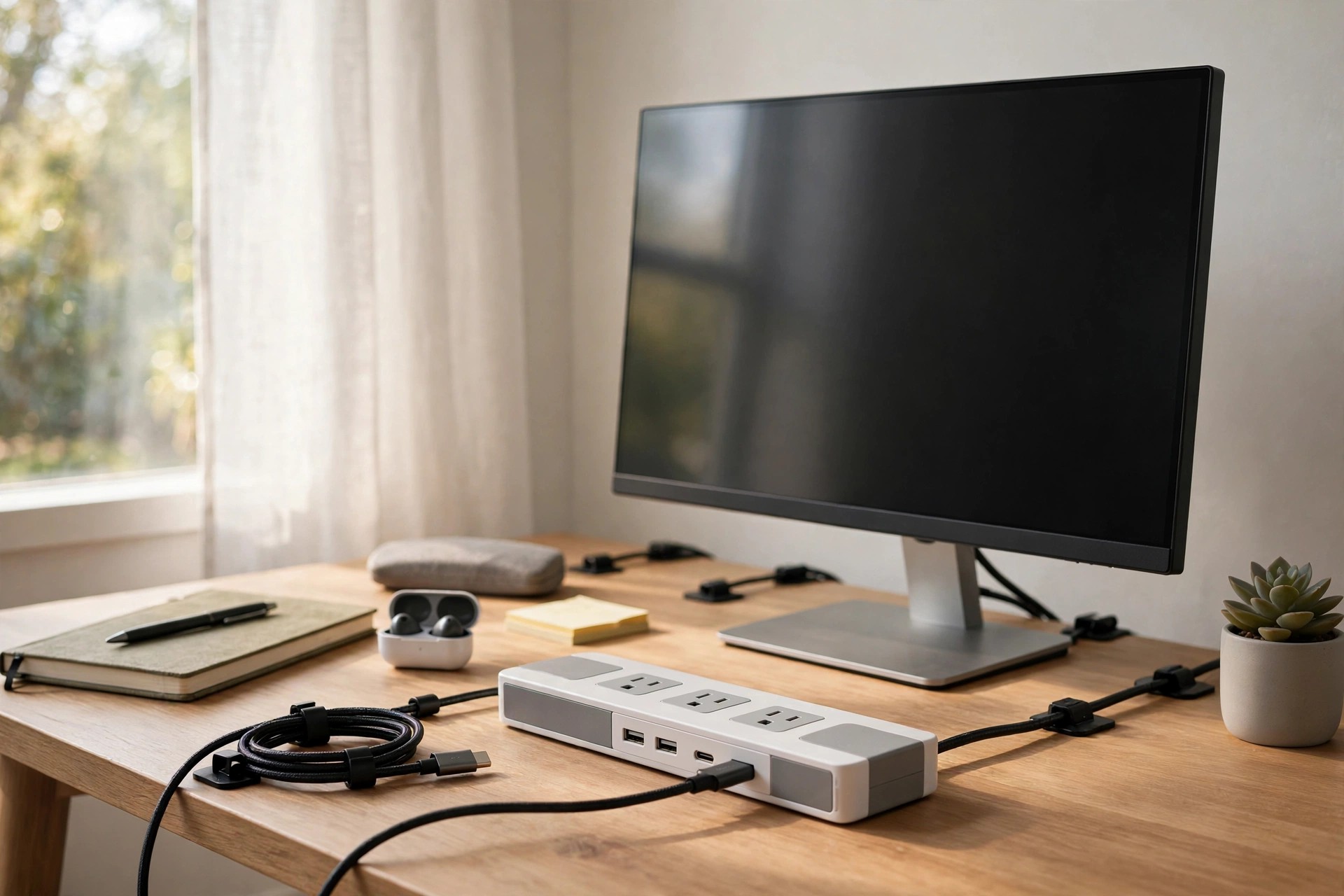

The best surge protector with usb ports for desk setups is a small but important part of a modern home office. It sits at the edge of your desk or mounts under it, and it does two jobs at once. It guards your computer, monitor, and other gear against sudden spikes in power. It also charges your phone, tablet, earbuds, and other small devices through built-in USB ports, so you no longer need a handful of wall chargers fighting for space.
Why does this matter now? Home offices have more devices than ever. A typical desk may hold a laptop, a monitor, a lamp, a printer, speakers, a phone, a tablet, and a desk fan. Each of these draws power or needs charging. A plain power strip gives you more outlets but no real protection. When lightning strikes nearby, when the power company switches lines, or when a large appliance in the house cycles on, the voltage in your outlets can jump far above normal for a fraction of a second. That spike can burn out a power supply, scramble data, or shorten the life of a circuit board. A surge protector stands in the way and soaks up the excess before it reaches your gear. Adding USB ports to that same housing simply makes the device more useful at arm’s length, right where you sit.
Why a Desk Surge Protector Matters
Your computer and peripherals are sensitive to voltage changes in a way that a toaster or a floor lamp is not. The power supply in a laptop or monitor expects a steady 120 volts, and it can only tolerate so much noise on the line. A single strong surge can kill a motherboard in an instant. Smaller, repeated surges do quieter harm: they wear down components over months until a device fails for no clear reason.
A surge protector placed at the desk gives protection where it counts most. A point-of-use protector at the desk is the next best thing. It reacts in nanoseconds, clamps the voltage, and diverts the excess to ground. Look for a unit with a joule rating of at least 1,000 for a desk with a computer; 2,000 joules or more is better if your setup is expensive.
The USB ports earn their keep in a different way. A desk power station with USB charging means you charge phones and tablets from the same strip that protects the desk. This cuts down on wall warts and frees wall outlets.
What to Look For When You Buy: Best Surge Protector with Usb Ports for Desk
Not all strips that claim protection are equal. A cheap strip may carry the words “surge” and “USB” on the box while offering almost no real defense. The details below separate a solid buy from a waste of money.
Joule Rating
The joule rating tells you how much surge energy the protector can absorb over its life. Think of it as the size of the bucket. A rating of 600 joules is small and fine for a lamp and a phone charger. A rating of 1,000 to 2,000 joules suits a real desk with a computer, monitor, and printer. Ratings above 2,000 joules are common on better units and give longer protection life. Because each surge the device absorbs uses up part of this capacity, a higher rating also means longer protection life.
Clamping Voltage
Clamping voltage is the level at which the protector starts to act. A lower number is better. Underwriters Laboratories ratings list this as UL 1449 clamping, and 330 volts is the best common grade for 120-volt outlets. A unit that clamps at 400 or 500 volts still helps, but it lets more through before it acts. Check product listings for this figure; many reputable makers print it plainly.
UL Listing
A genuine surge protector should carry a UL 1449 listing mark, often shown as “UL Listed” with the words “surge protective device.” This tells you an independent lab tested it. A strip with no UL mark, or with a mark only for the cord and not the protector, has not earned the same trust. The U.S. Consumer Product Safety Commission posts recalls of electrical products that fail safety standards, and it is worth a quick check of any brand you do not know well.
USB Ports and Charging Speed
Count the ports and check their type. Two to four USB ports suit most desks. USB-C ports matter now because new phones, tablets, and earbuds use USB-C cables. Some models deliver higher wattage on one port for faster charging, with lower wattage shared across the rest. If fast charging is a priority, read the total USB output in watts and the per-port ratings. Remember that the surge protection circuits guard the AC outlets; the USB ports usually run on their own regulated circuit inside the same box.
Outlets, Spacing, and Cord Length
Count your devices and add two spare outlets for the future. Spacing matters more than raw count: wide-spaced outlets accept bulky adapters without blocking neighbors. A cord of six to ten feet reaches most wall outlets without stretching, and a flat or low-profile plug fits behind a desk pushed against a wall. A braided or thick cord holds up better to daily use than a thin one.
Indicator Lights and Alarms
A good surge protector tells you when it is working. A small green light marked “protected” shows the surge circuit is active. When the device has absorbed all it can, that light goes out or an alarm sounds, which is your signal to replace the unit. Never keep using a protector whose protection light is off. At that point it is only a power strip, and your desk has no defense.
Types of Desk Surge Protectors
The market offers several shapes, and the right one depends on your desk and your habits.
Desktop towers stand upright like a small speaker. They save footprint because the outlets face sideways or upward in a slim column.
Flat desk strips lie low behind a monitor or along the back edge of a desk. They often have wide-spaced outlets and a few USB ports on top. This is the classic choice for a clean look with cables dropped behind the desk.
Under-desk mounts attach with screws or clamps to the underside of the desktop. Everything stays hidden, and only the USB ports peek out at the front edge for easy phone charging. If you value a tidy desk above all, this is the neatest option.
Clamp-on or edge units grip the edge of the desk like a lamp. They put outlets and USB ports within easy reach of your chair. These are handy when the wall outlet sits far from the desk and you want charging ports close to hand.
Each type pairs well with other desk upgrades. Good task lighting for a home office desk setup reduces eye strain. If your lamp charges by USB, a desk lamp with a wireless charging base can share the strip’s ports without another adapter. A dual-screen worker may add an adjustable monitor arm for a dual screen setup to free desk space, which leaves more room for a flat strip along the back edge.
Cost and Price
Prices track features in a clear way. A basic surge protector with two USB ports and a 1,000-joule rating often sells for 20 to 35 dollars at large electronics retailers such as Best Buy and office supply stores like Staples. Desk furniture with good cable routing from stores such as IKEA and Wayfair pairs well with a flat strip along the back edge. These basic units handle an ordinary desk well.
Step up to 35 to 60 dollars and you get higher joule ratings, four or more USB ports including USB-C, faster charging, wider outlet spacing, and sturdier cords. This is the sweet spot for a desk with a computer, two monitors, and several small devices.
Above 60 dollars you find premium units: 3,000 joules or more, high-watt USB-C ports that can charge a laptop, metal housings, and long braided cords. These suit a professional setup where downtime costs real money.
Avoid the cheapest no-name strips at discount prices. They often lack a real UL listing and quote vague protection claims. A protector that fails during a surge is worse than none at all, because it gives false confidence. Read independent reviews on sites like Consumer Reports, CNET, and PCMag before you buy, since these labs measure clamping voltage and real surge performance rather than trusting the box.
Care and Upkeep
A surge protector needs little care, but it is not a buy-it-for-life item. Follow these simple habits and it will serve you well.
Keep it dry and dust-free. Dust in the outlets is a fire risk over time, so wipe the unit and vacuum around it every few months. Do not let drinks sit above it, and do not run it under a window that leaks.
Do not daisy-chain strips. Plugging one power strip into another is a code violation in most workplaces and a real overload risk at home. One strip per wall outlet, with the total load kept well under the strip’s amp rating, is the safe rule.
Watch the protection light. When the “protected” indicator goes dark, or when the unit shows scorch marks, buzzes, or feels hot, replace it at once. If you know your area took a direct lightning hit, replace the protector even if the light still glows, because the surge circuits may be spent.
Unplug or switch off during storms. No point-of-use protector can stop a direct lightning strike. When a severe storm approaches, save your work and unplug the strip. It is the cheapest insurance there is.
Safety
Electrical safety is the whole point of this device, so treat it with respect. Buy only units with a genuine UL 1449 listing. Keep the strip on a hard surface with airflow around it, never buried under papers or blankets where heat can build. Keep the total draw of everything plugged in under 1,800 watts on a standard 15-amp circuit, and well under the strip’s own rating.
Place the strip where a child or pet cannot chew the cord or stick objects in the outlets. Some models include sliding outlet covers, which help in homes with small children. If your home has old two-prong outlets with no ground, note that surge protection needs a proper ground to work. An adapter that skips the ground leaves the surge circuit useless. In that case, call an electrician before you rely on any protector.
The CPSC recall database is worth checking for any brand you are unsure about, since counterfeit and substandard power products do appear in online marketplaces. A quick search there takes a minute and can prevent a bad buy.
Frequently Asked Questions
Do USB ports on a surge protector charge as fast as a wall charger? It depends on the model. Basic strips give standard slow charging, fine for overnight or desk-side top-ups. Better models deliver higher wattage, and some USB-C ports support fast charging that matches many wall chargers. Check the watts per port in the product specs. Tech reviewers at The Verge and CNET often test real charging speeds, which is more useful than the numbers on the box.
Can a desk surge protector charge a laptop through USB-C? Some can, but only models with high-watt USB-C ports, usually 45 watts or more. Most desk strips offer 15 to 30 watts per USB-C port, which charges a phone or tablet well but only trickle-charges a laptop. If laptop charging matters to you, look for a model that names laptop charging in its specs.
How many joules do I really need for a home office desk? For a desk with a computer and monitor, aim for at least 1,000 joules, and 2,000 joules is a safer choice. More joules means both stronger protection and a longer useful life, since the device wears out a little with every surge it absorbs.
Should I turn the strip off at night? Many models have a master switch, and turning it off saves a small amount of standby power and adds safety. But a switched-off strip still protects nothing while off is irrelevant; the protection circuits work whenever the unit is plugged in. The real question is convenience. If your devices need overnight charging, leave it on.
Is a surge protector the same as a power strip? No. Every surge protector is a power strip, but not every power strip is a surge protector. A plain strip only adds outlets. A surge protector adds the circuits that clamp voltage spikes. Look for the joule rating and the UL 1449 mark. If a product lists neither, treat it as a plain strip.
Where should I mount it on my desk? Put it where you can reach the switch and see the indicator light, but where cords fall neatly behind the desk. Under-desk mounts keep things tidy; a flat strip along the back edge works when you want the USB ports in reach. Keep it away from feet, chair wheels, and drink glasses.
A Final Word
The best surge protector with usb ports for desk use is not the fanciest model on the shelf. It is the one with a real UL listing, a joule rating that fits your gear, enough outlets with room for bulky plugs, and USB ports that match your devices. Spend a little time on the specs, buy from a brand with a record, and check the protection light now and then. That small box at the edge of your desk will guard thousands of dollars of gear and keep your daily charging simple for years.
Furniture and layout matter too. A well-chosen desk with room and cable routing lets you use a desk strip neatly, and gear from the Google Store can add voice control to the lamp on that same strip. Get the power right first, and the rest of the home office falls into place.
References
Best Buy. (n.d.). Consumer electronics retailer. https://www.bestbuy.com CNET. (n.d.). Technology news and reviews. https://www.cnet.com Consumer Reports. (n.d.). Product reviews and ratings. https://www.consumerreports.org Google Store. (n.d.). Smart home devices. https://store.google.com IKEA. (n.d.). Home furnishings. https://www.ikea.com PCMag. (n.d.). Technology product reviews. https://www.pcmag.com Staples. (n.d.). Office supplies and furniture. https://www.staples.com The Verge. (n.d.). Technology news and reviews. https://www.theverge.com U.S. Consumer Product Safety Commission. (n.d.). Product safety information. https://www.cpsc.gov Wayfair. (n.d.). Furniture and home goods. https://www.wayfair.com
Was this guide helpful?

About Sarah Mitchell
The My Garden US editorial team writes practical, in-depth home and garden guides for American homeowners — tested advice, no fluff.
You May Also Like

Adjustable Drafting Chair for Tall Desk Users: A Complete Guide
September 16, 2026 0 views
Adjustable Monitor Arm for Heavy 34 Inch Monitor: A Buyer’s Guide
February 2, 2026 0 views
Home Office Trash Can With Lid for Documents
September 28, 2026 0 views