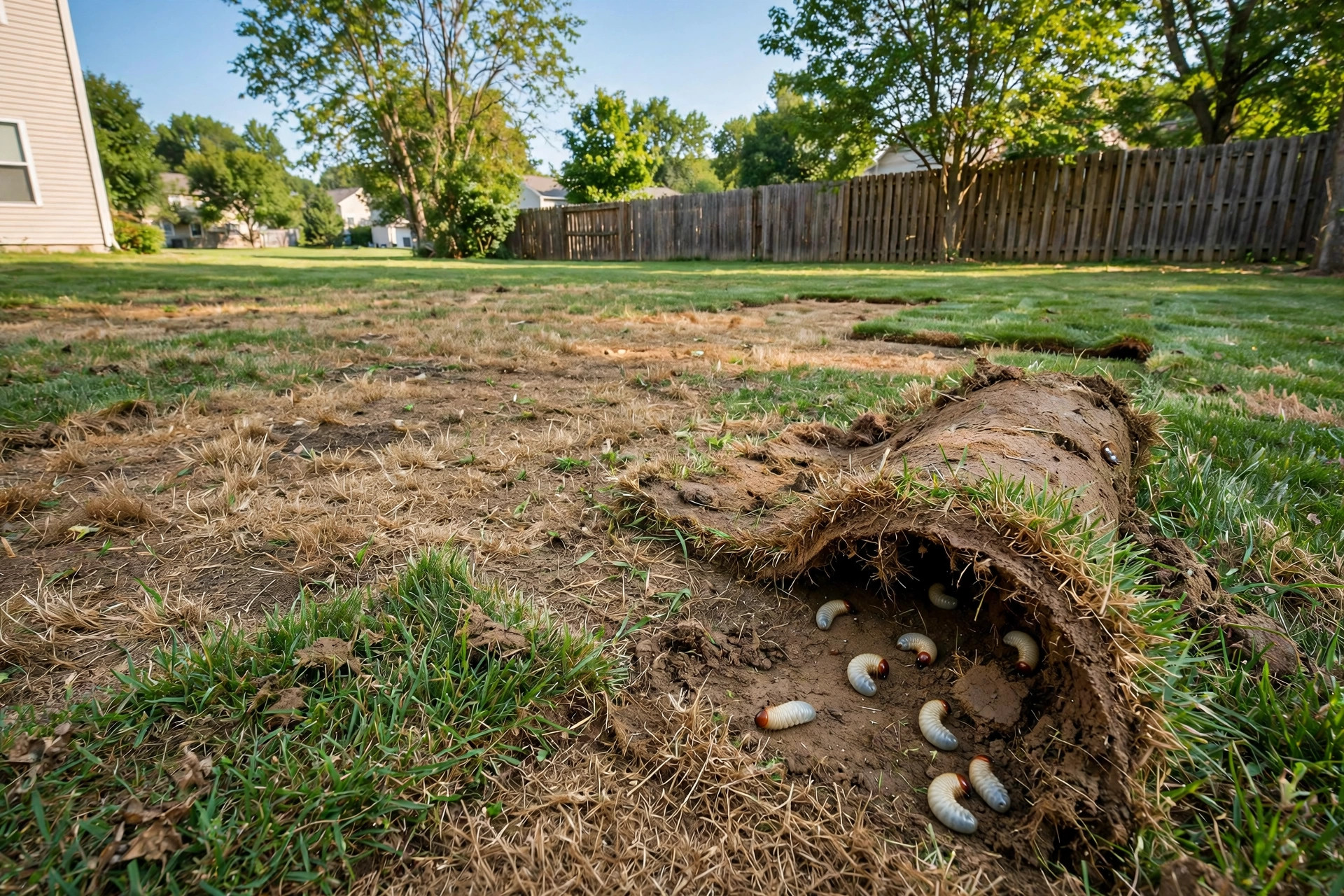

White grub treatment timing for Midwest lawns is one of the most asked questions in lawn care from Ohio to Iowa. Grubs are the soil stage of Japanese beetles and June beetles. They feed on grass roots in late summer and fall. Get the timing wrong and the product does little. Get it right and one application can protect a lawn for a full season.
This guide walks through the grub life cycle, the two kinds of treatment, and the calendar that works for most Midwest states.
Why Timing Matters More Than the Product
Most homeowners buy the strongest bottle on the shelf and hope for the best. With grubs, that habit wastes money. Grub control products work only when the insects are at the right stage of growth.
White grubs spend almost the whole year below ground. Eggs hatch in mid-summer. The young larvae feed through August and September. They grow larger in October, then move deep into the soil for winter. They come back up in spring and feed again before they turn into adult beetles in early summer.
Preventive products stop young larvae from ever growing. They must be in the soil before the eggs hatch. Curative products kill larvae that are already feeding. They must be applied while the grubs are near the surface and eating.
Miss these windows and you are watering the grass with expensive chemicals that do no harm to the pest.
The Grub Life Cycle in the Midwest: White Grub Treatment Timing for Midwest Lawns
Understanding the calendar starts with the life cycle. Most white grubs in the Midwest are Japanese beetle larvae. A smaller share are masked chafers and European chafers.
– Late June to early August: Adult beetles lay eggs in moist soil. Lawns that are watered often get the most eggs. – Mid-July to mid-August: Eggs hatch. Tiny larvae, called first instars, feed on fine grass roots near the surface. – Late August to October: Larvae grow larger and eat more root. This is when damage appears. Brown patches spread. Skunks and raccoons dig up the turf at night to eat the grubs. – November to March: Grubs move eight inches or more below the surface and go dormant for winter. – April to May: Grubs return near the surface and feed for a few weeks. – June: Larvae turn into pupae, then adult beetles emerge from the soil and fly.
The whole cycle takes one year. In some northern parts of the Midwest it can take two years, but the timing of treatment does not change much.
Preventive Treatment: The June to July Window
Preventive treatment is the first choice for lawns that have had grub problems before, or for lawns near woods and fields where beetles are thick.
The right time is late June through mid-July, before the eggs hatch. This is the single most important date in this article.
Preventive products contain ingredients such as chlorantraniliprole or imidacloprid. They soak into the root zone and wait for the young larvae. When the tiny grubs take their first bites, the product stops them.
Key rules for preventive treatment:
1. Apply before egg hatch. Once larvae are half grown, preventive products lose their power. 2. Water it in. The product must reach the root zone, about two to four inches down. A good rain or a deep watering within a few days is needed. 3. One treatment per season is enough. A single well-timed application protects the lawn through the fall.
Many homeowners apply preventive grub control at the same time as their early summer fertilizer. This saves a trip and puts the product down right on schedule. If you want guidance on seasonal schedules, read our pre emergent weed killer application timing guide for how lawn products are spaced through the year.
Curative Treatment: The August to September Window
Curative treatment is the rescue option. Use it when you see brown patches, loose turf, or animals digging in the lawn in late summer or early fall.
The right time is August through September, while the grubs are still feeding near the surface.
Curative products contain fast-acting ingredients such as trichlorfon or carbaryl. They kill grubs within a few days of contact. Speed matters because large grubs stop feeding and move deeper as the soil cools.
Key rules for curative treatment:
1. Treat when grubs are small to medium. Grubs larger than three quarters of an inch are harder to kill. 2. Water before and after. Moist soil brings grubs closer to the surface and carries the product down to them. A dry lawn is the most common reason a curative treatment fails. 3. Do not expect instant green-up. The product kills the grubs, but the damaged turf needs reseeding and water to recover.
If you treat after October, results are poor. The grubs are deep and feeding little. Save your money and plan a preventive treatment the next July instead.
How to Tell Grubs Are the Problem
Not every brown spot is a grub problem. Before you treat, check.
Walk the lawn and find a brown patch at the edge of green turf. Grab a handful of the brown grass and tug. If it rolls up like a loose rug with no roots holding it, grubs are likely. You can also cut a square foot of sod with a spade, peel it back, and count. More than five to ten grubs per square foot in a healthy lawn, or three to five in a stressed lawn, means treatment is worth it.
Dry weather can mimic grub damage. So can pet safe lawn weed killer reviews concerns when products burn the turf. The tug test is the plain way to know.
Choosing the Right Product
Lawn care shelves hold two broad kinds of grub control. Match the product to the window you are in.
Preventive products work best in June and July. They last for months in the soil. They protect the whole season. They are the best choice for lawns with a history of grub damage.
Curative products work best in August and September. They act fast but do not last. They are the best choice when damage is already showing.
Some homeowners prefer organic options such as milky spore or beneficial nematodes. These are living treatments that take time to build up. Milky spore works best against Japanese beetle grubs and may take two to three seasons to reach full strength. Beneficial nematodes must be applied to moist soil on a cool, cloudy day, usually in late August, and they need the grubs to be active to find them.
Always read the label. Note the active ingredient, the allowed window, and any rules about watering, pets, and mowing. The label is the law for that product.
Cost and Price of Grub Treatment
A do-it-yourself grub treatment is one of the cheaper lawn care jobs.
– Preventive granules for 5,000 square feet run about 25 to 45 dollars at most garden centers. – Curative products for the same area run about 30 to 50 dollars. – Professional lawn service treatments run about 60 to 120 dollars per application, depending on the market.
Most Midwest lawns need only one application per year. Lawns with heavy beetle pressure may need the preventive treatment every year. Lawns that have never had grubs can skip treatment and just watch.
Spreaders cost extra if you do not own one. A basic broadcast spreader runs 30 to 60 dollars and lasts for years. It also pays for itself across fertilizer and seed jobs. For watering the product in, proper coverage matters; see our affordable lawn sprinkler installation cost estimate if your lawn lacks even irrigation.
Care and Upkeep Through the Season
Treatment is only part of the story. A strong lawn fights grubs better than a weak one.
Mow high. Set the mower to three and a half or four inches. Tall grass shades the soil, holds moisture, and grows deeper roots. Short grass invites beetles to lay eggs.
Water deeply but not daily. One deep watering per week beats a daily sprinkle. Deep water grows deep roots. Constant wet soil is just what beetles want for their eggs.
Fertilize in fall. The fall feeding is the most important one for cool-season Midwest grasses like Kentucky bluegrass and fescue. It builds roots before winter and helps damaged turf recover.
Overseed thin spots. Grub damage leaves bare soil. Seed those spots in early fall, keep them moist, and the new grass will fill in before winter.
Sharpen mower blades. Dull blades tear grass and stress it. Sharp blades give clean cuts that heal fast. Equipment makers such as Toro and John Deere publish blade care guides for their mowers, and small-engine makers like Briggs & Stratton explain engine upkeep that keeps a mower running through the season.
Safety Around Kids, Pets, and Water
Grub products are pesticides. Use them with care.
Keep children and pets off the treated lawn until it is dry, or for the time the label states. Water the product in as directed so the granules move off the grass blades and into the soil. Store unused product in its original bag or bottle, out of reach of children, in a dry place.
Do not apply before a heavy rain. Runoff can carry the product into storm drains and streams. Do not apply near wells, ponds, or vegetable gardens unless the label allows it.
If someone in the home is sensitive to chemicals, the preventive options with chlorantraniliprole are often noted for low toxicity to mammals. Read the label and decide what fits your household.
Frequently Asked Questions
When is the best time to apply grub killer in the Midwest?
For prevention, apply in late June through mid-July, before eggs hatch. For rescue treatment of an active problem, apply in August through September while grubs feed near the surface.
Can I apply grub control in the spring?
Spring applications have little value. The grubs feeding in spring are large and near the end of their cycle. They will become beetles within weeks. Save the product for summer.
How do I know if I have grubs or just dry grass?
Pull up a patch of brown turf. If it lifts easily with few roots, suspect grubs. Peel back a square foot of sod and count. More than five grubs per square foot is a clear sign of a problem.
Do I need grub treatment every year?
Not every lawn does. Lawns with past damage, or lawns near fields and woods with many beetles, benefit from yearly preventive treatment. Lawns with no history can be watched instead.
Will grub killer hurt my lawn?
When used as labeled, grub products do not harm turf. Damage usually comes from applying at the wrong rate or failing to water the product in. Measure your lawn, set the spreader to the label rate, and water after.
Can animals spread grubs to my yard?
Animals do not spread grubs, but they do signal them. Skunks, raccoons, and birds tear up turf to eat grubs. If animals are digging in your lawn at night in fall, check for grubs.
A Final Word
White grub treatment timing for Midwest lawns comes down to two dates. Treat in late June or early July to prevent, and treat in August or September to cure. Check the lawn with the tug test before you spend money. Water the product in. Keep the grass tall and the roots deep. A lawn that is cared for through the season gives grubs little to eat and little room to thrive.
References
Toro. (n.d.). Lawn mowers and yard care equipment. https://www.toro.com Deere & Company. (n.d.). Lawn and garden equipment. https://www.deere.com Briggs & Stratton. (n.d.). Small engines and outdoor power equipment. https://www.briggsandstratton.com
Was this guide helpful?

About Robert Taylor
The My Garden US editorial team writes practical, in-depth home and garden guides for American homeowners — tested advice, no fluff.
You May Also Like
Cordless Edger vs Gas Edger: A Full Comparison Guide
September 29, 2026 0 views
The Best Backpack Sprayer for Weed Killer: A Plain Guide
May 13, 2026 0 views
Ornamental Grasses for Texas Heat Reviews: 10 Tough Varieties That Survive the Summer
August 1, 2026 0 views