
Most Americans lock their doors at night. That is a good habit. But a standard door lock can be picked, bumped, or forced. A door jammer security bar adds a second wall of defense. It wedges between the floor and the door handle, or it braces across the door frame. It does not need screws. It does not need batteries. It works in seconds.
This guide gathers what the best door jammer security bar reviews 2026 USA shoppers are reporting: how these bars work, which types suit which doors, what to check before you buy, what they cost, and how to use them safely. Everything is written in plain terms, so you can decide with a clear head.
Why a Door Bar Matters in 2026
Police departments across the country report the same pattern year after year. Most break-ins happen through a front or back door. The intruder kicks or shoulders the door, and a weak strike plate gives way. A deadbolt helps. A reinforced door frame helps. But both cost time and money to install.
A door jammer takes a different path. It turns the floor itself into the lock. When pressure pushes the door inward, the bar transfers that force down into the floor instead of into the lock. The door cannot swing in. It is a simple idea, and that is why it works.
Reviews from American buyers this year keep returning to three reasons people buy these bars. First, renters cannot change locks or drill into frames, and a jammer needs no tools. Second, travelers carry a light jammer in a suitcase and use it in hotel rooms, where they do not know the locks. Third, parents and older adults like the quick setup for a child’s bedroom or a guest room.
A jammer is not a replacement for a good lock. Security experts quoted in home security coverage from ADT and CNET make the same point: door security works in layers. The lock is the first layer. The bar is the second. A doorbell camera, like those sold by Ring, can be a third, because it lets you see who is at the door before it is touched.
How Door Jammers Work: Door Jammer Security Bar Reviews 2026 Usa
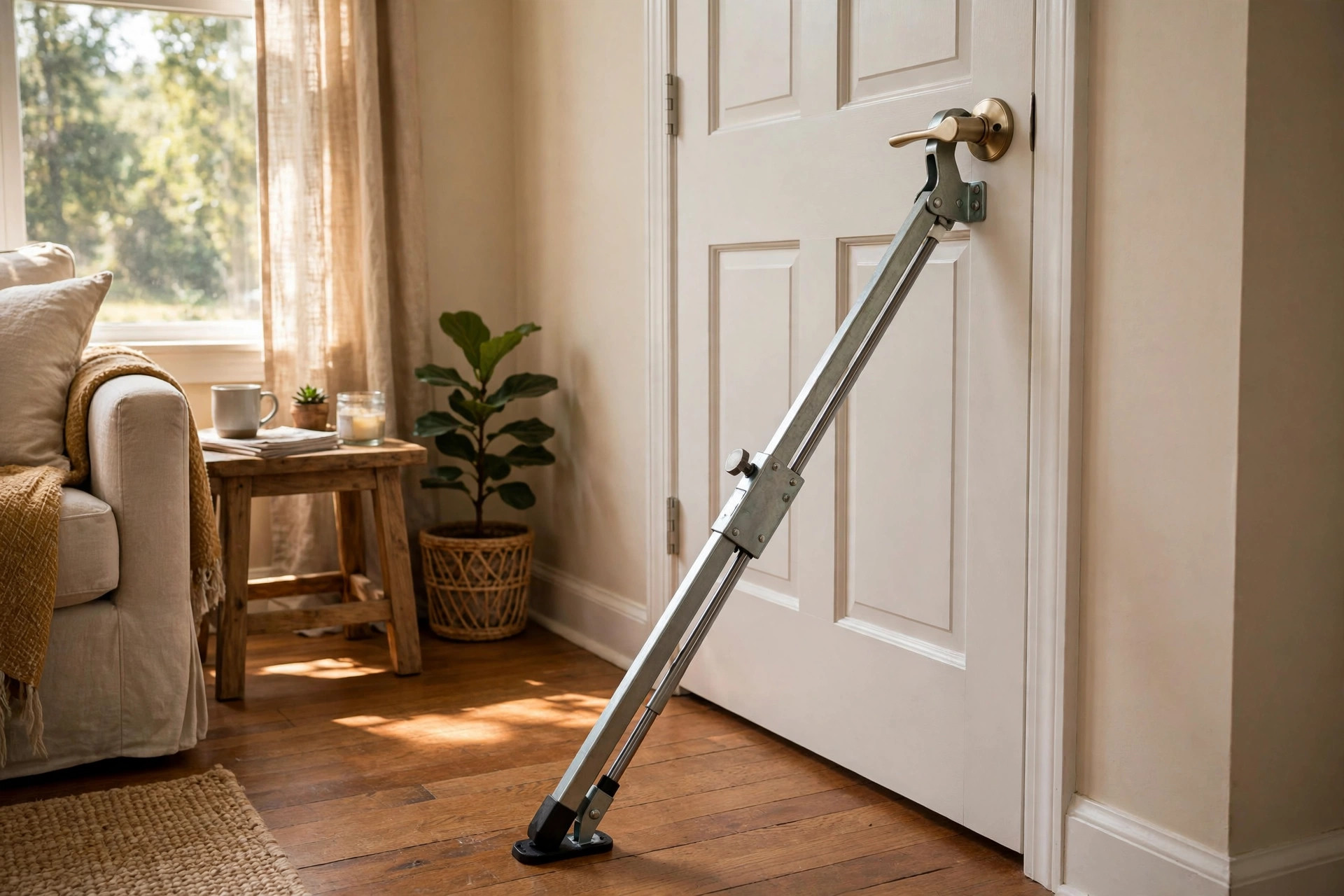
The most common design is the angled bar. It has a padded foot that sits on the floor and a hook or fork at the top that slips under the door handle. You lean the bar at a slight angle. When someone pushes the door, the bar digs harder into the floor. The harder the push, the tighter the grip.
A second design is the horizontal brace. It rests across the door frame, from one side of the jamb to the other, and blocks the door from moving. This type suits sliding doors and patio doors well. Many reviewers in 2026 note that a brace designed for sliding patio doors works on windows too.
A third design is the floor wedge with an alarm. It looks like a small door stop, but it has a loud buzzer inside. If the door moves and disturbs the wedge, the alarm sounds. This adds noise to the defense. Noise matters, because most intruders leave when they draw attention.
A fourth option is a full portable door lock for apartment living. These are small metal plates that sit in the door latch slot and block the latch from opening. They weigh almost nothing. They fit in a pocket. They are a favorite of frequent travelers.
Types and Options for American Homes
Not every bar fits every door. Reviews in 2026 point to four main groups.
Adjustable angled bars. These telescope to fit doors of different heights. The foot has rubber for grip on tile, wood, and laminate. Prices run low, and quality is fair across most brands. Look for thick steel, not thin tube.
Fixed patio braces. These are cut or set to the width of a sliding door. They sit in the track and stop the panel from sliding. They are cheap and strong. For sliding doors, this simple bar is often the best door security bar for sliding doors option available.
Alarmed wedges. These combine a wedge with a 120-decibel siren. They need a battery, usually a 9-volt. They are loud enough to wake a house. They are a popular choice for dorm rooms and first apartments.
Portable latch locks. These metal pieces block the door latch inside the jamb. They work only on inward-opening doors. They are the lightest choice for travel.
Some households add a door reinforcement bar for bedroom safety on interior doors. This is common where a teenager or an older parent wants privacy and an extra minute of warning. The bar goes on the door handle side and comes off in seconds during the day.
What to Look for Before You Buy
Read reviews with a checklist in mind. The same points appear in almost every careful review this year.
Material strength. Steel bars beat aluminum bars. A good bar feels heavy in the hand. If a listing hides the material, treat that as a warning.
Foot grip. The foot must not slide. Rubber feet work on most floors. On thick carpet, some bars sink and lose angle. Check reviews from people with carpet if your home has it.
Adjustability. Doors in American homes vary in height. An adjustable bar fits more doors. A fixed bar is stronger but fits only one size.
Handle fit. The top of the bar must sit under the handle without slipping off. Round knobs grip differently than lever handles. Check that your handle type is covered.
Finish and padding. The part that touches the door should be padded. Bare metal scratches wood and paint over time.
Weight. A travel bar should stay under two pounds. A home bar can be heavier, and heavier is often stronger.
Ease of removal. You should be able to remove the bar in under five seconds in the dark. Test this when it arrives. In a fire, you must get out fast.
Technology reviewers at PCMag and The Verge often test door hardware alongside smart devices. Their main advice transfers well: buy the tool that fits your door and your daily routine, not the one with the most features. A bar you use every night beats a clever bar you leave in a drawer.
Cost and Price in the USA
Prices are friendly. That is one reason these bars keep selling.
– Basic angled bars: 15 to 30 dollars. – Heavy-duty steel bars: 30 to 60 dollars. – Patio door braces: 10 to 25 dollars. – Alarmed wedges: 12 to 25 dollars, plus batteries. – Portable latch locks: 8 to 18 dollars.
Most buyers in 2026 pay between 20 and 35 dollars for a good home bar. Buying two at once, one for the front door and one for the back, is a common choice. There is little reason to pay more than 60 dollars unless the bar is made for commercial doors.
Check return policies before ordering. A bar that does not fit your floor or handle is not useful, and easy returns make the trial painless. Ratings aggregators like Consumer Reports remind shoppers to compare across sellers rather than trusting one store’s star count.
Care and Upkeep
A door jammer asks for almost no care. Still, a few habits keep it working well.
Wipe the rubber foot now and then. Dust and pet hair reduce grip. A damp cloth is enough. Check the foot each month. If the rubber is worn smooth, replace the bar or the foot. A worn foot can slide on tile when it matters most.
Check the telescoping lock if your bar adjusts. Make sure the pin or twist lock holds firm. A bar that collapses under load is worse than no bar, because it gives false confidence.
Keep the bar where you can reach it. Many buyers store it leaning by the door or hanging on a hook nearby. A bar in the garage does not help at midnight.
If you use an alarmed wedge, change the battery once a year. Test the alarm every few months. A dead battery turns an alarm wedge into a plain wedge, which still works, but you lose the noise.
Safety Notes Every Buyer Should Read
A door bar is a security tool, and like all such tools, it needs respect. Keep these points in mind.
Fire escape comes first. A jammer keeps people out, but it also slows you down when you need to get out. Every person in the room must know how to remove the bar in the dark. Practice once when you set it up. The U.S. Consumer Product Safety Commission publishes general guidance on home product safety, and its core message applies here: never let a safety device become a trap.
Children and guests. Tell guests that the bar is on the door. A child who cannot remove it may panic in an emergency. In a child’s room, use a bar the child can remove, or skip it.
Landlord rules. Renters should check their lease. A jammer that needs no screws is usually fine, but some buildings have rules about door hardware. A short note to the landlord avoids trouble.
Not a substitute for locks. A jammer buys time and adds force resistance. It does not fix a broken lock or a rotten door frame. Fix the basics first.
Apartment doors. Some apartment doors open outward into a hallway. Angled jammers work only on inward-opening doors. For outward-opening doors, a portable latch lock is the better pick.
Pairing a Bar With the Rest of Your Security
A bar works best as one layer among several. Many 2026 reviewers describe the same setup: a good deadbolt, a door jammer at night, and a camera or doorbell that shows the porch.
Smart home gear from makers like SimpliSafe and the devices listed on the Google Store handle the electronic side: motion alerts, door sensors, and cameras that record. These do not stop a door from opening. The bar does the physical work. Together they cover both the warning and the resistance.
People who travel often pair a portable door lock for apartment living with the smart lock habits they already use. A smart lock for short-term rental access gives remote control and codes, while a small jammer adds physical backup in an unfamiliar place. Other households fold in wider awareness tools, such as neighborhood watch camera apps, and safety devices like fall detection sensors for seniors, to round out a home safety plan.
FAQ
Do door jammers work on all doors?
No. Angled bars work on inward-opening doors with a handle or knob. They do not work on outward-opening doors, sliding doors without a track brace, or doors with no handle. Measure your door and check the product’s fit range before you buy.
Can a door jammer damage my floor or door?
It can mark soft floors or painted doors if used roughly. Choose a bar with a padded top and a wide rubber foot. Place the foot on a rug or mat if you worry about hardwood. Normal use leaves little or no trace.
Are door jammers allowed in apartments and dorms?
Most are, because they need no screws and leave no holes. Still, read your lease or dorm rules. Some buildings restrict anything attached to a door, and a few fire codes address door-blocking devices in shared housing.
How strong is a typical door jammer?
A decent steel bar resists several hundred pounds of force against the door. That is enough to stop a kick or a shoulder charge in most cases. It will not stop a determined intruder with tools and time, but it turns a quick break-in into a loud, slow one, which is often enough.
Should I get one with an alarm?
An alarm wedge suits bedrooms, dorms, and hotel rooms, where noise wakes you or scares off the intruder. For a front door in a busy house, a plain steel bar is usually enough and simpler to live with. Some buyers keep both: a bar for the main doors and an alarmed wedge for travel.
How do I test a new bar?
Set it up in daylight first. Push the door hard from outside while a family member watches the bar. It should bite harder, not slide. Then practice removing it quickly in the dark. If anything slips or sticks, adjust the angle or try a different foot position.
A Short Final Word
Door jammer security bar reviews in 2026 tell a steady story. These are simple tools. They cost little. They install in seconds. They give renters, travelers, and families an extra layer that a lock alone cannot give.
Pick a steel bar that fits your door and your floor. Test it the day it arrives. Teach everyone in the room how to remove it fast. Use it as one layer among good locks and sensible habits. Do that, and a small bar becomes one of the best bargains in home safety.
References
ADT. (n.d.). Home security and automation. https://www.adt.com CNET. (n.d.). Technology news and reviews. https://www.cnet.com Consumer Reports. (n.d.). Product reviews and ratings. https://www.consumerreports.org Google Store. (n.d.). Smart home devices. https://store.google.com PCMag. (n.d.). Technology product reviews. https://www.pcmag.com Ring. (n.d.). Smart home security devices. https://www.ring.com SimpliSafe. (n.d.). Home security systems. https://www.simplisafe.com The Verge. (n.d.). Technology news and reviews. https://www.theverge.com U.S. Consumer Product Safety Commission. (n.d.). Product safety information. https://www.cpsc.gov
Was this guide helpful?

About Emily Rodriguez
The My Garden US editorial team writes practical, in-depth home and garden guides for American homeowners — tested advice, no fluff.
You May Also Like
Best NVR Security System for Home USA: A Complete Guide
August 31, 2026 0 views
Smart Pool Pump with App Control Reviews USA: What to Buy and Why
February 28, 2026 0 views
Best EV Charger for Home Reviews 2026 USA: A Complete Guide for American Homeowners
March 24, 2026 0 views