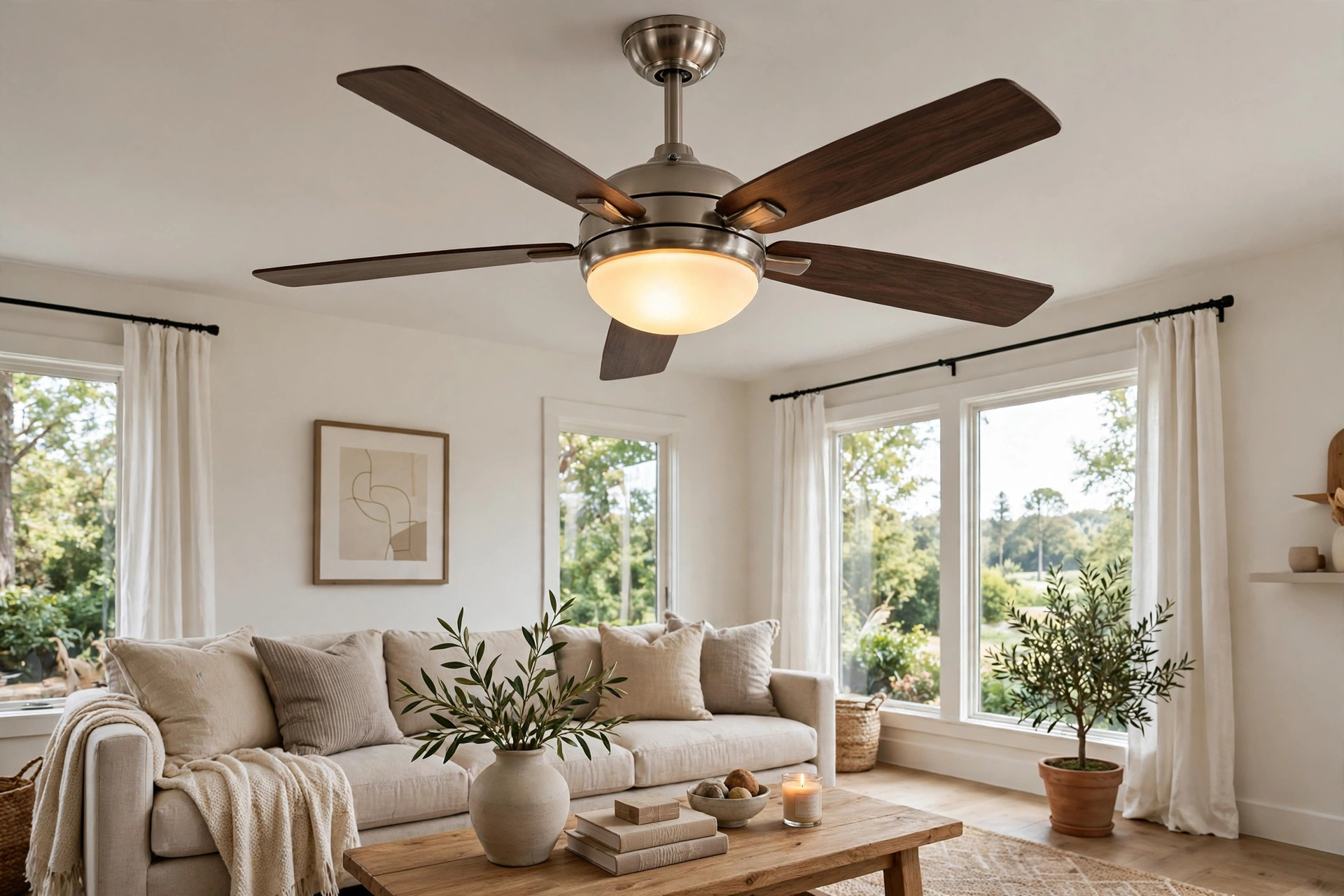

A ceiling fan with light and remote reviews USA shoppers write are among the most helpful guides on the market today. Few other home products bring together comfort, light, and control in one simple device. The fan moves the air. The light brightens the room. The remote puts both in your hand. When you read reviews with care, you can buy with confidence and avoid waste.
Why a Ceiling Fan with a Light and a Remote Is Worth a Look
A ceiling fan costs little to run. It uses far less power than an air conditioner. In summer it pushes air down and makes the room feel cooler. In winter it can run in reverse and push warm air down from the ceiling. This is basic sense, but many buyers forget it.
A built-in light saves the cost of a second fixture. You do not need a lamp or a separate ceiling lamp when the fan has its own light kit. The room stays clean and open.
A remote changes how you use the fan. You no longer stand on a chair to pull a chain. You change the speed from the couch. You dim the light from bed. Older buyers and tall families both gain from this.
Buyers in the United States now expect these three parts to come as one package. Reviews from American homes reflect that. Shoppers compare brands, test remotes, and note the noise level. The result is a rich set of reports you can learn from.
What to Look for Before You Buy: Ceiling Fan with Light and Remote Reviews Usa
Reviews only help when you know what you need. Work through these points first. Then read the reviews with your needs in mind.
Size and Room Fit
Fan size matters more than looks. A fan that is too small will not move enough air. A fan that is too large can feel like a storm in a small room. Use these rules from long practice:
– Rooms up to 100 square feet need a fan of 29 to 36 inches. – Rooms of 100 to 225 square feet need a fan of 36 to 44 inches. – Rooms of 225 to 400 square feet need a fan of 50 to 54 inches.
Measure your room before you shop. Many reviews complain about weak airflow when the real fault was a small fan in a large room.
Ceiling height matters too. The blades should sit at least seven feet above the floor. For high ceilings, a downrod lowers the fan to the right height. For low ceilings, a flush mount keeps the fan close to the ceiling.
The Remote Control
Not all remotes are the same. A good remote should offer at least three fan speeds. It should switch the fan on and off. It should dim or brighten the light. Some remotes include a reverse button for winter use. A few include a timer that shuts the fan off after a set number of hours.
Check the battery type in reviews. Most remotes use small batteries that last a year or more. Some remotes are wall mounted. Others rest in a cradle. A lost remote is a common complaint, so look for models with a cradle or a wall mount.
Some newer fans pair with smart home systems. You can read more about smart controls at ENERGY STAR, which lists guidance on efficient home devices.
The Light Kit
Light kits vary in kind and in strength. Older fans use bulbs you can change. Newer fans often use built-in LED boards. LED boards use less power and last many years, but they can be hard to replace when they fail.
Look at the brightness in lumens. A living room fan should give at least 800 lumens. A bedroom fan can work with less. Check the color of the light. Warm white suits living rooms and bedrooms. Cool white suits kitchens and work rooms.
Some light kits dim with the remote. Some do not. Reviews often note this. If dimming matters to you, confirm it before you buy.
Motor and Airflow
The motor is the heart of the fan. DC motors are quiet and use less power. AC motors are older in design but often cost less. Reviews across the country favor DC motors for bedrooms and living rooms because they hum less.
Airflow is rated in cubic feet per minute, or CFM. A good 52 inch fan should move at least 4,000 CFM on high. Higher CFM means stronger cooling. Check this number in the product specs. Home improvement guides at The Home Depot and Lowe’s often explain CFM in plain terms for shoppers.
Types and Options on the American Market
Shops across the United States carry a wide range. The main types are listed below.
Flush Mount and Low Profile
These fans hug the ceiling. They suit rooms with ceilings under eight feet. They are common in apartments and older homes. Reviews praise them for safety and clean looks. They give less airflow than downrod models of the same size because the blades sit close to the ceiling.
Downrod Fans
These hang from a metal rod. They suit ceilings of eight feet or more. The rod length can change with the ceiling height. Reviews note that downrod fans give the best airflow in large rooms. They also swing a little, which is normal.
Outdoor Rated Fans
Some fans carry a damp or wet rating for porches and patios. Damp rated fans handle humid air. Wet rated fans handle direct rain. Reviews from southern states praise these for porch comfort. Never hang an indoor only fan outside.
Smart and Wi-Fi Fans
A growing share of fans now link to phones and voice systems. You set schedules and change speeds from an app. Reviews are mixed. Some buyers love the control. Others find the setup fussy. If you want simple use, a standard remote may serve you better.
How to Read Ceiling Fan with Light and Remote Reviews
American reviews are useful, but only when read with care. Use these habits.
First, look for reviews from buyers with rooms like yours. A review from a small bedroom helps little if you cool a great room. Note the room size when the buyer states it.
Second, read the three star reviews. They tend to be the most fair. Five star reviews can be too brief. One star reviews can reflect a bad install, not a bad fan.
Third, watch for patterns. One report of a wobbly fan means little. Twenty reports of the same wobble mean a lot. The same holds for noisy motors, weak remotes, and dim lights.
Fourth, check the date. A review from 2019 may describe an old model. Makers change parts and remotes often. Recent reviews from this year and last year carry more weight.
Fifth, separate the fan from the install. Many complaints trace back to a loose mount or a bad wire, not the fan itself. Reviews that mention a licensed electrician often end better.
Guides on home fixtures at This Old House and Family Handyman give sound advice on mounts and wiring that can help you judge such reviews.
Cost and Price: What American Buyers Pay
Prices run wide. A basic indoor fan with a light and remote starts near 70 dollars. Mid range models with quiet DC motors run from 120 to 250 dollars. High end designer fans can pass 400 dollars.
The light kit adds little to the price now. Most makers include it as standard. The remote also adds little. What raises the price is the motor, the finish, and the size.
Install cost is separate. A simple swap of an old fan for a new one can cost 75 to 150 dollars in labor. A new install with new wiring can cost 200 to 400 dollars. Some cities run higher. Ask for a written quote.
Running cost is low. A fan at medium speed uses about 30 to 50 watts. At ten cents per kilowatt hour, eight hours of use costs about three to four cents. That is why fans remain the cheap way to feel cool.
Energy advice from the U.S. Department of Energy notes that fans let you raise the thermostat a few degrees without loss of comfort, which trims cooling bills.
Care and Upkeep
A fan needs little care, but it needs some. Dust the blades every few months. Dust on the blades throws the fan off balance and cuts airflow. A damp cloth works well. Do not spray water on the motor.
Tighten the screws once a year. Check the mount and the blade brackets. A loose bracket causes wobble and noise. Many review complaints about noise end with a simple tightening.
Change or clean the light cover as needed. Dust on the cover dims the light. If your fan uses bulbs, use the type the maker lists. The wrong bulb can overheat the kit.
For fans with a remote, test the remote range now and then. Replace batteries once a year even if they still work. Keep a spare set near the room.
If the fan wobbles, do not ignore it. Check the mount first. Then check that all blades sit at the same height. Many fans ship with a small balancing kit. Use it before you call for service.
Safety Points
Buy a fan listed by a known test lab, such as UL or ETL. The label should be on the box and on the motor. This is a basic safety mark in the United States.
Turn off the power at the breaker before any install or repair. Do not trust the wall switch alone. Test the wires with a simple tester.
Make sure the mount box is rated for fans. A light duty box can fail under the weight and motion of a fan. Fan rated boxes are marked as such. If you are unsure, ask an electrician.
Keep the blades at least seven feet above the floor. Keep them at least 18 inches from walls and slopes. Never run a fan with a cracked blade. Replace the blade set as a group.
Outdoor fans must carry the right rating. The U.S. Consumer Product Safety Commission publishes recall notices for fans and other home goods. A quick check of recall lists before you buy is a wise habit.
Frequently Asked Questions
Do ceiling fans with lights use a lot of power?
No. The fan uses about 30 to 60 watts at high speed. The light adds 10 to 20 watts with LED. The pair costs a few cents per hour to run. This is far less than an air conditioner.
Can I install a ceiling fan with a light and remote myself?
Many owners do. A swap of one fan for another is a common weekend job for a skilled homeowner. New wiring, high ceilings, and heavy fans call for an electrician. When in doubt, hire one. The cost is small next to the risk.
Will a ceiling fan cool a room without air conditioning?
A fan does not lower the air temperature. It moves the air across your skin, which makes you feel cooler. In mild heat this is enough. In hard heat, use the fan with the air conditioner set a few degrees higher. You will feel the same comfort for less money.
How long should a good ceiling fan last?
A well made fan lasts 10 to 15 years or more. The motor rarely fails first. Remotes, light kits, and finishes age faster. DC motor models tend to get the best long term marks in reviews. For the wider home comfort picture, brand resources at Carrier, Trane, Lennox, Rheem, and Goodman show where a ceiling fan fits beside your main heating and cooling system.
Are remote controlled fans safe for bedrooms?
Yes. The remote uses low power radio signals. It does not harm health. Keep the remote out of reach of small children, as with any small device with batteries.
What related home comfort upgrades pair well with a ceiling fan?
Many buyers pair a ceiling fan with better air movement through the house. If you want to compare, see our guides on the best quiet bathroom exhaust fan reviews usa, the quietcool whole house fan reviews usa, and solar attic fan reviews for usa homes.
A Final Word
A ceiling fan with a light and a remote is a small buy with a daily payoff. Read the ceiling fan with light and remote reviews USA buyers leave, and a clear picture forms. Buy the right size. Check the remote and the light kit. Mind the motor and the noise. Pay a fair price. Then keep it clean and tight, and it will serve your home for many years.
References
Carrier. (n.d.). Heating and cooling systems. https://www.carrier.com ENERGY STAR. (n.d.). Energy efficient products. https://www.energystar.gov Family Handyman. (n.d.). DIY home repair and maintenance. https://www.familyhandyman.com Goodman. (n.d.). Heating and cooling equipment. https://www.goodmanmfg.com Lennox. (n.d.). Heating and cooling systems. https://www.lennox.com Lowe’s. (n.d.). Home improvement products. https://www.lowes.com Rheem. (n.d.). Heating, cooling, and water heating. https://www.rheem.com The Home Depot. (n.d.). Home improvement products. https://www.homedepot.com This Old House. (n.d.). Home renovation guidance. https://www.thisoldhouse.com Trane. (n.d.). Heating and air conditioning. https://www.trane.com U.S. Consumer Product Safety Commission. (n.d.). Product safety information. https://www.cpsc.gov U.S. Department of Energy. (n.d.). Energy efficiency and renewable energy. https://www.energy.gov
Was this guide helpful?

About Lisa Anderson
The My Garden US editorial team writes practical, in-depth home and garden guides for American homeowners — tested advice, no fluff.
You May Also Like

Closed Cell vs Open Cell Foam Comparison USA: Which Spray Foam Insulation Is Right for Your Home?
June 4, 2026 0 views
Dyson vs Lasko Tower Fan Comparison USA: Which Is Best?
July 26, 2026 0 views
Boiler Replacement Cost Near Me 2026: What Homeowners Should Know
July 25, 2026 0 views