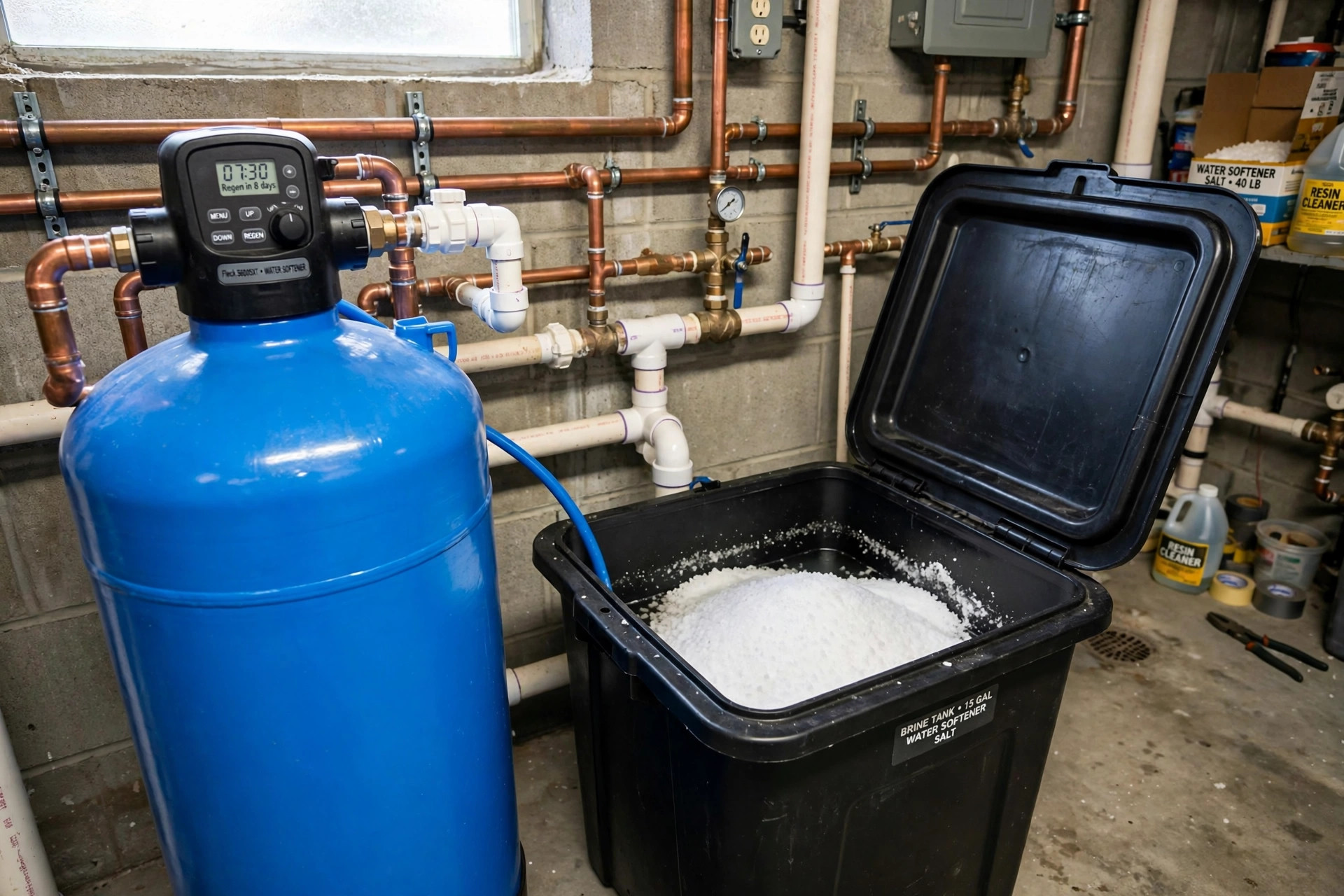

A water softener is a quiet worker in many American homes. It removes the hard minerals from the water before the water reaches the taps. But the softener cannot work forever without a rest. From time to time it must clean itself. That cleaning process is called regeneration. This water softener regeneration frequency guide usa explains how often that cleaning should happen, why it matters, and how to set it for your own home.
Why Regeneration Matters
Inside every salt-based water softener there is a tank full of small resin beads. As hard water flows through the tank, the beads grab the calcium and magnesium in the water. These are the minerals that cause hard water stains, soap scum, and scale in pipes and water heaters. In return the beads give off a small amount of sodium.
After some days of service, the beads become full. They cannot grab any more minerals. At that point the softener must flush the beads with a strong salt water brine. The brine washes the calcium and magnesium away and restores the beads. Then the softener is ready to work again. If regeneration happens too rarely, hard water passes straight through to the house. If it happens too often, the home wastes salt and water, and the drain works harder than it must.
Getting the frequency right is one of the most important parts of owning a softener. A good setting saves money, protects plumbing, and keeps the water soft day after day.
How Often Should Your Softener Regenerate: Water Softener Regeneration Frequency Guide Usa
Most American homes need a regeneration every 3 to 7 days. A small household with moderately hard water may go a full week between cycles. A large household with very hard well water may need a cycle every 2 or 3 days.
The exact answer depends on three things: how hard the water is, how much water the household uses, and how much grain capacity the softener holds. The next section explains these three in plain words.
Modern softeners fall into two groups. Each group handles the schedule in a different way.
Timer-Based Softeners
Older and simpler units regenerate on a fixed clock. The owner sets a number of days, for example every 4 days. The softener regenerates on that schedule no matter how much water was used. They are easy to understand, but wasteful: if the family goes on vacation, the softener still regenerates.
If you have a timer unit, start with a setting of once every 4 to 5 days. Then watch the results. If spots return on the dishes before the next cycle, shorten the interval. If the water stays soft with days to spare, lengthen it.
Metered or Demand-Based Softeners
Most new softeners are metered. They measure the gallons of water that pass through and regenerate only when the resin is close to full. This is the smarter design. It regenerates after the set number of gallons, which may be every 3 days in a busy week and every 9 days in a quiet one.
Many metered units also have a day override. This is a safety limit, often set to 7 or 14 days. If the meter has not triggered by then, the unit regenerates anyway. This keeps the resin bed fresh and stops bacteria growth. For most homes the factory day override of 7 to 14 days works well, and home repair guides often recommend leaving it in place.
The Three Numbers That Set Your Frequency
To find the right frequency, you need three pieces of information. Each one is easy to get.
1. Water hardness. Hardness is measured in grains per gallon, written as GPG. One grain per gallon equals about 17.1 parts per million. Soft water is under 3 GPG. Moderate hardness runs 3 to 7 GPG. Hard water is 7 to 10 GPG, and anything above 10 GPG is very hard. Many well water supplies test at 12 to 25 GPG or more.
You can test your own water with a simple kit from home supply stores. A drop-count test kit is cheap and gives a clear number. City water customers can also ask the water utility for a hardness report. The U.S. Environmental Protection Agency offers general drinking water information, and home improvement retailers stock both test kits and salt for softeners.
2. Grain capacity. The softener tank has a rated capacity, such as 32,000 or 48,000 grains. This number tells how many grains of hardness the resin can hold before it needs a wash. The number is printed on the softener or in its manual. Note that running a 48,000 grain unit to its full limit uses much more salt per cycle than running it at 32,000 grains, so most installers set a lower working capacity. If you are still choosing a unit, read up on how to size a water softener before you buy, because the right size makes the schedule simple.
3. Daily water use. A typical American uses about 60 to 80 gallons of water per day at home. A family of four therefore uses roughly 240 to 320 gallons a day. The metered softener uses this number automatically. For a timer unit you must estimate it yourself.
A Simple Example Calculation
Suppose a family of four uses 300 gallons a day. Their water tests at 12 grains per gallon. Multiply 300 by 12. That is 3,600 grains of hardness per day.
Now suppose the softener holds 48,000 grains of capacity. Divide 48,000 by 3,600. The answer is about 13 days of capacity. But you should never run the resin to its very limit. Most experts suggest regenerating when about 75 percent of the capacity is used. Take 75 percent of 13 days. That is about 10 days.
Even so, do not set the interval past 7 days on a timer unit, because the resin bed should stay fresh. A setting of every 5 to 7 days would be right for this example home. A metered unit with the same numbers would simply trigger on its own at the right time.
Run the same math with your own numbers. It takes five minutes and a pocket calculator. Write the result down and tape it near the softener.
Signs Your Softener Regenerates Too Often or Too Rarely
Your home will tell you when the setting is wrong. Watch for these signs.
Signs of too-rare regeneration: – White spots or film on glasses and dishes after washing. – Soap that will not lather well in the shower. – A crusty white scale on faucets and shower heads. – A slippery or slimy feeling disappears and the water feels hard again.
Signs of too-often regeneration: – The salt level in the brine tank drops very fast. A normal home uses about 40 to 80 pounds of salt a month. Much more than that points to excess cycles. – The softener runs at night far more often than every 3 days. – The water bill rises without a change in habits, since each cycle flushes many gallons to the drain.
Well water owners face an extra twist. Iron and sulfur foul the resin faster than hardness alone. If your well water carries iron, the softener may need a shorter interval plus a resin cleaner. Owners shopping for equipment often search for the best water softener for well water to find units built for tougher conditions.
How to Change the Setting
Most softeners put the controls on a small head at the top of the tank. Timer models have a dial or buttons marked for days between regeneration. Metered models have menus for hardness, capacity, and day override.
Follow these steps:
1. Test your water hardness first. Write the number down. 2. Find your grain capacity in the manual or on the tank label. 3. Estimate your daily gallon use: multiply the number of people by 70. 4. Enter the hardness number into the control. Metered units use it to compute the gallon trigger. 5. Set the day override to 7 days if the menu offers it. 6. Set the regeneration time to the early morning, usually 2 a.m., when no one uses water.
If the manual is lost, the maker often posts it online. Fixture makers like Moen, Kohler, and Delta keep parts and manuals for older units, and water treatment companies can service most brands.
One more tip: after any change, wait through two full cycles before you judge the result. The water in the pipes and water heater needs time to turn over.
Cost: Salt and Water Used in Each Cycle
Every regeneration uses two things: salt and water. A typical cycle uses 6 to 12 pounds of salt and 35 to 65 gallons of water, depending on the unit size and settings. High-efficiency models use less.
This is why frequency matters for the wallet. A softener that regenerates every 3 days uses twice the salt and water of one that regenerates every 6 days. Cutting unneeded cycles is one of the easiest ways to lower costs and keep salt use in check.
There is a balance, though. A cycle that is delayed too long lets hard water slip through and shortens the life of water heaters and fixtures. When installers quote the water softener installation cost near me they often include the first salt fill and a walk-through of these settings, so ask them to set the schedule before they leave.
Salt itself comes in pellets, crystals, and blocks. Pellets are the most common for home units. Keep the salt level at least a quarter full but do not fill the tank to the top, which can cause a salt bridge that blocks the brine draw.
Care and Upkeep
Regeneration keeps the resin clean, but the rest of the system needs attention too.
– Check the salt level once a month. Refill before it runs dry. – Look inside the brine tank twice a year. If you see mush or a hard crust of salt, clean the tank out. – Use a resin cleaner once or twice a year if you have iron in the water. Follow the label directions. Follow the manual. Keep the drain line clear and make sure it has an air gap above the drain, as most local codes require. – If water stands in the brine tank above the salt for days, the brine draw may be weak, which makes regeneration less effective.
Water filtration specialists and softener manufacturers both publish care guides, and DIY repair guides show the cleaning steps with pictures. A little upkeep goes a long way toward a softener that lasts 15 to 20 years.
Safety
A water softener is a simple and safe machine, but a few points deserve care.
First, the drain line from the softener carries salty backwash. It must drain to a proper floor drain or standpipe, never to a septic leach field in large amounts without checking local rules. Some areas limit softener discharge into septic systems because the salt can harm the drain field.
Second, softened water has extra sodium. For most people the amount is small. But people on strict low-sodium diets should talk to a doctor. A common fix is a separate unsoftened cold water tap at the kitchen sink for drinking and cooking. National water data can help you learn what minerals your local supply carries before you decide.
Third, keep salt bags dry and stored off the floor. Spilled salt on concrete can stain it. Finally, keep the area around the control head dry and never open the control box with wet hands.
Frequently Asked Questions
How often should a water softener regenerate? Most homes need a cycle every 3 to 7 days, set by water hardness, grain capacity, and household water use. Metered units decide on their own. Timer units need you to set the days.
How do I know my water hardness number? Use a drop-count test kit, which costs little and takes five minutes. Test the raw water before the softener, not the soft water after it. Well owners should test once a year, because well water can change with the seasons.
Can I set my softener to regenerate every night? You can, but you should not. Nightly regeneration wastes salt and water and wears the valve faster. It only fits very large homes with extremely hard water and a small softener, and even then a larger unit is the better fix.
Why does my softener regenerate during the day? The regeneration time is set wrong, or a power outage reset the clock. Reset the clock and the time in the control menu.
Should I use potassium chloride instead of salt? Potassium chloride works as a substitute for people who want less sodium. It costs more and needs about 25 percent more per cycle. Check that your unit allows it before switching.
How long does a regeneration cycle take? About 60 to 90 minutes for most home units. During the cycle the house has bypass water, which is hard water straight from the supply. That is why the cycle runs at night.
A Final Word
Regeneration is the heartbeat of a water softener. Set the frequency with real numbers, not guesses. Test the hardness, know the capacity, and count the gallons. Check the results after two cycles. A well-timed softener gives soft water every day, uses less salt, and runs for many years with only simple care. That is the whole goal of this water softener regeneration frequency guide usa: soft water, low waste, and no surprises.
References
Aquasana. (n.d.). Water filtration systems. https://www.aquasana.com Culligan. (n.d.). Water treatment services and products. https://www.culligan.com Delta Faucet. (n.d.). Kitchen and bathroom faucets. https://www.deltafaucet.com Family Handyman. (n.d.). DIY home repair and maintenance. https://www.familyhandyman.com Kohler. (n.d.). Bathroom and kitchen fixtures. https://www.kohler.com Lowe’s. (n.d.). Home improvement products. https://www.lowes.com Moen. (n.d.). Faucets and plumbing fixtures. https://www.moen.com Pentair. (n.d.). Pool and spa equipment. https://www.pentair.com The Home Depot. (n.d.). Home improvement products. https://www.homedepot.com This Old House. (n.d.). Home renovation guidance. https://www.thisoldhouse.com U.S. Environmental Protection Agency. (n.d.). Protecting human health and the environment. https://www.epa.gov U.S. Geological Survey. (n.d.). Groundwater. https://www.usgs.gov
Was this guide helpful?

About Sarah Mitchell
The My Garden US editorial team writes practical, in-depth home and garden guides for American homeowners — tested advice, no fluff.
You May Also Like
Thermostatic Shower Valve Pros Cons USA Homeowners Should Know
May 10, 2026 0 views
Whole House Sediment Filter Installation Cost: What You Pay and Why
February 13, 2026 0 views
The Best Whole House Water Filter System USA Homeowners Can Buy
September 20, 2026 0 views