
If you are thinking about a water heater pan with drain installation cost, you are asking about one of the cheapest ways to protect your home from water damage. A water heater holds forty to eighty gallons of water. When the tank wears out, it can leak slowly or burst all at once. A simple plastic or metal pan under the tank catches that water. When the pan also has a drain line, the water flows safely outside or into a floor drain instead of pooling on the floor. This small upgrade can save you thousands of dollars in repairs.
The water heater pan with drain installation cost runs one hundred and fifty to four hundred and fifty dollars in 2026. The pan itself is cheap; most of the price is labor: draining the tank, lifting it, setting the pan, and running a drain pipe to a safe spot.
Why a Water Heater Pan With a Drain Matters
Inside the tank, hot water eats at the metal walls. The anode rod fights this rust, but it wears down over time. When it is gone, the tank wall thins. A pinhole leak starts as a drip, then grows. One day the bottom seam gives way, and forty gallons of water spill across the floor in minutes.
A pan without a drain only holds two or three gallons. Once it fills, water spills over the edge anyway. A pan with a drain line keeps working. The drain pipe carries water away as fast as it leaks in, hour after hour, until you fix the tank.
Local codes in many states now call for a pan with a drain under any water heater placed where a leak would cause damage. That includes heaters in attics, laundry rooms, closets, and finished basements. The rules come from the same building codes that set plumbing fixture standards. Check with your city or county before you start work.
What a Water Heater Pan With a Drain Looks Like: Water Heater Pan with Drain Installation Cost
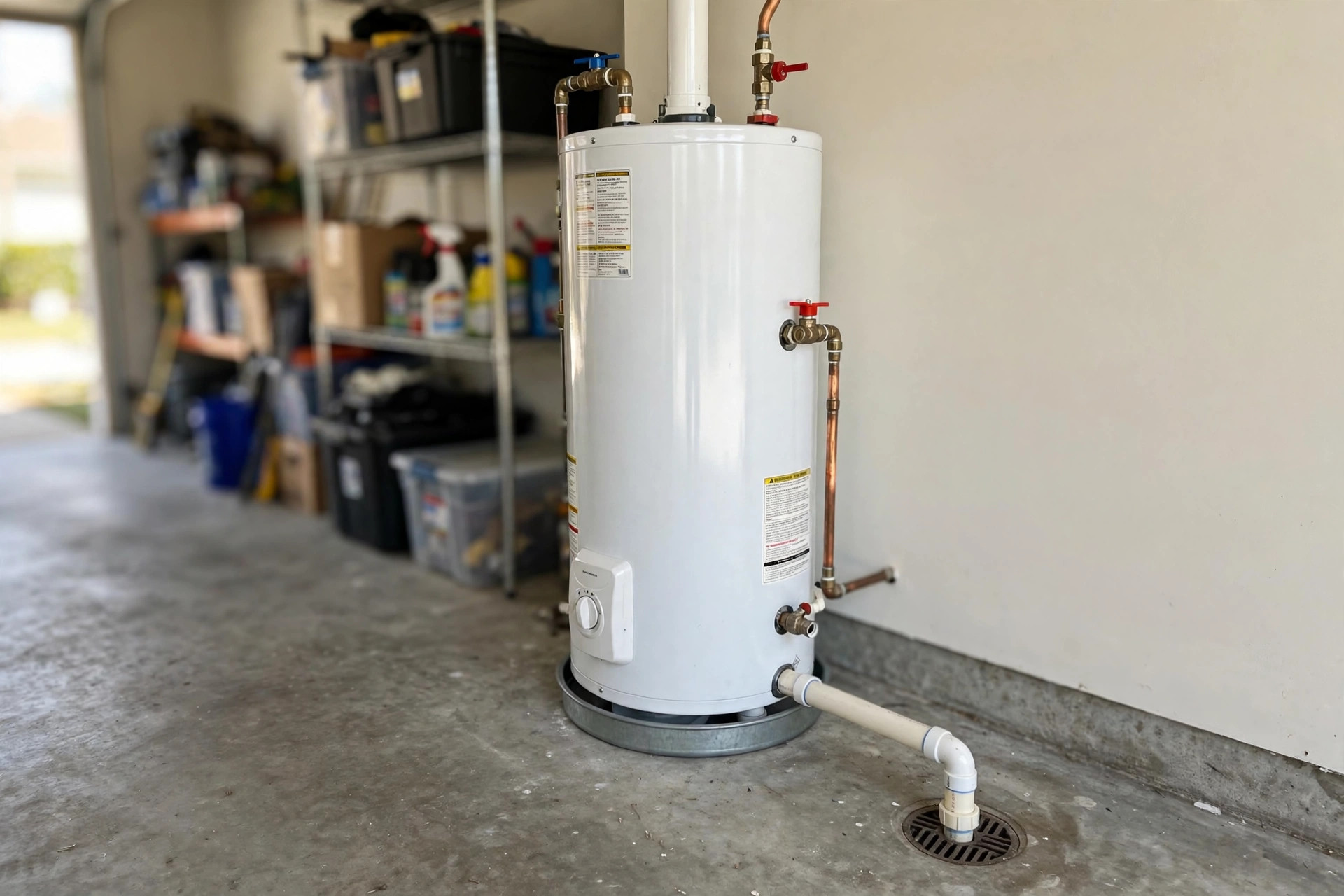
A water heater pan is a shallow, round tray that sits on the floor under the tank. It is about two to three inches deep and one or two inches wider than the tank on every side. A small threaded opening in the side wall, called a drain fitting, takes a pipe or hose that runs to a drain.
The drain line is usually three-quarter-inch PVC or CPVC pipe. It slopes gently down to a floor drain, a laundry sink, a sump pit, or straight through the wall to the outside of the house. The end of the line must be visible, so you can see water flowing out.
Types of Water Heater Pans and Their Prices
Pans come in three main materials.
Plastic pans cost fifteen to forty dollars. They are light, they never rust, and they are easy to set under a tank. Most are made from thick ABS or PVC and work well on ground floors and in garages. The weak point is heat: a plastic pan can soften if the tank runs very hot.
Aluminum pans cost twenty-five to sixty dollars. They handle heat better than plastic and are still light enough for one person to carry. Aluminum does not rust like steel, so it holds up in damp basements and hot attics.
Steel pans cost forty to ninety dollars. Steel is the strongest option and handles heavy commercial tanks and tight installs. The trade is rust: a steel pan needs a good coating, and you should check it for rust spots once a year.
Pans also come with different drain fittings. The most common fitting is a one-inch female pipe thread molded or welded into the side wall. Some pans have two fittings, so you can drain from either side. A few deluxe pans add a small port for a water alarm. That alarm adds twenty to thirty dollars but tells you the moment water hits the pan.
Retailers such as The Home Depot and Lowe’s stock pans for standard tank sizes and list the drain fitting size on the box.
What Drives the Water Heater Pan With Drain Installation Cost
The water heater pan with drain installation cost moves up or down with six main factors.
1. The pan material and size. A basic plastic pan costs under thirty dollars. A large steel pan with two fittings can pass eighty dollars. An odd-size tank may need an oversized pan, which adds to the price.
2. Whether the tank must be moved. This is the biggest labor item. If the tank is already out for a replacement, slipping a pan under it takes minutes. If the tank is full and piped in, the plumber must shut off water and gas or power, drain forty or more gallons, disconnect the pipes, lift a heavy tank, set the pan, and hook everything back up. That adds one hundred to two hundred dollars.
3. The length of the drain line run. A line that drops two feet into a nearby floor drain is cheap. A line that crosses a basement and exits through a far wall takes more pipe and more time, adding fifty to one hundred and fifty dollars.
4. Drilling through walls or concrete. A core drill through concrete may add seventy-five to one hundred and fifty dollars. Going through a wood-framed wall is much cheaper.
5. Permit and code rules. Some towns want a permit for any plumbing change. A permit can add twenty-five to one hundred dollars.
6. Your region. Labor rates vary a lot across the country. Get two or three quotes so you can compare.
Average Water Heater Pan With Drain Installation Cost in 2026
Here is what most homeowners pay in 2026:
– Pan added during a new water heater install: fifty to one hundred and twenty-five dollars. The tank is already out and the crew is on site. Many plumbers throw in a basic pan for the price of the part. – Pan added to an existing tank, short drain run: one hundred and fifty to three hundred dollars. The plumber drains the tank, lifts it, sets the pan, and runs a short pipe to a nearby drain. – Pan added to an existing tank, long or hard drain run: three hundred to four hundred and fifty dollars. This covers drilling, long pipe runs, and attic or tight-space work.
These ranges cover the pan, the pipe and fittings, and the labor. They do not cover a new water heater. If your tank is old, ask for the pan price as part of a full replacement quote. Cost guides from This Old House and Family Handyman publish similar ranges for small plumbing jobs.
Should You Do It Yourself or Hire a Plumber?
A handy homeowner can install a water heater pan with a drain, but the job has real risks. You must shut off the water, power, or gas to the tank before you touch anything. Draining a tank wrong can scald you or flood the room. Lifting a tank takes two strong people or a proper dolly. Running the drain line calls for basic plumbing skills: cutting pipe, gluing joints, and holding a steady slope.
Do it yourself if the tank is already empty, the drain run is short, and you are comfortable with simple pipe work. Your material cost stays under one hundred dollars.
Hire a plumber if the tank is full and piped in, the run must cross concrete, or the heater runs on gas. A licensed plumber knows the code and handles the gas line safely. Makers of plumbing products such as Moen and Delta Faucet stress that even small plumbing changes must meet local code, and a pro keeps you on the right side of it.
How a Pro Installs a Pan With a Drain
Knowing the steps helps you see what you pay for.
Step one: shut everything off. The plumber closes the cold water valve, turns off the breaker or gas valve, and lets the tank cool.
Step two: drain the tank. A hose goes from the drain valve to a safe spot. Draining takes twenty to forty minutes.
Step three: lift and set. The plumber loosens the water lines and lifts or tilts the tank just enough to slide the pan under it.
Step four: run the drain line. Pipe goes from the fitting to the drain point with a steady downward slope, about one quarter inch per foot. The end stays visible.
Step five: reconnect and test. The plumber hooks up the water and power or gas, fills the tank, and pours a bucket of water into the pan to prove the drain flows.
The whole job takes about one to three hours, depending on the drain run.
Care and Upkeep for Your Drain Pan
A drain pan needs almost no care, but a few small habits keep it ready.
Once a year, pour a gallon of water into the pan and watch it drain. This proves the line is clear. If the water drains slowly, flush the line with a garden hose or a wet-dry vacuum.
Check the pan for cracks each year. Plastic pans can crack if something heavy drops on them. A cracked pan leaks around its own edges, so replace it before the tank fails.
Keep the area around the pan clear. Boxes and bins stacked against the pan hide leaks and block the drain end. A water alarm in the pan is a smart extra. It costs about twenty dollars and sounds a loud alert at the first sign of water.
If your home has hard well water, sediment builds up in the tank faster and shortens its life. A shorter tank life makes a drain pan more important, not less. Many well owners also add sediment filters for well water to protect the whole system. And if chlorine taste is your worry, look at carbon filters for chlorine removal for cleaner water through the house.
Safety Points to Keep in Mind
Water and electricity do not mix. If your electric water heater leaks and the pan is full, stand clear of standing water near the tank and call a pro. Do not reach into the pan while the power is on.
The drain line must not block the combustion air vents at the base of a gas heater. Keep the pipe away from the burner area and the vent pipe. The drain line end must never sit in a sealed spot. Codes call for an air gap so drain water cannot siphon back into the pan. Small hidden leaks waste a lot of water over time, a point the EPA makes in its water conservation guidance, so keep the drain end open and visible.
Hot water from a failed tank can be near one hundred and forty degrees. Wear gloves and closed shoes near a leaking tank, and let the tank cool before you drain it.
Frequently Asked Questions
How much does a water heater pan with drain installation cost? About one hundred and fifty to four hundred and fifty dollars for an existing tank. Added during a new heater install, it costs fifty to one hundred and twenty-five dollars. The pan is cheap; labor for draining, lifting, and running the drain line is most of the price.
Can I put a pan under a tank without draining it? No. The tank must be drained and lifted, even if only an inch or two. This is why adding a pan during a heater replacement is so cheap: the tank is already empty.
Where should the drain line go? The best spots are a floor drain, a laundry sink, a sump pit, or through the wall to the outside. The line must slope down the whole way, and the end must be visible. Avoid running it into a closed sewer line without an air gap.
Do I need a pan if my heater is in the garage? A garage floor is concrete, so a leak does less damage there. Many codes still call for a pan when the heater sits near a wall shared with living space. Even where it is not required, a pan with a drain keeps the garage dry and shows you when the tank starts to fail.
How long does a water heater pan last? A plastic or aluminum pan lasts as long as the water heater, ten to fifteen years, and often longer. Replace the pan whenever you replace the tank, since the tank is already out and the cost is small.
Does a drain pan stop all water damage? A pan with a working drain handles slow leaks and many tank failures, though a sudden tank burst can overwhelm it. For full protection, add a water alarm and an automatic shutoff valve.
A Short Final Word
The water heater pan with drain installation cost is small next to the damage a failed tank can cause. A few hundred dollars buys a pan, a drain line, and a plumber’s hour of work. In return, you get an early warning and a path for leaking water to leave the house safely. If your tank is old or your heater sits over finished space, do not wait for the first puddle. Add the pan when you replace the heater, or schedule the job on its own. It is one of the best values in home protection.
Homeowners comparing bigger plumbing projects sometimes look at septic tank replacement costs too, since both jobs come down to the same question: what does it cost to keep water where it belongs. Filtration brands like Aquasana agree on the same habit: fix small water problems before they grow.
References
Aquasana. (n.d.). Water filtration systems. https://www.aquasana.com Delta Faucet. (n.d.). Kitchen and bathroom faucets. https://www.deltafaucet.com Family Handyman. (n.d.). DIY home repair and maintenance. https://www.familyhandyman.com Kohler. (n.d.). Bathroom and kitchen fixtures. https://www.kohler.com Lowe’s. (n.d.). Home improvement products. https://www.lowes.com Moen. (n.d.). Faucets and plumbing fixtures. https://www.moen.com The Home Depot. (n.d.). Home improvement products. https://www.homedepot.com This Old House. (n.d.). Home renovation guidance. https://www.thisoldhouse.com U.S. Environmental Protection Agency. (n.d.). Protecting human health and the environment. https://www.epa.gov
Was this guide helpful?

About James Carter
The My Garden US editorial team writes practical, in-depth home and garden guides for American homeowners — tested advice, no fluff.
You May Also Like
How Often Should You Pump Your Septic Tank? A Plain Guide for American Homes
July 2, 2026 0 views
Sewer Camera Inspection Cost Near Me: A Plain Guide for Homeowners
August 15, 2026 0 views
Rain Barrel With Filter Kit Reviews USA: A Homeowner’s Guide
July 6, 2026 0 views