
Most people turn on the tap and trust what comes out. They do not think about what hides in the glass. Yet the water in a home can carry lead, nitrates, bacteria, and hard minerals. A simple water test can reveal all of this. Many homeowners search for the home water quality test cost near me when they notice a strange taste, cloudy water, or stains on their sinks. Others test because they bought a house with a well, or because they want to choose the right filter. This guide walks through every option, what each one costs, and how to pick the test that fits your home and budget.
Why Water Testing Matters
Water looks clean long after it turns unsafe. Lead has no taste and no color. Nitrates from farm runoff do not change how water looks. Bacteria can live in a well for months without giving a sign. The only way to know the truth is to test.
Testing matters most in these cases. You have a private well. You bought an older home with lead pipes or lead solder. Your water has a rotten egg smell, a metallic taste, or leaves white scale on fixtures. Someone in the home is pregnant or a baby drinks the tap water. You plan to install a whole house filter and want to size it right. Local rules may also require a test after a new well is drilled or a septic repair.
City water is not always safe either. Public water systems test their water at the plant, but lead can enter the water from old service lines and old pipes inside the home. A home test fills in that gap. The EPA publishes drinking water standards that tell you which levels are safe and which are not.
Types of Home Water Tests: Home Water Quality Test Cost near Me
Not all water tests work the same way. The right one depends on what you want to learn.
Do-It-Yourself Test Strips
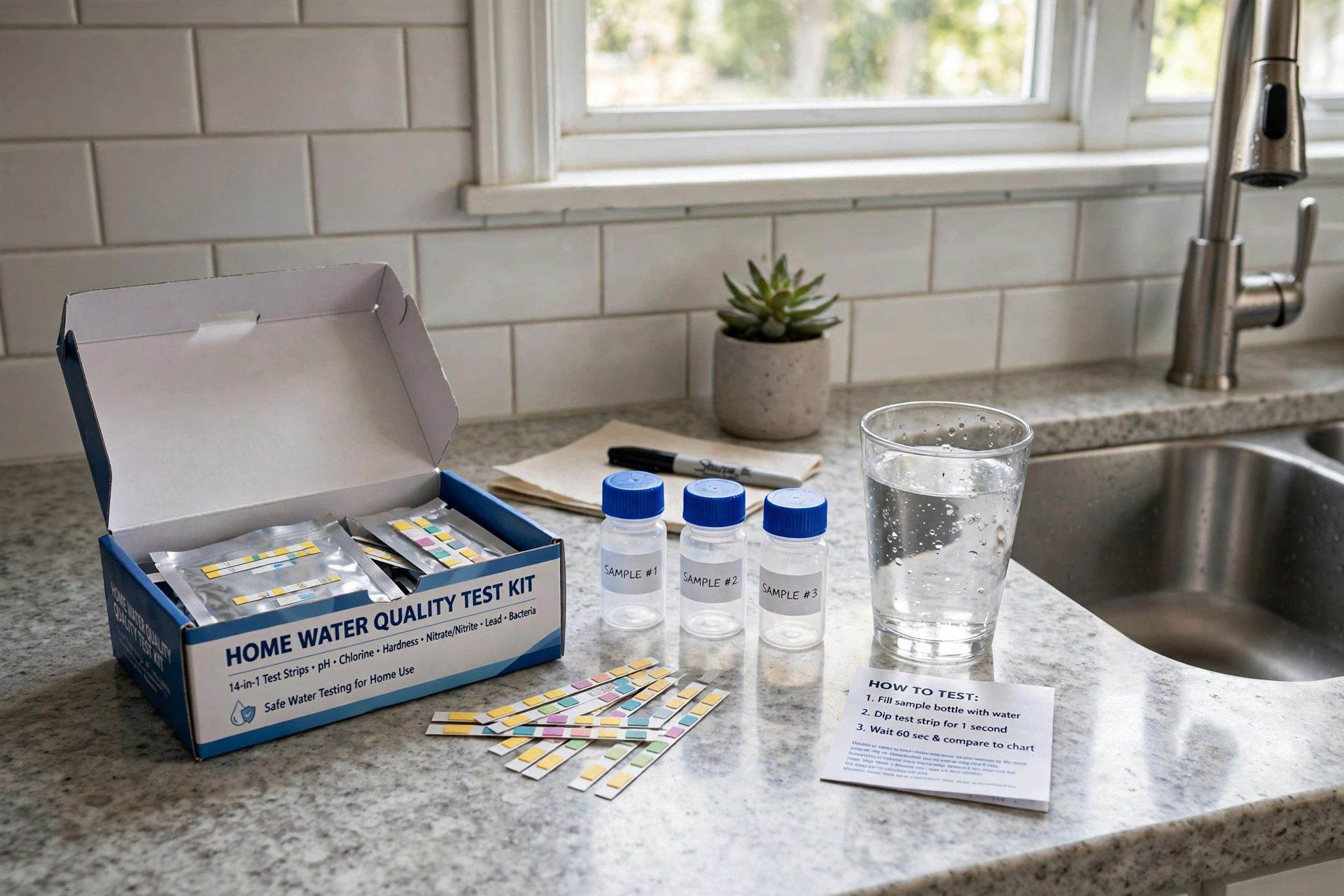
Test strips are the cheapest and fastest option. You dip a strip in a glass of tap water and read the color change against a chart. A strip kit usually checks pH, hardness, chlorine, iron, copper, nitrates, and lead. Some kits add bacteria.
Strips cost about $10 to $25 for a pack. They give a rough answer in minutes. The weakness is accuracy. Color charts are hard to read, and strips miss low levels of contaminants. They work well as a first screen. If a strip shows a problem, follow up with a better test.
Digital Home Test Kits
Digital kits use a small handheld meter or a color reader to measure hardness, total dissolved solids, pH, or chlorine. They cost $20 to $60. The reading is clearer than a strip. These meters suit people who track their water over time, for example after they install a softener or a reverse osmosis unit.
For a deeper option, many shoppers compare a water test kit for well water before they buy. A good mail-in kit from a trusted brand can rival a local lab.
Mail-In Lab Kits
With a mail-in kit, you fill sample bottles at home and mail them to a certified lab. The lab runs professional tests and emails a detailed report in a few days to two weeks. These kits test for dozens of contaminants, including lead, arsenic, pesticides, volatile organic compounds, and bacteria.
Mail-in kits cost $60 to $150 depending on how many contaminants they cover. They are a strong middle ground. You get lab-grade results without paying for a technician to visit your home.
Professional In-Home Testing
Some companies send a trained technician to your home. The technician collects samples, may run quick tests on the spot, and sends bottles to a certified lab. This service costs $150 to $350, and sometimes more for a full panel with dozens of contaminants.
The visit adds value when you have a well, when you need a certified report for a real estate sale, or when you want advice on which treatment system to buy. Be careful with free tests offered by water softener salesmen. A free test is often a sales pitch, not a neutral test. Ask who certifies the lab before you agree.
Home Water Quality Test Cost Near Me: Typical Prices
Search results for home water quality test cost near me vary because prices depend on the test type, the number of contaminants, and your area. Here is what most American homeowners pay.
– Test strips: $10 to $25 per pack. – Handheld digital meter: $20 to $60. – Bacteria-only lab test: $25 to $75. – Mail-in lab kit, basic panel: $60 to $100. – Mail-in lab kit, full panel: $100 to $150. – Professional in-home test with lab analysis: $150 to $350. – Real estate water test package with bacteria and lead: $200 to $400.
City homes on public water usually need a smaller panel. The water company already tests for most regulated contaminants, so you mainly need to check lead, hardness, and chlorine levels in your own pipes. Well owners need a larger panel, because no one tests their water for them. A full well panel that covers bacteria, nitrates, lead, arsenic, iron, manganese, pH, and hardness often costs $150 to $250.
Some local health departments test well water for free or at low cost. Call your county health office before you pay a private lab. The EPA also suggests testing private wells at least once a year for bacteria and nitrates.
How to Choose the Right Test
Start with the source of your water. If you use city water, ask your water company for its latest water quality report. This report is free and public. Then decide what gaps remain. Lead from old pipes is the most common gap. A lead filter only makes sense after you know your lead level.
If you have a private well, test for total coliform bacteria and nitrates every year. Test for lead, arsenic, and radon every three to five years, or sooner if you notice a change in taste, color, or smell. After floods, nearby construction, or a new septic system, test again right away.
Match the test to your goal. You want a quick check before buying a filter. A strip kit or digital meter is enough. You need results you can trust for a home purchase. Use a certified lab, either mail-in or in-home. You suspect a serious contaminant like lead or bacteria. Skip the strips and go straight to a lab test.
Check that the lab is certified by your state. Most state health departments keep a list of approved labs online. A lab without certification may still sell you a test, but its results may not hold up for real estate or legal needs.
What the Results Tell You
A lab report lists each contaminant and its measured level, next to the EPA limit for that substance. The report may flag anything above the limit in red or bold type. Do not panic at a single flagged item. Many problems have simple fixes.
Hard water, which is high in calcium and magnesium, does not threaten health but ruins fixtures and shortens the life of appliances. A water softener or conditioner fixes it. High chlorine affects taste and dries out skin. A carbon filter removes it. Lead above the EPA action level needs a certified lead filter or a reverse osmosis unit. Bacteria require disinfection, often with chlorine shock treatment or a UV purifier. Nitrates above the limit are serious for infants, and they need a proper treatment system such as reverse osmosis or ion exchange.
Keep a copy of every report. Over time, the reports show trends. A rising nitrate level, for example, can warn of a failing septic field before it becomes a crisis.
Cost-Saving Tips
You do not need to overspend on testing. A few smart steps cut the bill.
First, check free options. County health departments, state extension offices, and some water companies offer free or cheap basic tests. Second, buy the right panel. Testing for fifty contaminants when you need ten wastes money. Third, avoid the free in-home test from a company that sells treatment systems, unless you also get an independent lab test. Fourth, test once to learn your baseline, then retest only when something changes. Annual bacteria tests for wells are the exception.
Retailers like Home Depot and Lowe’s sell well-known test kits at fair prices, and many carry the same kits their websites list. Compare the kit price with a local lab. In some towns, the county lab is cheaper than any store kit.
Care and Upkeep After Testing
A test is a snapshot. Water quality changes with the seasons, with rainfall, and with the age of your pipes and well. Plan a simple routine.
Test well water for bacteria and nitrates once a year, ideally in spring when runoff is high. Test city water when you move into a new home or after plumbing work. Replace filter cartridges on schedule, because an old cartridge can make water worse, not better. Flush your taps for thirty seconds in the morning if your home has old pipes, to clear water that sat overnight. Clean faucet aerators twice a year, since sediment and biofilm collect there.
If you installed a softener or a filter, retest after a month to confirm it works. A post-treatment test proves the system does its job. Guides from This Old House and Family Handyman show simple maintenance steps for common water systems.
Safety Notes
Handle test kits with care. Keep strips and sample bottles away from children and pets. Follow the sampling instructions exactly. A dirty bottle or an unflushed tap gives a false result. For bacteria tests, the sample must reach the lab within a set time, often 24 to 30 hours, and stay cool in transit.
Never drink water you suspect is contaminated while you wait for results. Use bottled water for drinking and cooking until the lab report arrives. If the report shows lead above the action level, do not boil the water. Boiling does not remove lead. It concentrates it.
Brand makers such as Moen, Delta, and Kohler publish guidance on fixtures and lead-free plumbing parts that help reduce exposure at the tap. For treatment options, companies like Aquasana explain how certified filters target specific contaminants.
FAQ
How much does a home water quality test cost near me on average?
Most homeowners pay between $25 and $150. A strip kit costs under $25. A mail-in lab kit costs $60 to $150. A professional in-home test with full lab analysis costs $150 to $350. Local prices vary, so call two or three providers.
Is a free water test from a softener company reliable?
Treat it as a sales tool, not a diagnosis. Some companies run honest tests, but many use them to sell equipment. Ask for the lab name and certification. For a neutral answer, use a state-certified lab.
How often should I test my well water?
Test for bacteria and nitrates every year. Test for lead, arsenic, pesticides, and other contaminants every three to five years. Test right away after floods, nearby drilling, or a change in taste, smell, or color.
Can I test my own water with strips and trust the result?
Strips work for a rough screen. They show big problems with hardness, chlorine, or pH. They are not precise enough for lead, bacteria, or nitrates at low levels. Use a lab test for anything that affects health.
Does my city water need testing?
City water is tested at the treatment plant, but your home pipes can add lead and copper. A basic home test for lead, hardness, and chlorine closes that gap. It is cheap insurance, especially in older homes.
What should I do if the test finds lead?
Stop drinking the tap water and switch to bottled or filtered water until you fix the source. A certified lead-removal filter or reverse osmosis unit at the kitchen sink protects drinking water. For a long-term fix, replace lead service lines and lead solder. Your water company can tell you if the service line contains lead.
A Short Final Word
A water test is one of the cheapest home projects with the highest return. For the price of a dinner out, you learn exactly what flows from your taps. Whether you pick a $15 strip kit or a $250 professional panel, the result guides every later choice, from a simple pitcher filter to a full home system. Test first, treat second, and rest easy knowing your water is safe.
References
Aquasana. (n.d.). Water filtration systems. https://www.aquasana.com Delta Faucet. (n.d.). Kitchen and bathroom faucets. https://www.deltafaucet.com Family Handyman. (n.d.). DIY home repair and maintenance. https://www.familyhandyman.com Kohler. (n.d.). Bathroom and kitchen fixtures. https://www.kohler.com Lowe’s. (n.d.). Home improvement products. https://www.lowes.com Moen. (n.d.). Faucets and plumbing fixtures. https://www.moen.com The Home Depot. (n.d.). Home improvement products. https://www.homedepot.com This Old House. (n.d.). Home renovation guidance. https://www.thisoldhouse.com U.S. Environmental Protection Agency. (n.d.). Protecting human health and the environment. https://www.epa.gov
Was this guide helpful?

About James Carter
The My Garden US editorial team writes practical, in-depth home and garden guides for American homeowners — tested advice, no fluff.
You May Also Like
Iron Filter for Well Water Reviews: What American Homeowners Report
February 14, 2026 0 views
Battery Backup Sump Pump Reviews 2026 USA: A Plain Guide for Homeowners
March 26, 2026 0 views
Heat Pump Water Heater Installation Cost USA: What You Pay in 2026
June 30, 2026 0 views