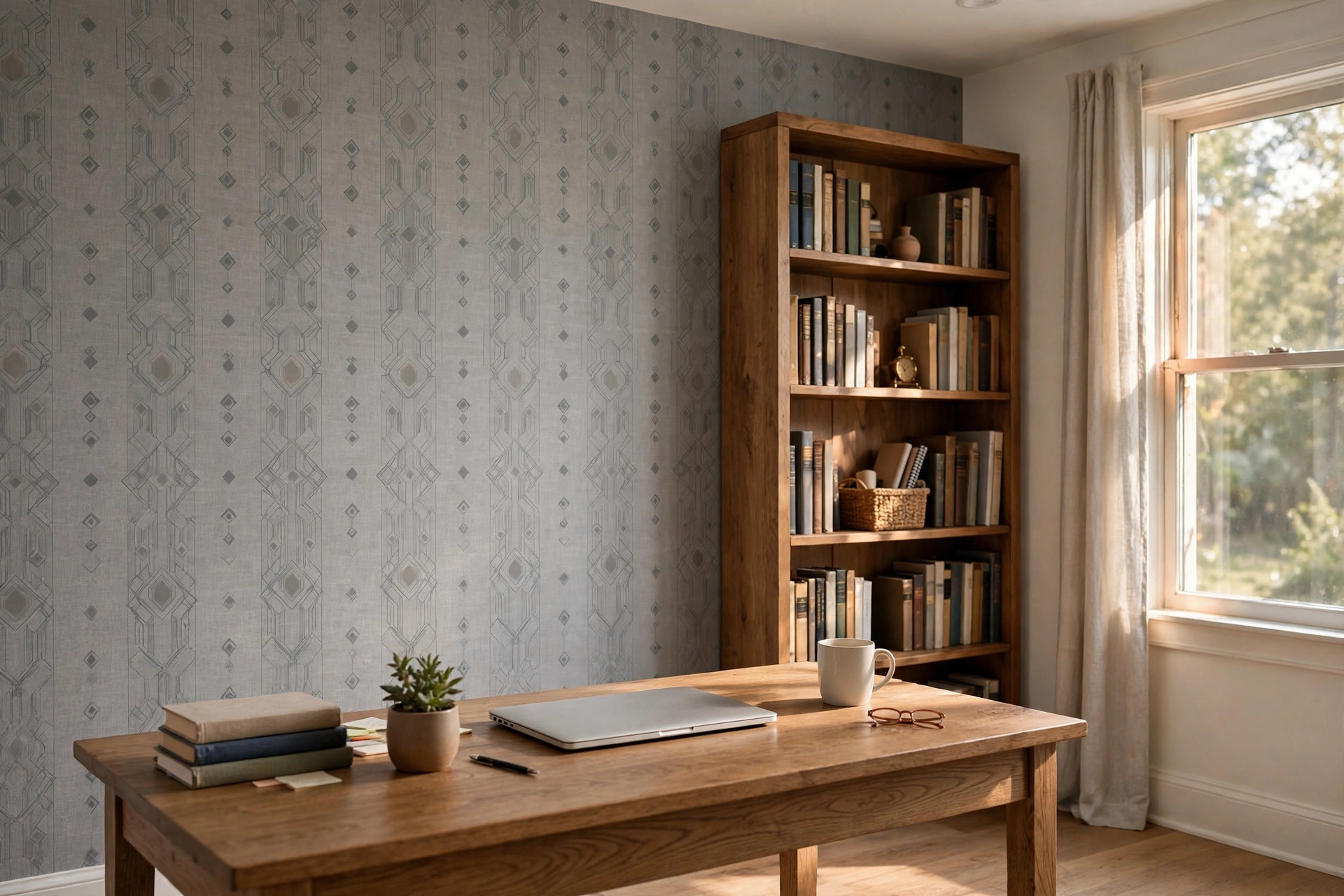

Many workers in the United States now spend their days at a desk in a spare room, a corner of the living room, or a finished basement. These home offices often look dull. Plain white walls do not help a person focus or feel at ease. A simple change can lift the whole room. Geometric wallpaper for home office USA homes is one of the simplest changes a homeowner can make. It adds order, energy, and character to a wall without a full remodel.
Geometric patterns have a long history. People have used triangles, hexagons, diamonds, and grids in homes for more than a century. In a home office, these shapes can do real work. They give the eye a quiet rhythm. They hide small marks on old walls. They set a tone for the day. This guide explains how to choose the right pattern, what kinds of wallpaper are sold in the United States, what they cost, and how to hang and care for them.
Why Geometric Wallpaper Suits the Home Office
A home office is a room with one clear purpose. A person goes there to think, read, write, and talk on the phone. The walls around the desk shape that work. Paint gives a flat field of color. Wallpaper gives texture and structure. A geometric design gives both.
There are several sound reasons to choose a geometric pattern for a workroom. First, geometry reads as order. Straight lines and repeated shapes suggest a clear mind. Second, the pattern can frame the desk. One accent wall behind the desk is often enough to change the room. Third, video calls look better. A tidy geometric wall behind a worker gives a clean, professional backdrop. Fourth, the range of choice is wide. Soft grays and creams keep the room calm. Bold navy or black lines add drama. There is a pattern for nearly every taste.
Design writers have long noted that a small room gains depth from pattern. A spare bedroom turned into an office often feels cramped. A geometric print can break up the flat surface and make the wall seem farther away. The effect works best with patterns of medium size. Very small prints can look busy on a big wall. Very large prints can overwhelm a small room. A balanced middle ground suits most home offices.
What to Look For When You Choose: Geometric Wallpaper for Home Office Usa
Pattern Scale
Scale matters more than color at first. Stand back from a sample and look at it from across the room. In a room of ten by twelve feet, a pattern with repeats of four to eight inches usually looks best. In a larger room, the pattern can grow. Keep in mind the desk and shelves. Furniture will cover parts of the wall. The pattern must read well in the parts that stay visible. A good test is to tape up a sample for a few days and live with it before you buy a full roll.
Color and Light
Home offices often face different light through the day. A north-facing room gets cool, steady light. A south-facing room gets warm sun. Hold samples in the actual room at morning, noon, and evening. Pale patterns with warm beige or soft gold can warm a cool room. Cool grays and blues can calm a sunny room. White-based patterns with thin lines stay bright in dark corners. Dark patterns suit rooms with strong natural light, where deep tones do not turn gloomy.
Backdrop for Screens
Think about the wall behind your monitor or your chair. On video calls, the wall behind you is part of your image. A busy, high-contrast pattern can distract the people watching. A soft, low-contrast pattern looks calm and neat. If you plan to paper the wall that shows on camera, choose a pattern with gentle rhythm rather than loud contrast. Test it with your camera on. What looks fine in person can shimmer or buzz on a webcam. Fine stripes and tiny grids are the worst offenders. Medium shapes with clear spacing record best.
Durability and Finish
Wallpaper comes in several finishes. Smooth non-woven papers are easy to hang and easy to remove. Vinyl-coated papers resist scuffs and can take light wiping. This matters in a workroom where chairs bump walls and coffee cups ring desks. Check the product label for washability. A paper marked as scrubbable will stand up to marks better than one marked as spongeable only. For homes with pets or small children near the office door, a tougher finish is worth the extra cost.
Types of Geometric Wallpaper
The American market offers several kinds of wallcovering. Each has its own way of hanging and its own price range. Your choice depends on skill, budget, and how long you plan to stay in the house.
Peel and Stick
Peel-and-stick paper is the newest favorite. It has an adhesive backing covered by a liner. You peel the liner and press the paper to the wall. It needs no paste, no water, and no special tools beyond a smoothing tool and a sharp knife. Renters love it because most brands promise clean removal. The catch is surface prep. The wall must be smooth, clean, and dry. Textured walls will show bumps through the paper. Bubbles are common for first-time users. Work slowly from the top down and smooth as you go. Many home improvement guides note that peel and stick suits one accent wall better than a whole room, since long panels get hard to handle alone.
Paste the Wall
Paste-the-wall paper is a modern take on a classic. You roll paste onto the wall, then press dry paper into it. This avoids the old step of soaking long strips in a water tray. Non-woven paste-the-wall papers are stable. They do not stretch like old paper-backed papers did. They also strip off in whole sheets when you redecorate. This type suits a full room. It costs more than peel and stick per roll but covers well and lasts for years.
Traditional Pre-Pasted
Pre-pasted paper has dried paste on its back. You wet it in a tray, book it for a few minutes, then hang it. It is the classic American wallpaper of the last century. It costs less than non-woven paper. It still gives a crisp finish when hung well. Removal takes more work. You must steam or wet it off, and glue residue may need washing. Homeowners who plan to keep a pattern for a decade or more may find it a fair bargain.
Mural Panels and Statement Prints
Some geometric designs come as mural panels. These are wide strips printed as one large design. A single mural can cover the wall behind a desk with one bold composition. Murals suit offices that need a clear focal point. They cost more per square foot than rolled paper. Hanging a mural is like hanging paste-the-wall paper, with extra care to match panel edges. Order the mural sized to your wall and check the lead time. Custom prints can take weeks to ship.
Cost and Price
Price varies with material, brand, and where you buy. As a rough guide for the United States market, peel-and-stick rolls often run from fifteen to forty dollars per roll. Each roll usually covers about twenty-eight square feet. Paste-the-wall non-woven rolls often run from thirty to seventy dollars for similar coverage. High-end designer papers can pass one hundred dollars a roll. Murals often cost from one hundred fifty to four hundred dollars for a wall-sized panel.
Do not forget the extra costs. You may need paste, a smoothing tool, a seam roller, a sharp knife, and a level. These tools together can add twenty to fifty dollars if you own none of them. Hiring a professional changes the math. A paperhanger often charges by the roll or by the square foot. For a simple accent wall, labor may run from two hundred to five hundred dollars. Get a written estimate before you commit. Many homeowners find that one feature wall is a fair first project to learn on, and they hire help for full rooms.
One wall is often enough. Papering all four walls doubles or triples the cost. An accent wall behind the desk gives most of the design effect for a fraction of the price. It also makes future changes easy. If you tire of the pattern, you change one wall, not four. Pair the accent wall with plain paint on the other walls for a clean, finished look. If you want to compare wall costs with hiring a painter for the plain walls, look up the going house painter hourly rate near me 2026 before you decide.
Hanging the Paper: The Basic Steps
You can hang most geometric papers yourself with care. The steps below suit peel-and-stick and paste-the-wall types. For pre-pasted paper, follow the wetting steps on the package.
First, prepare the wall. Fill holes and sand them smooth. Wash off dirt and grease. Let the wall dry fully. If the wall was painted with glossy paint, sand it lightly so paste can grip. Some hangers prime the wall with a thin wallpaper primer. This step helps removal later.
Second, plan the layout. Find the center of the wall or the main sight line, usually the center of the desk. Hang the first strip plumb, using a level. Pattern matching matters with geometric prints. Check the match type on the label: straight match, drop match, or random match. Straight match is easiest. Drop match takes more paper because each strip shifts down by half a repeat. Buy extra rolls for drop-match patterns. A good rule is to add ten to fifteen percent to your measured amount.
Third, hang the strips. For paste the wall, roll paste on a section slightly wider than the strip. Press the top of the strip to the wall, align it, and smooth down with a brush or plastic smoother. Trim at the ceiling and baseboard with a sharp knife and a straightedge. For peel and stick, peel a short section of liner, align the top, and smooth downward while peeling more liner. Keep tension even. Pull a strip off and reset it if it goes crooked. Most repositionable papers allow one or two resets.
Fourth, roll the seams. Run a seam roller lightly along each joint. Wipe off excess paste with a damp sponge before it dries. Step back often to check alignment. A small error at the top grows into a large one at the bottom.
Let the paper rest for a day before you push furniture back. Keep the room at a mild temperature and avoid strong drafts from open windows while paste sets. For detailed step-by-step help, home improvement references such as Bob Vila and This Old House publish hanging guides worth reading before you start.
Care and Upkeep
Geometric wallpaper in a home office needs little care. Dust the wall a few times a year with a dry cloth or a soft brush attachment on a vacuum. This stops dust from settling into the texture. For marks, follow the product label. Most modern papers allow a light wipe with a damp sponge and mild soap. Test any cleaner on a hidden spot first. Never scrub hard on printed inks. They can fade or smear.
Watch the seams. In rooms with changing humidity, seams can lift at the edges. A small tube of seam adhesive fixes a lifted edge in minutes. Press it flat and wipe away excess. Keep direct sun in mind. Strong sun can fade dark inks over years. A window shade or sheer curtain slows fading on the sunniest wall. If one wall gets full afternoon sun, consider hanging your boldest pattern on a different wall and painting the sunny wall a matching tone.
Steam from a nearby bathroom can also loosen paper over time. If your office shares a wall with a bath, make sure that room is well vented. A working exhaust fan protects both paint and paper. Small repairs beat full replacement. Keep a leftover roll or a large offcut in a closet. It is the only way to patch a torn spot with a true pattern match.
Safety
Wallpaper is safe for most homes, but a few points deserve care. Check the product label for fire rating. Most residential wallpapers carry a Class A or Class B surface burning rating. This is standard for wall finishes in homes. If your office has a fireplace or a space heater, keep heat sources well away from papered walls, just as you would with painted walls.
Read the label for material safety. Modern wallpapers sold by major retailers meet current standards for indoor use. Some imported papers may carry strong chemical odors when new. Air the room well for a few days after hanging. If anyone in the house has a strong sensitivity to odors, choose a paper labeled low-VOC or odor-free, and let it air before you move the desk back.
Electrical safety matters during hanging. Turn off power to outlets and switches on the wall you are papering. Remove cover plates. Cut the paper around boxes with care and leave a small margin. Replace the plates after the paste dries. Metal tools near live outlets are a real hazard. A few minutes with the breaker off is cheap insurance.
Ladders deserve respect too. Use a stable step ladder, not a chair. Keep paste trays and tools off the top step. Many home accidents happen on short falls in familiar rooms. Take your time. Consumer safety resources such as the CPSC publish general home safety guidance that applies to any decorating project, and design sources like HGTV often remind readers to plan safe work areas.
Frequently Asked Questions
Does geometric wallpaper make a small home office feel smaller?
It depends on the pattern. Dark, large-scale prints can close in a tiny room. Light patterns with medium shapes often make a small room feel larger and more finished. If your office is under one hundred square feet, choose a pale background with a soft geometric print. Paper one wall, not four. Keep the ceiling white to lift the room.
Is peel-and-stick wallpaper safe for apartment walls?
Most peel-and-stick brands promise damage-free removal from smooth, primed, or painted drywall. Results vary with paint quality and how long the paper stays up. Paper left for years can bond more firmly. Test a small piece in a closet first. Remove it slowly at a low angle. Heat from a hair dryer softens stubborn adhesive. Check your lease before you start. Some landlords still forbid any wallcovering.
How do I match geometric patterns at the seams?
Read the label for the match type. A straight match lines up at the same height on each strip. A drop match shifts each strip down by half a repeat. Mark the back of each strip as you cut. Hang the first strip plumb and let the pattern guide the rest. Buy extra paper for drop matches. When in doubt, order one more roll than the calculator suggests. It is cheaper than a second shipping fee.
Can I hang wallpaper over textured walls?
Light orange-peel texture often shows through thin paper. Heavy knockdown texture will show through almost any paper and may stop adhesive from gripping. For best results, skim-coat the wall smooth and sand it before hanging. Peel-and-stick makers state this clearly in their instructions. Skipping the prep step is the most common cause of bubbles and lifting edges.
What pairs well with geometric wallpaper in an office?
Solid colors in the desk, shelving, and textiles let the pattern lead. Pick one color from the paper for an accent, such as a chair cushion or a lamp shade. Wood tones warm up cool gray patterns. Black metal frames suit bold black-and-white geometry. Keep the desk surface clear. A calm desk against a patterned wall reads as intentional, not busy. For another wall idea in the same room, some homeowners add magnetic paint for home office walls usa on a side wall to pin notes and plans where they can see them.
Should the whole office match, or is one wall enough?
One wall is enough for most rooms. Designers call it a feature wall. It gives the room a focal point without the cost and labor of a full room. Put the paper behind the desk or behind the chair that shows on video calls. Paint the other walls in a quiet tone pulled from the paper. The result looks planned and professional. If you love the pattern after a year, you can always add a second wall.
A Final Word
Geometric wallpaper for home office USA rooms is a small project with a large return. It turns a plain box into a place with character. It frames your workday. It gives video calls a clean backdrop. Start with one wall, choose a pattern you can live with for years, and hang it with care. Measure twice, buy a little extra, and take your time at the seams. The room will pay you back every working day.
For paint and paper shopping, major home centers such as Home Depot and Lowe’s carry wide ranges in store and online. Paint makers including Sherwin-Williams, Benjamin Moore, and Behr offer color tools that help match paint tones to your chosen paper. Home advice sites like The Spruce publish pattern and color guides that can sharpen your choice before you buy. And if the office door needs a fresh coat to match the new wall, a best black paint for interior doors usa roundup can point you to durable options.
References
Behr. (n.d.). Paints, primers, and stains. https://www.behr.com Benjamin Moore. (n.d.). Paints and stains. https://www.benjaminmoore.com Bob Vila. (n.d.). Home improvement advice. https://www.bobvila.com HGTV. (n.d.). Home and garden ideas. https://www.hgtv.com Lowe’s. (n.d.). Home improvement products. https://www.lowes.com Sherwin-Williams. (n.d.). Paints and coatings. https://www.sherwin-williams.com The Home Depot. (n.d.). Home improvement products. https://www.homedepot.com The Spruce. (n.d.). Home and garden advice. https://www.thespruce.com This Old House. (n.d.). Home renovation guidance. https://www.thisoldhouse.com U.S. Consumer Product Safety Commission. (n.d.). Product safety information. https://www.cpsc.gov
Was this guide helpful?

About Lisa Anderson
The My Garden US editorial team writes practical, in-depth home and garden guides for American homeowners — tested advice, no fluff.
You May Also Like

Best Paint for Metal Fence USA: A Practical Guide for Homeowners
January 10, 2026 0 views
Shoe Molding vs Quarter Round Guide USA
April 10, 2026 0 views
Modern Farmhouse Paint Colors Exterior USA
August 2, 2026 0 views