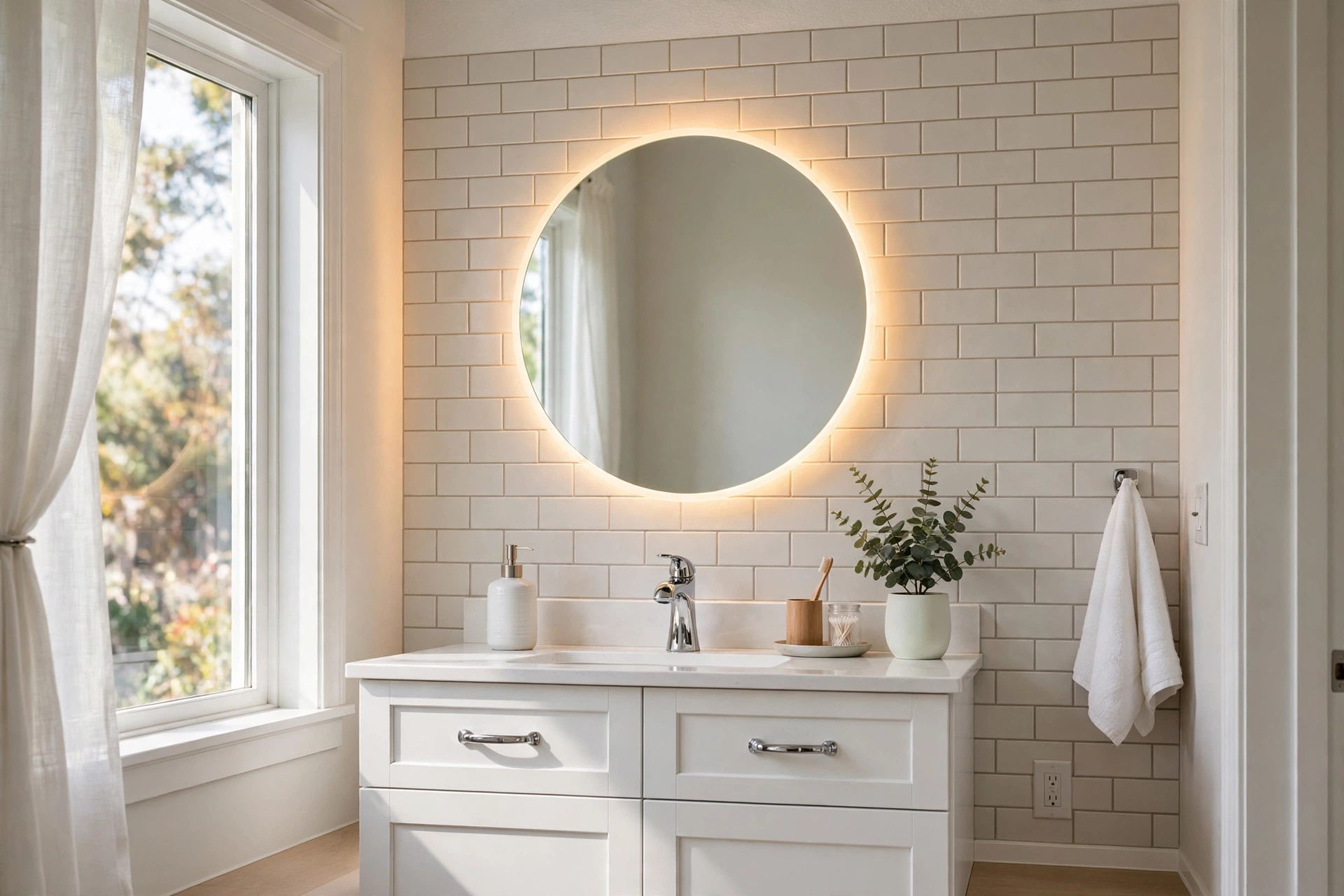

The led bathroom mirrors buying guide usa starts with one simple fact. A bathroom mirror is no longer just glass on a wall. It has become a light fixture, a grooming station, and in many homes the centerpiece of the remodel. This guide walks through everything a buyer in the United States needs to know before spending money on an LED bathroom mirror.
Light matters more in a bathroom than in any other room. People shave there. They apply makeup there. They check their appearance before work. Poor light casts shadows and changes color. A good LED mirror gives even, true light across the face. That is the promise. This guide explains how to find the ones that keep it.
Why an LED Mirror Matters
An LED bathroom mirror places a ring or border of light around or behind the glass. The light comes from small diodes built into the frame or etched into the glass edge. It turns on with a touch sensor, a button, or a wall switch.
The first reason buyers switch is simple: the light is where it is needed. Overhead ceiling lights shine down from above and leave shadows under the eyes and chin. Wall sconces beside a mirror help, but they take up wall space and need wiring. An LED mirror solves both problems at once. The light comes from the mirror itself, straight at the face, from the sides or from all around.
The second reason is energy use. LED diodes draw very little power. A typical LED mirror uses about 10 to 20 watts when lit, far less than a pair of vanity bulbs. Over a year of daily use, the cost of running the light is only a few dollars. Many makers note this point in their product pages, and the figure holds up in practice.
The third reason is style. Backlit mirrors float off the wall with a soft halo. Edge-lit mirrors carry a crisp line of light. In a modern remodel, they give the room a finished, built-from-scratch look that a plain mirror cannot match.
What to Look For When You Buy: Led Bathroom Mirrors Buying Guide Usa
Size and Shape
Measure the vanity first. The mirror should be narrower than the vanity top, usually by a few inches on each side. For a single 30-inch vanity, a 24-inch mirror is a safe pick. For a 60-inch double vanity, many buyers choose one wide mirror of 48 inches, or two mirrors of 24 inches each.
Height matters too. The center of the mirror should sit near eye level, roughly 60 to 65 inches from the floor for most adults. Round mirrors run 24 to 36 inches across. Rectangle mirrors often run 24 by 32 inches or 36 by 48 inches. Arched shapes are popular now, but round and rectangle styles fit more rooms.
Depth counts as well. Most LED mirrors hang one to two inches off the wall. Some models are thicker to house drivers and defog pads. Check the depth figure before ordering, because a mirror that juts too far can hit a faucet or a medicine cabinet door.
Light Color and Brightness
LED mirrors come in several color temperatures, measured in kelvin. Warm white is 2700 to 3000 kelvin, like old incandescent bulbs. Neutral white is 3500 to 4000 kelvin. Daylight white is 5000 to 6500 kelvin.
Most buyers do best with neutral or daylight settings for grooming, because they show skin tone closest to daylight. Warm light flatters but hides flaws. Many modern mirrors let you switch between settings with a touch, which is a feature worth paying for.
Brightness is measured in lumens. A mirror in the range of 1500 to 2500 lumens gives strong face light for a single sink. Some mirrors add a dimmer, which helps at night when full light feels harsh. If the listing does not state lumens, check reviews or the maker specs before you buy.
Anti-Fog and Defogger Pads
A hot shower fills a bathroom with steam, and a cold mirror fogs over. Many LED mirrors include a defogger pad, a thin heated film on the back of the glass. Touch a sensor and the pad warms the glass so steam does not condense.
This is one of the most useful extras on a bathroom mirror. Check that the defogger covers the central area of the glass, not just a small patch. Some models run the pad only while the light is on. Others have a separate timer. Both styles work. If you live in a humid region, treat this as close to required.
Power and Wiring
LED mirrors need electricity. There are two main kinds. Hardwired models connect directly to the wall wiring, usually to the same circuit as the old vanity light. Plug-in models use a cord to a standard outlet. Hardwired looks cleaner. Plug-in is easier to install.
Before buying, check what is behind your wall. If you are replacing an old light bar above the mirror, an electrician can usually reuse the wiring box. If there is no wiring at the mirror spot, plan for a small electrical job. Many guides on home sites suggest this step comes before the mirror ships, so the box is in place when it arrives.
Look for UL or ETL listing on any mirror you buy in the USA. That mark means the electrical parts passed safety testing. Mirrors sold for wet rooms should note an IP rating, such as IP44, which means the unit resists splashes from all sides.
Touch Controls and Extras
Most LED mirrors use touch sensors built into the glass or the frame. Common controls include on and off, dimmer, color change, and defogger. Higher-priced models add a clock display, a temperature readout, or Bluetooth speakers. A magnifying panel is another common extra, useful for close work.
Extras add cost and points of failure. A buyer who wants a mirror that lasts ten years should weigh each feature. Touch dimmers and color switching see daily use. Bluetooth speakers in a steamy room tend to see less.
Types and Options
Front-lit mirrors carry the LED strip on the face of the glass, often as a frosted band around the edge. They give the strongest direct light on the face. They suit small bathrooms where the mirror is the main light source.
Backlit mirrors hide the diodes behind the glass. The light spills around the edges onto the wall, giving a soft glow. They look high-end but give less direct face light than front-lit models. Many buyers pair a backlit mirror with a ceiling light for full coverage.
Edge-lit mirrors place the strip along the glass edge. They give a thin, clean line of light and a slim profile. The effect sits between front-lit and backlit.
Framed LED mirrors add a metal or wood frame around the lit glass. They suit traditional rooms where a floating glass slab would look out of place. Frameless models suit modern rooms.
Medicine cabinet mirrors with lights combine storage and light. The front is a lit mirror, and the inside holds shelves. They cost more and run deeper, but they solve storage in small baths.
Shoppers who are planning a full remodel often read a bathroom sink vanities buying guide alongside the mirror, since the two pieces are sized together. Those redoing the shower at the same time may look at walk in shower kits or frameless shower doors to keep the fixtures in one style.
Cost and Price in the USA
Prices vary widely. A basic LED mirror from a large retailer runs from 80 to 200 dollars. These usually offer front light, a touch switch, and sometimes a defogger. Mid-range models run 200 to 500 dollars, with color temperature control, dimmers, and stronger anti-fog pads. High-end designer mirrors run 500 to 1500 dollars or more, with custom sizes, fine finishes, and smart features.
Size drives price. A 24-inch round mirror costs far less than a 72-inch double-sink model. Shape matters less, though arched glass sometimes carries a premium. Defogger pads, dimmers, and smart controls each add to the ticket.
Shipping is a real factor. Mirrors are large, flat, and fragile. Many online sellers ship free, but returns for a broken or wrong-size mirror can be slow. Measure twice. Check the return policy before you order.
Installation cost is separate. A handyman can hang a plug-in mirror for a modest fee. A hardwired install by a licensed electrician often runs 150 to 300 dollars, more if new wiring is needed. Add this to the budget before you fall in love with a model.
Care and Upkeep
LED diodes last a long time. Most makers rate their strips at 30,000 to 50,000 hours. At one hour a day, that is decades. The diodes are not the part that fails. Power supplies and touch sensors fail first. Buying from a maker with a real warranty, usually two to five years, protects against that.
Clean the glass like any mirror. Use a soft cloth and a mild glass cleaner. Do not spray cleaner directly onto a backlit edge, where liquid can seep behind the glass. Wipe the frame with a damp cloth. Avoid abrasive pads on frosted LED bands, which scratch easily.
In hard-water areas, wipe the mirror after steamy showers when the defogger is off. Mineral spots etch glass over time. A quick wipe keeps the surface clear.
If the light flickers or dies, check the driver first. Many mirrors use an external LED driver that can be replaced without changing the glass. Keep the model number and the maker contact from the box.
Safety
Electricity and water share the bathroom, so safety rules are strict for good reason. Only buy mirrors with a UL or ETL mark. Do not install a mirror rated for dry rooms inside a shower zone. Follow the maker minimum distances from tubs and showers, which the manual states.
Turn off the breaker before any hardwired install. If you are not sure about wiring, hire an electrician. The job is small, but mistakes in a wet room carry real risk. Ground-fault protection on the bathroom circuit is standard in modern US homes and should stay in place.
Check the glass safety too. Large mirrors should use tempered or safety-backed glass, so a break does not send sharp shards across the room. The listing or manual should state this. If it does not, ask the seller before you buy.
Frequently Asked Questions
Are LED bathroom mirrors worth the money? For most buyers, yes. They combine a mirror and a vanity light in one unit, use little power, and give better face light than a ceiling fixture. The value rises if you would otherwise pay an electrician to wire separate sconces.
Do LED mirrors work without a wall switch? Many do. Touch sensors on the glass turn the light on and off. Hardwired models can also tie into a wall switch, so the mirror lights when the switch flips. Check the manual for your model.
How long do LED bathroom mirrors last? The diodes are rated for tens of thousands of hours, which is many years of daily use. The full unit usually lasts as long as its power supply and sensors, which is why a multi-year warranty matters.
Can I install an LED mirror myself? A plug-in model is a simple DIY job: hang the bracket and plug it in. A hardwired model needs basic electrical work. Many homeowners hire an electrician for safety and code compliance.
What is the best light color for a bathroom mirror? Neutral to daylight white, around 4000 to 5000 kelvin, shows skin tone most truly. Mirrors with adjustable color let each user pick warm or cool light as needed.
Do all LED mirrors have anti-fog? No. Anti-fog is an extra on many models, not a standard feature. If steam is a problem in your bathroom, filter your search to models with a defogger pad and confirm the pad size in the specs.
A Short Final Word
An LED bathroom mirror is one of the simplest upgrades in a remodel. It improves daily grooming, cuts energy use, and gives the room a modern finish. The buying process is simple too: measure the vanity, pick a light color you like, confirm the anti-fog and safety marks, and budget for the install. Do those steps in order and the mirror you choose will serve the household for years.
References
American Standard. (n.d.). Bathroom and kitchen products. https://www.americanstandard.com Bob Vila. (n.d.). Home improvement advice. https://www.bobvila.com Delta Faucet. (n.d.). Kitchen and bathroom faucets. https://www.deltafaucet.com HGTV. (n.d.). Home and garden ideas. https://www.hgtv.com Kohler. (n.d.). Bathroom and kitchen fixtures. https://www.kohler.com Lowe’s. (n.d.). Home improvement products. https://www.lowes.com Moen. (n.d.). Faucets and plumbing fixtures. https://www.moen.com The Home Depot. (n.d.). Home improvement products. https://www.homedepot.com The Spruce. (n.d.). Home and garden advice. https://www.thespruce.com This Old House. (n.d.). Home renovation guidance. https://www.thisoldhouse.com
Was this guide helpful?

About Lisa Anderson
The My Garden US editorial team writes practical, in-depth home and garden guides for American homeowners — tested advice, no fluff.
You May Also Like
Shower Grab Bars for Sale USA: What to Know Before You Buy
June 2, 2026 0 views
Brushed Towel Holders Buying Guide: How to Choose the Right Ones for Your American Bathroom
February 22, 2026 0 views
Quiet Exhaust Fans Texas Homes USA
September 16, 2026 0 views