Most bathrooms in American homes get one light bar above the mirror, and it is installed once and forgotten. This bathroom vanity light bars buying guide usa will change how you look at that fixture. The right bar makes a small bathroom feel larger. It makes a large bathroom feel calm. It decides whether you see your face clearly in the morning or squint into a harsh glare. A poor choice, on the other hand, leaves dark corners, casts shadows across the mirror, and makes the whole room look tired. This guide walks you through size, brightness, color temperature, finishes, mounting, and cost, so you can buy with confidence and install once, correctly.
Why It Matters
A vanity light bar is not a decoration. It is a working light, and its job is harder than most people think. It must light a face evenly for shaving, makeup, and contact lenses, without throwing deep shadows under the nose and chin. Overhead room lights cannot do this alone. They shine down from above, and the forehead casts a shadow over the eyes. A bar mounted above the mirror throws light forward onto the face, and that one change fixes most bathroom lighting problems.
Good vanity light also protects your eyes. Bathrooms are often the first room you enter in the morning, when your eyes are still adjusting. A bar that is too bright will dazzle you. A bar that is too dim forces you to lean close to the mirror. The right balance gives clear, comfortable light from the first minute of the day.
There is also the question of how the room looks. A vanity bar is one of the few fixtures you see every single day, often several times. Its finish, its shape, and its glass shades set the tone for the whole bathroom. If you plan a mirrored medicine cabinet above the sink, the light bar sits directly beside it and the two must look like they belong together. Buying the bar as part of the room, not as an afterthought, saves money and trouble later.
What to Look For When You Choose: Bathroom Vanity Light Bars Buying Guide Usa
Size and Width
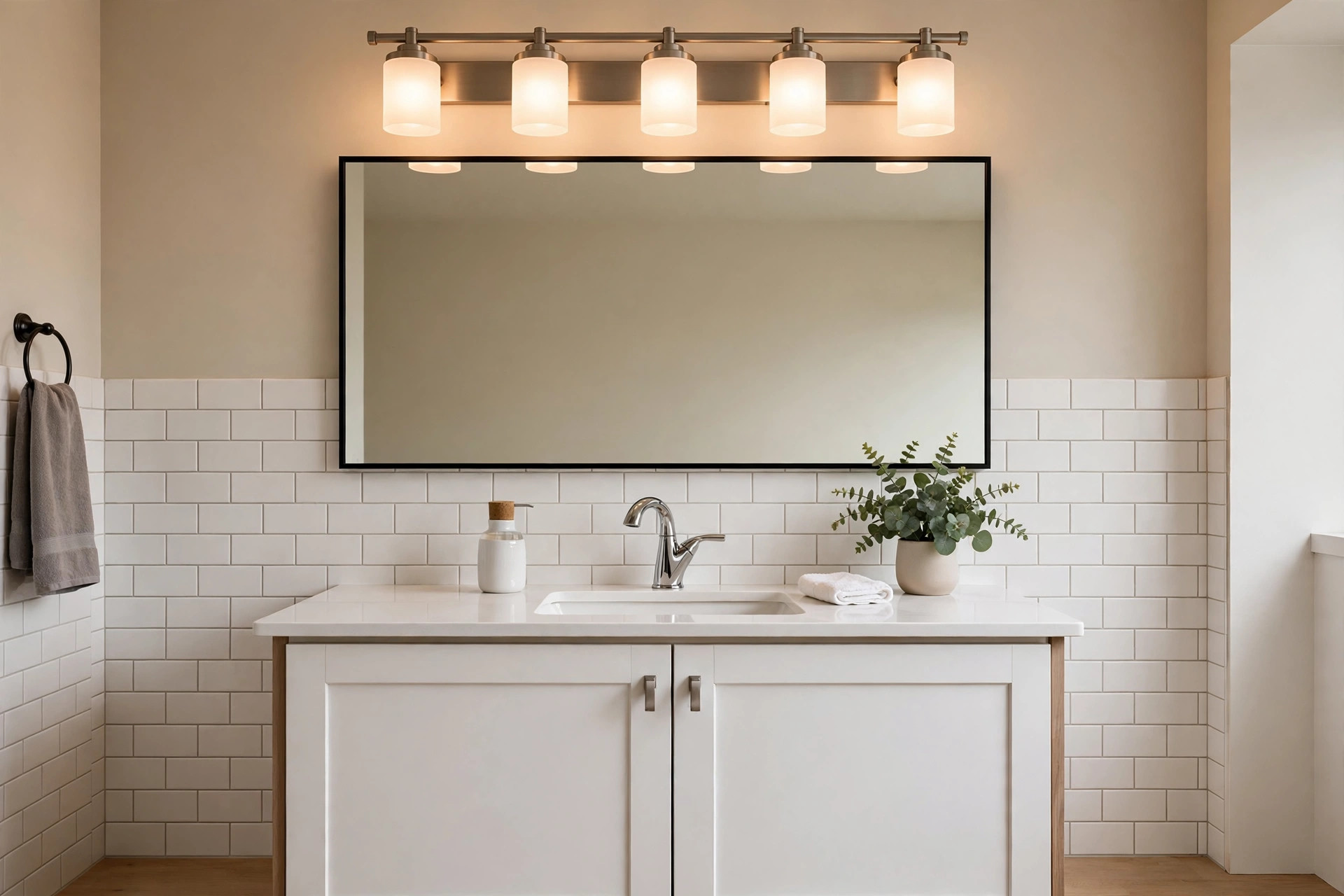
Measure the mirror or the vanity before you shop. A useful rule from the lighting trade is simple: the light bar should be about two-thirds to three-quarters of the mirror’s width, never wider than the mirror itself. A bar that hangs past the edges looks clumsy. A bar that is too short leaves the sides of your face in shadow.
Common lengths run from eighteen inches to forty-eight inches. A single sink with a twenty-four-inch mirror usually takes a two-light or three-light bar of about eighteen to twenty inches. A double vanity with a sixty-inch mirror may need a forty-two-inch or forty-eight-inch bar, or two separate bars. Count the bulbs as well. Two bulbs suit a small bath. Three or four bulbs suit a master bath.
Color Temperature
Color temperature is measured in kelvins and written on the box. It describes whether the light looks warm or cool. For a bathroom mirror, most designers pick between 2700K and 3500K. A 2700K bulb gives a warm, golden light that flatters skin and feels comfortable in the morning. A 3000K bulb is neutral and slightly crisper. Anything above 4000K looks blue and clinical, like a hospital corridor, and most homeowners dislike it.
If you buy LED fixtures, the color temperature is built into the fixture and cannot be changed later. Read the label before you buy. Some newer bars offer selectable color temperature, with a small switch that lets you choose between 2700K, 3000K, and 4000K during installation. These are a safe choice if you are unsure. Guidance from The Spruce and This Old House on bathroom lighting consistently favors warm-to-neutral tones for vanities.
Brightness
Brightness is measured in lumens, and the box will list it. A single-sink vanity needs roughly 500 to 1,000 lumens in total from the bar. A double vanity needs about 1,000 to 2,000 lumens. More is not always better. A bar of 3,000 lumens in a tiny powder room will bounce off white tile and leave you blinking.
Dimmers solve this problem. A dimmer switch lets you run the bar bright for morning routines and low for a late-night visit. Make sure the fixture is marked dimmable, and pair it with a dimmer made for its bulb type. LED bars need LED-rated dimmers. The older dimmer in the wall may not work and can make the lights flicker.
Finish
The finish must match the rest of the bathroom, or at least sit comfortably beside it. If your faucet and towel bars are brushed nickel, buy a brushed nickel light bar. Common finishes include chrome, brushed nickel, bronze, matte black, and brass. Chrome is the brightest and easiest to clean. Matte black suits a modern bath but shows water spots. Bronze and brass bring warmth but must be matched carefully, since shades of bronze differ between makers.
Look at finish guides from makers such as Moen and Delta Faucet before you decide. They show how one finish family runs across faucets, hardware, and lighting, which helps you keep the room consistent.
Wiring and Mounting
Most vanity bars are hardwired. They connect directly to the wiring in the wall, usually controlled by a wall switch. Check the position of the electrical box in your wall. If the old bar was centered on the mirror, the new one should be roughly the same size or larger, or the box may show at the edges. If the box is off center, choose a bar with a backplate wide enough to cover it.
A few bars are plug-in models that connect to a wall outlet. These suit renters and rooms where new wiring is too costly, but the cord will show, and they look less finished. For a permanent remodel, hardwired is the better path.
Types and Options
Standard LED Bars
Most new vanity bars use built-in LED modules instead of replaceable bulbs. They last twenty thousand hours or more, use little power, and run cool. The trade-off is that when the LED fails years from now, the whole fixture usually must be replaced. For most buyers this is a fair trade, since LED life spans many years of normal use.
Bars With Replaceable Bulbs
Some bars still take standard bulbs, usually G9 capsules or medium-base bulbs. These give you freedom. You can change the brightness and color temperature later simply by changing the bulb. They suit buyers who like to adjust things over time. The fixture itself will last as long as any metal and glass fixture, which is to say decades.
Multi-Light vs. Single-Light Bars
Multi-light bars use two to five small shades along a horizontal rod. They are the classic American bathroom light and spread illumination evenly across the mirror. Single-light bars are narrower fixtures with one wide shade, common in powder rooms and small baths. For a wide mirror, the multi-light bar is almost always the better choice.
Backlit and Mirror-Integrated Options
Some homeowners skip the separate bar entirely and buy a LED bathroom mirror with built-in lighting. These mirrors have LEDs around the edge and give a clean, modern look with no separate fixture. They cost more, but they free wall space and give very even light. If you are replacing both the mirror and the light, compare the cost of a good mirror with the combined cost of a plain mirror plus a bar.
Cost and Price
Prices for vanity light bars in the United States cover a wide range. A simple two-light bar from a big-box store may cost thirty to sixty dollars. A well-made three-light or four-light bar in a good finish usually runs from eighty to two hundred dollars. Designer brands and solid-brass fixtures can run from two hundred to five hundred dollars or more.
Installation adds to the cost. If the wiring is already in place and you are replacing an old bar with a new one of similar size, a homeowner with basic skills can do it in under an hour. If new wiring or a new switch is needed, expect an electrician to charge one hundred to three hundred dollars, depending on your market. Budget for both the fixture and the labor before you buy.
Retailers such as Home Depot and Lowe’s carry a wide range at every price point, and their sites let you compare sizes, finishes, and lumen ratings side by side. Project guides on HGTV and Bob Vila also show what typical bathroom lighting budgets look like, which helps you set a number before you shop.
Care and Upkeep
A vanity bar is easy to maintain, but a little care keeps it looking new. Dust the shades and the bar once a month with a soft cloth. Glass shades can be removed and washed in warm soapy water twice a year. Dry them fully before you put them back, since water spots show under bright light.
Clean the finish gently. Chrome and nickel take a damp cloth and mild soap. Avoid strong cleaners, bleach, and rough pads, which scratch the finish and leave marks that never come out. Matte black and bronze finishes need the gentlest touch of all.
If the fixture uses replaceable bulbs, write the bulb type on a small label and stick it inside the linen cabinet door. Years from now, when a bulb fails, you will thank yourself. Speaking of storage, a tidy bathroom linen cabinet is a good place to keep spare bulbs, a soft cloth, and the instruction sheet that came with the fixture. Makers such as Kohler publish care guides for their finishes, and the advice applies to any brand.
Safety
Bathroom light fixtures sit close to water, so safety ratings matter. Look for a fixture rated for damp locations at minimum. Every fixture sold for bathroom use in the United States should carry this rating on the box. Fixtures mounted directly above a tub or inside a shower enclosure need a wet-location rating instead, which is stricter.
Turn off the power at the breaker before you install or service the fixture, not just at the wall switch. Bathroom circuits are often shared with other rooms, and a switch that looks off may not be. Test with a non-contact voltage tester if you own one. If the wiring in the box looks damaged, burned, or frayed, stop and call an electrician. A light bar is not worth a fire.
Keep the fixture away from direct spray. A bar mounted above the mirror is far from the shower and poses no special risk, but a bar inside a shower zone must meet the wet-location rules noted above. When in doubt, read the installation sheet that comes in the box. It is written for your exact fixture and it is the final word.
Frequently Asked Questions
How high above the mirror should a vanity light bar go? Mount the bar so its center sits about seventy-five to eighty inches above the floor. For most mirrors, this puts the fixture a few inches above the top edge of the mirror. If the mirror runs very high, mount the bar on the mirror itself or just below the top of the frame, keeping the same height.
Can I mount a vanity bar vertically beside the mirror? Yes. Sconces or short bars mounted on both sides of the mirror give the most even light of all, because they light the face from both sides and remove shadows almost entirely. They need wiring on both sides, which is harder to add later, so they are easiest to plan during a remodel.
Do I need a special dimmer for an LED vanity bar? You need a dimmer rated for LED loads, and the fixture must be marked dimmable. Old dimmers made for incandescent bulbs can cause flicker, buzzing, or a narrow dimming range. The fixture maker usually lists compatible dimmer models on its site.
What color temperature is best for applying makeup? Most people work best in 3000K to 3500K, a neutral light that shows color truly without the yellow cast of warmer bulbs. If you want one light for both makeup and a warm evening bath, choose a fixture with selectable color temperature and set it to taste.
How long do LED vanity bars last? Most built-in LED fixtures are rated for twenty thousand to fifty thousand hours. In normal bathroom use of one to two hours a day, that is many years. Heat is the main enemy of LED life, so choose a fixture with good ventilation and do not enclose it in a tight space.
Is it worth hiring an electrician to install a vanity bar? If the wiring and switch are already in place, a careful homeowner can swap a bar safely. If new wiring is needed, the breaker panel must be touched, or the old box is damaged, hire a licensed electrician. The cost is modest and the safety is worth it.
A Final Word
A bathroom vanity light bar is a small purchase that shapes your mornings for years. Measure the mirror, pick a width that covers two-thirds of it, choose a warm-to-neutral color temperature, match the finish to the room, and check the safety rating. Do these five things and you will buy once and be done. This bathroom vanity light bars buying guide usa was written to make that process simple, and we hope your new light serves you well.
References
Bob Vila. (n.d.). Home improvement advice. https://www.bobvila.com Delta Faucet. (n.d.). Kitchen and bathroom faucets. https://www.deltafaucet.com HGTV. (n.d.). Home and garden ideas. https://www.hgtv.com Kohler. (n.d.). Bathroom and kitchen fixtures. https://www.kohler.com Lowe’s. (n.d.). Home improvement products. https://www.lowes.com Moen. (n.d.). Faucets and plumbing fixtures. https://www.moen.com The Home Depot. (n.d.). Home improvement products. https://www.homedepot.com The Spruce. (n.d.). Home and garden advice. https://www.thespruce.com This Old House. (n.d.). Home renovation guidance. https://www.thisoldhouse.com
Was this guide helpful?

About Michael Thompson
The My Garden US editorial team writes practical, in-depth home and garden guides for American homeowners — tested advice, no fluff.