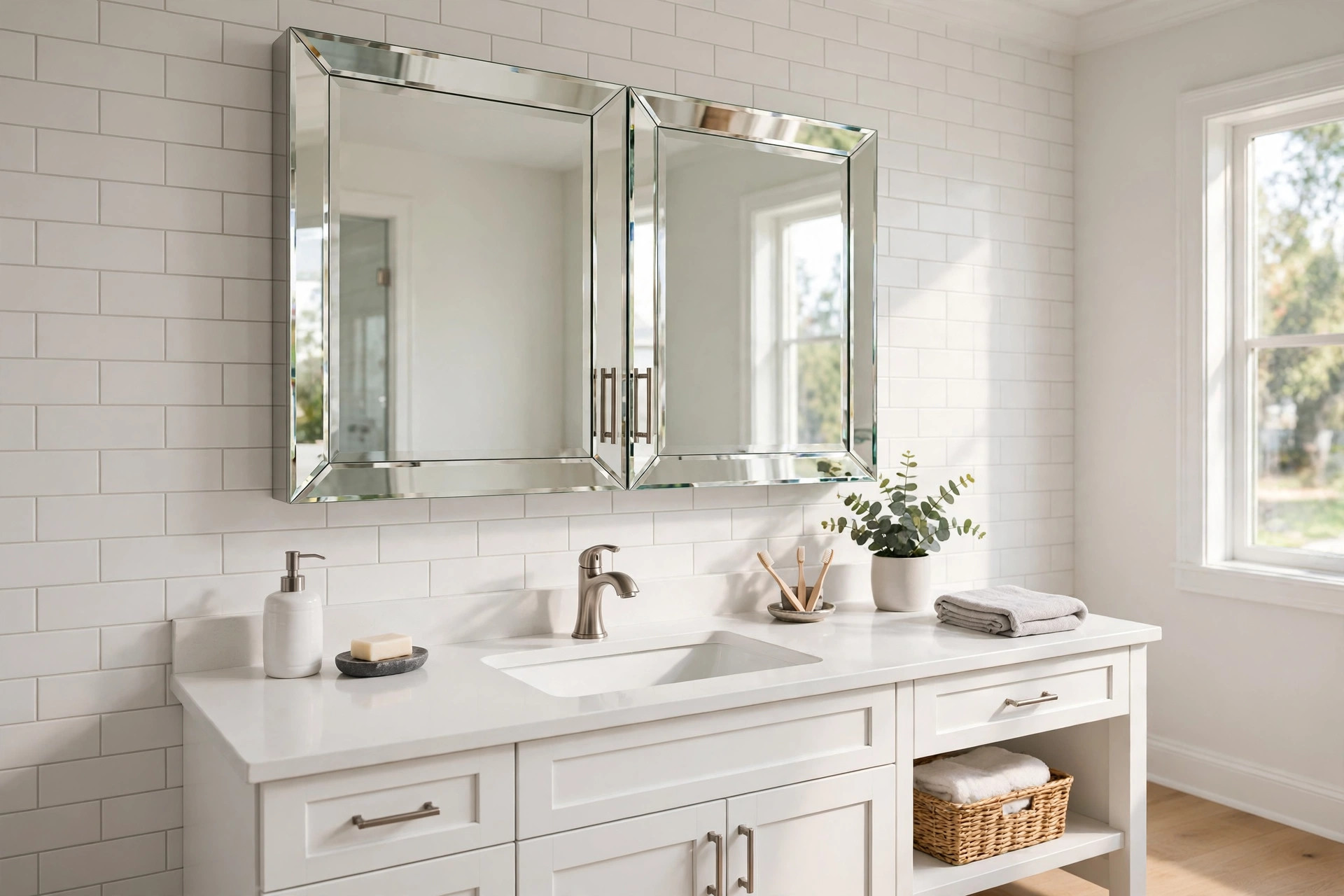

A bathroom mirror is useful. A bathroom mirror that also holds your daily goods is better still. This mirrored medicine cabinets buying guide usa will walk you through the choices in plain terms, so you can buy with confidence and avoid a unit that rusts, sags, or fails to fit your wall.
Why a Mirrored Medicine Cabinet Matters
Space above the sink is prime real estate. A plain flat mirror gives you nothing but a reflection. A mirrored medicine cabinet uses the same wall space to store toothpaste, razors, pills, contact lens cases, and all the small items that clutter a sink top. In a small bathroom the cabinet is often the difference between a tidy counter and a crowded one.
The mirror also plays a big part in how the room feels. A cabinet mirror sits a few inches off the wall, and its frame or beveled edge can make a small bath feel wider and brighter. Design guides from HGTV often note that reflective surfaces are one of the simplest ways to lift a dark bathroom. Light from the window or the vanity light bar bounces off the glass and lifts the whole room. For renters and owners alike, it is one of the cheapest ways to add both storage and light in a single step.
A good cabinet also keeps things within reach. Items used at the sink each morning and night belong right there. When they have a fixed home behind the mirror, you stop hunting through drawers and you stop leaving bottles on the counter. That daily convenience is the real reason these cabinets have stayed popular for close to a century.
What to Look For: How to Choose: Mirrored Medicine Cabinets Buying Guide Usa
Start with the wall. Medicine cabinets come in two main mounting styles: surface mount and recessed. A surface-mounted unit hangs on the wall like a picture, with a bracket or cleat. It takes about fifteen minutes to hang and needs no cutting. A recessed unit sits inside the wall between the studs, so only the mirror face shows. Recessed cabinets look sleeker and save a few inches of room depth, but they require cutting into the wall and checking that no pipe or wire runs through the bay. If your home was built before the 1970s, have a look behind the wall before you commit to cutting. Renovation guides from This Old House stress the same point: know what is inside the wall before you open it.
Next, measure. The cabinet should line up with the vanity below it. A common rule is to pick a cabinet about as wide as the vanity, or a few inches narrower on each side. Height matters too. The center of the mirror should sit near eye level for the people who use it. If the tallest and shortest users in the home differ a lot, aim for the middle and choose a cabinet tall enough to cover the spread.
Mirror quality deserves attention. Cheaper glass can show a faint waviness when you look close. Look for terms like “plate glass mirror” or “distortion-free mirror” on the box. A beveled edge adds a finished look and catches the light. Some cabinets carry mirrors on the inside of the door as well, which helps when you are shaving or applying makeup at an angle.
Shelving is where the cabinet earns its keep. Most units hold two or three glass shelves. Check whether the shelves move up and down. Fixed shelves force tall bottles to sit sideways. Adjustable shelves let you set the spacing to fit what you own. Glass shelves are easy to wipe clean and let light pass through, which keeps the inside bright. Count how many bottles you actually store before you buy, and make sure the shelf count and spacing can hold them.
The door is the working part. It should open and shut smoothly and stay shut on its own. Soft-close hinges stop the door from banging. A door that swings the wrong way will knock into a light fixture or a towel bar, so check the hinge side before you order. Some models offer reversible doors that can hinge left or right. If two people use the bath at once, a two-door unit gives each person a side and keeps mornings moving.
The body of the cabinet matters more than it looks. Steel bodies resist dents and last for years. Wood bodies suit a traditional bath but need a finish that can stand steam. Plastic bodies cost less and never rust, but they can feel light and may warp in a hot bath. Whatever the body, look for a rust-free claim and check that the back panel is sealed. Makers such as Kohler and American Standard publish care notes that agree: steam is the enemy of bathroom storage, and a sealed back keeps moisture out of the works.
Types and Options
Single-door cabinets are the classic form. They fit most vanities from 24 to 36 inches wide and cost the least. The single door gives one large mirror, which is what most people want.
Double-door and triple-door cabinets span wider vanities, 36 to 48 inches and up. They give more mirror area and more storage, and each door can open on its own. In a shared bath, two doors mean two private shelves.
Corner cabinets fit where two walls meet. They save space in very small baths but hold less than a straight cabinet. Corner units are harder to find and often cost more for less storage, so measure twice before going this route.
Lighted cabinets build lighting into the frame. LED strips along the sides or top give shadow-free light for the face. These units need power at the wall, so plan for an outlet or a hardwire box. If you already have a good vanity light bar above the mirror, a plain cabinet may be all you need.
Fog-free mirrors carry a heated pad behind the glass that keeps the surface clear after a hot shower. The feature uses a small amount of power and adds to the price. It is a luxury, not a need, but in a bath with no window it can be a real comfort.
Some cabinets add a magnifying mirror on the inside of the door, a small swing-out panel that helps with close work. Others add a built-in outlet or a USB port inside the cabinet for charging an electric toothbrush or shaver. These extras are handy, but every extra part is one more thing that can fail, so weigh the convenience against the price.
Cost and Price
In the USA, a basic steel single-door cabinet runs from about 60 to 150 dollars. These units do the job: a clear mirror, two or three shelves, a working door. They are the best value for a guest bath or a rental.
Mid-range cabinets cost from about 150 to 400 dollars. Here you get better mirror glass, adjustable shelves, soft-close hinges, nicer finishes, and wider or double-door sizes. This is the range where most homeowners should shop.
High-end and designer cabinets run from 400 dollars to well over 1,000. Lighted models, fog-free glass, custom sizes, and hardwood frames sit in this range. The quality is real, but the gain over a good mid-range unit is mostly in looks and extras rather than in daily function.
Recessed installation adds cost if you hire help. A handyman may charge 150 to 300 dollars to cut the opening, frame the bay, and set the cabinet. Surface mounting costs nothing but your time. Keep the total cost in mind when you compare a 120-dollar cabinet with a 300-dollar recessed unit that needs a paid install.
Watch the shipping too. Large double-door cabinets ship in big boxes, and some sellers charge extra freight. Check the return policy before you order. A cabinet that arrives with a cracked mirror should go back at the seller’s cost, and you should know that before you click buy. Big retailers like The Home Depot and Lowe’s list return terms on each product page, so read them before you order.
Care and Upkeep
A mirrored cabinet asks little of you. Wipe the mirror with a soft cloth and a standard glass cleaner, or with a mix of water and a drop of dish soap. Avoid harsh powders and scouring pads, which scratch the glass and the frame. Clean the shelves now and then with a damp cloth to stop dust and dried drips from building up.
Check the hinges once a year. If the door starts to sag, a small turn of the hinge screws usually puts it right. Tighten the shelf pins if a shelf starts to rock. These small jobs take minutes and keep the cabinet working for a decade or more.
Steam is the main threat. Run the bath fan during showers and for twenty minutes after. If your bath has no fan, crack the door. Constant steam will find its way into the cabinet seams and rust a steel body from the inside. If the current fan is too loud to use, replace it with a quieter model so it actually gets switched on.
Do not store heavy items on the door shelves, if the door has any. Door storage is fine for small tubes but not for full bottles, which strain the hinges. Keep heavy goods on the fixed shelves inside the box.
Safety
Medicine cabinets hold pills, blades, and sharp tools, so safety is part of the buy. Mount the cabinet to a stud or use proper wall anchors rated for the weight. A loaded cabinet can weigh 30 to 50 pounds, far more than the empty box. A cabinet that pulls off the wall can shatter the mirror and injure someone badly.
If small children live in the home or visit often, fit a small latch on the cabinet door. Child-proof latches cost a few dollars and keep little hands away from pills and razors. Store all medicines up high and in their original bottles with caps on.
The mirror glass itself should be safety-backed if you have kids. Safety backing is a film on the back of the glass that holds the pieces together if the mirror breaks. Many cabinets include it; if not, a lighted or steel-framed model still keeps most shards in place.
When recessing a cabinet, cut the power to the room and check for wires and pipes before you cut. A stud finder and a small inspection hole are cheap insurance. If you are not sure what runs through the wall, hire a professional. The cost of a handyman is small next to the cost of a burst pipe.
Match the cabinet to the rest of the bath’s fixtures. A brushed nickel frame pairs well with brushed nickel faucets, and a chrome frame suits a chrome faucet set. Matching finishes make a small bath look planned rather than patched together.
FAQ
What is the best width for a medicine cabinet? Match the cabinet to the vanity below it. For a 30-inch vanity, a 24 to 30-inch cabinet works well. For a 48-inch double vanity, a 36 to 48-inch double-door cabinet fits best. Keep a few inches of wall showing on each side so the unit does not crowd the room.
Should I recess or surface-mount the cabinet? Recess the cabinet if the wall is open or you plan to cut into it, and you want a flush, built-in look. Surface-mount if you want a fast install with no cutting, or if pipes or wires block the wall bay. Both styles work well; the choice is about looks and labor.
Do mirrored medicine cabinets rust? Cheap steel cabinets can rust where steam reaches bare metal, usually at the seams and the back. Cabinets rated as rust-resistant or rust-free, with sealed backs and coated steel, hold up much better. Running the bath fan after showers is the best defense for any unit.
Can I hang a medicine cabinet on tile? Yes, but drill with care. Use a masonry or glass-and-tile bit, drill slow, and keep the bit cool with water. Mount into the stud behind the tile when you can; when you cannot, use tile-rated anchors. Fixture makers such as Delta Faucet include mounting guidance with their bathroom products that covers the same ground. Mark your holes with tape so the bit does not wander.
Are LED medicine cabinets worth it? They are worth it if your bath light is weak or casts shadows on the face. Built-in LEDs give even, shadow-free light that helps with shaving and makeup. They cost more and need power at the wall, so plan the wiring before you buy. Practical how-to advice on running power for bath fixtures appears on Bob Vila and The Spruce.
How long does a medicine cabinet last? A well-made cabinet lasts 10 to 20 years. The mirror may lose its edge first, showing dark spots where moisture got behind the glass. Tightening hinges and cleaning shelves now and then will carry a good unit through its full life.
A Short Final Word
A mirrored medicine cabinet is one of the hardest-working fixtures in the home. It stores the daily goods, lights the face, and brightens the room, all from one patch of wall. Measure the space, pick the mounting style that fits your wall, check the mirror quality and the shelves, and buy from a seller with a fair return policy. Do that, and this mirrored medicine cabinets buying guide usa will have done its job: a cabinet that serves you well every morning and night for years to come.
Related guides on this site include walk in shower kits buying guide usa.
References
American Standard. (n.d.). Bathroom and kitchen products. https://www.americanstandard.com Bob Vila. (n.d.). Home improvement advice. https://www.bobvila.com Delta Faucet. (n.d.). Kitchen and bathroom faucets. https://www.deltafaucet.com HGTV. (n.d.). Home and garden ideas. https://www.hgtv.com Kohler. (n.d.). Bathroom and kitchen fixtures. https://www.kohler.com Lowe’s. (n.d.). Home improvement products. https://www.lowes.com The Home Depot. (n.d.). Home improvement products. https://www.homedepot.com The Spruce. (n.d.). Home and garden advice. https://www.thespruce.com This Old House. (n.d.). Home renovation guidance. https://www.thisoldhouse.com
Was this guide helpful?

About Sarah Mitchell
The My Garden US editorial team writes practical, in-depth home and garden guides for American homeowners — tested advice, no fluff.
You May Also Like
Bathroom Towel Warmers Reviews Buying Guide USA
March 13, 2026 0 views
Walk In Shower Kits for California Homes USA
February 23, 2026 0 views
Walk In Shower Kits Deals Near Me: A Buyer Guide
February 7, 2026 0 views