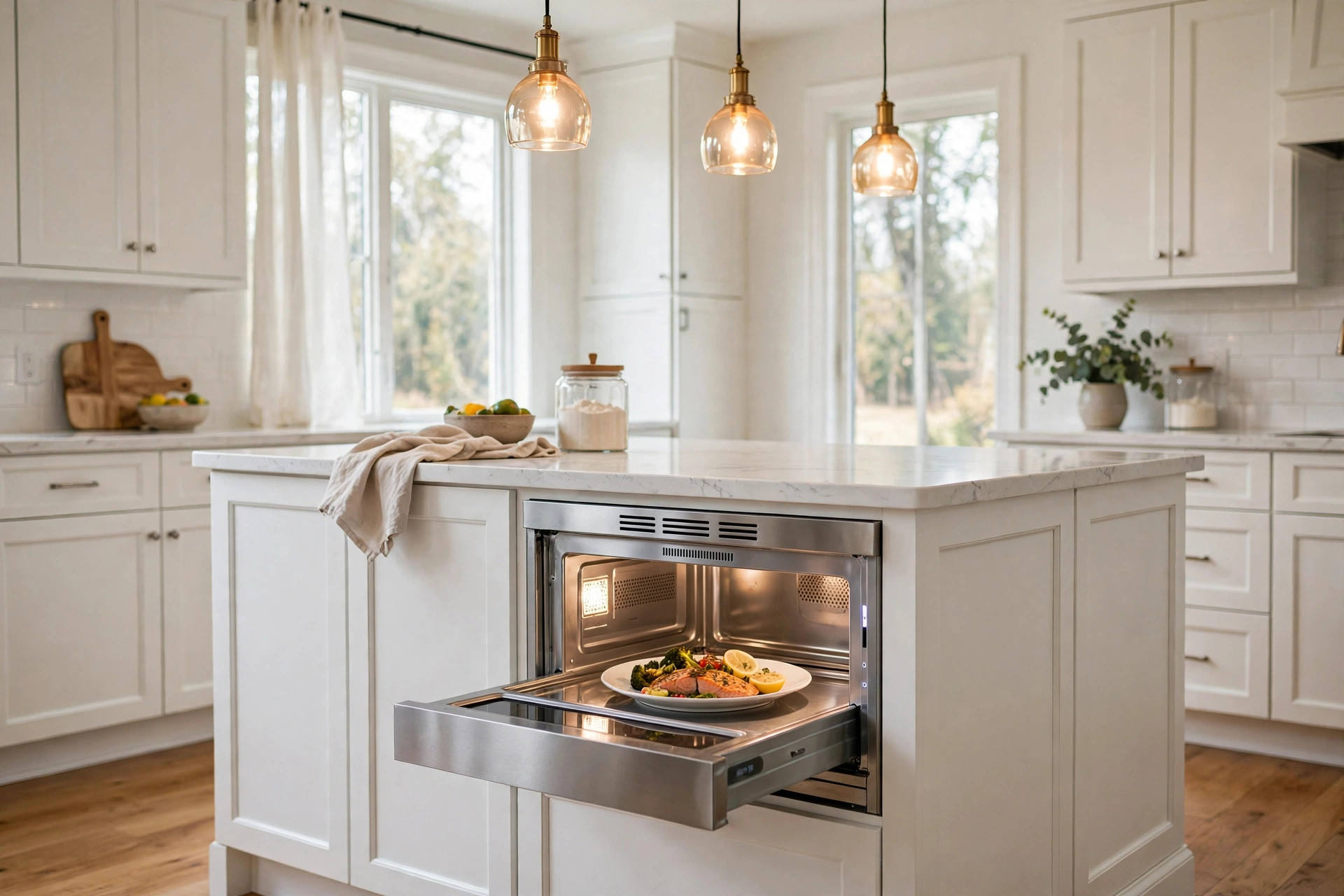

A microwave drawer unit sits low in a kitchen cabinet and opens like a drawer. You pull it out, place your food inside, and push it shut. It is a small change to a kitchen. But it changes how the kitchen works and how it looks. This microwave drawer units american homes guide will walk you through the basics. You will learn what these units are, why people buy them, what to look for, what they cost, and how to keep them in good shape.
Why Microwave Drawers Matter
For many years, the microwave lived on the kitchen counter. It took up space. It collected crumbs. It sat at the back of the room and hummed. Then some people put it above the stove. That freed the counter. But it placed the microwave high up. Hot soup had to come down from chest height or higher. That was hard for short people and for children.
The microwave drawer changed this. It goes under the counter, often in a kitchen island or a base cabinet. You open it with a touch of a button or a light pull. You look down into the unit to see your food. You lift your dish up and out. The motion is easy on the back and the shoulders.
Design matters too. Many American homes now favor open kitchens. The kitchen opens to the living room. The family room is one big space. A bulky microwave on the counter breaks the clean line of the room. A drawer microwave hides inside the cabinets. The kitchen looks smooth and calm. Cabinet makers now build drawer bases to fit these units. That is why they have grown so popular in new kitchens and in full remodels.
What to Look For When You Choose: Microwave Drawer Units American Homes Guide
Not all drawer microwaves are the same. Here are the main points to study before you buy.
Size and Fit
Drawer microwaves come in standard widths. The most common is 24 inches. Some are 30 inches wide. Measure your cabinet opening before you shop. The unit needs room around it for air to move. Check the maker cutout specs. Many cabinet makers follow standard dims, but always measure twice.
Height is fixed in most models. The drawer depth is enough for a dinner plate or a small casserole dish. Tall mugs may not fit. If you often heat tall items, check the interior height first.
Power and Capacity
Power is measured in watts. Most drawer microwaves run between 850 and 1000 watts. Higher watts heat food faster and more evenly. Lower watts cost less to buy. For daily family use, 950 watts or more is a good mark.
Capacity is measured in cubic feet. Drawer models are often around 1.0 to 1.2 cubic feet. That is smaller than many countertop models. It fits most plates and bowls. It is not made for large turkeys or big roasts. Think about what you heat most days.
Controls and Features
Most drawer microwaves open with a button press or a gentle pull. Some have child lock buttons. A child lock keeps small hands from opening the unit. This is worth having in homes with toddlers.
Look for sensor cooking. The unit reads steam from the food and sets the time for you. This helps with vegetables and frozen meals. Look for a keep warm setting. It holds food at serving heat after cooking. Look for a melt and soften setting. It is handy for butter and chocolate.
Some models link with a wall oven of the same brand. The styling matches. The handles match. If you care about a matched look, shop within one brand family.
Ease of Cleaning
A flat interior floor is easier to wipe than one with grooves. Some drawers have a removable rack. The rack must come out for washing. Stainless steel interiors resist stains better than painted ones. Ask about this if you heat a lot of tomato sauce or curry.
Types and Options
Drawer microwaves fall into a few groups. Each group fits a different kitchen.
Standard drawer microwave. This is the most common type. It opens flat, like a desk drawer. It fits a 24-inch or 30-inch base cabinet. It works in islands and in lower wall runs. Most brands make this type.
Drawer microwave with convection. Some models add a convection fan. The fan lets the unit bake and brown, not just heat. This costs more. It is useful if you want a second small oven. Not every home needs it. But in small kitchens it can stand in for a second oven.
Trim kit models. Some drawer microwaves come with trim kits. The trim fills gaps between the unit and the cabinet. This gives a built-in look even in older cabinets. Ask your dealer if a trim kit is sold for the model you like.
Built-in combos. A few makers sell a microwave drawer that pairs with a warming drawer below. The stack gives two useful functions in one cabinet column. This is a high-end choice. It suits large kitchens and people who entertain often.
If you want to compare more appliance choices, our microwave drawer units buying guide walks through current models and prices. Our microwave drawer units for sale page lists where to find them in the USA. If you are planning a full wall of ovens, see our double wall ovens buying guide for how the pieces fit together.
Cost and Price
A drawer microwave costs more than a countertop model. Expect to pay between 1,000 and 2,000 dollars for most units in 2026. High-end models with convection can run above 2,000 dollars. A basic countertop microwave may cost under 200 dollars. The drawer style carries a clear premium.
Why the higher price? The drawer slides must be strong. They must hold hot food and open smoothly for years. The unit must fit tight cabinet specs. The market is smaller, so makers build fewer units. All of this adds cost.
Installation adds more. A drawer microwave needs a dedicated power outlet. Most run on a standard 120-volt line. But the outlet must be in the right spot inside the cabinet. An electrician may need to move or add an outlet. That can cost 150 to 400 dollars. If the cabinet must be cut to fit, a carpenter adds cost too.
Cabinets are another cost. New kitchens often plan the drawer base from the start. That adds little. In an old kitchen, you may need to replace one base cabinet. A single stock cabinet costs a few hundred dollars. Custom cabinets cost more.
Think of total cost, not just the price tag. Add the unit, the outlet work, and any cabinet changes. Many buyers still choose the drawer. They pay for the look, the ease, and the clear counter.
Installation Basics
Plan the spot first. The drawer works well in a kitchen island. It also works in a base cabinet near the main prep area. Keep it close to the fridge. Food moves from fridge to microwave in a few steps.
Do not put the drawer under a cooktop. Heat rises from the cooktop. The maker may warn against this. Do not put it in a damp spot with no air flow. The unit needs vent space at the sides and back.
Check the power. The unit needs its own circuit or a shared one that is rated high enough. Read the install manual. If the words are not clear, ask an electrician. A wrong hookup can trip breakers or harm the unit.
Level the unit. A drawer that is not level will slide oddly and may not seal well. Use a small level during install. Tighten the mounting screws. Test the open and close motion before you push the cabinet back in place.
Care and Upkeep
A drawer microwave is easy to care for. Wipe the inside after spills. A damp cloth with mild soap works for most messes. For hard spots, heat a bowl of water with lemon for two minutes. The steam loosens the grime. Then wipe it out.
Clean the drawer seal. The seal is the soft edge around the drawer front. Crumbs collect there. A dirty seal can keep the drawer from closing tight. Wipe it each week.
Do not slam the drawer. The slides are strong, but they are not made for rough use. Push it shut with a light hand. Teach children to do the same.
Watch the vents. Dust can block the air vents at the back or sides. Vacuum them gently twice a year. Good air flow keeps the unit cool and helps it last longer.
Run a check once a year. Heat a cup of water for one minute. It should be hot. If heating gets slow, the unit may need service. Call the maker or a local repair shop. Do not open the case yourself. Microwaves hold electric charge even when unplugged. This is not a do-it-yourself fix.
Safety
Microwave drawers are safe when used right. Keep these points in mind.
First, use microwave-safe dishes. Glass and ceramic marked for microwave use are best. Some plastics are safe. Check the mark on the bottom. Never use metal. Never use foil. Metal can spark and harm the unit.
Second, watch hot liquids. Water can heat past boiling and then burst when moved. This is called superheating. Stir liquids before and after heating. Let them sit a minute before you lift them.
Third, use the child lock. Small children can reach a low drawer with ease. That is the whole point of the design. But it means children can open it. Turn on the child lock when the unit is not in use.
Fourth, let steam escape. When you heat covered food, leave a small vent. Hot steam can burn hands and faces. Open covers away from your body.
Fifth, keep the area clear. Do not store paper or cloth near the vents. Keep the drawer front free of clutter. A clear space helps the unit work and stay cool.
For more on home appliance safety, the Consumer Product Safety resources and the Energy Star program offer plain guidance for households.
Pros and Cons at a Glance
Pros:
– Frees up counter space for prep work – Easy to reach for children, older adults, and people of short height – Clean built-in look that suits open kitchens – Safe lifting motion: you look down into the drawer, not up over your head
Cons:
– Costs much more than a countertop or over-range model – Smaller interior than many standard microwaves – Needs cabinet work and a proper outlet, which adds install cost – Fewer models and brands to choose from
Weigh these with care. If your kitchen is small and your budget is tight, a simple countertop model may serve you well. If you are building a new kitchen and want a clean look, the drawer is worth the cost.
FAQ
Are microwave drawer units worth the money?
For many buyers, yes. They free the counter. They look neat. They are easy to use. But they cost four to ten times more than a basic countertop microwave. If the budget is tight, the basic model heats food just as well. Buy the drawer for ease and style, not for better heating.
Can I put a microwave drawer in an existing kitchen?
Often yes. You need a base cabinet with the right width. You need an outlet in the right place. You may need a trim kit to fill gaps. A carpenter and an electrician can do the work in a day or two. Measure with care before you buy.
How long do microwave drawer units last?
Most last 8 to 12 years with normal use. Good care helps. Wipe spills fast. Keep vents clear. Do not slam the drawer. When heating slows or the drawer sticks, call for service. At some point, repair costs more than a new unit. That is the time to replace.
Do drawer microwaves heat food evenly?
They heat about as well as other microwaves. Power and wattage matter more than the drawer shape. Look for 950 watts or more. Use sensor cooking when the model has it. Stir food halfway for best results. No microwave heats with perfect evenness.
Can children use a microwave drawer safely?
They can, with rules. The low height is good for children. They do not lift hot food from above. But they can also open it on their own. Use the child lock. Teach them to use oven mitts. Stay near when they heat food. Never let a small child heat food alone.
Do I need a special circuit for a drawer microwave?
Most models run on a standard 120-volt outlet. But the outlet should be on a circuit that can carry the load. Check the amp rating in the manual. If your kitchen wiring is old, have an electrician check it. This is a small cost that buys peace of mind.
A Short Final Word
A microwave drawer unit is a quiet luxury. It does not cook better than a plain microwave. It does not save much time. What it gives is ease. Food goes in and out at a kind height. The counter stays clear. The kitchen looks calm.
Before you buy, measure your cabinets. Count the full cost, with install. Pick a power level that fits your cooking. Read the manual. Then enjoy the small daily ease of a drawer that opens at just the right height. For more buying help, browse the kitchen appliance guides at The Spruce, the project advice at This Old House, and the how-to articles at Bob Vila. Big-box stores like The Home Depot and Lowe’s list current models and prices. Maker sites such as Whirlpool, GE Appliances, and Bosch show specs and manuals.
References
Bob Vila. (n.d.). Home improvement advice. https://www.bobvila.com Bosch. (n.d.). Home appliances. https://www.bosch-home.com Consumer Reports. (n.d.). Product reviews and ratings. https://www.consumerreports.org ENERGY STAR. (n.d.). Energy efficient products. https://www.energystar.gov GE Appliances. (n.d.). Kitchen and home appliances. https://www.geappliances.com Lowe’s. (n.d.). Home improvement products. https://www.lowes.com The Home Depot. (n.d.). Home improvement products. https://www.homedepot.com The Spruce. (n.d.). Home and garden advice. https://www.thespruce.com This Old House. (n.d.). Home renovation guidance. https://www.thisoldhouse.com Whirlpool. (n.d.). Home appliances. https://www.whirlpool.com
Was this guide helpful?

About Lisa Anderson
The My Garden US editorial team writes practical, in-depth home and garden guides for American homeowners — tested advice, no fluff.
You May Also Like

Shaker Cabinet Doors Buying Guide USA: What to Know Before You Buy
September 29, 2026 0 views
Where to Buy Vinyl Plank Flooring in the USA: A Shopper’s Guide
July 11, 2026 0 views
Shaker Cabinet Doors: Where to Buy Them in the USA
September 17, 2026 0 views