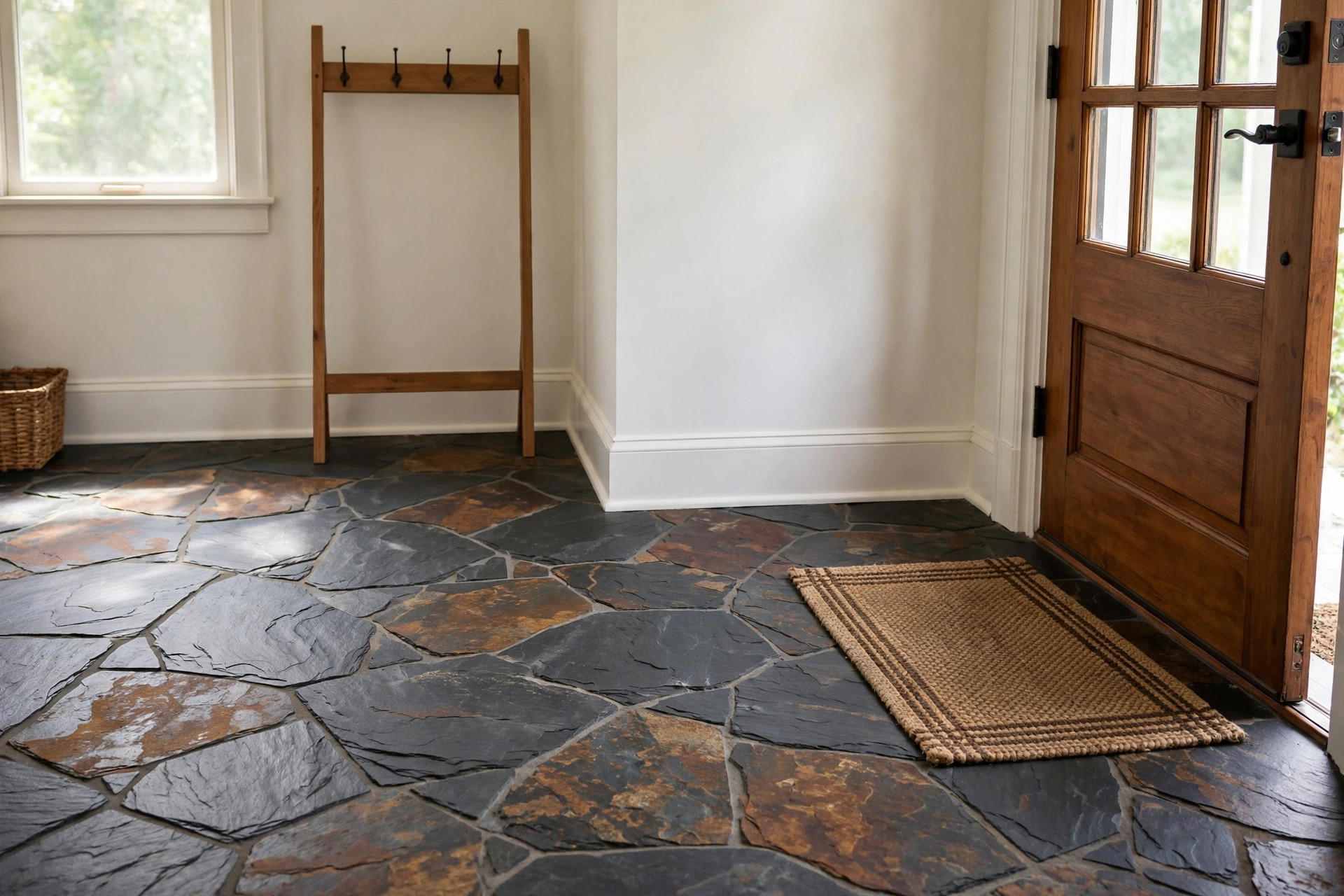

Slate tile flooring for entryway use has served American homes well for a very long time. It is one of the oldest flooring materials known to man. Builders used it in fine houses long before modern sheet goods ever existed. It still earns its place today. The entryway is the hardest working floor in the house. It meets boots, paws, umbrellas, salt, snow, mud, and grit on a daily basis. A weak floor shows damage there first. Slate stands up to this punishment with quiet strength. It also looks the part. Its natural cleft face and deep mineral color give a foyer a sense of weight and calm that man-made tile rarely matches.
Homeowners across the United States are rediscovering this old material. It fits farmhouses in Vermont and ranch homes in Texas alike. This guide explains what slate offers, how to choose it, what it costs, and how to keep it looking fine for decades.
Why It Matters
The entryway takes more abuse than any other room. Foot traffic is constant. Dirt is ground into the surface. Water sits in puddles by the door. In northern states, winter brings rock salt that eats through cheap finishes. In southern states, sand acts like sandpaper under shoes. A floor that cannot handle this will look tired within two or three years.
Slate handles it because it is dense stone. It resists stains better than marble and scratches better than most glazed tile. Its natural texture hides small marks that would show plainly on a smooth porcelain floor. For homes with dogs, slate is a kind choice. Claws slide over it without gouging the surface. Readers with active pets may also want to review pet friendly flooring options for usa homes to compare slate with other tough materials before they decide.
Appearance matters too. The entryway is the first room a guest sees. Slate gives it a grounded, serious look. No two tiles are alike. The subtle shifts in tone from tile to tile create a floor that feels crafted rather than manufactured.
How to Choose Slate for Your Entryway: Slate Tile Flooring for Entryway Usa
Not all slate tile is equal. A few simple checks will steer you toward the right product.
First, look at color and tone. Slate comes in charcoal black, deep gray, rust red, green, purple, and gold. Black slate from some regions is very hard and dense. Rust and multicolor slate can be softer. Ask the seller which quarry the stone came from. Reputable dealers will know. A natural stone tile resource can help you see how quarry origin affects tone and texture.
Second, check the surface finish. Cleft slate keeps the rough, split face of the stone and gives the best grip underfoot. Honed slate is ground smooth but left without shine. It feels more refined but can be slippery when wet. For an entryway, cleft or a light hone is usually the best call. Avoid highly polished slate by the front door.
Third, consider gauging. Gauged tile is cut to a uniform thickness, usually around half an inch. Ungauged tile varies from piece to piece and looks more rustic, but the installer must level each tile by hand. For most homeowners, gauged slate saves money on labor and gives a flatter, safer walking surface.
Fourth, test the density. Real entryway slate should feel heavy for its size. Soft slate powders at the edges and chips easily. A simple scratch test with a coin tells a lot. If the coin digs in with light pressure, the slate is too soft for a front hall. Ask for the water absorption rating. Good floor slate absorbs less than three percent water. Anything higher belongs on a wall, not under boots.
Fifth, choose tile size with care. Twelve by twelve inch tiles are the old standard. Sixteen by sixteen gives a more modern feel with fewer grout lines. Twelve by twenty-four planks suit long, narrow foyers. Larger tiles need a very flat subfloor. If your subfloor is old and uneven, stay with smaller sizes. Browsing stone and tile flooring collections can help you compare sizes and finishes side by side before you order samples.
Types and Options
Slate tile comes in several forms, and each has its place in an American entryway.
Gauged slate is the workhorse choice. Its even thickness makes installation straightforward. It works well in straight grid, running bond, and herringbone layouts. Most gauged slate sold in the United States comes from Brazil, India, or China.
Cleft slate refers to the face finish rather than the cut. Both gauged and ungauged tiles can have a cleft face. The split surface shows the natural layers of the stone. It gives the best traction of any slate finish and hides wear beautifully.
Honed slate is ground to a smooth, matte surface. It looks more formal than cleft slate and suits traditional foyers. It needs a good sealer because grinding opens the pores of the stone.
Tumbled slate is aged in a drum with grit and water. The edges round off and the surface softens. It gives an old-world look that fits country and Mediterranean style homes.
Vermont slate deserves a special note. Quarried in New England, it is among the hardest and finest slate in the world. It costs more than imported stone. For a homeowner who plans to stay in the house for decades, it is worth pricing.
Slate-look porcelain is not real slate, but it deserves mention. Modern porcelain can mimic slate closely. It needs no sealer and resists stains well. It lacks the true texture and depth of real stone, but it suits buyers who want a low-maintenance floor. If you are comparing natural stone with other hard surfaces, flooring comparison resources show how real and imitation stone differ in cost and care.
Layout patterns change the feel of the room. A straight grid feels orderly. A running bond, where each row is offset by half a tile, feels traditional. Herringbone adds drama but raises labor cost. The Versailles pattern mixes square and rectangular tiles for a formal French look. For buyers weighing patterned stone against patterned cement tile, terrazzo tile flooring cost per square foot offers a useful price comparison.
Cost and Price
Slate tile flooring for entryway projects falls in the middle range of hard flooring costs. Prices vary by region, tile size, and labor rates, but the following ranges hold true across most of the United States.
Material cost runs from about four dollars to ten dollars per square foot. Basic imported gauged slate sits at the low end. Premium Vermont slate and large-format tiles sit at the high end. Specialty finishes add one to three dollars per square foot.
Labor is the larger expense. Professional installation typically runs from five to twelve dollars per square foot. The rate depends on the pattern, the condition of the subfloor, and local wages. Ungauged slate costs more because the setter must level every tile. Herringbone and Versailles patterns also raise labor cost. A plain grid of gauged twelve by twelve tile is the most economical to set. For a breakdown of what installers charge, see tile installation cost per square foot usa.
Subfloor preparation can add cost. Slate needs a rigid, flat base. Old wood floors may need cement backer board. Cracked concrete may need patching and leveling. Budget two to four dollars per square foot for prep work if your floor is old or uneven.
Sealer and grout add another one to two dollars per square foot. A penetrating sealer is the right choice for slate. It soaks into the stone and protects from within. Film-forming sealers can peel and turn cloudy in high-traffic areas. Sealers and setting materials are easy to compare at major home improvement retailers before you buy.
All told, a typical American entryway of sixty to one hundred square feet costs between twelve hundred and twenty-five hundred dollars installed. This puts slate below natural marble and above basic ceramic tile. It is a fair price for a floor that can last fifty years.
Care and Upkeep
Slate is low maintenance, not no maintenance. A simple routine keeps it handsome for decades.
Sweep or vacuum the entryway often. Grit is the enemy of every floor. Small stones ground under shoes act like sandpaper. A daily sweep in busy households takes one minute and adds years to the floor. Place a good doormat outside the door and a second mat inside.
Mop with a pH-neutral stone cleaner. Mix it as the label directs. Never use vinegar, lemon juice, or harsh acidic cleaners on slate. Acid attacks the minerals in the stone and dulls the surface. Never use bleach. Rinse the mop well and change the water when it turns gray. Guides from flooring care publishers and a stone cleaning guide can help you pick products that are safe for natural slate.
Reseal the floor every one to two years. Entryways wear sealer faster than other rooms because of foot traffic and weather. Test the sealer with a few drops of water. If the water beads up, the sealer is still working. If it soaks in and darkens the stone, it is time to reseal. Clean the floor well, let it dry fully, and apply a penetrating sealer with a paint pad or cloth.
Grout lines need attention too. Use a grout brush and the same neutral cleaner to keep them fresh. If grout cracks, have it repaired before water gets under the tile. Epoxy grout resists stains better than cement grout and suits busy entries, though it costs more.
Small chips can be repaired. A dab of matching stone repair epoxy, leveled and sealed, makes most chips vanish. For larger damage, a single tile can be cut out and replaced without disturbing the rest of the floor. Keep a few spare tiles from the original job for this purpose.
Safety
An entryway floor must be safe underfoot in all weather. Slate earns good marks here, but a few steps make it better.
Choose a cleft or textured finish for the main walking path. The natural roughness gives grip even when the floor is damp. If you prefer honed slate, add a textured runner in the wet zone by the door. A home improvement resource offers practical advice on entryway safety and subfloor preparation for stone tile.
Sealer choice affects traction. Penetrating sealers do not change the surface texture. Some topical sealers add shine but reduce grip. Ask for a sealer rated safe for floors, not for countertops.
Lighting matters as much as the floor itself. A well-lit entryway lets people see wet spots and step edges. Add a bright ceiling fixture or wall sconces by the door. Light-colored grout also helps, since it outlines each tile clearly.
In winter climates, keep ice melt products off the slate when possible. Many de-icers contain salts that stain and pit natural stone. Knock snow from boots on an outdoor mat. Keep a boot tray inside the door for wet footwear.
Check for loose tiles once a year. Tap each tile lightly with a knuckle. A hollow sound means the bond has failed. A loose tile is a trip hazard. Have it reset before someone catches a toe on the edge.
Frequently Asked Questions
Is slate a good choice for an entryway? Yes. Slate is one of the best natural materials for a front hall. It is hard, dense, and forgiving of dirt and scratches. Its texture gives good traction. It handles water, mud, and winter salt better than hardwood and most manufactured tile. With proper sealing and basic care, a slate entryway lasts for decades.
Does slate tile flooring for entryway usa projects feel cold underfoot? Slate feels cool, as all stone does. Most homeowners adjust within days. In cold regions, radiant floor heating under the slate solves the problem completely. Electric heat mats are a popular upgrade during installation.
How long does a slate entryway floor last? A well-installed slate floor lasts fifty years or more. The stone itself does not wear out under foot traffic. What fails over time is the grout, the sealer, and occasionally the bond to the subfloor. All of these can be repaired without replacing the stone.
Will slate scratch or chip? Hard slate resists scratching well. Soft slate can chip at the edges. The fix is simple: buy hard, dense slate and have it installed by a setter who knows stone. Keep spare tiles for repairs. Small chips blend in because the stone has no surface glaze to break through.
Can slate go over a concrete slab? Yes, and concrete is an excellent base for slate. The slab must be clean, dry, and level. Cracks should be repaired and a crack-isolation membrane applied where needed. A flooring retailer guide can walk you through the underlayment and setting materials a concrete slab requires.
Does slate need to be sealed? Yes. All slate used on floors should be sealed with a penetrating sealer. Sealing protects against stains from oil, salt, and tracked-in dirt. It also deepens the color of the stone. Reseal every one to two years in an entryway, or whenever the water drop test shows the old sealer has worn thin.
A Final Word
Slate tile flooring for entryway spaces is a choice made once and enjoyed for a lifetime. It asks for honest installation, a good sealer, and simple regular care. In return it gives a floor that grows more beautiful with age. Walk through the options slowly. Handle the samples. Ask your installer hard questions. Then enjoy the solid feeling of real stone under your feet every time you come home.
References
Daltile. (n.d.). Ceramic and porcelain tile. https://www.daltile.com LL Flooring. (n.d.). Hardwood, vinyl, and tile flooring. https://www.llflooring.com Lowe’s. (n.d.). Home improvement products. https://www.lowes.com Mohawk Flooring. (n.d.). Flooring products. https://www.mohawkflooring.com Shaw Floors. (n.d.). Flooring products. https://www.shawfloors.com The Home Depot. (n.d.). Home improvement products. https://www.homedepot.com The Spruce. (n.d.). Home and garden advice. https://www.thespruce.com This Old House. (n.d.). Home renovation guidance. https://www.thisoldhouse.com
Was this guide helpful?

About James Carter
The My Garden US editorial team writes practical, in-depth home and garden guides for American homeowners — tested advice, no fluff.
You May Also Like

The Best Rug for Under Dining Table: A Complete USA Guide
October 5, 2026 4 views
Replacing Single Cracked Floor Tile Guide: A Step-by-Step Plan for One Tile Only
February 25, 2026 0 views
Picket Tile Backsplash Ideas for Kitchens
September 4, 2026 0 views