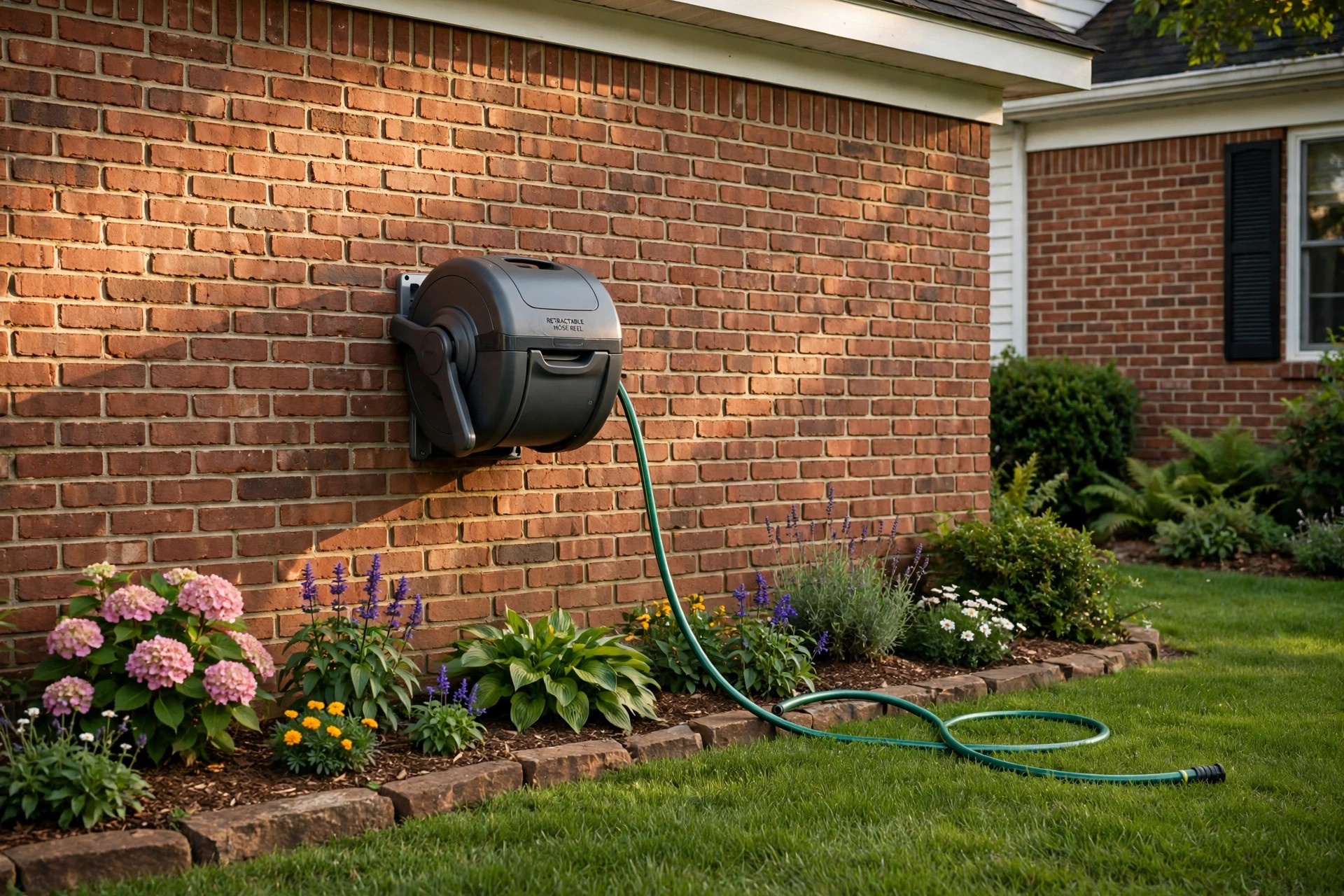

Garden owners in the United States have faced the same mess. A long hose lies in a tangle across the lawn. It kinks. It trips people. It takes ten minutes to coil by hand after every watering. The retractable garden hose reel reviews USA promise a simple fix: pull the hose out, use it, and let the reel wind it back in on its own. This guide reads through what those reviews actually say. It covers how the reels work, what to look for, what they cost, and how to keep one running for years.
Why a Retractable Hose Reel Matters
A garden hose is one of the most-used tools in an American yard. People use it to water flower beds, wash cars, rinse patios, and fill pools. But a loose hose is hard to live with. It wears out faster when it drags on concrete. It can damage plants when it snakes across beds. And winding a fifty-foot hose by hand is a chore few people enjoy.
A retractable garden hose reel solves these problems with one simple idea. The hose sits on a spring-loaded reel inside a case. You pull the hose to the length you need, and a lock holds it there. When you are done, a small tug releases the lock. The spring pulls the hose back in. Many models add a guide arm that lays the hose flat on the reel, so it does not pile up on one side.
The retractable garden hose reel reviews USA agree on the main benefit: it saves time. Reviews written by homeowners in many states say the same thing. Watering goes faster. The yard looks neater. For older gardeners, the reel removes a real strain. There is no heavy coil to lift and no bending to wind it up.
There is a second benefit that reviews mention less often. A hose stored inside a case lasts longer. Sun light breaks down rubber and vinyl over time. A reel case blocks most of the sun. It also keeps the hose off hot driveways and away from sharp stones.
How to Choose: What the Reviews Point To: Retractable Garden Hose Reel Reviews Usa
Reading retractable garden hose reel reviews USA is useful, but reviews can disagree. One buyer loves a model. Another hates the same one. The trick is to look for the patterns. When many reviews mention the same weak point, it is probably real. When many praise the same feature, it is probably worth having. Here are the points that come up again and again.
Hose Length and Diameter
The first choice is hose length. Common sizes in the USA are fifty, seventy-five, and one hundred feet. A fifty-foot hose suits a small yard or a home where the tap is near the beds. A hundred-foot hose reaches far corners of a large lot. But longer is not always better. A long hose weighs more, and the spring has to work harder to pull it back. Many reviews warn that a hundred-foot reel can rewind slowly in cold weather.
Diameter matters too. Most reels use a half-inch hose. Some heavy-duty models use a five-eighths-inch hose, which moves more water. That helps when you run a sprinkler at the far end. But a thicker hose is heavier and harder to wind. If you only water beds and pots, a half-inch hose is enough.
Mounting and Placement
A retractable reel must mount to something solid. Most are wall-mounted. They bolt to a house wall, a fence post, or a wooden stud. Reviews stress one point above all: mount to a stud or a brick wall. Mounting to siding or thin panels leads to trouble. The reel pulls hard when the hose is stretched. Weak mounts work loose within months.
Good models come with a bracket that lets the case swivel. This matters more than buyers expect. A swiveling case lets you pull the hose in any direction. Without it, you fight the reel every time you walk around a corner. Look for a bracket that turns at least 180 degrees.
Placement counts too. Mount the reel close to the water tap. A short connector hose joins the tap to the reel. The shorter this lead is, the less it kinks. Keep the reel within reach of a ladder-free height. About chest height is best. That makes the pull smooth and the tug to rewind easy.
Rewind Speed and Locking
Reviews often talk about rewind speed. A good spring pulls the hose in at a steady, even pace. The best models have a slow-rewind feature. This stops the hose from whipping back at high speed. A fast whip can hurt ankles, scratch cars, and knock over pots. Buyers with children strongly favor slow rewind.
The locking mechanism also matters. The standard system locks the hose every few feet as you pull. To release it, you walk back toward the reel or give a short tug. Some cheap models have locks that slip. Then the hose creeps back in while you water. Reviews call this one of the most annoying faults. Look for reviews that mention a firm, quiet lock.
Types and Options
Not every retractable reel is the same. There are three main types sold in the USA. Each suits a different kind of yard.
Wall-mounted reels are the most common. They fix to the house or a post. They hold the hose in a closed case. They keep the yard tidy and the hose out of sight. Most retractable garden hose reel reviews USA cover this type. They are best for homes with a clear wall near the tap.
Cart or portable reels sit on a wheeled frame. They are not truly retractable in the spring sense, but many now have a rewind crank or motor. They suit large lots where one tap cannot serve the whole yard. You roll the cart where you need it. The trade-off is bulk. A cart takes up garage space and is heavier to move.
Ground stake or post reels mount on a metal post driven into the soil. They sit out in the yard near the beds. This shortens the pull distance. But they are exposed to weather and mowers. Reviews are mixed. Some owners love the reach. Others report that the post leans after a wet season.
Materials also differ. Cases are usually plastic or metal. Plastic cases resist rust and weigh less. Metal cases handle knocks and sun better. The hose itself is often hybrid polymer, which stays flexible in cold weather. Pure vinyl hoses stiffen in winter and kink more. Many reviewers in northern states recommend hybrid polymer for year-round use.
Extra features appear on higher-priced models. Some have a built-in hose stopper ball that keeps the nozzle out of the case. Some include a multi-pattern nozzle. A few have a lock for the reel itself, to keep children from pulling the hose out. The hose stopper is cheap and useful, and reviews often wish it were included.
Cost and Price in the USA
Prices for retractable garden hose reels in the USA fall into three bands. Knowing them helps you read reviews with clear eyes.
Budget models, thirty to seventy dollars, use plastic cases and vinyl hoses. They work well for a season or two. Reviews say the springs weaken over time, the locks slip, and the cases crack in strong sun.
Mid-range models, seventy to one hundred fifty dollars, form the heart of the market. Most retractable garden hose reel reviews USA discuss these. They offer hybrid polymer hoses, swivel brackets, and slow-rewind springs. Owners report five to eight years of service. This band gives the best value for most homes.
Premium models, one hundred fifty to three hundred dollars, use metal cases, longer hoses, and stronger springs. They suit large yards and daily use. Reviews praise their smooth rewind and firm locks. But the price jump is large. For most families, a good mid-range reel does the same job.
Care and Upkeep
A retractable reel needs little care, but a few habits make a big difference. Reviews from long-term owners repeat the same advice.
First, drain the hose before winter in cold states. Water left in the hose can freeze and split it. Disconnect the lead hose from the tap. Pull the hose out fully. Let it drain. Then let it rewind. Some owners bring the whole case indoors for winter. That is the safest choice where winters are harsh.
Second, clean the case once a year. Dirt builds up around the guide arm and the hose opening. Wipe it with a damp cloth. Check that the opening is clear. A blocked opening makes the rewind rough and strains the spring.
Third, inspect the hose for wear. Look for soft spots, small splits, and worn couplings. A coupling that leaks at the tap wastes water and lowers pressure.
Fourth, do not let the hose snap back from full stretch. Walk the nozzle back toward the reel as it winds. This keeps the layers even and spares the spring. Many reviews blame broken springs on years of full-speed snapbacks.
Finally, tighten the mounting bolts once a year. The constant pull of the hose works them loose. A few turns with a wrench take one minute and prevent a costly failure.
Safety
Retractable reels are safe when used with care. Still, reviews and maker guides note a few risks.
The rewind spring is the main one. A hundred feet of hose pulled tight holds real force. Never let go of the nozzle during rewind. Guide it back by hand. Keep children away while the hose winds in. Teach them to pull the hose only as far as needed and never to ride the nozzle.
Water pressure is the second point. Most reels handle normal home pressure, which in the USA is about forty to eighty pounds per square inch. Very high pressure can burst a worn hose. If your home has high pressure, fit a pressure regulator at the tap. This protects the hose, the reel, and your plumbing.
Chemical safety matters too. Some hoses leach lead or other metals into standing water. If you fill pet bowls or vegetable beds, let the water run for a few seconds first. Better yet, choose a hose marked as drinking-water safe. Keep garden chemicals away from the reel case.
Mounting safety is last. A reel full of water is heavy. A hundred-foot model can weigh over thirty pounds. Make sure the mount can carry twice that. If you are unsure, ask a hardware store for the right anchors for your wall type. A falling reel can hurt a person and break the water tap.
Frequently Asked Questions
How long do retractable garden hose reels last? A good mid-range reel lasts five to eight years with basic care. Budget models may last two to three years. The spring and the hose wear first. Keeping the hose out of the sun and draining it in winter adds years of life.
Can I leave the reel outside all winter? In warm states, yes. In states with freezing winters, it is risky. Frozen water can split the hose and crack the case. Either drain the hose fully or bring the case inside. This is the single most common cause of early failure in northern reviews.
Why does my hose not rewind fully? Three causes are common. The spring may be weak from age. The hose layers may be uneven, which jams the reel. Or the guide arm may be dirty. Pull the hose out fully, clean the opening, and walk it back in slowly. If it still stops short, the spring is likely worn.
Can I replace the hose without buying a new reel? On most models, yes. The hose connects to a fitting inside the case. You can buy a replacement hose of the same length and diameter and fit it yourself. Check the maker guide first. Some budget models glue the hose in place, which makes replacement hard.
Is a retractable reel better than a hose cart? For most homes, yes. A wall-mounted retractable reel takes up no floor space and winds itself. A cart suits very large lots where one tap cannot reach everywhere. If you want to compare other yard tools while you shop, our guide to robot lawn mowers for half acre yards and our top rated string trimmer for thick weeds round out a small-yard tool set, and our pet safe lawn weed killer reviews cover the chemical side of lawn care.
Do retractable reels work with low water pressure? They do, but long hoses reduce pressure further. With a hundred-foot hose on a low-pressure tap, a sprinkler may throw weakly. A shorter hose helps. Test with the hose fully extended before you mount the reel for good.
A Final Word
The retractable garden hose reel reviews USA tell a clear story. These reels are not perfect. Springs wear. Locks slip. Cheap cases crack. But for most American homes, a well-chosen reel turns a daily chore into a small pleasure. Buy a mid-range model with a swivel bracket and a slow-rewind spring. Mount it to something solid. Drain it in winter. It will serve you well for years, and your yard will be free of the old tangled mess. Independent product testers at Consumer Reports publish hands-on ratings of yard gear, and makers such as Toro and Briggs & Stratton offer guides on matching lawn tools to your yard.
References
Consumer Reports. (n.d.). Product ratings and reviews. https://www.consumerreports.org Toro. (n.d.). Lawn care products and support. https://www.toro.com Briggs & Stratton. (n.d.). Engines and outdoor power equipment. https://www.briggsandstratton.com
Was this guide helpful?

About Emily Rodriguez
The My Garden US editorial team writes practical, in-depth home and garden guides for American homeowners — tested advice, no fluff.
You May Also Like

How to Plant Sod on Slope: A Guide for the Homeowner
May 8, 2026 0 views
Affordable Tree Stump Grinding Service Near Me: What It Costs and How to Choose
May 4, 2026 0 views
The Best Electric Lawn Mower for Seniors: A Practical Guide for Older Homeowners
March 10, 2026 1 views