
Renters have the same right to clean water as owners. But renters cannot change pipes. They cannot drill into walls. They cannot install a system under the sink in most leases. That is why renter friendly water filter options usa matter so much. These are filters that need no tools, no plumber, and no permission slip. They sit on the counter, clip onto the faucet, or rest in the fridge. When the lease ends, they move with the renter.
Tap water in the United States is treated and tested. But taste, smell, and local pipes still cause concern. Old buildings can have lead pipes or lead solder. Chlorine taste is common. Hard water leaves spots and film. A renter cannot fix the building plumbing. A renter can fix the water that comes out of the tap into the glass. The options below work for apartments, rental homes, and rooms.
Why Renters Need Water Filters
Renters face one limit owners do not face. The lease forbids changes. Most standard leases ban alterations to plumbing, fixtures, and cabinets. A filter that screws into the pipes counts as an alteration. A filter that sits on the counter does not. That one fact shapes every good choice.
Water quality also varies by place. The EPA sets national rules for public water systems. Local utilities publish water reports each year. Those reports show what was found in the source water and the treated water. They do not show what old pipes add inside the building. Lead and copper can leach from old service lines and fixtures. That is why point-of-use filters matter. They clean the water at the tap, after the building pipes.
Taste is the other reason. Chlorine keeps water safe on its way to the home. But chlorine tastes bad to many people. A simple carbon filter takes the taste and smell out. The water still meets safety rules. It just tastes better.
What To Look For When Choosing: Renter Friendly Water Filter Options Usa
A renter-friendly filter must pass four tests. First, no tools. If it needs a wrench or a drill, skip it. Second, no pipe changes. It must attach without cutting or altering the supply line. Third, portability. It should fit in a moving box. Fourth, a low cost per gallon. Some cheap filters cost more over time because the cartridges are pricey.
Check the cartridge life before you buy. A pitcher filter cartridge may last two months. A countertop filter cartridge may last six months. Write the change date on the filter with a marker. Late changes mean the filter stops working well.
Look for NSF certification marks. NSF is a private testing group. Its marks show the filter was tested to remove certain substances. A filter may be certified for chlorine taste, for lead, or for cysts. The box or listing should name the exact claim. A vague claim like “purifies water” means little without a standard number.
Think about what bothers you. Bad taste points to a carbon filter. Chlorine taste also points to carbon. Lead concern points to a filter certified for lead. Hard water spots point to a different kind of fix, and most renter-friendly filters do not soften water well. Read reviews and guides on sites like Consumer Reports and The Spruce to compare real test results.
Space and Water Pressure
Pitchers need fridge space. Countertop units need counter space near the faucet. Faucet-mount filters need a faucet with a removable aerator and a round spout. Many modern pull-down kitchen faucets do not accept faucet-mount filters. Check the faucet type first. A gravity filter needs a tall spot on the counter and time to drip.
Main Types of Renter Friendly Water Filters
Pitcher Filters
The pitcher is the classic renter choice. You fill it from the tap. Water flows through a carbon cartridge into the lower chamber. It needs no hookup at all. It costs little up front. Most pitchers reduce chlorine taste and odor. Some are certified to reduce lead, copper, and mercury.
The trade is speed and volume. A pitcher holds a quart or two. A family that cooks and drinks a lot will refill it many times a day. Cartridges last about two months for an average household. Long-term cost is higher than it looks. Still, for a single renter or a couple, the pitcher is the simplest start. If lead is the main worry, start with a pitcher rated for lead removal rather than a basic taste-only model.
Faucet-Mount Filters
A faucet-mount filter screws onto the faucet tip in place of the aerator. It has a switch. Flip it one way for filtered water. Flip it back for full-flow unfiltered water. This matters when you wash dishes. You do not waste the cartridge on dish water.
Faucet filters usually hold more filter media than pitchers. They often filter faster per gallon and cost less per gallon. Many are certified for lead and chlorine. The limit is fit. They do not fit pull-down faucets, sprayer faucets, or non-standard threads. Most kits include thread adapters. Keep the original aerator in a drawer so you can put it back on move-out day. Our roundup of faucet filter reviews compares the best-rated models for apartments.
Countertop Filters
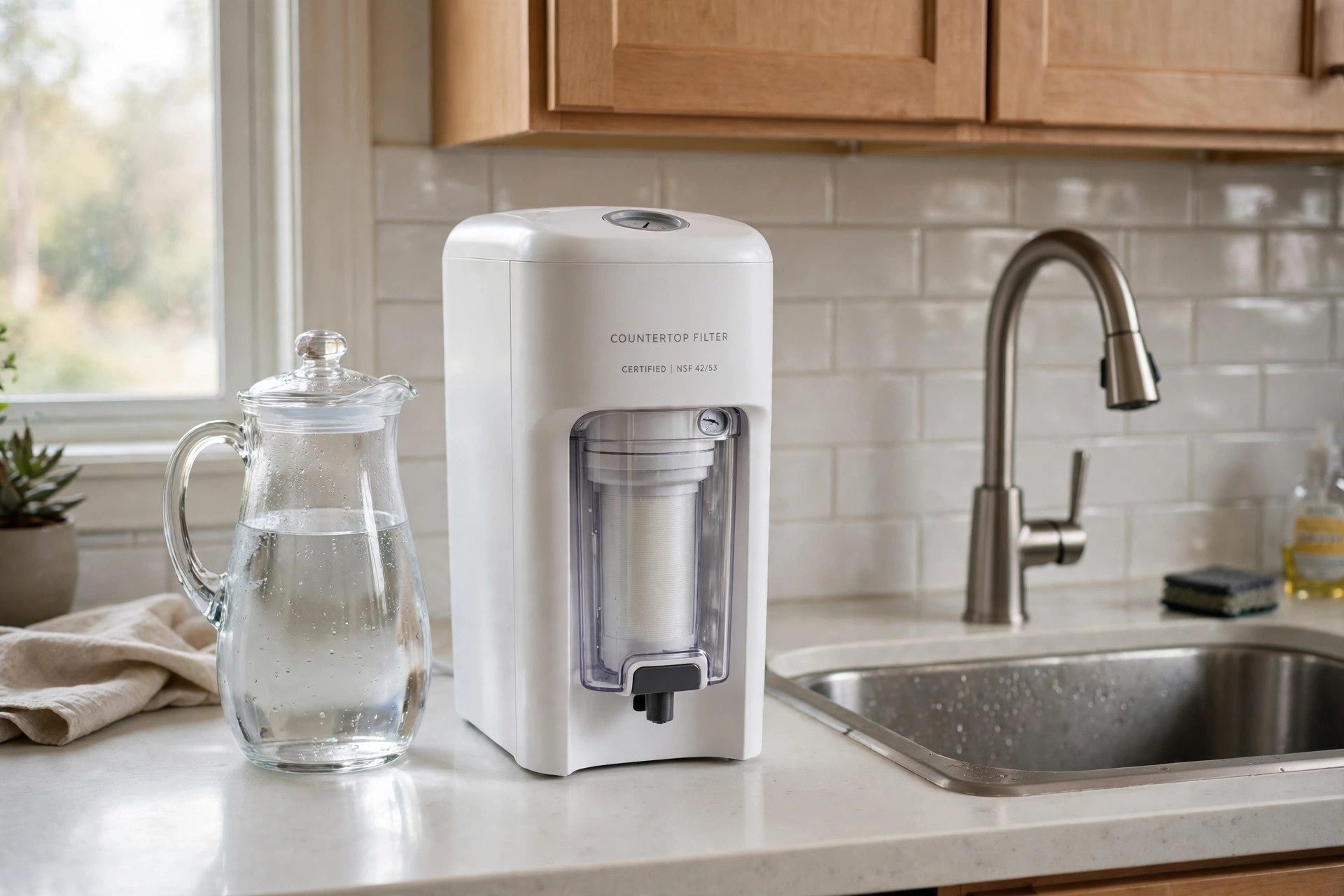
Countertop filters sit next to the sink. A hose with a diverter attaches to the faucet tip. Turn the diverter and water flows through the filter instead of out of the spout. Nothing is cut or drilled. The unit lifts away in seconds.
These filters often last the longest between cartridge changes. Some handle lead, chlorine, and cysts in one cartridge. They take counter space, and the hose looks a bit plain. But for a renter who wants strong filtration without touching the pipes, this type is hard to beat. See the best countertop water filter reviews for models that fit small apartment kitchens. Models from makers like Aquasana and Culligan sell widely through stores such as Home Depot, which makes it easy to compare them side by side.
Gravity Filters
A gravity filter has an upper chamber and a lower chamber. You pour water in the top. It drips through ceramic or carbon elements into the bottom. No faucet hookup. No electricity. No pressure needed.
These suit renters who want a lot of filtered water with no install at all. The catch is time. A full chamber can take an hour or more to filter. They are also tall and heavy when full. They work well for drinking water but not for filling pots fast.
Shower Filters
Some renters ask about the shower. Shower filters screw between the shower arm and the shower head. They reduce chlorine, which can dry skin and hair. Most leases treat a shower head swap as fine, since the original can go back on. This is not drinking-water filtration. It is a comfort fix. Makers such as Kohler and Delta Faucet sell shower heads and accessories that pair well with these add-on filters.
Refrigerator and Bottle Filters
If the rental has a fridge with a water dispenser, use its filter. Change it on schedule. For renters on the move, filtered water bottles with built-in straws help at the gym and at work. These are small fixes, not whole-kitchen fixes.
Cost and Price
Upfront prices run wide. A basic pitcher costs about fifteen to forty dollars. Faucet-mount units cost about twenty to fifty dollars. Countertop units cost about sixty to two hundred dollars. Gravity filters cost about one hundred to three hundred fifty dollars.
The real cost is the cartridge. A pitcher cartridge may cost eight to fifteen dollars and last two months. That is roughly fifty to ninety dollars a year. A countertop cartridge may cost forty to eighty dollars and last six to twelve months. That is roughly forty to one hundred sixty dollars a year. Faucet cartridges sit between these.
Do the math for your own use. A heavy drinker who cooks a lot burns cartridges faster. Check the rated gallons, not just the months. A cartridge rated for one hundred gallons that you use up in two months costs more per year than one rated for three hundred gallons. Guides from This Old House and Family Handyman often break down these running costs in plain terms.
Care and Upkeep
Care is simple but it must be steady. Change the cartridge on time. A tired carbon filter can release trapped tastes back into the water. Mark the date on the unit. Set a phone reminder.
Clean the parts you can reach. Wash the pitcher and lid each week. Rinse the countertop housing when you change the cartridge. Wipe the faucet-mount unit so grime does not build up at the threads.
Use cold water only. Hot water ruins carbon cartridges fast. If you need hot filtered water, filter cold water first, then heat it in the kettle. This one habit doubles the useful life of many cartridges.
Store spare cartridges dry. Keep the box so you know the model number. When you move, rinse the unit, dry it, and pack the original faucet aerator with it. Leave the rental exactly as you found it.
Safety Notes
Filters improve taste and reduce certain substances. They do not make unsafe water safe in every case. If your water comes from a private well, test it first. Well water can carry bacteria, nitrates, and minerals that a simple carbon pitcher will not fix. If a boil notice is in effect, boil the water. A filter is not a substitute for boiling.
Read the certification labels. A filter certified for chlorine taste is not automatically certified for lead. Match the filter to the concern. If lead is the concern, choose a filter with a clear lead-reduction claim and a testing standard. The EPA publishes plain-language pages on lead in drinking water that every renter should read before buying.
Never modify the faucet or pipes to force a fit. Adapters that come in the box are fine. Tape, glue, and filed-down threads are not. If the filter does not fit, pick a different type. Your security deposit depends on it.
FAQ
Can a renter install a water filter without landlord permission?
Most renter-friendly filters need no permission. Pitchers, gravity filters, and countertop units touch nothing permanent. Faucet-mount filters and shower filters screw on and off and leave no mark. When in doubt, read the lease and ask the landlord in writing. Keep the original parts so you can restore everything at move-out.
Which type is best for an apartment with old pipes?
Old pipes raise the lead question. Choose a filter with a stated lead-reduction certification. Countertop filters and many faucet-mount filters carry this claim. A basic pitcher may or may not. Check the label. Test the water if you want facts instead of guesses.
Do these filters remove fluoride?
Most carbon filters do not remove fluoride. Some specialty filters do. If fluoride removal is the goal, look for a filter that names it in the certification list. Do not assume.
How do I know when to change the cartridge?
Follow the rated gallons or months, whichever comes first. Slow flow is a common sign the cartridge is full. Bad taste returning is another sign. Do not wait for both. Change on schedule.
Are expensive filters worth it for renters?
Sometimes. A pricier countertop unit with a long-life cartridge can cost less per gallon than a cheap pitcher. But a renter who moves often may prefer the cheap, light pitcher. Match the filter to your stay. Short lease, simple filter. Long lease, invest a bit more.
Can I take the filter when I move?
Yes. That is the point of renter-friendly design. Clean it, dry it, pack the original fittings, and set it up in the next kitchen in minutes.
A Short Final Word
Renters do not have to drink bad-tasting tap water. They also do not have to fight the lease. A pitcher, a faucet-mount unit, or a countertop filter gives clean-tasting water with no tools and no damage. Pick the type that fits the faucet, the counter, and the budget. Change the cartridge on time. Take it along when you go. Clean water should follow the renter, not the apartment.
References
Aquasana. (n.d.). Water filtration systems. https://www.aquasana.com Consumer Reports. (n.d.). Product reviews and ratings. https://www.consumerreports.org Culligan. (n.d.). Water treatment services and products. https://www.culligan.com Delta Faucet. (n.d.). Kitchen and bathroom faucets. https://www.deltafaucet.com Family Handyman. (n.d.). DIY home repair and maintenance. https://www.familyhandyman.com Kohler. (n.d.). Bathroom and kitchen fixtures. https://www.kohler.com The Home Depot. (n.d.). Home improvement products. https://www.homedepot.com The Spruce. (n.d.). Home and garden advice. https://www.thespruce.com This Old House. (n.d.). Home renovation guidance. https://www.thisoldhouse.com U.S. Environmental Protection Agency. (n.d.). Protecting human health and the environment. https://www.epa.gov
Was this guide helpful?

About Robert Taylor
The My Garden US editorial team writes practical, in-depth home and garden guides for American homeowners — tested advice, no fluff.
You May Also Like

Septic System Installation Cost for 3 Bedroom Homes
September 18, 2026 0 views
Lead in Drinking Water Filter Reviews USA: What Tests, Types, and Brands to Trust
February 25, 2026 0 views
Crawl Space Dehumidifier Reviews 2026 USA: A Plain Guide for Homeowners
May 2, 2026 0 views