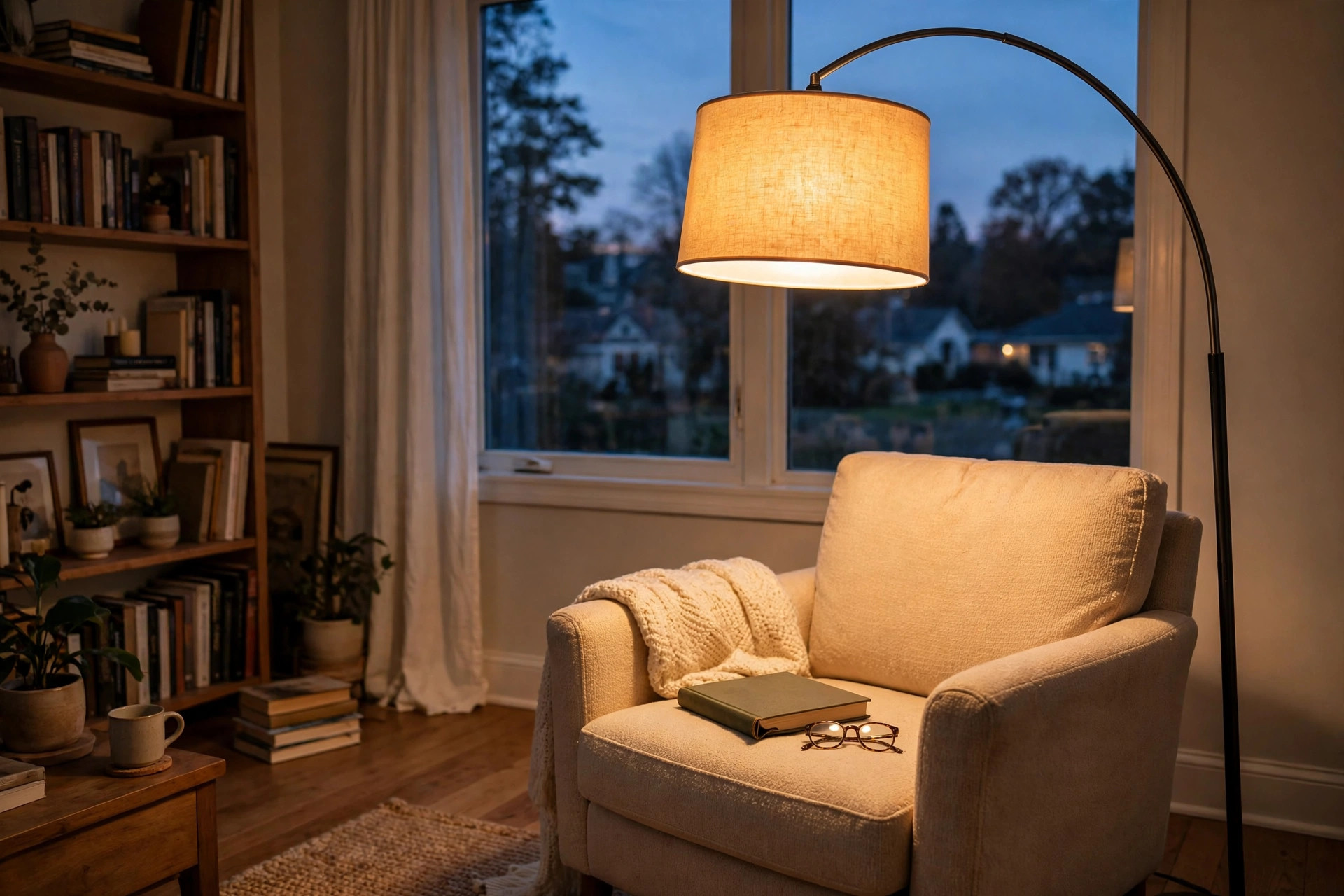

A good reading corner starts with good light. Overhead lamps cast shadows. Table lamps need a table. A reading floor lamp stands beside your chair and puts light right where your book is. It is one of the simplest upgrades a room can get.
Many shoppers type “reading floor lamps deals near me” into a search box and hope for the best. The results can be mixed. Some are true bargains. Some are thin lamps with weak light. This guide will help you tell the two apart. It covers what to look for, what types exist, what prices to expect, and where to find honest deals close to home.
Why a Reading Floor Lamp Matters
Reading under poor light tires the eyes. The muscles around the eyes work harder when the print is dim. A page lit from above the shoulder gives steady, even light. That is what a floor lamp does. The shade directs the beam down onto the page, not into your eyes.
Good light also sets a mood. A warm pool of light in the corner of a room feels calm. Many people read for an hour each night. A floor lamp turns that hour into a small ritual. It marks the reading spot. Guests notice it. Children learn that this chair is the reading chair.
Floor lamps also save space. They stand on a small footprint. They work in a rented room, a dorm, or a small flat. No holes in the wall. No electrician. You plug the cord into the wall and switch it on.
Readers who want a deeper look at lamp styles may enjoy our reading floor lamps buying guide, which covers shapes and finishes in more detail.
What to Look For When You Shop: Reading Floor Lamps Deals near Me
A floor lamp has four parts to judge: the base, the stem, the shade, and the socket. Each one matters.
The Base
The base must be heavy and wide. A lamp that tips over is a hazard. Look for a base that feels solid when you lift the box. Metal bases beat plastic ones. A wide base, about ten inches across, keeps the lamp steady on thick carpet.
The Stem and Height
Most reading floor lamps stand between 55 and 65 inches tall. That height puts the shade just above the shoulder of a seated reader. Adjustable stems are useful. They let you raise or lower the light as you like. Swing arms are another good feature. They let you pull the head of the lamp closer to the page.
The Shade
The shade shapes the light. A wide drum shade spreads light around the room. A narrow metal shade focuses it on the page. For reading, a focused shade is often better. It keeps the light on the book and off the television screen across the room. Light-colored shades give a warm glow. Dark shades give a more dramatic look but cut the light.
The Socket and Bulb
Check the socket before you buy. Most modern lamps use E26 sockets, the standard size for most LED bulbs. Some use smaller E12 sockets. Make sure replacement bulbs are easy to find. A wifi smart bulbs buying guide can help if you want app control or dimming. Many new lamps include dimmer switches on the cord or the stem. A dimmer is worth having. Full brightness for reading, low light for evening rest.
Types of Reading Floor Lamps
Shops group floor lamps into several types. Each suits a different reader.
Arc lamps. These lamps bend over the chair in a long curve. They give overhead light without a ceiling fixture. They suit wide chairs and sofas. They take up more floor space, so they fit best in open rooms.
Swing arm lamps. The arm moves in and out and up and down. You can aim the head exactly where you need it. These are the classic reading lamps. They sit close behind the shoulder and throw light straight down on the page.
Torchiere lamps. These point light upward. The light bounces off the ceiling and fills the room. They are not the best choice for reading. They do not focus light on the page. They do make a nice second lamp in a dark room.
Pharmacy lamps. These have a small shade on a tall thin stem, often with a height adjustment. They were first used on work desks. They give a neat, focused beam. They fit well in tight corners.
Tree lamps. These have three or four heads on one pole. You can aim each head in a different direction. One head can serve the reader while the others light the room. They are a good value when you need more than one light.
LED panel lamps. These are newer. A flat panel of LEDs gives bright, even light with very little heat. Many run for years on low power. Lighting reviews often note how little energy these lamps use.
Where to Find Deals Near You
“Near me” searches work best when you know where to look. Start with the big home stores in your town. Home improvement stores and national hardware retailers carry dozens of floor lamps. Their websites show local stock, so you can check before you drive. Clearance racks in the lighting aisle often hide the best prices.
Furniture stores are another stop. Furniture retailers run frequent sales events, and many have local warehouses for fast pickup. Specialty lighting stores stock a wide range and run seasonal discounts. Big box shops with home sections, such as department-style furniture outlets, sell simple modern lamps at low prices.
Online, lighting fixture shops list sale sections with deep cuts on last season’s styles. Home design guides publish roundups of lamp sales each season. A store name like Philips lighting can lead you to certified dealers near you through its store locator.
Timing matters. January brings clearance on holiday stock. Late summer brings back-to-school sales on dorm lighting. Black Friday and the weeks after Christmas are strong for lamp deals. Floor models sell at a discount if you ask. A small scratch on the base can cut the price by a third, and no one will see it.
Do not forget local shops. Thrift stores and estate sales often have solid brass floor lamps from the 1970s and 1980s. These old lamps are built like tanks. A new shade and a new LED bulb can make one look new again. Yard sales in older neighborhoods are worth a Saturday morning.
Cost and Price Ranges
Prices run wide. A simple torchiere lamp can cost under 25 dollars. A basic swing arm lamp often runs 40 to 80 dollars. Mid-range lamps with dimmers and heavy bases run 80 to 150 dollars. Designer arc lamps can run 200 to 500 dollars or more.
The sweet spot for most readers is 60 to 120 dollars. In this range you get a steady base, an adjustable head, and a shade that aims light well. Lamps below 40 dollars can work, but check the base weight and the cord length. Thin cords and light bases are common at the low end.
Bulbs add cost. A good LED reading bulb costs 8 to 15 dollars. It will last for years. Cheaper bulbs flicker or give harsh light. It is worth spending a little more on the bulb. Energy efficiency ratings help you find bulbs that use little power and last long. The Department of Energy offers plain-language guides on lighting choices for the home.
Watch for total cost. A 50 dollar lamp with a 12 dollar bulb and no dimmer may cost more in the end than a 75 dollar lamp that includes the bulb and the dimmer. Read the box. Check what is included.
Care and Upkeep
A floor lamp asks little care. Dust the shade every few weeks. A soft cloth or a lint roller works. Paper shades yellow over time, but they are cheap to replace.
Check the cord each year. Look for cracks or flat spots where the cord meets the plug. A damaged cord is a fire risk. Replace it or retire the lamp. Do not run cords under rugs. Heat builds up under the rug, and the cord wears faster.
Use the right bulb wattage. The socket has a maximum rating, often 60 watts. LED bulbs draw far less power than old bulbs, so staying under the limit is easy. Still, do not put a high-heat bulb in a small shade. Heat shortens the life of the shade.
Tighten the stem joints now and then. Swing arm lamps loosen with use. A gentle turn of the wing nut keeps the arm in place. If the lamp wobbles, check that the base nut is tight.
Safety
Floor lamps are safe when used with care. Keep the shade away from curtains and paper. Bulbs give off heat, and fabric should never touch a hot shade.
Place the lamp where no one will trip on the cord. Run the cord along the wall or under a cord cover. In homes with toddlers, anchor the base if the lamp stands in a play area. In homes with pets, a heavy base keeps the lamp upright when a cat brushes past.
Look for the UL mark on the lamp. UL-listed lamps have passed safety tests. Most lamps sold in the United States carry the mark. Avoid lamps with no safety label at all.
Never use a damaged lamp. A cracked socket or a frayed cord is not worth the risk. New lamps are cheap enough that repair of a badly damaged one is rarely wise.
Frequently Asked Questions
What is the best height for a reading floor lamp?
Between 55 and 65 inches works for most chairs. The bottom of the shade should sit near shoulder height when you are seated. Adjustable lamps let you fine-tune the height.
What bulb is best for reading?
A warm white LED bulb, around 2700 to 3000 Kelvin, suits most readers. It feels like old lamp light. Choose 800 lumens or more for clear print. Dimmable bulbs give you control for evening use.
Are LED floor lamps worth the extra cost?
Often yes. They use less power and run cooler. Many last 15,000 hours or more. Over five years, the savings on power and replacement bulbs can beat the higher price.
Can I use a floor lamp without a side table?
Yes. That is the point. The lamp stands on its own base. You need only a wall outlet nearby. If the cord is short, use an extension cord rated for the lamp, and keep it flat along the floor.
How do I find real deals and not just sale signs?
Compare the sale price to the lamp’s usual price at two or three stores. Some shops raise the “regular” price to make the discount look bigger. Check the build quality in person when you can. A heavy base and a smooth dimmer are signs of a fair price.
Should I buy a floor lamp online or in a store?
Both work. Stores let you test the switch, feel the base, and check the shade. Online shops offer a wider range and easy price comparison. If you buy online, read the return policy. A lamp that looks good in a photo may feel cheap in person. For bedside use, also see our bedroom table lamps buying guide.
A Final Word
A reading floor lamp is a small purchase that pays off every day. It makes reading easier on the eyes. It makes a corner of the home feel finished. Deals are out there if you shop with a plan. Know your budget. Check the base, the shade, and the socket. Compare prices at local stores and online. Buy in sale season when you can.
Start your search today. Type “reading floor lamps deals near me” and visit two or three stores. Sit in a chair, hold a book, and test the light. The right lamp will tell you. Your eyes will thank you for years.
References
Consumer Reports. (n.d.). Product reviews and ratings. https://www.consumerreports.org ENERGY STAR. (n.d.). Energy efficient products. https://www.energystar.gov IKEA. (n.d.). Home furnishings. https://www.ikea.com Lamps Plus. (n.d.). Lighting and home decor. https://www.lampsplus.com Lowe’s. (n.d.). Home improvement products. https://www.lowes.com Lumens. (n.d.). Lighting and ceiling fans. https://www.lumens.com Philips. (n.d.). Lighting products. https://www.philips.com The Home Depot. (n.d.). Home improvement products. https://www.homedepot.com The Spruce. (n.d.). Home and garden advice. https://www.thespruce.com U.S. Department of Energy. (n.d.). Energy efficiency and renewable energy. https://www.energy.gov Wayfair. (n.d.). Furniture and home goods. https://www.wayfair.com
Was this guide helpful?

About James Carter
The My Garden US editorial team writes practical, in-depth home and garden guides for American homeowners — tested advice, no fluff.
You May Also Like
Dining Room Chandeliers American Homes Guide: Choosing the Right Light for Your Table
August 17, 2026 0 views
Outdoor Wall Lanterns Deals Near Me: How to Find the Best Prices
September 28, 2026 0 views
Under Cabinet Strips for Sale USA: A Plain Buying Guide
August 21, 2026 0 views