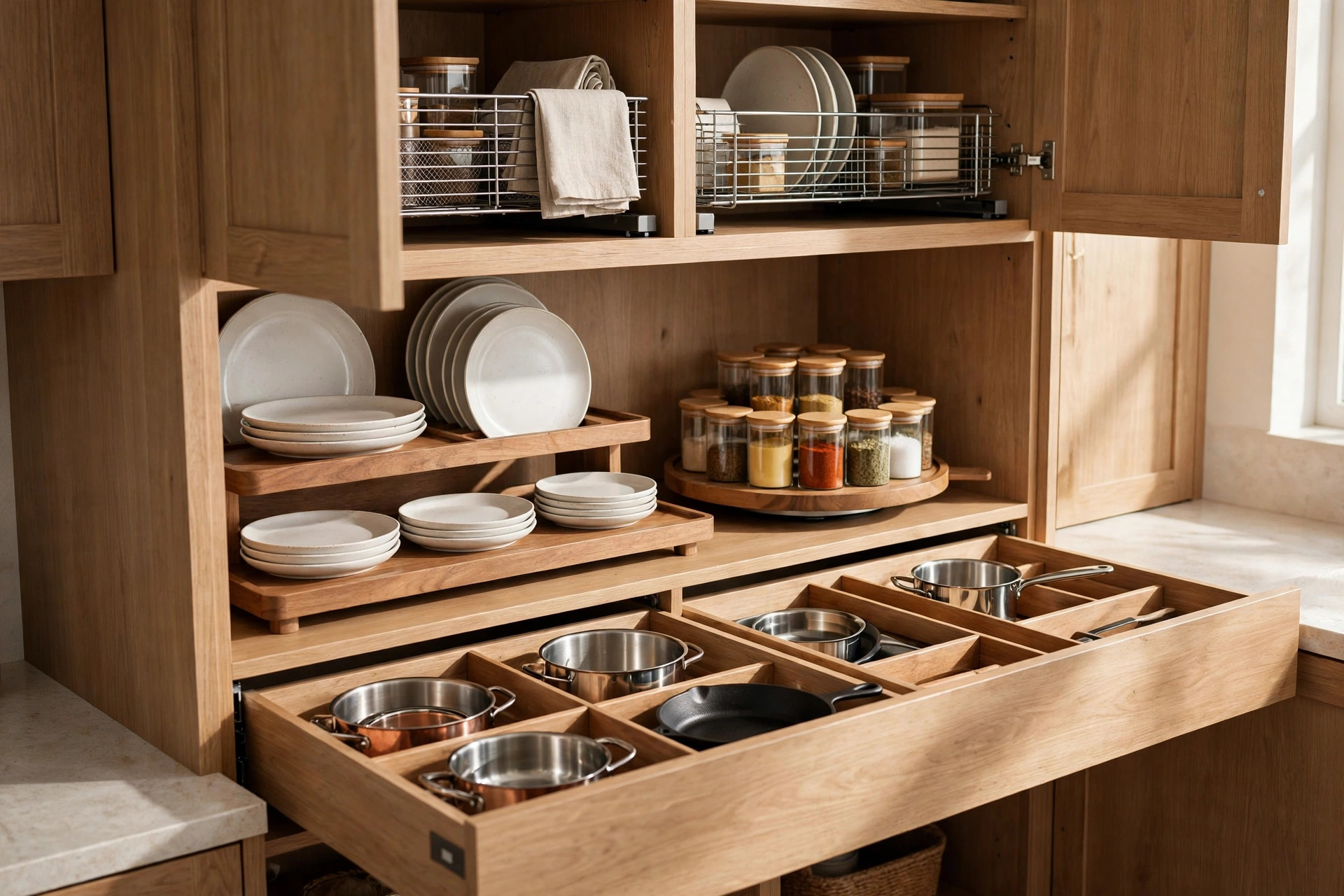

A good kitchen saves time. A bad one wastes it. This premium kitchen cabinet organizers buying guide will help you choose storage pieces that make your kitchen calm and easy to use. You do not need to spend a fortune. You only need to pick the right organizers for the space you have.
Why Cabinet Organizers Matter
Most kitchen cabinets hold far less than they could. Plates stack in tall piles. Pots hide behind other pots. Spice jars stand in rows you cannot reach. An organizer changes this. It turns dead space into useful space. It brings each item within reach. It keeps order day after day.
Studies by home editors at Apartment Therapy often note that a tidy kitchen feels larger than it is. This is true in small flats and in big family homes alike. When each cabinet has a place for each thing, cooking becomes simple. Cleaning takes less time. You stop buying things you already own because you can finally see them.
Premium organizers differ from cheap ones in small but real ways. They use thicker steel. Their rails run smooth for years. Their wood parts come from solid boards, not thin veneer. They carry full weight without bending. That is what “premium” means in this guide: built to last, not built to impress.
What to Look for Before You Buy: Premium Kitchen Cabinet Organizers Buying Guide
Measure First
Take a tape measure to every cabinet. Write down the width, depth, and height of each one. Note where the door swings and where pipes sit. Many buyers skip this step and guess. Then the organizer does not fit. A premium piece costs more, so a wrong guess costs more. Measure twice. Retailers such as IKEA and The Home Depot both publish sizing charts that help you match products to cabinet openings.
Know Your Cabinet Type
Face-frame cabinets have a wooden frame around the opening. Frameless cabinets do not. Some organizers fit only one type. Pull-out shelves, for example, mount to the frame in different ways. Read the product page with care. If you are unsure, look at the back of your cabinet door. The difference is plain to see.
Pick Materials That Last
Steel wire baskets with a thick chrome or epoxy coat resist rust. Solid bamboo trays look warm and hold shape for years. Heavy plastic bins clean with a wipe but can crack in heat. For a premium feel, choose steel, bamboo, or solid beech. Avoid thin wire that bends when loaded with cans.
Types of Premium Kitchen Cabinet Organizers
Pull-Out Shelves and Baskets
Pull-out shelves mount on full-extension rails. They slide the whole shelf toward you. No more kneeling to reach the back of a lower cabinet. Heavy-duty rails can carry fifty pounds or more. Two-tier pull-out baskets work well for pots and pans. One tier holds lids, the other holds pots. Reviewers at Consumer Reports have long praised smooth ball-bearing slides as the mark of a quality unit.
Shelf Risers and Under-Shelf Baskets
A riser is a small shelf that sits inside your cabinet. It doubles the stacking space for plates and bowls. Under-shelf baskets hook onto an existing shelf and hang below it. They are cheap, simple, and useful for mugs and small boxes. These suit renters too, since they need no screws.
Lazy Susans and Turntables
A turntable spins so you can reach the back without stretching. Large kidney-shaped lazy susans fit corner cabinets, the hardest space in any kitchen. For pantry items, a small round turntable keeps oils and vinegars in order. Our companion guide on the best rotating lazy susan turntables for Texas homes covers sizes and spin styles in more depth.
Drawer Organizers and Dividers
Deep drawers swallow spatulas and gadgets. A tray with fixed or adjustable dividers ends the mess. Bamboo dividers with spring tension fit without screws. For cutlery, a wide tray with long slots keeps knives apart from forks. Shoppers at The Container Store will find modular trays that join together for odd drawer sizes.
Door-Mounted Racks
The inside of a cabinet door is free storage. Slim racks hold spice jars, wraps, and foil. Cutting boards can hang on hooks. Measure the gap between the door and the shelf edge first. Some doors sit too close for deep racks. Clear over-door racks are popular in guides from The Spruce.
Stackable Bins and Canisters
Clear stackable bins turn a deep pantry cabinet into neat columns. You see what is inside without opening anything. Canisters with tight lids keep flour and rice fresh. For ideas on smaller storage, see our notes on the best kitchen cabinet organizers for American homes.
Materials Compared: Which Holds Up Best
Not all organizers age the same way. Steel wire with a baked epoxy coat is the workhorse of the premium shelf. It shrugs off spills and heat. Chrome looks bright but can pit near the sink if the coat is thin. Solid bamboo brings warmth to drawers and resists stains better than soft pine. It needs a little oil each year to stay fresh. Solid beech costs more but takes daily knocks without denting.
Heavy-duty plastic has its place. Food-safe polypropylene bins clean in seconds and never rust. They suit pantry shelves and the space under the sink. They can crack, though, if you drop a full one on a hard floor. Thin particleboard shelves with paper veneer look fine at first but swell when wet. In a steamy kitchen, they fail first. When you shop, lift the product if you can. A premium piece feels dense and solid. A cheap one feels light and hollow. That quick test tells you more than any sales tag.
Cost and Price: What Should You Expect to Pay?
Premium organizers cost more than basic ones, but the range is wide. Here is a rough guide to 2026 prices in the United States:
– Under-shelf baskets and risers: 10 to 30 dollars each. – Bamboo drawer dividers: 20 to 45 dollars. – Turntables and small lazy susans: 15 to 50 dollars. – Pull-out shelves and basket units: 60 to 200 dollars each. – Full corner cabinet systems: 150 to 400 dollars.
Big-box stores like Lowe’s and Target carry mid-range lines that suit most budgets. Specialty shops and premium brands charge more for thicker steel and softer-close rails. Online marketplaces such as Wayfair let you compare dozens of models side by side. Read the reviews with care. Look for comments written after a year of use, not just the first week.
Care and Upkeep
Keep organizers working well with small habits. Wipe wire baskets with a damp cloth each month. Grease builds up near the stove and makes slides stick. Oil the drawer rails once a year with a drop of silicone spray. Never use cooking oil, which turns gummy.
Check screws twice a year. Wood swells and shrinks with the seasons, and screws loosen. Tighten them before a shelf sags. For bamboo pieces, a thin coat of mineral oil each spring keeps the wood from drying out. Guides from Family Handyman offer step-by-step fixes for loose pull-out shelves if a rail ever slips.
One more habit helps. Once a year, take everything out of one cabinet. Wipe the shelves. Throw out old spices and cracked lids. Put back only what you use. This small reset stops clutter from growing back. Many organizers fail not from wear but from being packed past their limit. Give each one a little room to breathe.
Safety Notes
Safety matters more than style. Anchor tall pull-out units so they cannot tip when loaded. Keep heavy pots low and light items high. This keeps the center of gravity down.
Do not overload a shelf past its rated weight. A 50-pound rail that holds 70 pounds of cast iron will fail in time. It may fail all at once. Store cleaning chemicals in a locked cabinet away from food organizers. If a turntable spins near a gas stove, keep flammable items off it.
Check cords and pipes before drilling. Many cabinets hide water lines and wires behind the back panel. Use a stud finder and move slowly. When in doubt, choose no-drill organizers that mount with tension or adhesive.
Frequently Asked Questions
Are premium cabinet organizers worth the extra cost?
Often, yes. A premium pull-out shelf uses thicker rails and stronger screws. It will still slide smooth in five years. A cheap one may sag or jam in one. For pieces you touch every day, the extra cost pays for itself. For a spice rack you rarely move, a basic model is fine.
Can I install pull-out shelves myself?
Most pull-out shelves need only a drill, a screwdriver, and a level. The job takes thirty to sixty minutes per cabinet. Read the instructions fully before you start. If your cabinets have face frames, buy units made for that style. Renters should pick no-drill options instead.
What is the best organizer for a blind corner cabinet?
A kidney-shaped lazy susan or a two-tier corner pull-out works best. Both swing the back contents forward. Measure the door opening with care, since corner doors vary in size. A full article on turntables, the best rotating lazy susan turntables for Texas homes, explains the options.
How do I organize deep lower cabinets?
Deep cabinets are the hardest space in a kitchen. Use full-extension pull-out shelves or two-tier baskets. They bring the back row to you. Avoid stacking more than two items high. Stackable bins help, and our piece on stackable bathroom vanity organizers buying guide shows how the same idea works in other rooms.
Do organizers fit all cabinet sizes?
No. Cabinet sizes vary by maker and by age of the home. Always measure first. Many brands sell units in one-inch steps to fit standard openings. For odd sizes, look for adjustable or trim-to-fit models. Custom sizes cost more but fit perfectly.
How often should I clean my cabinet organizers?
Wipe them down once a month. Deep clean twice a year. Pull the shelves out, wash them, and check the rails. A small routine keeps everything smooth and stops grease from building up near the stove.
Shopping Tips That Save Money
Buy one organizer before you buy ten. Test it in your busiest cabinet for a month. If it works, buy more of the same. This stops you from filling the kitchen with pieces that do not suit your habits.
Watch for sales in January and July. Stores clear storage lines after the holidays and again in mid-summer. Buying sets also helps. A five-piece drawer set often costs less per piece than five single trays. Check return rules before you order online. Sizes on screen can fool the eye. A retailer that takes returns without a fee lets you test with peace of mind.
Finally, read the one-star and two-star reviews. They show how a product fails. If three people report the same bent rail, trust them. Five-star reviews show how it shines on day one. Low reviews show how it holds up on day three hundred.
A Final Word
A premium kitchen cabinet organizers buying guide can only point the way. The real test is your own kitchen. Measure it. List what drives you mad each day. Then buy the one organizer that fixes the worst problem first. Add more over time. In a year, your kitchen will feel new, and you will wonder why you waited so long. Small changes, made with care, last longer than big ones made in haste.
References
Apartment Therapy. (n.d.). Home design ideas and inspiration. https://www.apartmenttherapy.com Consumer Reports. (n.d.). Product reviews and ratings. https://www.consumerreports.org Family Handyman. (n.d.). DIY home repair and maintenance. https://www.familyhandyman.com IKEA. (n.d.). Home furnishings. https://www.ikea.com Lowe’s. (n.d.). Home improvement products. https://www.lowes.com Target. (n.d.). Retail store. https://www.target.com The Container Store. (n.d.). Storage and organization products. https://www.containerstore.com The Home Depot. (n.d.). Home improvement products. https://www.homedepot.com The Spruce. (n.d.). Home and garden advice. https://www.thespruce.com Wayfair. (n.d.). Furniture and home goods. https://www.wayfair.com
Was this guide helpful?

About Lisa Anderson
The My Garden US editorial team writes practical, in-depth home and garden guides for American homeowners — tested advice, no fluff.
You May Also Like
Buy Slim Rolling Pantry Carts Online in Colorado
August 3, 2026 0 views
Spice Rack Organizers Reviews and Buying Guide: Choose the Right One for Your Kitchen
May 11, 2026 0 views
Top Rated Freestanding Wardrobe Closets for USA Homes
May 5, 2026 0 views