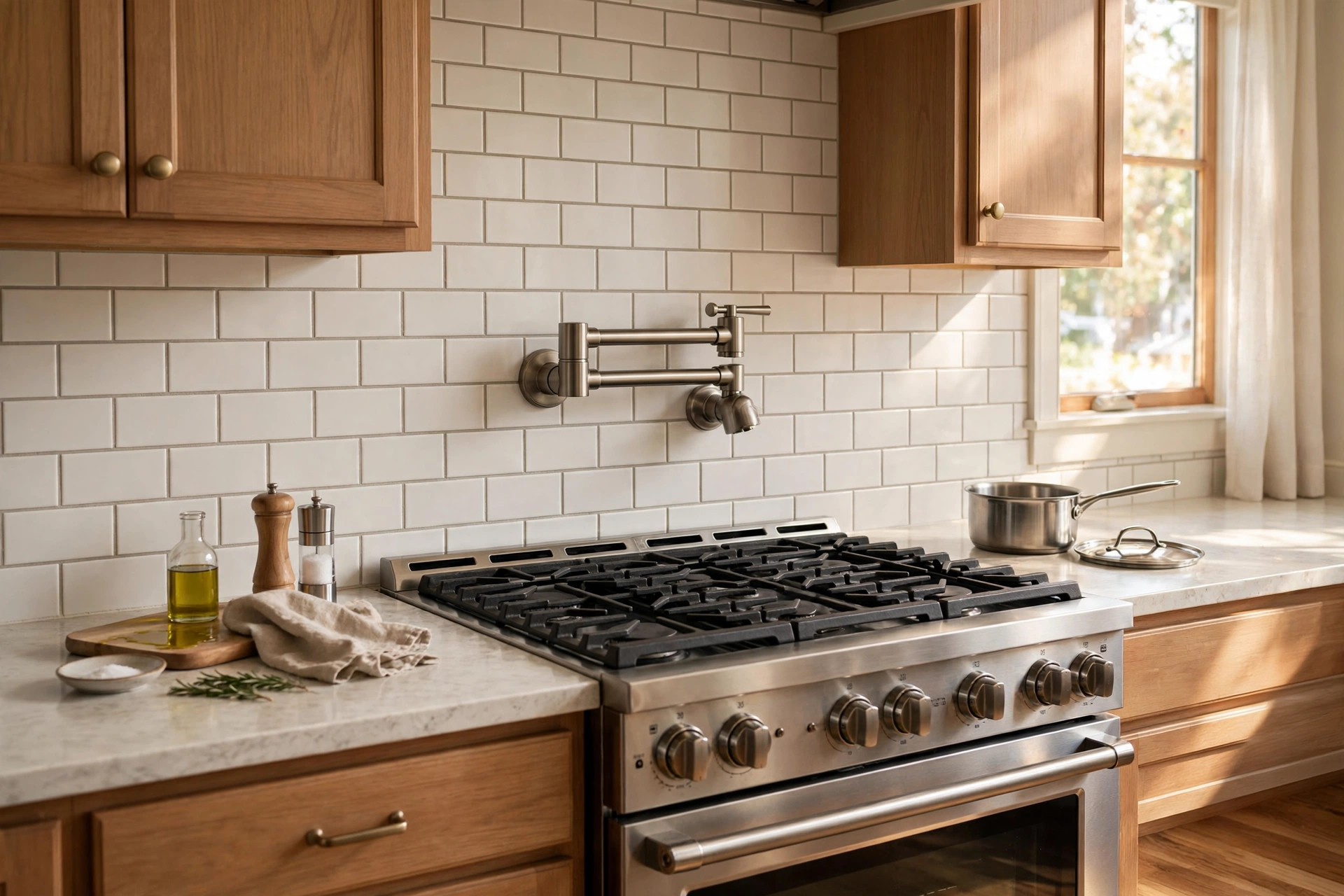

When you look for pot filler faucets for sale usa, you are shopping for a small luxury that cooks notice right away. A pot filler is a long, folding faucet fixed to the wall or deck behind your stove. You swing it out, fill a heavy pot with cold water right on the burner, and swing it back flat. No more carrying a sloshing pot from the sink across the kitchen. If you cook pasta, boil stock, or can vegetables in large kettles, this fixture can change your daily work at the stove. This guide walks through what they are, what to look for, what they cost in the United States, and how to buy one with care.
Why a Pot Filler Matters in a Working Kitchen
The value of a pot filler is simple: it removes a heavy lift. A stockpot full of water can weigh thirty pounds or more. Moving that weight from sink to stove invites spills, burns, and sore backs. Older cooks and anyone with a bad shoulder feel the difference first. A pot filler puts cold water right where the heat is, so the pot stays put until the cooking is done.
A second benefit is speed. Filling directly at the range skips the walk to the sink and back. It also keeps the main sink free for prep work while the pot fills. In a busy kitchen, that small gain in motion adds up over hundreds of meals.
There is also the look of the thing. Many homeowners remodeling a kitchen plan the pot filler as part of a wider upgrade, the same way they plan a new range or cooktop. The folded arm reads as a professional touch, and it tells guests the kitchen was built for real cooking. Real estate writers at The Spruce often list small pro-style details like this among features buyers notice in a kitchen.
Finally, a pot filler only delivers cold water. That is by design. The cold line feeds the fixture, and there is no hot supply to cross over. It keeps the plumbing simple and the risk of scalding down.
What to Look for When You Shop: Pot Filler Faucets for Sale Usa
Buying pot filler faucets for sale usa means sorting through a field of choices. A few key traits matter more than the rest.
Reach and swing. Most pot fillers have a single or double swing arm that extends sixteen to twenty-four inches from the wall. Measure from the mounting point to the center of your largest burner, then add a few inches. A double-jointed arm folds flatter against the wall when not in use, which suits small kitchens. A single-joint arm is simpler and often sturdier. Check the product listing for the stated reach before you buy.
Mounting style. Wall-mount models attach to the wall behind the range, usually through the backsplash. Deck-mount models attach to the countertop beside the range. Wall-mount is far more common. Both need a cold-water supply line run to that spot, so plan this during a remodel if you can.
Flow rate. Most pot fillers flow between four and six gallons per minute, far faster than a standard kitchen faucet. That speed is the point: a five-gallon stockpot should fill in about a minute. Low-flow models under three gallons per minute will feel slow and are best avoided.
Material and finish. Solid brass bodies last longest and resist corrosion. Stainless steel is a strong second choice. Finish options include chrome, brushed nickel, matte black, and oil-rubbed bronze. Pick a finish that matches your main sink faucet so the kitchen reads as one design. Brushed finishes hide water spots better than polished chrome.
Valve and handles. A quarter-turn ceramic valve opens and closes fast and holds up for years. Many pot fillers have two shut-off valves, one at the wall and one at the spout, which gives you a backup if one seal wears. Cross handles look classic; lever handles are easier for hands full of work.
Certification. Look for compliance with NSF/ANSI 61, which covers safe drinking water contact, and ASME A112.18.1 for plumbing fixtures. Reputable consumer testing groups and home improvement retailers list these codes on the product page. A fixture without them may not pass a local inspection.
Types and Options on the Market
Most pot filler faucets for sale usa fall into a few clear groups.
Single-joint swing arms are the classic design. The arm swings left and right from one pivot. They are easy to clean and tend to cost less. Their folded profile sticks out a bit more than double-joint models.
Double-joint swing arms fold like an elbow, so the spout tucks tight against the wall. They give you more precise placement over off-center burners. They have more seals to wear, so quality of the joints matters more here.
Deck-mount pot fillers rise from the countertop beside the range instead of the wall. They suit ranges set into islands or walls where running a water line behind the range is hard. They take up counter space, so they are less common.
Spring or commercial-style models use an exposed coil and a high-arc spout, much like a pro prep faucet. They look bold and deliver high flow, but they dominate the visual field above the stove. They also need a deep backsplash clearance to operate.
Finishes are not just looks. In a hard-water area, matte and brushed finishes keep their looks longer than polished ones. If your kitchen already has matte black cabinet pulls and a black gas range, a matching pot filler ties the room together at modest cost.
Cold-only versus mixing models. Almost all pot fillers are cold-only, which is the safe and standard choice. A few rare models offer a mixing valve, but plumbers generally advise against hot water so close to a burner with a long folding arm.
Cost and Price: What You Will Pay in the USA
Prices for pot filler faucets for sale usa cover a wide range, and the fixture itself is only part of the bill.
The fixture. Budget models from big-box house brands run about eighty to one hundred fifty dollars. Mid-range faucets from known plumbing brands run roughly two hundred to four hundred fifty dollars. Premium designer pieces in solid brass with specialty finishes can run five hundred to over one thousand dollars. Most homeowners land in the two-hundred-to-four-hundred range and do well there.
Installation. If you are remodeling and the wall is open, a plumber may charge one hundred fifty to three hundred dollars to run the cold line and mount the fixture. If the wall is finished and the backsplash must be cut or matched, expect three hundred to six hundred dollars, plus the cost of repairing the backsplash. A dedicated shut-off valve for the line adds a small charge but is worth it.
What drives price up. Solid brass bodies, double-joint arms, ceramic disc valves, and lifetime finishes cost more. A matching finish to an existing faucet family from a name brand also costs more. What drives price down is usually a simpler single arm, a standard chrome finish, and a house brand rather than a designer label.
Where the smart money goes. Spend for brass and a ceramic valve, but do not overspend on the finish alone. A mid-range faucet with strong joints will outlast a pretty cheap one. Also budget for the plumber before you fall in love with a fixture; the installed total is the real price.
Care and Upkeep
A pot filler asks little of you, but a few habits keep it working well for decades.
Wipe the spout and arm after heavy steam sessions so mineral spots do not set. For chrome and polished finishes, a soft cloth with mild soap is enough; skip abrasive pads, which scar the surface. Brushed finishes forgive more neglect.
Exercise both shut-off valves a few times a year. Valves that sit still for years can seize. Turn them gently from full open to full closed and back. If a valve drips, the cartridge or washer is usually a standard part you can order from the maker.
Check the wall mount for looseness once a year. A long arm acts as a lever, and repeated swinging can work a mounting plate loose over time. Tighten the escutcheon screws and make sure the fixture still sits flat against the wall.
In freezing climates, remember that the line to the pot filler runs through a wall that may sit on an outside face of the house. Keep the supply valve off during a deep freeze if the line is not in a heated chase, and insulate the run. Energy efficiency guides from the federal government offer plain advice on insulating water lines in cold walls.
Descale now and then if your water is hard. White vinegar on a cloth, held to the aerator or spout tip for a few minutes, dissolves most buildup. Never use harsh acids on decorative finishes.
Safety Notes
A pot filler is a safe fixture when it is installed and used right, but it sits above a hot stove, so respect a few rules.
Install a shut-off valve. Every pot filler should have its own accessible shut-off, either in the wall below the fixture or in a nearby cabinet. If the arm ever leaks while a burner is lit, you need to stop the water fast without reaching across flames.
Mind the swing. A long arm swung over a lit burner can heat the metal and the water inside it. Always swing the arm back against the wall when you are done filling. Keep the spout folded before you light the burners.
Cold water only. The standard cold-only design exists for a reason. If you ever replace the fixture, do not connect it to a hot supply. Hot water in a long arm above a flame invites scalding and steam burns.
Code and inspection. Some local codes treat the pot filler as a fixture that needs an anti-scald or backflow detail, or they require it to be listed to the right standard. Ask your plumber what your city wants. Product safety information pages and federal water resources can help you ask the right questions, but your local inspector has the final word.
Children and reach. Mount the fixture high enough that small children cannot swing it out and play with it. Most installations place it eighteen to twenty-four inches above the cooktop, which is out of a small child’s reach but still easy for an adult.
Frequently Asked Questions
Do I really need a plumber, or can I install a pot filler myself? If the water line already exists behind the stove, a handy homeowner can mount the fixture. But running a new cold line through a finished wall is plumber’s work. It involves cutting, soldering or pressing, and patching. Most buyers of pot filler faucets for sale usa hire a plumber for the rough-in and mount the faucet themselves to save money.
Can a pot filler go on an island cooktop? Yes, with a deck-mount model or a wall-mount model set into a raised backsplash on the island. The water line must come up through the floor or island cabinet. Plan it before the cabinets go in, since retrofitting an island line is costly.
Does a pot filler add value to a home? It adds appeal more than dollars. Buyers who cook notice it and remember it. Appraisers rarely add a line item for it, but in a competitive listing it can be the small detail that makes a kitchen stand out, much like matching backsplash tiles or a well-chosen range hood.
How far should the pot filler reach? It should reach the center of your largest burner with a few inches to spare. For most American ranges, that means an extension of about twenty to twenty-four inches. Measure your own range rather than trusting a rule of thumb.
What finish should I choose? Match the finish of your main kitchen faucet and appliances. If the rest of the kitchen is chrome, buy chrome. Consistency reads as design; a lone odd finish reads as an afterthought. In hard-water regions, brushed finishes age more gracefully.
Are there any ongoing costs? Very little. There is no filter to change and no cartridge to buy yearly. Your only costs are the water you use and, once in a great while, a replacement washer or cartridge. That is one reason cooks who buy them tend to keep them for life.
A Short Final Word
A pot filler is not a necessity. Plenty of good cooks never own one. But if you boil big pots often, it is one of the most-used small upgrades a kitchen can have. When you shop pot filler faucets for sale usa, buy for reach, brass, and a good valve, match the finish to the room, and have the water line run right. The fixture itself is the cheap part; a careful installation is what makes it feel like it was always meant to be there. Do that, and every big pot of pasta, stock, or canning water gets a little easier from the day it goes in.
References
Consumer Reports. (n.d.). Product reviews and ratings. https://www.consumerreports.org ENERGY STAR. (n.d.). Energy efficient products. https://www.energystar.gov GE Appliances. (n.d.). Kitchen and home appliances. https://www.geappliances.com Moen. (n.d.). Faucets and plumbing fixtures. https://www.moen.com The Home Depot. (n.d.). Home improvement products. https://www.homedepot.com The Spruce. (n.d.). Home and garden advice. https://www.thespruce.com This Old House. (n.d.). Home renovation guidance. https://www.thisoldhouse.com U.S. Consumer Product Safety Commission. (n.d.). Product safety information. https://www.cpsc.gov U.S. Environmental Protection Agency. (n.d.). Protecting human health and the environment. https://www.epa.gov Whirlpool. (n.d.). Home appliances. https://www.whirlpool.com
Was this guide helpful?

About Robert Taylor
The My Garden US editorial team writes practical, in-depth home and garden guides for American homeowners — tested advice, no fluff.
You May Also Like
Under Sink Filters: American Homes Guide
March 5, 2026 0 views
Butcher Block Countertops: A Guide for American Homes
July 25, 2026 0 views
Vinyl Plank Flooring Buying Guide USA: How to Choose Planks That Last
July 3, 2026 0 views